Eastshore State Park has the potential to become a true urban oasis.
It currently extends 8.5 miles along San Francisco Bay, from the Bay
Bridge to Richmond, and includes 1,854 acres of tidelands and uplands.
There’s also plenty of room for growth. Environmentalists, for example,
want to transform part of the Albany shoreline now covered by concrete
parking lots into rolling dunes and tidal marshes. But those dreams
would be dashed if a state agency decides to put a ferry-boat terminal
there instead.
In fact, significant sections of Eastshore State Park would be
harmed by two of the four potential ferry terminal locations now under
consideration by a state agency — the San Francisco Water
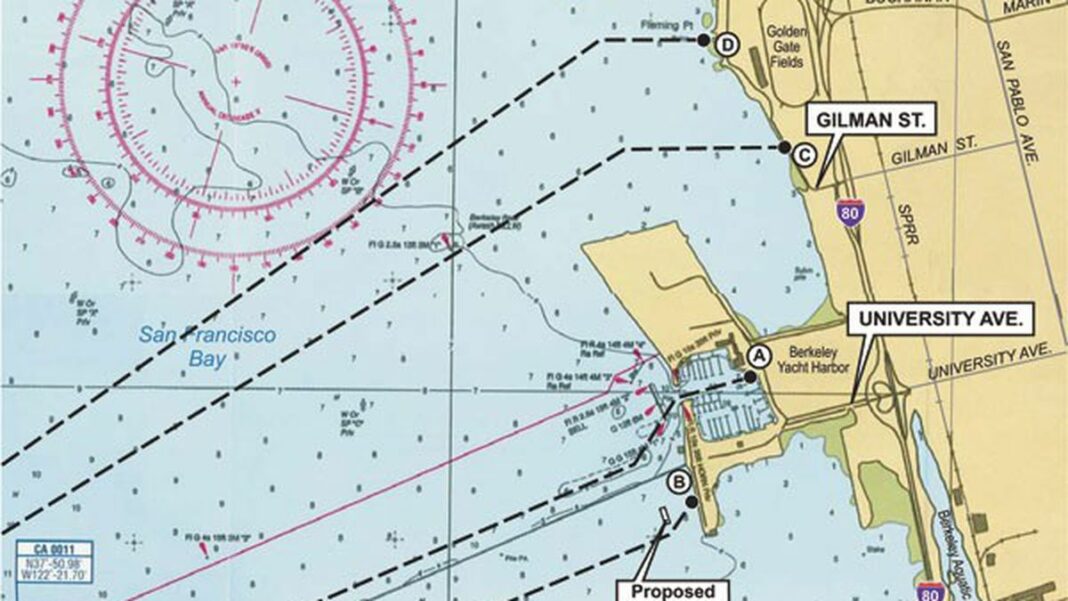
Emergency Transit Authority. The two spots, one at the end of Buchanan
Street and the other at the end of Gilman Street, would cause
“significant and unavoidable impacts” on the park even after
mitigations, according to the authority’s own recently released draft
environmental impact report.
Massive dredging of Eastshore State Park’s aquatic lands would be
required for either of the sites to become ferry terminals. For
Buchanan Street, the authority would have to remove 280,000 cubic yards
of bay mud to build a ten-foot deep shipping channel, and for Gilman,
it would be 240,000 cubic yards. In addition, ferry boat operations
could disturb roosting and foraging habitats for environmentally
protected birds, including white-tailed kite, burrowing owl, American
peregrine falcon, long-billed curlew, and osprey.
By contrast, the other two possible spots for a ferry terminal would
wreak far less environmental havoc. They are the Berkeley Marina and a
site just south of the Berkeley Fishing Pier. The transit authority
board of directors is expected to select one of the four sites as its
top pick in January. The new ferry terminal and ferry service will
connect Berkeley and Albany to San Francisco and is part of a 2004
regional ballot measure that increased bridge tolls in the Bay Area to
finance myriad transportation projects. The Berkeley-Albany ferry is
projected to handle about 1,700 passengers a day and is one of several
new terminals in various stages of development around the bay.
Not surprisingly, the plans for the Buchanan and Gilman sites
received near universal condemnation from environmentalists at a public
hearing last week in Berkeley. Some threatened to take the water
authority to court if it selected either of the locations for a new
ferry terminal. “Clearly, that area should be open space,” Norman
LaForce, chairman of the San Francisco Bay Chapter of the Sierra Club’s
Legal Committee and East Bay Public Lands Committee, told Eco Watch
after the meeting.
Albany Mayor Robert Leiber and Vice Mayor Marge Atkinson also spoke
out against the two sites. The Albany City Council officially opposes
putting ferry terminals at either spot. As a result, the two sites may
be effectively dead in the water because the authority must obtain
permits from the City of Albany to move forward with either. In
addition, both the East Bay Regional Park District, which manages
Eastshore State Park, and the state parks department are expected to
register their opposition to both sites in the coming weeks.
So why does the authority still consider these sites to be in the
running? According to LaForce, Leiber, and a few water transit
authority officials, it’s because onetime authority board member Ezra
Rapport demanded it. Rapport is influential because he is a longtime
close confidante of state Senate President Pro Tem Don Perata, who
spearheaded the 2004 campaign measure that is funding the expanded
ferry service. LaForce said that Rapport told him he favored Buchanan
and Gilman because the existing parking lots at Golden Gate Fields
racetrack would make them convenient for commuters.
But Leiber argued that the transit authority should not have spent
public funds studying Buchanan and Gilman because of the environmental
damage they would cause and the widespread opposition to them. “We
wasted nearly $1 million,” he told Eco Watch after last week’s
meeting.
The transit authority estimates that it will cost $58 million to
establish a ferry terminal at any one of the four sites, including
purchasing two new ferry boats. About $15.5 million of that will come
from the 2004 Regional Measure 2, and another $39.5 million will come
from Proposition 1B, a 2006 statewide bond that Perata also
spearheaded.
In general, environmentalists don’t favor ferry boats as an
efficient or ecologically friendly form of mass transportation. For
starters, ferries don’t carry that many people. By contrast, more than
160,000 people cross the bay on BART each day, and about 15,000 go to
San Francisco on AC Transit, according to transit authority figures.
And because they’re less efficient, ferries tend to require much higher
public subsidies than other forms of transit.
Still, environmentalists supported the 2004 measure because of all
the money it provided for other mass transit. So now they’re intent on
making sure the new Berkeley-Albany ferry does the least amount of
harm. If last week’s hearing was any indication, there is no consensus
on whether the terminal should be at the Berkeley Marina or near the
Berkeley Fishing Pier. Both are at the base of University Avenue.
Both also face parking problems. The Berkeley Marina site would end
up taking parking spaces now used by boaters, windsurfers, and patrons
of the Doubletree Hotel, along with visitors to the Shorebird Nature
Center and Park, Cesar Chavez Park, and Eastshore State Park. The
Berkeley Fishing Pier site, meanwhile, would commandeer nearly all the
parking from Hs Lordships restaurant and banquet facility.
Of the two, the Berkeley Marina site would require less dredging
because of its existing shipping channel. But the fishing pier might be
the frontrunner because ferry boats would operate more efficiently
there. The boats would be able to get in and out of the terminal more
quickly because they wouldn’t have to fight boat traffic like they
would in the marina.
Either way, a Berkeley ferry terminal should also ease commute
traffic on the Interstate 80 approach to the Bay Bridge —
although not by much. Getting 1,700 commuters out of their cars will be
helpful, but they represent just a small fraction of the motorists on
the Bay Area’s busiest stretch of freeway. Still, if we’re going to
have a ferry terminal, it’s better to build it on the Berkeley
waterfront than harming a shoreline state park.