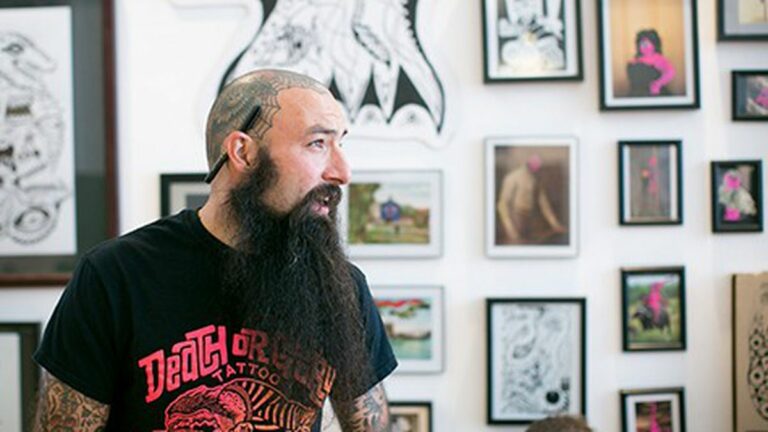
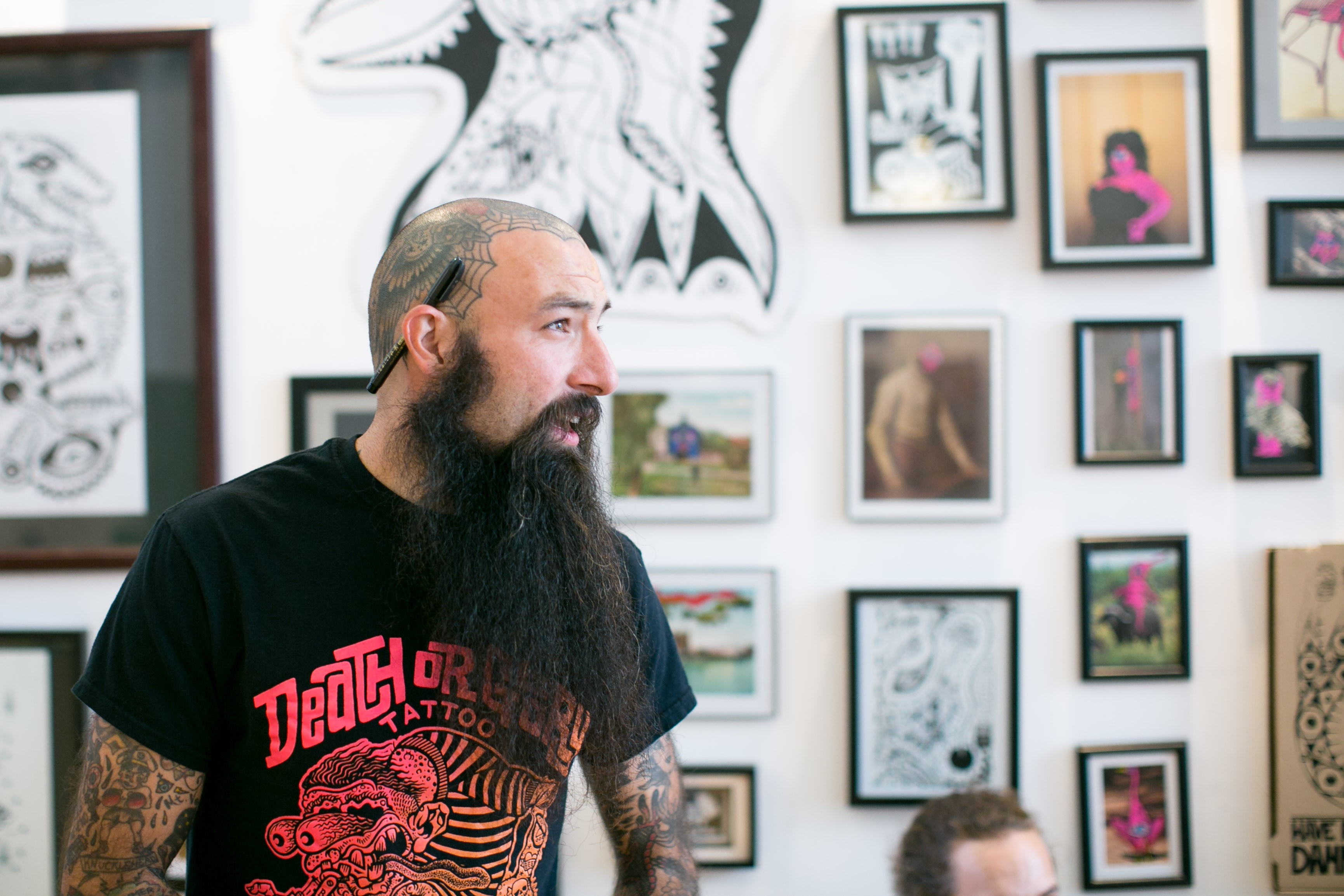
Last Thursday, Chris Collins posted a photo to Instagram picturing him and his coconspirator Kiki Niederberghaus with their pants around their ankles and their mouths gaping open in a cry of excitement as they stood in their brand new gallery in downtown Oakland (268 14th St.). The two men, covered head to toe in tattoos, held up a huge painting of a rooster’s head with the acronym D.O.G.T. emblazoned on its crown. That stands for Defenders of Good Times — the name of the new gallery, the moniker of Collins’ amorphous art collective, and the phrase that sums up Collins’ entire worldview. The photo’s lengthy caption reminded followers to join the duo for the grand opening of the gallery, which took place on Saturday. “[We] can’t wait to see and meet you all!!!” it read. “… so leave your pants at home, shake yer buttcheeks and HAVE FUN DAMNIT!!!!! … Life is completely fucking awesome!!!! eeeeeyyyyyooowwww!!!!!!”
Collins has more than 19,000 followers on Instagram. It’s partly because D.O.G.T, his art movement of sorts, has attracted obsessed fans from across the globe. He’s also a member of the Swamp Wizards, an international collective of thirteen lowbrow artists that boasts a cult following of its own. Plus, he’s the “shop dude” (aka receptionist) at Temple Tattoo, a revered tattoo establishment that’s also located in downtown. But, potentially, above all associations, his personal brand of punk rock positivity has most to do with his magnetism on social media. Collins is known to post eccentric photos of himself — typically naked, yelling, and engaging in extreme behavior — with long, inspirational affirmations as captions, usually involving some demand that people have fun followed by his signature onomatopoetic cry and an eccentric number of exclamation marks. Collins is like the ultimate inclusive outsider — a guru for radical positivity, self-acceptance, and good times with the edge of someone who has seen rock bottom and built himself back up again.
Chris Collins is adamant that all art should be appreciated.
Credits: Bert Johnson
Chris Collins is adamant that all art should be appreciated.
Credits: Bert Johnson
A little more than four years ago, at the age of 26, Collins nearly died after being hit by a car. His body mangled, Collins was sequestered to his bed inside his apartment in San Francisco for two and a half years, unable to walk. Before the accident, he had an unfulfilling day job and was drinking nearly every day — something he had been doing since he was thirteen. Then one day, he woke up in bed and decided he was going to stop drinking and become an artist. He also became determined to take D.O.G.T., the name that his friend group had given itself, and turn it into “something more that just dudes partying.”
So, Collins started teaching himself to draw and reaching out to artists he liked to ask if they wanted to be involved with D.O.G.T. He wasn’t sure what it was going to be yet, but he knew that it would be about appreciating work by underappreciated artists — artists who he often saw expressing insecurities about their work and about feeling like an outsider in the art game. “I was like, ‘Oh man, I want to show those people that there are people that give a shit about what they’re doing — and that just being productive is an accomplishment in itself,'” he said.
Collins grew up on a farm in a conservative town in Ohio. In school, he was consistently told that he would never be an artist because his work wasn’t serious enough. Plus, he was unpopular for insisting on being the one guy wandering through the woods with a zebra print vest and a mohawk. “I always got beat up and picked on because I was the different dude of my town,” said Collins. “I just wanna show people, be whoever the fuck you wanna be, be that fucking weirdo, let people fucking look down on you because you’re different. That’s cool!”
Collins infused that attitude into the D.O.G.T. mission, and it resonated with others. Gradually, he began getting packages of artwork in the mail. And, from bed, he started sending back art of his own, building correspondences with people all over the world who connected with D.O.G.T via social media. He eventually amassed so much artwork that it barely fit in his bedroom.
Finally, last year, he decided to put it all into a show. He put out an open call for work, meaning that whoever submitted would make it in, guaranteed. He also reached out to artists he liked — one of them being Niederberghaus, whose art he describes as “the highbrow of lowbrow art.” Niederberghaus, who was living in Germany at the time, took the request to heart. Weeks later, he showed up unannounced in Portland, where Collins was prepping to open the show at a popular gallery, bar, and pizza joint called Sizzle Pie. Together, they installed more than three hundred pieces of art for the show and kept the venue at capacity for four hours on opening night.
That’s when Collins knew that D.O.G.T had taken on a life of its own. Fast forward a year, and Niederberghaus has moved to Oakland to open the D.O.G.T gallery with Collins.
The D.O.G.T. grand opening on Saturday night was a certain kind of celebratory fun, perhaps best encapsulated by the photobooth art — a massive wooden panel painted with two pink butt cheeks surrounding a hole just big enough for a face, and “Shake your butt cheeks!” written in big, green, bubble letters. The gallery’s front room was filled with work by Swamp Wizards artists, including a massive wizard painted on the ceiling of the space. The walls of the backroom were covered floor to ceiling with open call submissions — mostly low-brow illustrations with a sense of humor. Every piece in the show sported the acronym D.O.G.T., and many could even have counted as Collins fan art, depicting him in poses culled from his social media presence.
Collins and Niederberghaus plan to keep the space open every day and put up a new show every three months or so. The front room will be curated work, while the back will always be open call — anyone is invited to show anything they want. “Nothing about what we’re doing has anything to do with being cool or making money or any of that shit,” said Collins. “It’s just about passion. … We just want to get people excited about stuff.”
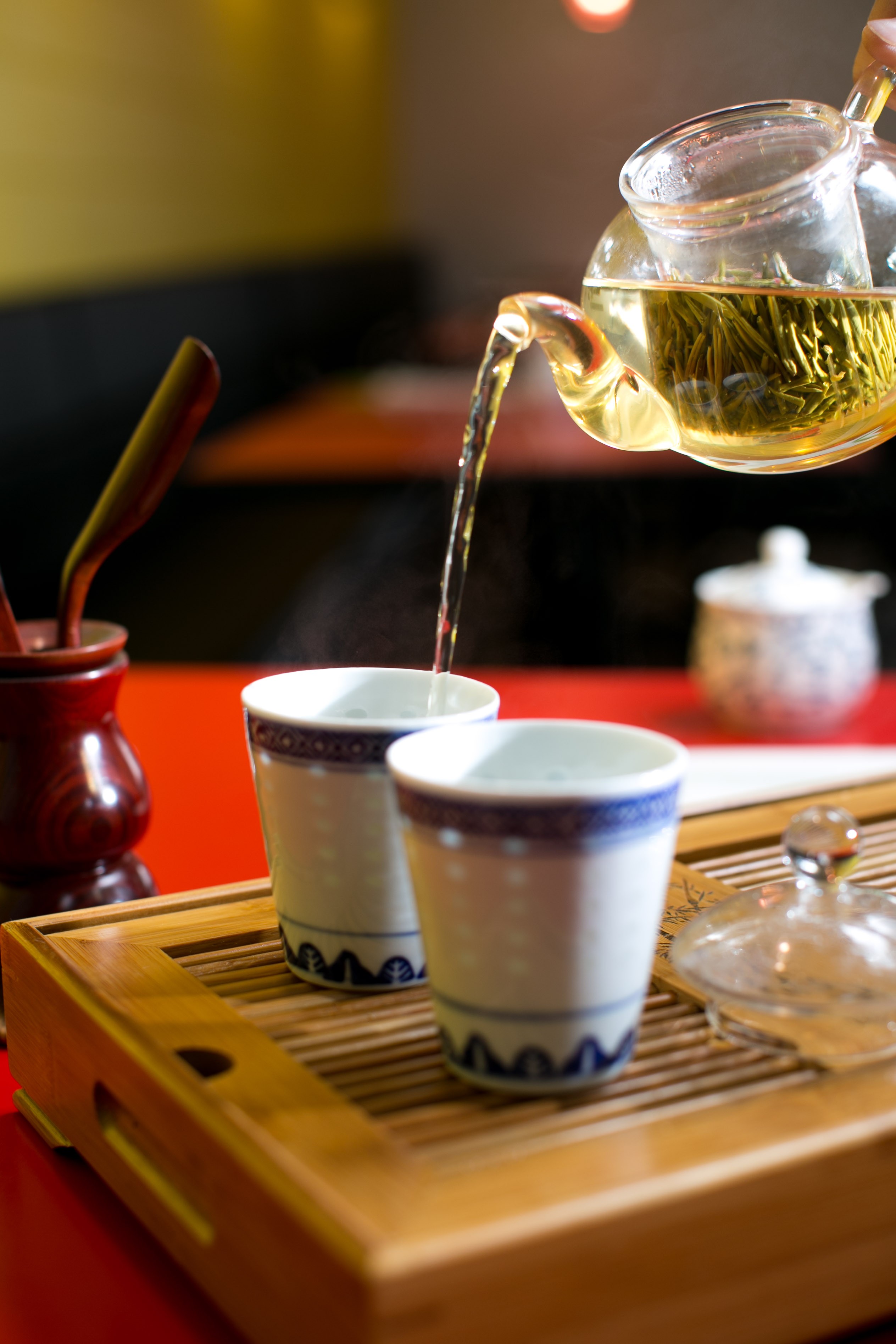
When you walk into Noodles Fresh, a new Chinese restaurant in El Cerrito, the first thing you see is a wall of little blue teapots with water dripping down from one to the next, like a stylized water curtain. Chef and co-owner Wenyan Petersen grew up in the southeastern Chinese province of Jiangxi, in the city of Jingdezhen, which is known as the “porcelain capital” of China — hence the teapots. In a phone interview, Petersen said she wanted to introduce American diners to her hometown cuisine, which is mostly unknown in the United States. (A cursory internet search turned up just two other restaurants that specialize in Jiangxi dishes; one of them, Root Chinese Restaurant, recently opened in South San Francisco.)
But Noodles Fresh isn’t the kind of hyper-authentic Chinese eatery that attracts adventure-seekers looking for odd regional specialties or bold, envelope-pushing flavors. Instead, the menu is meant to be a kind of “greatest hits” of famous regional Chinese noodle dishes: dan-dan noodles from Sichuan, “crossing the bridge” noodles from Yunnan, and noodles with black-bean meat sauce like they serve in Beijing. And each of these dishes has been adapted and refined in order to make them more palatable to the Western diner, Petersen explained. In some cases, that means a little more meat is added to a sauce than a Chinese chef would normally use; in others, the level of chili heat is dialed back several notches.
Jingdezhen is the “porcelain capital” of China.
Credits: Bert Johnson
Noodle Fresh’s Sichuan Chili Fish.
Credits: Bert Johnson
The Jiangxi rice noodles are the one specialty you won’t find anywhere else in the East Bay.
Credits: Bert Johnson
This kind of modified East-meets-West concept isn’t so different from the premise behind a restaurant like P.F. Chang’s — but Noodles Fresh is less expensive and has better, more distinctive food. It goes to show how deeply regional Chinese cuisine has become embedded in our collective dining consciousness, at least here in the Bay Area, that someone would open a restaurant geared toward Westerners that serves something as obscure, to the average American diner, as half the dishes on the Noodles Fresh menu.
It’s an interesting line that the restaurant straddles, then. On the one hand, the service might loosely be described as “Western style,” insofar as it’s English-friendly and a bit more formal than what you might expect at your typical hole-in-the-wall noodle shop. Plus, the menu is very accessible, with vegetarian and gluten-free options clearly marked. But on the other hand, about half of the customers during my visits appeared to be native Chinese speakers, and the servers — all Chinese — shifted back and forth between English and Mandarin as needed.
The food itself toes a similar line. It’s not exactly Americanized, at least not in the overly-sweet, gloopy-sauced manner of Panda Express. But by design, none of the recipes are strictly traditional either, and, in fact, discerning noodle slurpers can find better versions of several of the restaurant’s regional specialties elsewhere in the East Bay — if they know where to look. And maybe that’s the point: There aren’t many places that boast such a wide variety of Chinese noodle dishes under one roof and especially not in a setting that’s as unintimidating as Noodles Fresh. For the modestly adventurous Chinese food eater, the restaurant offers a nice entry point into a whole world of dishes beyond your neighborhood takeout joint. For the rest of us, the kitchen serves up some pretty tasty bowls of noodles — by any standard.
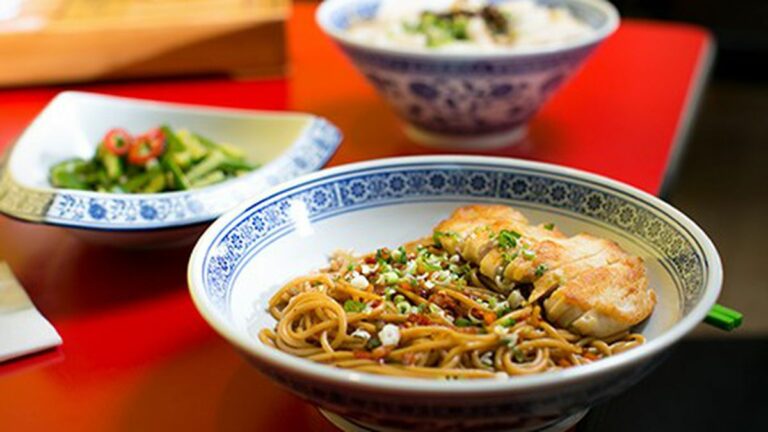
The one specialty at Noodles Fresh that you won’t find anywhere else in the East Bay are its Jiangxi rice noodles, which the restaurant imports. The main distinction, Petersen explained, is that these noodles are made with natural spring water to yield a cleaner, less-chemical taste compared to ones that are made with plain tap water (if you can taste the difference, you have a finer palate than mine). At any rate, these noodles are good: spaghetti-shaped, with a pleasant bounce to their texture.
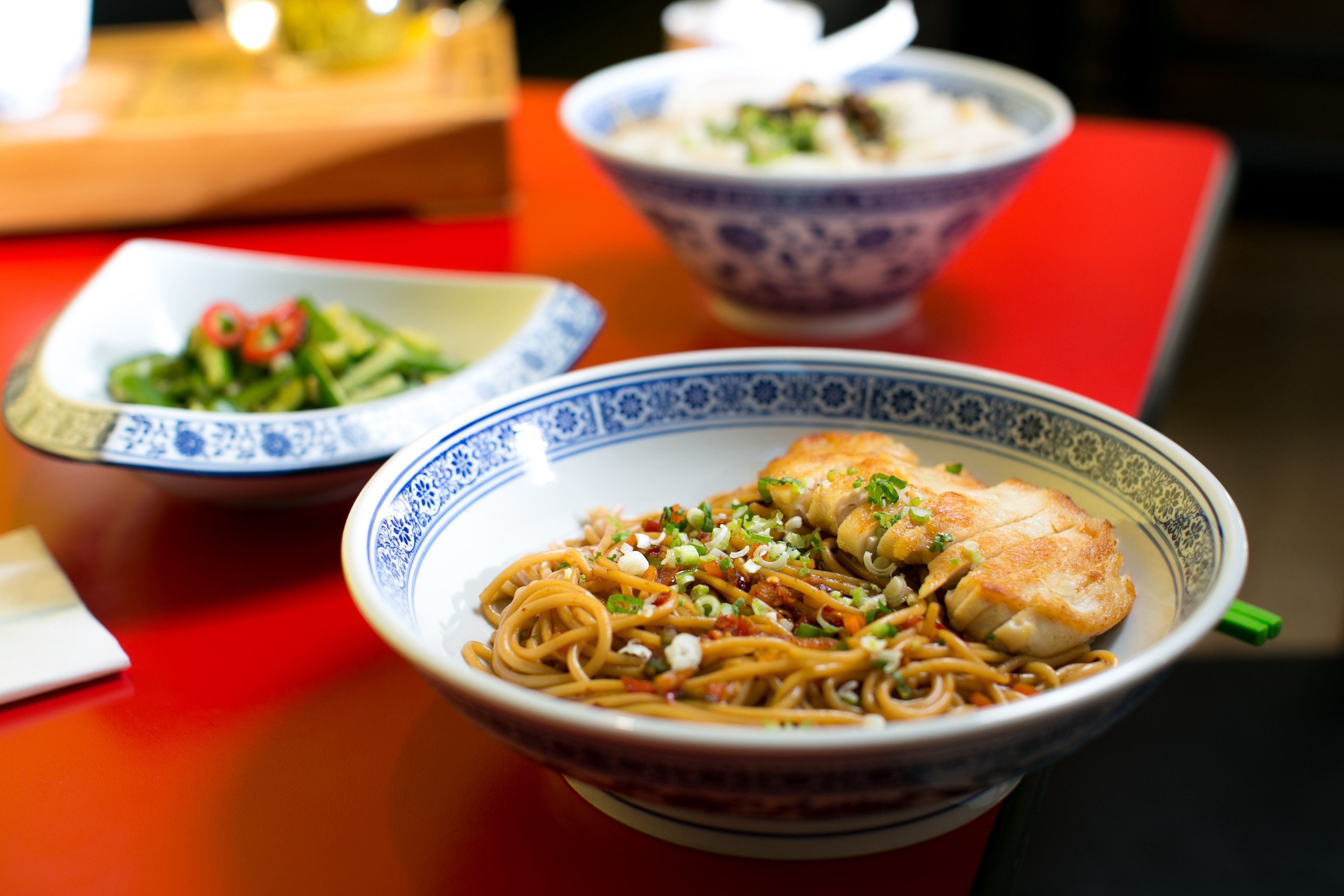
Noodles Fresh uses the Jiangxi rice noodles for about half of the noodle dishes on the menu, but two of them are marked as Jiangxi-style dishes — a stir-fried beef and noodle dish, and a noodle salad that’s topped with “barbecue”-style chicken. Outwardly, the stir-fry resembled a generic beef chow mein, but was notable for the chew of those soy-sauce-soaked rice noodles, the tenderness of the sliced flank steak, and the hit of fresh ginger that made all the other flavors pop. The noodle salad was served hot and topped with nicely seared slices of chicken breast and finely diced bell peppers. (It was a “salad” in the loosest possible sense.)
The best part of both dishes was that they were tossed in a housemade Jiangxi-style chili sauce made with fermented black beans and various aromatics. Just don’t request the dish “mild” or even “medium,” or you won’t get any heat at all.
The other item that jumps off the menu was the “Guilin beef stew” — a version of Guilin rice noodles, a dish that’s famous throughout China but only served at a small handful of places in this country. One of those places — Guilin Classic Rice Noodles, in Oakland Chinatown — is so good that it was hard for me not to feel slightly underwhelmed by Petersen’s rendition. It hit a lot of the right notes: the fermented tang of the pickled long beans, the crunch of the roasted peanuts, and, best of all, a heady dose of minced raw garlic. The main flaw was that a heavy dose of Chinese-herb-infused soy sauce made the dish way too salty. And the traditional accompaniment — a bowl of very mild beef broth that the diner uses as a palate-clearing counterpoint — wasn’t provided.
The Jiangxi rice noodles are the one specialty you won’t find anywhere else in the East Bay.
Credits: Bert Johnson
Meanwhile, customers of China Village (Albany) and King Tsin (Berkeley), the East Bay’s two titans of Sichuan cuisine, will immediately recognize the dish listed on the menu as “Sichuan Chili Fish.” The base of it is a broth infused with the fragrance of a large number of dried red chili peppers. At Noodles Fresh, it has been adapted to be more of a noodle dish (with more of those rice noodles) than a soup, and while the broth was perhaps a touch less complex than the ones at the two Sichuan restaurants, the tenderness of the sliced fish and the smoky heat from the drizzle of Sichuan chili oil on top made for a winning combination.
Of course, the Chinese have about as many varieties of noodles as the Italians have pasta shapes. To keep things manageable, Noodles Fresh has limited itself to two kinds for now: the Jiangxi rice noodles (available in two thicknesses), and fresh wheat noodles made by a local company. So while the restaurant features a couple of dishes inspired by northern China, you won’t find the thick hand-pulled noodles that are characteristic of those provinces. For me, the one wheat noodle dish I tried — the Taiwanese beef noodle soup — was the biggest disappointment. Petersen told me she uses fermented tofu and tomato paste as the base of her broth, but none of those bold flavors came across in this rather bland soup. Pickled mustard greens, the traditional accompaniment to Taiwan’s national dish, was listed on the menu, but absent in the dish itself. And the noodles were cooked so soft, I’d have never guessed that they were fresh. The one saving grace: The beef was incredibly tender.
While the noodles are the unquestioned focal point, the restaurant also serves a handful of rice plates, as well as a selection of well-executed, if mostly generic, appetizers. Of these, the pork potstickers trumped the scallion pancake. And both were overshadowed by the garlic cucumber — a non-spicy version of a Sichuan specialty in which pieces of cucumber are smacked with a cleaver to loosen up their flesh and help them soak up the flavors of a deliciously garlicky sauce.
It’s a comfort dish, really — and one, I’m happy to see, that a restaurant like Noodles Fresh is helping to bring to a much wider audience.
When Shifra de Benedictis-Kessner joined the Downtown Berkeley Association in 2011, one of the most important challenges to tackle was parking. “People just couldn’t find spots in the core around BART,” she said. “The perception in downtown Berkeley was that parking was awful.” The association subsequently partnered with the city to overhaul parking downtown — by raising meter prices on the most popular streets where it was impossible to find a spot and lowering the rates in areas that typically had a high number of available spaces.
The concept was based on a simple principle of economics: Where demand is high, increase meter prices, and where demand is low, decrease the fees. That pricing scheme encourages high turnover on crowded streets (thereby increasing availability) while also incentivizing drivers to park in peripheral areas that are typically underused. According to the city’s data and anecdotal reports from businesses, the new downtown parking program has worked well. “There has been an immense improvement. If you want to park right there, right then, you can,” said de Benedictis-Kessner, who is now executive director of the Temescal Telegraph Business Improvement District.
Matt Nichols, Oakland’s transportation policy director, wants to shift city parking meter rates.
Credits: Bert Johnson
Matt Nichols, Oakland’s transportation policy director, wants to shift city parking meter rates.
Credits: Bert Johnson
Oakland’s mayor’s office is now proposing the same concept for commercial districts throughout the city, including Temescal, with the hopes of boosting small businesses by making it much easier for drivers to find parking in busy retail corridors. If the city can overcome the typical obstacles to this kind of parking policy reform — a lack of funding to conduct proper studies and loud resistance from businesses and residents who oppose all meter rate increases — it could bring important economic and environmental benefits to Oakland.
Spearheading the effort is Matt Nichols, Mayor Libby Schaaf’s transportation and infrastructure policy director, who in 2013 led the parking revamp in Berkeley, where he formerly served as a principal transportation planner. Nichols also previously studied under UCLA urban planning professor Donald Shoup, who is the leading academic expert on this parking concept, known as “market-based pricing” or “demand-responsive parking” (see “Berkeley’s Parking Solution,” 12/11/13). Nichols recently helped write an Oakland grant proposal requesting $2 million from the Metropolitan Transportation Commission (MTC), the Bay Area transit agency, which would enable the city to implement the progressive parking strategy in downtown, Uptown, Lake Merritt, Chinatown, Temescal, the Jack London district, and the Grand Lake district.
Cities, including Berkeley and San Francisco, have increasingly moved away from the conventional parking meter system in which all on-street locations in a district have the same prices and time limits. Instead, forward-thinking governments have launched market-based pricing systems, in which meter fees are established based on the needs and demands of drivers. That means helping shoppers and diners find convenient parking — not by building more garages or on-street parking spaces, but by setting fees in a way that encourages the most efficient use of the existing parking supply.
A key way to accomplish this is to flip the standard pricing model and make off-street parking garages cheaper than highly coveted on-street metered spots. That way, people who want to park for several hours will gravitate toward the affordable spots in nearby garages — which typically have high vacancy rates — thereby freeing up short-term spots in front of stores and restaurants for customers. The target “magic number,” Nichols explained, is roughly 85 percent occupancy rate per block (meaning one or two empty spaces). That means if the block is constantly at 100 percent capacity, then prices need to go up, and if a block has a large number of open spots, then the city should decrease fees. This pricing model can also increase overall parking revenues through high turnover on more expensive on-street spots, and can also help support businesses, which, in turn, increases sales tax revenues for the city.
Once merchants see these programs in action, they are generally supportive, said Valerie Knepper, MTC’s regional parking initiative manager and one of the officials reviewing Oakland’s grant proposal. “The first response from some businesses is, ‘If you charge for parking in front of my business, nobody will come here anymore,'” she said. “But this is actually a pro-business policy.”
Most important, this pricing model can substantially reduce greenhouse gas emissions by eliminating the need for cars to drive in circles trying to find parking. When a large majority of motorists visiting a popular business district are forced to keep driving for five to ten minutes, the unnecessary pollution — not to mention, driver aggravation — can be substantial. Shoup’s research has repeatedly demonstrated that when meter prices are too low, and time limits too long, parking becomes impossible to find, and as a result, a large percentage of on-street congestion and greenhouse gas emissions are directly attributable to cars searching for parking.
After Berkeley piloted market-based pricing in downtown, the Elmwood district, and a section of South Berkeley, the city estimated that it reduced the total vehicle miles traveled per day by 1,649 miles, which translates to 1.4 fewer tons of greenhouse gas emissions each year. And when San Francisco applied demand-based pricing to roughly 6,000 on-street meters and 12,250 off-street spaces, the city experienced a 30-percent reduction in vehicle miles traveled. “It’s kind of amazing how much traffic is actually people circling,” said Nichols, noting that drivers looking for parking are also the most distracted and more likely to get into collisions.
In most of the business districts included in Oakland’s proposal, the meter rates are uniformly two dollars per hour with a two-hour time limit. Nichols said it was too soon to say exactly how much prices and time limits would change in certain districts and said the city would approach each neighborhood differently based on studies of area trends. The project would build on a 2014 pilot that Schaaf, then a councilmember, launched in Montclair Village. There, the city raised prices to $2.50 per hour in high-demand streets and reduced the rates on peripheral blocks to one dollar per hour. Notably, the city incentivized drivers to use a nearby city-owned garage by offering spots for free for the first twenty minutes, followed by only two dollars per hour.
Daniel Swafford, executive director of the Montclair Village Association, the merchants’ group, said that the system has helped divert parking to the garage, which has made it somewhat easier to park on-street. “They’re utilizing spaces that are less important for folks who have to get in and get out,” he said, adding that he thinks the city needs to raise on-street prices even higher, since it can still be challenging to find a spot on the main strip. In Berkeley, the city raised some meter rates on busy streets to $2.75 per hour while making city-owned garages only $1.50 or $2 per hour (and, in one lot, free for the first hour).
If MTC awards Oakland the grant, the city’s first phase would focus on Civic Center and Old Oakland; Lake Merritt and Uptown; and Chinatown. It would also spend some of the funding to improve the Montclair program. The first phase would rely on a downtown parking study that the city’s Public Works Agency recently completed. After collecting parking occupancy rates on a weekday afternoon, the city determined that while many downtown streets were crowded with parked cars (above 85 percent occupancy), there were many other streets, often nearby, that had a significant number of available spaces (below 65 percent occupancy). There were also four city-owned garages and lots that were below 65 percent occupancy. The city’s proposal would establish “premium” zones with higher meter rates and “value” zones on the periphery and in garages with cheaper fees.
Phase two of the project — in Jack London, Temescal, and Grand Lake districts — would require further studies and outreach, Nichols said. And a third phase, which is not included in the MTC funding request, would focus on the commercial districts of Rockridge, Piedmont Avenue, and Fruitvale.
The MTC funding would also support a concept known as a “parking benefit district” in each area. That means setting up a system through which the city would reinvest a portion of parking revenues directly into the neighborhood, typically by allowing a merchants’ group to dole out funds for certain streetscape improvements or other local projects. This feature is part of the Montclair Village pilot, though the city has not yet determined how much funding it will return to the business association for the first year. The grant proposal also features a number of “transportation demand management” (TDM) strategies, which are aimed at reducing driving and encouraging alternative modes of transit. That includes providing free transit passes to targeted groups of city and private employees in each district and other incentives designed to limit car use, such as subsidized bike-share memberships or preferential parking for carpool vehicles.
Oakland is seeking funding from MTC’s Climate Initiatives Parking Management and TDM Grant Program, which will dole out a total of $6 million to projects across the Bay Area. Twenty agencies submitted initial project ideas, and MTC selected eleven of those, including Oakland, to write formal proposals. The funding requests call for nearly $10 million total, which means not every project will receive an award or their full request, according to MTC spokesperson John Goodwin. MTC will make final selections later this year and start distributing funds in early 2016.
Deep Look with KQED. With a discussion and hands-on experience (Valley Life Sciences Building, UCMP Atrium, UC Berkeley, Berkeley, 5:00)
The Hand That Feeds (85 min., 2014). Followed by a panel discussion (0160 Kroeber Hall, UC Berkeley, 6:30)
Tuesday, November 3
Better This World (82 min., 2011). Followed by a Q&A with the filmmakers (Parkway, 7:00)
Saved By Language (53 min., 2014) and Jews of the Spanish Homeland (14 min., 1931). Depth of Field Seminar Series (The Magnes Collection of Jewish Art and Life, Berkeley, 9:30)
Wednesday, November 4
The Second Mother (112 min., 2015). (Valley Life Sciences Building, Room 2040, UC Berkeley, 7:00)
Some cheer, some hiss, but one thing is for sure: Uber will transform Oakland, and our city will become ground zero, not only for a discussion of growth and displacement, but also for the pitfalls of the “sharing economy.”
This year, my partner and I needed to move out of our one-bedroom place to make room for our growing family. We were priced out of our neighborhood. It was hard to say goodbye to the home that we decided to get married in, and to bring our newborn son into.
A few months later, the nonprofit I work for was forced to move because our building was sold and there was a dramatic rent increase. Ironically, our mission is to ensure that low-income people of color make enough money so that they can stay in their homes. It will be sad to say goodbye to the home in which we’ve gathered community members, shared struggles, and raised wages for tens of thousands of people.
As the sharing economy has rapidly expanded, many Bay Area consumers have rejoiced that there are more choices, as well as flexibility for workers. But as we welcome innovation, let’s also address new challenges. Many “on demand” companies classify their workers as independent contractors instead of employees. They do not have to pay the minimum wage or provide benefits, which leaves many struggling to pay the bills.
In short, nonprofits, like the low-income people we support, are being pushed out of Oakland. And with the announcement of Uber moving in, income inequality will be exacerbated with more poverty-wage jobs.
Oakland has a deeply rooted sense of community and a legacy for caring for those in need. We now must create policies that ensure that everyone in our community truly benefits and receives their fair share. Let’s follow the example of places like Seattle, where city leaders are crafting legislation to allow “on-demand” workers to bargain collectively, or Oregon, where regulators ruled that Uber drivers are employees.
Oakland’s elected leaders, businesses, nonprofits, unions, and community members need to come together and harness our ingenuity and make the new sharing economy an economy that benefits us all. We call on our city leaders to follow through on their commitment to ensure Uber and similar companies help make Oakland a more equitable city by creating new rules for the housing and job market, so that the sharing economy provides a fair share to Oakland’s workers and residents.
Aries (March 21–April 19): On a January morning in 1943, the town of Spearfish, South Dakota experienced very weird weather. At 7:30 a.m. the temperature was minus 4 degrees Fahrenheit. In the next two minutes, due to an unusual type of wind sweeping down over nearby Lookout Mountain, thermometers shot up 49 degrees. Over the next hour and a half, the air grew even warmer. But by 9:30, the temperature had plummeted back to minus 4 degrees. I’m wondering if your moods might swing with this much bounce in the coming weeks. As long as you keep in mind that no single feeling is likely to last very long, it doesn’t have to be a problem. You may even find a way to enjoy the breathtaking ebbs and flows. Halloween costume suggestion: roller coaster rider, Jekyll and Hyde, warm clothes on one side of your body and shorts or bathing suit on the other.
Taurus (April 20–May 20): How dare you be so magnetic and tempting? What were you thinking when you turned up the intensity of your charm to such a high level? I suggest you consider exercising more caution about expressing your radiance. People may have other things to do besides daydreaming about you. But if you really can’t bring yourself to be a little less attractive — if you absolutely refuse to tone yourself down — please at least try to be extra kind and generous. Share your emotional wealth. Overflow with more than your usual allotments of blessings. Halloween costume suggestion: a shamanic Santa Claus; a witchy Easter Bunny.
Gemini (May 21–June 20): In the last ten days of November and the month of December, I suspect there will be wild-card interludes when you can enjoy smart gambles, daring stunts, cute tricks, and mythic escapades. But the next three weeks will not be like that. On the contrary. For the immediate future, I think you should be an upstanding citizen, a well-behaved helper, and a dutiful truth-teller. Can you handle that? If so, I bet you will get sneak peaks of the fun and productive mischief that could be yours in the last six weeks of 2015. Halloween costume suggestion: the most normal person in the world.
Cancer (June 21–July 22): Members of the gazelle species known as the springbok periodically engage in a behavior known as pronking. They leap into the air and propel themselves a great distance with all four feet off the ground, bounding around with abandon. What evolutionary purpose does this serve? Some scientists are puzzled, but not naturalist David Attenborough. In the documentary film Africa, he follows a springbok herd as it wanders through the desert for months, hoping to find a rare rainstorm. Finally, it happens. As if in celebration, the springboks erupt with an outbreak of pronking. “They are dancing for joy,” Attenborough declares. Given the lucky breaks and creative breakthroughs coming your way, Cancerian, I foresee you doing something similar. Halloween costume suggestion: a pronking gazelle, a hippety-hopping bunny, a boisterous baby goat.
Leo (July 23–Aug. 22): “A very little key will open a very heavy door,” wrote Charles Dickens in his short story “Hunted Down.” Make that one of your guiding meditations in the coming days, Leo. In the back of your mind, keep visualizing the image of a little key opening a heavy door. Doing so will help ensure that you’ll be alert when clues about the real key’s location become available. You will have a keen intuitive sense of how you’ll need to respond if you want to procure it. Halloween costume suggestion: proud and protective possessor of a magic key.
Virgo (Aug. 23–Sept. 22): The ancient Hindu text known as the Kama Sutra gives extensive advice about many subjects, including love and sex. “Though a man loves a woman ever so much,” reads a passage in chapter four, “he never succeeds in winning her without a great deal of talking.” Take that as your cue, Virgo. In the coming weeks, stir up the intimacy you want with a great deal of incisive talking that beguiles and entertains. Furthermore, use the same approach to round up any other experience you yearn for. The way you play with language will be crucial in your efforts to fulfill your wishes. Luckily, I expect your persuasive powers to be even greater than they usually are. Halloween costume suggestion: the ultimate salesperson.
Libra (Sept. 23–Oct. 22): I encourage you to be super rhythmical and melodious in the coming days. Don’t just sing in the shower and in the car. Hum and warble and whistle while shopping for vegetables and washing the dishes and walking the dog. Allot yourself more than enough time to shimmy and cavort, not just on the dance floor but anywhere else you can get away with it. For extra credit, experiment with lyrical flourishes whenever you’re in bed doing the jizzle-skazzle. Halloween costume suggestion: wandering troubadour, street musician, free-styling rapper, operatic diva, medicine woman who heals with sound.
Scorpio (Oct. 23–Nov. 21): I expect you to be in a state of continual birth for the next four weeks. Awakening and activation will come naturally. Your drive to blossom and create may be irresistible, bordering on unruly. Does that sound overwhelming? I don’t think it will be a problem as long as you cultivate a mood of amazed amusement about how strong it feels. To help maintain your poise, keep in mind that your growth spurt is a natural response to the dissolution that preceded it. Halloween costume suggestion: a fountain, an erupting volcano, the growing beanstalk from the “Jack and the Beanstalk” fairy tale.
Sagittarius (Nov. 22–Dec. 21): “Just as a snake sheds its skin, we must shed our past over and over again.” So says Buddhist teacher Jack Kornfield. Can you guess why I’m bringing it to your attention, Sagittarius? It’s one of those times when you can do yourself a big favor by sloughing off the stale, worn-out, decaying parts of your past. Luckily for you, you now have an extraordinary talent for doing just that. I suspect you will also receive unexpected help and surprising grace as you proceed. Halloween costume suggestion: a snake molting its skin.
Capricorn (Dec. 22–Jan. 19): Speaking on behalf of your wild mind, I’m letting you know that you’re due for an immersion in revelry and festivity. Plugging away at business as usual could become counterproductive unless you take at least brief excursions to the frontiers of pleasure. High integrity may become sterile unless you expose it to an unpredictable adventure or two. Halloween costume suggestion: party animal, hell raiser, social butterfly, god or goddess of delight. Every one of us harbors a touch of crazy genius that periodically needs to be unleashed, and now is that time for you.
Aquarius (Jan. 20–Feb. 18): I hope you will choose a Halloween costume that emboldens you to feel powerful. For the next three weeks, it’s in your long-term interest to invoke a visceral sense of potency, dominion, and sovereignty. What clothes and trappings might stimulate these qualities in you? Those of a king or queen? A rock star or CEO? A fairy godmother, superhero, or dragon-tamer? Only you know which archetypal persona will help stir up your untapped reserves of confidence and command.
Pisces (Feb. 19–March 20): It’s time to stretch the boundaries, Pisces. You have license to expand the containers and outgrow the expectations and wage rebellion for the sheer fun of it. The frontiers are calling you. Your enmeshment in small talk and your attachment to trivial wishes are hereby suspended. Your mind yearns to be blown and blown and blown again! I dare you to wander outside your overly safe haven and go in quest of provocative curiosities. Halloween costume suggestions: mad scientist, wild-eyed revolutionary, Dr. Who.
Our October 21 feature, “Damning California’s Future,” misspelled Yolla Bolly Wilderness. It also mistakenly stated that the Westlands Water District has a contract to receive water from the State Water Project. Westlands is actually a contractor of the federally operated Central Valley Project. 
On a late-August Saturday in Oakland Chinatown, a Taiwanese-American cover band performed a version of “Uptown Funk” to the great delight of the handful of middle-aged white couples gyrating at the foot of the stage. The 28th annual Oakland Chinatown StreetFest sprawled over the eight blocks that constitute Chinatown proper, and although the festival had just kicked off, Webster Street was beginning to fill up with tourists.
Sponsored by the Oakland Chinatown Chamber of Commerce, the two-day StreetFest is easily the single biggest event in Chinatown — the one time each year when the spotlight shines most brightly on the historic neighborhood. At a time when the entire city of Oakland is undergoing rapid changes, the festival is also, depending on who you talk to, either a symbol of Chinatown’s vibrancy, or a sign of how out of touch its leadership is.
Ener Chiu believes it shouldn’t be a binary choice between unrestricted development and no development.
Credits: Bert Johnson
Sonny Le doesn’t believe the chamber of commerce benefits the “downstairs” Chinatown.
Credits: Bert Johnson
To spend time in Oakland Chinatown is to risk falling in love with the place, especially if you go on a random weekday when there isn’t any special event scheduled. Day-to-day life is what sets the neighborhood apart: elderly Chinese doing their early-morning tai chi exercises at Madison Square Park, or squabbling good-naturedly in Cantonese at the Ruby King Bakery — a folded-up Sing Tao newspaper in their lap, the table scattered with crumbs from the flakiest egg custard tarts in town. If you want to buy a live fish to steam at home, or choose between a half-dozen varieties of fresh Chinese noodles, or eat a bowl of jook before the parking meters start running for the day, Oakland Chinatown is the place to be.
This is why folks who frequent the neighborhood talk about how Oakland Chinatown is a “working Chinatown” — a characterization that doubles as a jab at the trinket shops and tourist traps that dominate the more famous Chinatown across the bridge. And it’s also why StreetFest, for all its pomp and circumstance, might be the worst time to visit the neighborhood if you want to get a sense of Chinatown’s real flavor.
At no other time does the area feel quite so corporate than during StreetFest. Onstage, the emcee rattled off the list of sponsors, whose logos covered the large banner that served as a backdrop for the morning’s proceedings: Kaiser Permanente, Xfinity, Budweiser, Wells Fargo, Allstate. Later, about twenty local dignitaries with perfunctory connections to the neighborhood (someone from the Oakland Police Department, a person from the district attorney’s office, etc.) lined up and each offered his or her own two-minute variation on a theme of “why I love Chinatown.” It was a lot of glad-handing.
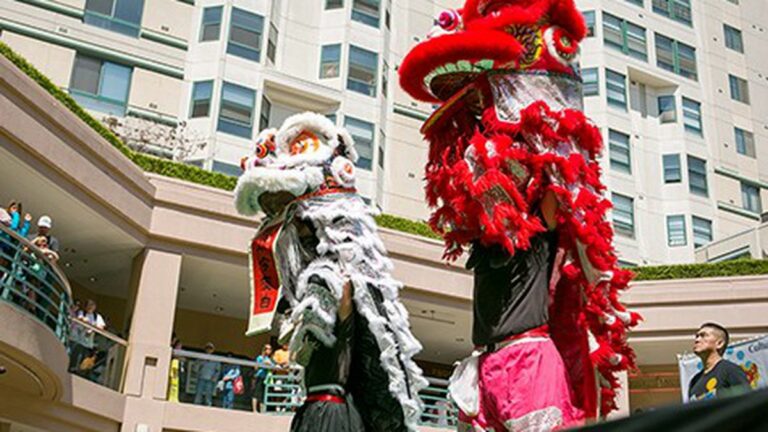
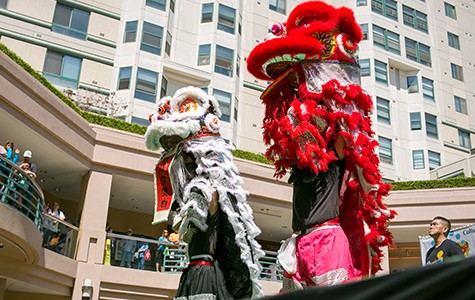
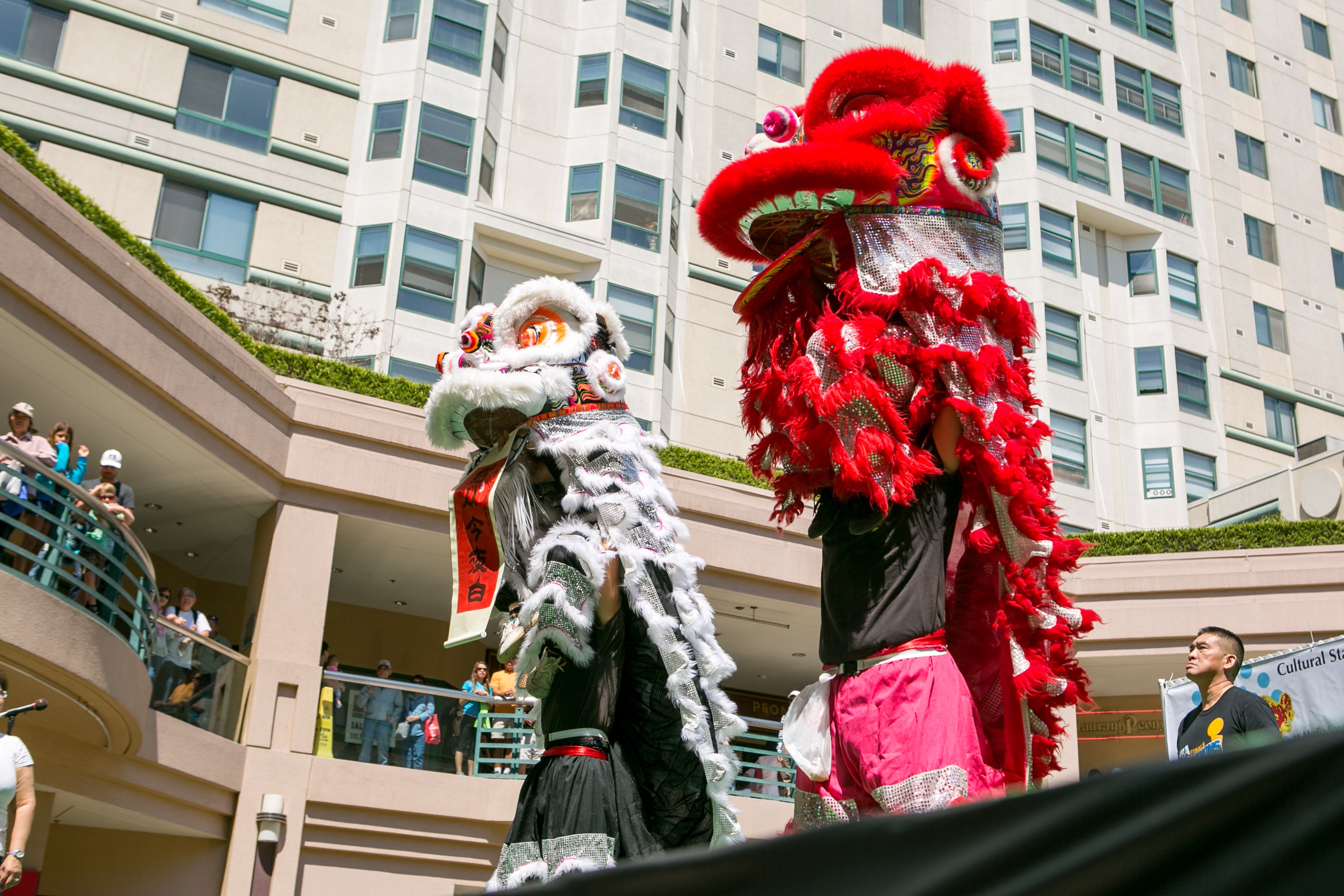
StreetFest included a full slate of cultural performances — a lion dance, kids doing choreographed martial arts routines to the Mortal Kombat theme song, and so forth. But the main emphasis of the festival was the tables and booths that lined the streets. They ran the gamut from community organizations to the Graton Resort & Casino to at least two different funeral homes that were — rather macabrely — offering discounts to the local Chinatown seniors that stopped by their displays.
The food, too, wasn’t exactly what Chinatown regulars would have expected: Taiwan Bento, a Taiwanese restaurant in Uptown, had set up a table, as had the downtown Korean takeout specialist E+M Catering. At another booth, a Southeast Asian vendor pressed thick branches of sugar cane into juice. The rest were your typical, generic festival food purveyors.
Noticeably missing were Oakland Chinatown restaurants. None had set up booths. Moreover, little of the food that was being sold seemed particularly Chinese. Instead, a small cluster of gourmet food trucks hawked wood-fire pizza and frozen custard.
The festival’s organizer, the Oakland Chinatown Chamber of Commerce, was founded in 1985 by a group of local business owners as a way to foster economic development in Chinatown. The chamber’s board is a mix of property owners, real estate agents, business owners, and corporate execs. Jennie Ong, the longtime executive director and the chamber’s only full-time paid staff member, has been putting StreetFest together since 1994. Besides the Lunar New Year Bazaar held in February, it’s the chamber’s signature event and its biggest source of revenue. The idea, Ong explained, is to attract people who don’t normally visit Chinatown, and, once they’re there, to show off all the things the neighborhood has to offer so that they’ll come back.
But the chamber isn’t without its critics. Sonny Le, a community activist and a former board and staff member of the Oakland Asian Cultural Center, doesn’t mince words in that regard. As Le sees it, there are really two Chinatowns. On the one hand, there’s an “upstairs” Chinatown that consists of property owners, lawyers, doctors, and real estate developers. Then, there’s the “downstairs” Chinatown, which includes the minimum-wage workers and the struggling immigrant-run businesses — marginalized folks who tend to be hidden from view during big events like StreetFest.
Who in Chinatown is speaking up for those “downstairs” people? From Le’s perspective, and that of other local Asian-American activists, the chamber’s efforts — which, in recent months, have included railing against Oakland’s minimum wage increase and advocating for extensive market-rate development — mostly benefit the developers, property owners, and landlords. “I don’t see anyone fighting for those businesses and workers in Chinatown,” Le said.
These issues have a particular urgency right now as Oakland Chinatown faces a crossroads. What may not have been obvious amid the upbeat atmosphere of the street festival is the grim reality that many Chinatown businesses aren’t doing so well. A recent walk around the block on 8th and 9th streets, between Webster and Franklin streets — the very heart of Chinatown — revealed no fewer than five empty storefronts. Meanwhile, the neighborhood’s large group of low-income seniors are particularly vulnerable to being displaced by Oakland’s citywide affordability crisis.
As other historic Chinatowns have been practically wiped out as a result of changing demographics and unchecked development, it’s worth asking: What’s the best way to save Oakland Chinatown?
Gentrification is often associated with socio-demographic shifts in which white newcomers displace longtime Black and Latino residents, but all around the country, ethnic enclaves similar to Oakland Chinatown are also in danger of being gentrified out of existence — or, at the very least, becoming a shadow of their former selves.
In Boston, an influx of luxury condominiums caused what had traditionally been a working class and predominantly Asian Chinatown to become increasingly affluent and white, according to a 2013 report on the gentrification of Chinatowns published by the Asian American Legal Defense Fund. In Washington, DC, the situation is even more dire: According to a Washington Post story published in July, only three hundred Chinese Americans are left in all of that city’s Chinatown, down from a high of 3,000 — and many of those who remain are embroiled in a protracted legal battle to prevent their landlord from demolishing their Section 8 building to make way for more luxury condos.
The Oakland Chinatown StreetFest is easily the single biggest event in Chinatown each year.
Credits: Bert Johnson
Lailan Huen, who runs a national anti-displacement initiative for the National Coalition for Asian Pacific American Community Development (whose West Coast office is located in Oakland), recently completed a nationwide tour of historic Chinatowns. In an interview, Huen said it’s overly simplistic to say that a Chinatown is “dying” just because some white people have moved in. But she confirmed that while a number of Chinatowns around the nation continue to thrive, the danger of displacement is very real.
DC’s Chinatown, she said, was “pretty much the worst” example. Once comparable in size to Oakland’s Chinatown, it now consists of about two city blocks — and even those are dotted with chain stores whose only connection to the old neighborhood are their architecture and signage. As the Washington Post story put it, “The historic Chinatown Garden restaurant shares a block with Panera Bread. The Chinese Community Church stands across from new high-rises.”
Huen explained that the Chinatowns, Little Tokyos, and other similar ethnic enclaves have always been vulnerable because of their proximity to downtown areas, where rents and property values tend to skyrocket during boom times. Over the years, Oakland’s Chinatown has also been impacted by these kinds of external pressures: Large sections of the old neighborhood were torn down in 1950 to make way for Interstate 880, and then again in the Sixties when the Webster Tube and Lake Merritt BART Station were built. Chinatown residents moved and rebuilt their community to adjust to each of these changes. And, for now, despite the occasional empty storefront, the neighborhood remains a mostly vibrant, bustling place — and one that’s still overwhelmingly Asian.
What’s frightening, though, is how quickly it can all fall apart — a matter of ten or fifteen years in the case of DC’s Chinatown, which began to change rapidly following the construction of a sports arena, the Verizon Center, in 1997.
And if the last vestige of Chinese residents really do get pushed out of DC’s Chinatown — or Oakland’s, for that matter — Huen fears that what remains won’t be much of a Chinatown at all. “You can have restaurants there, but it’s not real,” she said. “It’s basically like Disneyland for the gentrifiers.”
For those advocating to protect the cultural legacy of Oakland Chinatown, part of the problem is that the neighborhood is largely an enigma to members of the general public who aren’t involved in its day-to-day life — who know it as an occasional dim sum destination, perhaps, but nothing more.
It doesn’t help that, in recent months, the neighborhood has become a sort of token that gets trotted out whenever local media outlets decide to run stories critical of Oakland’s recent minimum wage increase. Inevitably, a shopkeeper or restaurant owner from Chinatown is the one quoted saying that he or she is “dying” as a result of the wage hike, or opining, ominously, that workers won’t benefit if all the businesses in the neighborhood shut down. (Four of the first ten results from a recent Google search for news stories about Oakland Chinatown were articles about the minimum wage.)
This is no coincidence — in part because, by most accounts, the transition to the higher wage has been difficult for many of the neighborhood’s small businesses. In addition, the Oakland Chinatown Chamber of Commerce has been an outspoken critic of Measure FF, the ballot measure responsible for raising the minimum wage — from $9 to $12.25 an hour — this past March. In one memorable headline-grabbing example, former chamber president and current board member Carl Chan described the minimum wage as the “final nail to the coffin.”
Chan, more than any other individual, is the public face of Oakland Chinatown. Emcee of this year’s StreetFest, consummate hobnobber, and wearer of innumerable hats, he’s known to many by his longstanding nickname: “the mayor of Chinatown.” In addition to his day job running Claremont Development (an East Bay real estate company), Chan is the chair of the Chinatown crime prevention council, chair of the board of directors for the nonprofit Asian Health Services, a board member of Visit Oakland, and a member or chairperson of a half-dozen other assorted committees in Oakland.
When I interviewed Chan and Ong at the Oakland Chinatown Chamber of Commerce’s second-floor office in the Pacific Renaissance Plaza, Chan joked that the reason he lives in Alameda is because, here in Oakland, “Everyone wants me to run for office.” Chan is popular in part because he’s a relentless cheerleader for anything and everything related to Chinatown. He’s also an unapologetic critic of the minimum wage increase and a champion of unfettered market-rate development, both in and around Oakland Chinatown — positions that are reflected in the stances taken by the chamber.
The story Chan and Ong tell about Chinatown’s recent decline is one familiar to those who have watched various touchstones of the Chinese community spread to the suburbs during the past decade. Call it the “99 Ranch Effect,” after the Los Angeles-based chain of Taiwanese-American mega-supermarkets that have spread all over the East Bay, with locations in Richmond, Concord, Fremont, Newark, Dublin, and Pleasanton. Open since 1998, the 35,000-square-foot Richmond location of 99 Ranch Market is typical in that it anchors an entire Asian-themed shopping mall — the Pacific East Mall. On weekends, a family can easily spend the better part of an afternoon here: a dim sum (or ramen or sushi) meal followed by a haircut, a grocery run to pick up hard-to-find imported ingredients and fresh seafood, and maybe even a couple rounds of karaoke — all tasks that, just a couple of decades ago, were almost exclusively the purview of traditional Chinatowns. Chan explained that the prices at 99 Ranch tend to be higher than what you’ll find at Chinatown’s mom-and-pop grocery stores, but for many, the wide aisles and vast parking lot are an irresistible draw. Meanwhile, the higher-end Chinese restaurants — the Koi Palaces of the world — have opened almost exclusively in these suburban Chinatowns, drawn, presumably, by the large swaths of available space and the prospect of a more affluent customer base.
The Oakland Chinatown StreetFest is easily the single biggest event in Chinatown each year.
Credits: Bert Johnson
The upshot, Chan explained, is that more and more Chinese Americans who live in the East Bay suburbs are staying there to shop and eat — and even Oakland residents are choosing to frequent 99 Ranch and its associated businesses. For some shops and restaurants in Oakland Chinatown, that competition proved to be more than they could withstand. And, in Chan’s view, the minimum wage hike exacerbated a precarious situation. Business owners who were already struggling decided to close for good; those that had shut down for extended, unspecified “renovation” projects simply never reopened. One of the casualties was Legendary Palace, a dim sum restaurant and banquet hall that had been a Chinatown landmark since 1917 and was housed in a building owned by chamber president Ong’s husband’s family. According to Chan, the owners cited the minimum wage as one of the reasons they decided to close. (The dim sum house finally reopened earlier this month under new ownership and with a new name: Cinnamon Tree.)
From Chan and Ong and the chamber’s perspective, the answer to saving Oakland Chinatown from the 99 Ranch Effect is unbridled growth — especially more market-rate housing in the downtown area. “We all believe that housing is in huge demand. No matter how fast you are building, you can’t keep up with the demand,” Chan said. “You don’t have to be a rocket scientist.”
Chan argues that market-rate housing will bring an influx of affluent residents who will help build up Chinatown’s declining customer base — in essence replacing some of the spending power of those shoppers who have been drawn away by the siren call of 99 Ranch. And the chamber opposes requiring developers to build affordable housing, because Chan believes any added costs that result from such requirements will ultimately get passed on to the buyer, making a new home more expensive for younger, middle-class, first-time homebuyers. (One of the community benefits the chamber has pushed for in talks with developers is that local workers be hired to do the actual contracting, Chan said.)
In the end, the chamber has endorsed nearly every market-rate project that developers have brought to the table in and around Chinatown — including significant market-rate housing projects at the intersection of Webster and 12th streets, at Broadway and 8th Street, and at 7th and Harrison streets. Another redevelopment project, at 524 8th Street in Old Oakland, will convert an SRO (single-room occupancy hotel) that currently houses mostly low-income, Chinese-speaking residents into studio apartments intended for “a student with mom and dad paying, or a tech tenant who can’t afford three-grand a month in San Francisco,” as the developer told the San Francisco Business Times.
Chan said he could recall only one development that the chamber took a neutral position on: the luxury apartment tower that had been slated to be built on a city-owned parcel on East 12th Street near Lake Merritt, not far outside of Chinatown. The deal fell through earlier this year after the Express revealed that the sale of the property violated a state affordable housing law.
What Ong and Chan talk a lot about is the need for new blood. Compared to other neighborhoods in Oakland, Chinatown has a disproportionately high percentage of businesses that have been around for decades — restaurants, for instance, that have done little to brush off the dust, whether in terms of menu or decor. And so many of these businesses have struggled to adapt to the changing demographics of the neighborhood. They may have poorly translated menus and staff with limited English proficiency. They tend to compete more on price than on quality or innovation. And slowly, Ong and Chan say, some of the businesses that have failed to adapt have simply called it quits.
There are success stories, though: According to Chan, the Hong Kong-style eatery Shooting Star Cafe has done tremendously well. Its lounge-y decor and offbeat, English-friendly menu (which includes a series of horoscope-themed drinks) appeal to a younger generation of customers. Same goes for Sobo Ramen, the often-crowded noodle shop on the first floor of the Pacific Renaissance Plaza.
One of the new-school business owners that Ong cites as a model is Tsuwei Weng, a young UC Berkeley grad who works as a software developer by day and manages Fortune Restaurant (940 Webster St.) — the Chinatown eatery he recently bought — by night. Weng said he’s already implemented a number of changes at Fortune: updated the menu, raised prices, and installed a new point of sale system that relies on computers rather than handwritten order checks. He’s in the process of training his staff so that they’ll be able to offer better English-language service. It’s all part of an effort to institute a more “Western” style of service that will make diners feel like they’re eating at a modern, upscale restaurant — not your traditional mom-and-pop Chinatown spot, Weng said.
It’s also apparent that Weng doesn’t expect the restaurant to be profitable for quite some time. Instead, he has set his sights squarely on Oakland’s coming tech boom — on the arrival of Uber and others like it, and the wealthy employees of those companies who are expected to flock to Oakland in the next few years. “The only hope I have is when those high tech companies come,” he said. “That’s my target customer.”
In fact, Weng expects that after he’s done making all of the changes he has planned for Fortune, the low-income Chinatown seniors who have hitherto been the foundation of the neighborhood’s customer base won’t be able to afford to eat at his restaurant, except perhaps for certain breakfast or lunch specials that he might run during the times when the tech workers aren’t likely to come. Weng acknowledged that it was sad that this would be the case, but he blamed the minimum wage increase, not his business model: “Senior people will get killed, or they will starve to death, because of our government’s policies,” he said.
Lailan Huen runs a national anti-displacement initiative.
Credits: Bert Johnson
Weng, who recently became an Oakland Chinatown Chamber of Commerce board member, isn’t the only one in Oakland who’s holding up the tech industry as the city’s savior. Indeed, it feels at times as though the bulk of the city’s elected officials have taken that stance. Still, it’s easy to imagine how Chinatown’s fundamental character would change if every business adopted Weng’s approach — that is, if everyone decided the tech worker was the ideal customer, and that the low-income monolingual Chinatown senior was someone whose business was expendable.
At the end of the day, the fact that a neighborhood chamber of commerce is pro-development and somewhat conservative with respect to the minimum wage is hardly surprising. After all, the chamber’s mission is to promote business interests. But it does lend credence to the idea that the chamber is out of step with neighborhood activists and others who fear for the cultural legacy of Chinatown and worry that low-income residents and immigrants are being priced out. That’s the question, then: When all of that development comes, and when the techies start moving into the neighborhood in large numbers, what’s to prevent Oakland Chinatown from going the way of DC’s? And who is to say that the policies the chamber is advocating won’t really be the “final nail to the coffin” for Oakland Chinatown?
When Sonny Le asked me who in Chinatown was speaking up on behalf of low-income, marginalized workers and residents, I took it as a rhetorical question. As it turned out, an October 5 gathering of community leaders at the Oakland Chinatown office of the Asian Pacific Environmental Network (APEN) was the closest thing I found to an answer.
APEN is an Oakland-based environmental justice organization that has focused much of its activism on tenants’ rights, development, and affordable housing. One of the nonprofit’s signature campaigns was a five-year effort to prevent the eviction of more than forty low-income tenants from affordable housing units at the Pacific Renaissance Plaza. At APEN’s Chinatown office, the snack spread (clusters of grapes and a tin of flaky Chinese pastries) was typically Asian, but it was Malcolm X’s words — not those of, say, some Chinese Buddhist philosopher — that adorned a poster on the wall: “Don’t ever accuse a Black man for voicing his resentment and dissatisfaction over the criminal condition of his people as being responsible for inciting a situation. You have to indict the society that allows these things to exist.”
About thirty neighborhood activists, religious leaders, and nonprofit representatives had crowded into this small office space to talk about the future of Oakland Chinatown. One by one, each person gave a little introduction about the organization he or she represented and talked about their hopes and dreams for the neighborhood — about crime reduction, graffiti abatement, and traffic mitigation. Mostly, though, the group talked about the housing crisis, the tech boom, and a growing sense that, as much as rent in Chinatown has soared in the past few years, things were just now about to get really crazy.
“There’s a serious threat of displacement,” said Ener Chiu, who moderated the discussion along with APEN lead community organizer Alvina Wong, in his opening remarks.
Chiu — a commercial planning manager with the East Bay Asian Local Development Corporation (EBALDC), which develops and manages affordable housing projects, and serves as office landlord to many Oakland-based nonprofits — told me that Chinatown leaders had been meeting to talk about development issues since 2009, but that the recent gathering was by far the most comprehensive in terms of stakeholders represented in one room: public health advocates, providers of legal services for low-income Asians and Pacific Islanders, leaders of 100-plus-year-old churches in Chinatown, and more. As a result, the meeting had a circle-the-wagons, all-hands-on-deck feeling. Nearly everyone in the room seemed to agree that Chinatown was facing a looming crisis.
A high proportion of Chinatown restaurants have been around for decades.
Credits: Bert Johnson
There was one notable absence: No one from the Oakland Chinatown Chamber of Commerce had been invited. It wasn’t an oversight. The chamber was originally part of a coalition of Chinatown community leaders that met a few years ago to come up with a set of recommendations for the City of Oakland when it was putting together the Lake Merritt BART Station Area Plan — a 25-year blueprint for the future development of the roughly half-mile radius of land around the BART station, which includes Chinatown. But due to a range of disagreements, the chamber eventually left the coalition. At the heart of the rift were fundamentally different philosophies with regard to affordable housing. While the chamber pushed for as much market-rate development as possible, progressive nonprofits such as APEN and EBALDC advocated for tenant protections and affordable housing to make sure that low-income immigrants would still be able to live in the neighborhood. Activists also feared that allowing tall buildings would add even more pressure to the area’s already soaring rental market.
“If you allow twenty-story buildings, or fifty-story buildings, to go up, it increases property values,” argued Timmy Lu, APEN’s State Organizing Director, in a phone interview. “That’s where things get hot, even if you’re all operating from a place of, ‘We want to do what’s best for the community.'”
The Chinatown coalition’s proposal would have allowed developers to build high-rises — but only if they agreed to implement certain community benefits, including contributing funds that would go toward the construction of affordable housing. All told, the coalition wanted 30 percent of the units in any new development to be set aside as affordable housing.
The October 5 meeting at the APEN office was largely an effort by community leaders to regroup in the aftermath of the Lake Merritt BART Station Area Plan, the final version of which was approved by the city in 2014. Ultimately, Chiu and others said the plan turned out to be a resounding defeat for their efforts: Although the city council enacted height restrictions of a relatively modest 85 feet at the core of Chinatown, it zoned lots of land all along the neighborhood’s perimeter to allow for 275-foot-tall buildings. And while the plan adopted by the council mentions many of the community benefits that groups like APEN and EBALDC had pushed for, it doesn’t structure the zoning regulations in a way that provide any mechanism to ensure that they’ll happen. The council, for example, did not require high-rise developers to pay for affordable housing.
In an interview, Chiu said it’s not that EBALDC doesn’t think market-rate housing ought to be built in Chinatown, particularly larger market-rate units that can help attract middle-class families back to the neighborhood. There shouldn’t be this binary choice between unrestricted development and no development at all, he said. Rather, it’s a matter of making sure the development is scaled in such a way that it doesn’t price out poor people. “If prices force our constituencies out, then you end up with Washington, DC: hollowed out — the names of McDonald’s and Starbucks in Chinese, and pagoda orientalism, but no working-class Chinese people living there anymore,” Chiu said.
Chiu also believes the chamber underestimates the extent to which low-income seniors are actually the backbone of Chinatown’s traditional businesses. While these elders’ annual income may only be $20,000, they spend money at the shops and restaurants every day, and deposit their savings in the neighborhood’s many banks. As for the San Francisco tech workers who live in those nice condos in Oakland Chinatown — the ones that restaurateurs such as Weng are so eager to attract? Chiu said most of the ones he knows shop for groceries at Whole Foods or Trader Joe’s.
As APEN’s Alvina Wong put it, “I’m not saying that Chinatown should always be poor, but it’s about staying true to the character of the neighborhood and making sure it’s still a place that new immigrants and longtime immigrants can survive and thrive in.”
For his part, Carl Chan is adamant that he does care about the low-wage worker — the person that he, too, describes as the “backbone” of Oakland Chinatown. According to Chan, anyone who has invested time and energy in Chinatown over the years has an obligation to protect that worker. Despite the chamber’s displeasure with the minimum wage increase, Chan said he has been encouraging business owners to comply with the law so that workers receive every penny to which they are entitled, and he has told employers not to try any “funny business,” such as manipulating their workers’ on-the-book hours.
Chan and Ong say the chamber has also been trying to help struggling businesses. They say they want to start an outdoor night market that will run on weekends during the summer, as a way to draw more customers to the neighborhood and highlight local restaurants. In a few cases, Chan said, they’ve been able to help shop owners quietly renegotiate their leases. He said the chamber has also approached city officials about the possibility of offering microloans to some of these small business owners. “If they need help filling out a form, we are happy to do that,” he said.
But neighborhood activists at APEN and EBALDC say they’re concerned about property owners who are jacking up rents and trying to cash in on the big tech boom. And Wong, APEN’s community organizer, said she has heard story after story about Chinatown businesses not paying their employees the new minimum wage. In response, she and her colleagues recently started the process of trying to connect workers to resources that will help them advocate for themselves.
What the drastic changes occurring in other Chinatowns across the country make clear is that the forces of gentrification and displacement are a reality that can’t be ignored. The 2013 Asian American Legal Defense Fund report found that local government policies “encouraged and assisted the gutting of Chinatowns” in Boston, New York, and Philadelphia, in part by promoting the construction of luxury condos in those neighborhoods. In Boston, this was exacerbated by the fact that a hospital and several university campuses took over large sections of the Chinatown area. The result? Census data showed that between 1990 and 2010 the proportion of white residents in Boston Chinatown had more than doubled while the percentage of Asians dropped from 70 percent of the total population to just 46 percent. At the same time, housing values in Boston Chinatown had soared to nearly double that of the city as a whole by 2010, and the percentage of multi-generational family households and foreign-born residents — both hallmarks of a traditional Chinatown — saw a sharp decline.
And in DC, the mostly Chinese tenants in the Museum Square apartment complex — one of only two remaining Section 8 buildings in Chinatown — have avoided eviction thus far only because of a city law that requires landlords to offer tenants the opportunity to buy a building before it can be demolished to make way for new development. The Washington Post has reported, however, that the owner is asking for more than $800,000 per apartment — far more than the building’s low-income tenants can afford.
At the October meeting at APEN, the community leaders in attendance had no shortage of ideas for how to save Oakland Chinatown. Ken Wong, administrative director at the Chinese Independent Baptist Church, brought up the idea of appealing to the sense of “legacy” on the part of longtime property owners, who might be willing to sell their property for a discounted rate if they felt it was for something that would benefit the community. He cited the nonprofit community health center Asian Health Services, which purchased the former Silver Dragon Restaurant in 2011, as one example of this approach and said he’s aware of religious organizations in Chinatown that have done the same thing.
Julia Liou, planning and development director for Asian Health Services, argued that nonprofits can be an engine of economic activity for the neighborhood. Even now, folks who had moved away from Oakland Chinatown routinely come back to see one of the clinic’s Chinese- or Vietnamese-speaking doctors, and then eat a meal and do some shopping while they’re there. (One thing 99 Ranch Market doesn’t have is an Asian Health Services.) And, because of the clinic’s need for staff members who speak their patients’ native languages and understand their culture, Asian Health Services also provides employment to many Chinatown residents. “We’re a model for the community overall, in terms of sustainability,” Liou said in a phone interview.
Jennie Ong (left) and Carl Chan of the Oakland Chinatown Chamber of Commerce advocate for aggressive market-rate development.
Credits: Bert Johnson
And EBALDC’s Chiu agrees with the chamber about the need for some of the older Chinatown restaurants to modernize — to make them worth the higher prices they’d like to charge. At the same time, he stressed the importance of preserving affordable options for the neighborhood’s current residents. Chiu mentioned Swan’s Market, Old Oakland’s now-thriving gourmet food court, which EBALDC manages, as a possible model: The food is good enough to attract people from all over the city, but the restaurants are also encouraged to always offer a menu item that costs less than five dollars, so that anyone can walk in off the street and enjoy a dignified meal.
There’s also no question that plenty of good things are already happening in Chinatown: Artists have collaborated with local businesses to clean up tagged buildings and replace the graffiti with murals. The Lincoln Square Recreation Center has been widely lauded for its role as a vibrant community hub that caters to both Chinatown seniors and the diverse mix of teenagers who attend nearby schools. And restaurants specializing in relatively obscure regional Chinese cuisines have opened and are thriving.
But with skyrocketing rents sweeping through the downtown, Jack London, and Lake Merritt BART station areas, there’s also no question that many longtime residents are in serious danger of being displaced. What might save Oakland from the fate of other Chinatowns around the country may be the simple fact that so many members of the community are deeply committed to preserving Chinatown and have gotten together to make plans in a strategic way. Huen, the anti-displacement activist, said that was something that seemed to be missing in Washington, DC.
“I want to believe that the Oakland chamber does care more, relative to the Chinatown in DC,” Huen said. “They do care more about preserving our history and our culture. They’re not going to just sell it to the highest bidder.”
The key, she added, is for Chinatown’s community leaders to organize to fend off that threat. And, for now, she’s hopeful. “I think the narrative that Oakland’s going to be destroyed is not quite accurate.”
Correction: The original version of this story misspelled the name of the National Coalition for Asian Pacific American Community Development.
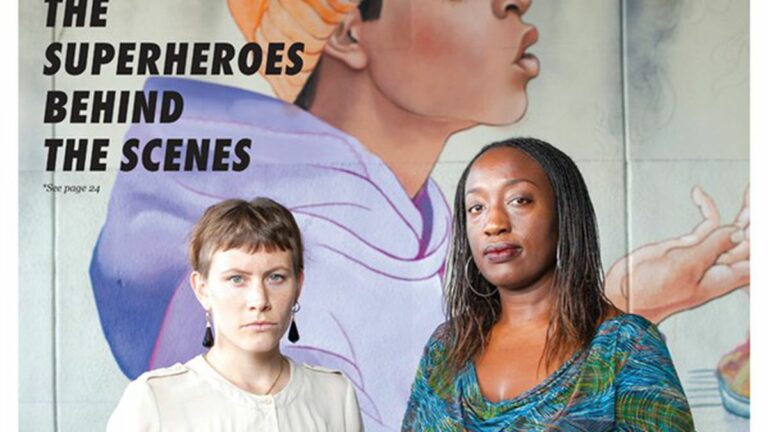
“The Superheroes Behind the Scenes,” Culture Spy, 10/14
My Heart Breaks
The story of this beautiful project coming out of [Attitudinal Health Connection] Art Esteem as visualized by Amana Harris and her amazing parents, co-creators, and artists, who run AHC, breaks my heart. I am at a loss for words in expressing the grief I feel for the family and friends of Antonio Ramos. Oakland is my home town and I will continue to pray for its healing and love for all!
Roberta Llewellyn, Sebastopol
“Censored!: Ten Big Stories the Media Ignored,” Feature, 10/14
A Point of Clarification
I am disappointed that Tim Redmond suggested that, at times in the past, we “veer[ed] off in the Looney world of conspiracies and 9/11 Truther territory.” I went back and reviewed the top 25 stories for 2003 to the present. There were three news stories listed in the top 25 related to 9/11 out of 325 stories we published in that time period. This amounts to less than 1 percent of all the stories we ranked in the top 25 each year. This is hardly a “veering off in the Looney world of conspiracies” that Redmond claims.
The three 9/11 stories we did cite were more than adequately sourced, including Deseret News, FBI records, and transcripts from the Japanese parliament. All three had been completely censored by the US corporate media. The topics included how the FBI had no evidence that Osama Ben Laden was involved in 9/11, coverage in Japanese news and television regarding 9/11 questions from official transcripts in the Japanese Parliament, and news from a Salt Lake City mainstream paper on how a university physicist was questioning the collapse of Building Seven.
The Project Censored mission is to research and report important news stories that the corporate media ignores or censors. In that regard, there are no forbidden topics, including 9/11, and we stand proudly on our record.
Peter Phillips, President Media Freedom Foundation/Project Censored, Occidental
“Oakland’s Culture Clash,” Seven Days, 10/14
Newcomers, Please Volunteer
Thanks, Bob Gammon, for this. I wish all the folks who are moving in would take the energy to volunteer somewhere in our community. Every school, recreational center, arts nonprofit, or food bank that has been working for years to make Oakland better can use your help by donating money, or better yet, your time.
Karen Hester, Oakland
Diversity Is the Secret Sauce
Given the recent representation Oaklanders’ received from Ms. Rachel “There is no affordability crisis” Flynn, director of [Planning and Building], and Libby “Let’s appointment an eviction specialist as tenant advocate” Schaaf, mayor of Oakland, it seems pretty clear that the folks in power are failing to prioritize and enact policies that would preserve Oakland’s “secret sauce.”
I would also like to suggest that the “sauce” is 99 percent cultural capital that has been built up by and sustained by Oakland’s economically and ethnically diverse, working-class residents and only 1 percent actual financial investment in Oakland by private and state monies. But, to hear our leaders tell it, it’s the other way around. Thank you for voicing these concerns so succinctly. Just one peeve: Hella lot equals hell of a lot. Maybe “hella sauce” if you have to.
Chanty Nok, Oakland
The Newcomers Are Not to Blame
This is what I love about our Liberal Bay Area Writers. We celebrate and cherish diversity. But … if they don’t look like us, earn like us, like what we like, want what we want, then we don’t welcome them here.
Oh, and you really think that people (young or old, white or not) really want to move into areas being “gentrified” if they are wealthy and have lots of disposable income? Really? It is just people looking for housing that is affordable to them. They just happen to be able to afford more. Shame on them.
We would not want them here. They are different than us. We are too busy promoting diversity. The East Bay is liberal and conservatives try to maintain the status quo but we had better not let anything change around here.
Geez, listen to yourself.
Michael Good, Oakland
“A Park to Nowhere?” Eco Watch, 10/14
What’s Wrong with the Deck?
Where is the city going to get the great amount of funds needed to make it a park, especially a highly accessible park?
What the Bay Area really needs most is more housing to address the acute housing shortage. That is the reason the housing prices are so high. And if most of the housing at this new location will be high cost, so what? That will take the price pressure off of all available housing in the area as the well-to-do will abandon existing housing for this site. Let them have their big boardwalk. The site was awful before and no one went there. In the future, I can bicycle there, and it will be a great bike destination. [People with disabilities] can take East Bay paratransit service to get there or a taxi.
Vincent Sauve, Oakland
The Whole Thing Should Be a Park
The public already decided what it wanted. We learned when the project was first proposed that a ten-year-long citywide open consultation process determined the entire Oak to Ninth [Avenue] area should be an open space park, as per California state requirements that waterfront be recreational or water-based industrial. Never residential. [Then-state Senator Don] Perata pushed an exception through the state legislature allowing Oakland and Signature Development [Group] to build residential there, in direct opposition to the citywide decision to make it parkland.
Mike Bradley, Oakland
“Nanos, the Literary Nomad,” Books, 10/14
Miss You, Nanos
This little bookshop was, for me, a major draw to living in the Temescal area. It’s terrible that there is no longer room for independent printmaking and bookselling in the neighborhood.
Sarang Shah, Oakland
“Salsipuedes,” Dining Review, 10/14
Scrumptious
I went to Salsipuedes recently. It was impressive to watch the prep. Even more surprising was that the delivery exceeded expectations. I met chef Marcus Krauss and the crew, who are all talents in their own right. The wines are most decidedly natural Spanish, French, Sicilian. It was excellent. I ate the roasted vegetables, pork steak, shishito peppers, and black cod tail. Scrumptious.
Don Holm, Oakland
“Racial Profiling via Nextdoor.com,” Feature, 10/7
Clearer Info, Please
Each Nextdoor neighborhood has at least one “lead” or moderator. In most instances the lead has a pretty good idea of his responsibilities, however every once in a while he has little idea of what those are. Even though they are spelled out, it’s up to the lead to be aware of them and abide by them.
I can vouch for one (only one!) instance when I thought that a thread had gone too far. I asked the lead in that neighborhood to please close the thread or remove the most offensive comments. He responded that he thought that free expression should be encouraged. In the end, Nextdoor itself closed the thread.
As well, each Nextdoor participant is supposed to register with his own real name. This makes it difficult for folks to make outrageous statements under pseudonyms as on other venues.
If nasty comments have been allowed to remain after you have flagged them, I would send a [private message] directly to your lead respectfully asking them why.
Please note that the Express article, though long, has little clear first-hand info. Most folks interviewed have reported items they have seen. There are no actual website screenshots included. As well, even though the title states it is about Nextdoor, the author includes Glenfriends, Yahoo, Google, Facebook groups, and in doing so muddies the water even further.
Judy Berkowitz, San Francisco
The ‘Curtain-Twitchers’
In Britain, busy-bodies are referred to as “curtain-twitchers.” It seems this hyper-vigilant, eternally suspicious, and perhaps bigoted demographic is being well catered for by Nextdoor. Oh, the wonders of social media!
John Seal, Oakland
This Is Sensationalism
The Express has eloquent writers but these articles are intentionally divisive for the sake of publicity. The Express is one of the few passionate news organizations in Oakland, so I keep reading. These stories could be real news if the writers would present statistics, studies, and stories from all sides of the situation. This helps the readers understand the whole picture rather than read a few inflammatory anecdotes to fit the writer’s opinion.
Racism is real, it sucks, and everyone should do more to stop it. But Oakland is awesome, full of amazing people from diverse backgrounds, and we need to focus how to grow stronger together. The Express can help us do this by separating writers’ opinions from their “news.” Oakland desperately needs a reliable and balanced news source. Is there any good reason not to do this?
Will Roscoe, Oakland
We Need to Take Responsibility
I thought the racism exposed in this article was appalling, and then I saw the [online] comments. We white people are used to going into denial about racism, which is fed to us with our mothers’ milk. We don’t realize that our pretending hurts people of color. We don’t want to take responsibility for our actions. But we know the truth deep inside. We feel guilt and shame, especially if we consider ourselves liberal or progressive. Life is much better for everyone when we white people work on our racism. It is freeing to let go of fear and prejudice. We need to end white supremacy before the next generation is poisoned and more people of color are harmed. I recommend the work of Tim Wise.
Holly Harwood, Oakland
Thanks!
Terrific article! At this juncture, when police are being called on drummers and church choirs, we need to increase the dialogue and understand the effect on others when we call police due to our own biases. I know some will not agree with this perspective, but I appreciate hearing voices from Oaklanders of color on racial profiling, feeling their celebrations are not welcome at Lake Merritt, and other issues that are currently being raised.
Ginger Holman, Oakland
Get to Know Your Neighbors
It would be great if people could have a National Night Out block party with Oakland police and the neighbors getting to know each other, their vehicles, and their interests. By knowing neighbors, helping each other, and watching out for each other the suspicious activity on the block would hopefully be by others who do not live or travel the block just to get to somewhere else.
People do not always trust the people next door if they do not take the time to get to know them.
Owen Martin, Richmond
You Missed the Big Picture
Oakland residents need to be aware of suspicious activity because burglaries, robberies, and other street crimes here are two to three times what most major cities suffer. The article tries to portray awareness as racism, but it has no data, no proof, only anecdotes. I’m on Nextdoor, and I could give you stories about white people reported as suspicious. So what?
Suspicious does not mean guilty, it does not mean a crime has occurred. Courtroom rules of evidence do not apply. Suspicious simply means that a situation warrants further attention. Unfortunately, there are all too many of these in Oakland.
Maybe the next article could report crimes deterred because alert neighbors observed, called OPD, the dispatcher made a professional evaluation, and police arrived and caught a burglar in the act. These events, too, have been reported on Nextdoor.
Again, great investigative reporting work here. You’re to be commended. This project must be stopped. Coal is a killer — a dead-end energy source. Isn’t it enough that we see endless oil tanker cars rumbling right through our precious 4th Street boutique ‘hood and downtown Oakland? And again, when is this [Phil] Tagami character going to be thoroughly investigated and thrown in jail? Didn’t he pocket enough from the Fox Theater rehab debacle, and now this?
Ben Kapinski, Oakland
Umm, Ms. DA?
Time to thoroughly investigate the attorneys and coal companies. Where is the district attorney, asleep?
Steve Redmond, Berkeley
“Oakland Favors Bank Over Bus Riders,” News, 9/30
Classic Oakland
This is classic City of Oakland staff incompetence. Why do people infer that there is no transportation planning expertise in City Hall until Mayor Libby Schaaf’s new department is established? That is not true. There is a legion of well-paid transportation engineers working every day in the Public Works Department. They are responsible for technical review and coordination of citywide transportation-related issues.
The problem is that they have no leadership and nobody willing to make tough decisions. They are especially averse to and incapable of making an unpopular decision that they will have to defend publicly or across the plaza in City Hall. For that group, the path of least resistance is always the way to go. What do you expect when the Public Works director is not a civil engineer, but a political appointee from a past regime?
In this case, clearly the benefits of this AC Transit stop to the community as a whole, especially at the base of Pill Hill, seem to outweigh the concerns of a single business along the corridor. However, when that owner is politically connected, it takes a professional staff with the balls to say no and an environment in City Hall that respects and supports that expertise. That kind of environment does not exist and has not existed in the City of Oakland for years.
Gary Patton, former deputy director of Planning and Zoning for the City of Oakland, Hayward
For those unfamiliar with the name, Jafar Panahi is part of the wave of Iranian filmmakers that established itself on Western screens with groundbreaking, politically daring films beginning in the 1990s. Alongside his compatriots Abbas Kiarostami, Mohsen Makhmalbaf, Majid Majidi, and Marjane Satrapi, among many others, Panahi specializes in veiled, and sometimes not so veiled, commentaries on life in contemporary Iran — with the common theme that modern Iranians are hungry for various kinds of freedom.
Not surprisingly, such messages have drawn fire from the country’s ultra-conservative religious oligarchy. In 2010, Panahi was placed under house arrest while awaiting sentencing on charges of defaming the government. His response was to make This Is Not a Film, a documentary shot in his Tehran flat, depicting his daily routine intercut with a critique of the suppressed Iranian cinema. The doc was smuggled out of the country and unsurprisingly attracted controversy in the West. Despite the vocal support of international film folks, he was sentenced to a twenty-year ban on movie-making, travel outside his homeland, and giving interviews. Panahi, however, does not cave easily.
Jafar Panahi in Taxi.
Jafar Panahi in Taxi.
Which brings us to Panahi’s Taxi. It opens with a Tehran street scene as viewed from a stationary camera mounted on a taxi’s dashboard. Suddenly the camera swivels around, and as the film goes on we encounter a procession of passengers and passersby interacting with the “taxi driver” (the director himself) and speaking their minds on everything from the number of thieves in the capital to the desirability of Hollywood movies to Iran’s Topic Number One: the omnipresent fear of saying or doing the wrong thing and feeling the wrath of the Islamist theocracy. It’s a talky, bumpy ride, and before it’s over we realize we’re engrossed in one of the most original, most intelligent films of 2015 — part documentary, part scripted “reality” show, and 100 percent Panahi.
Panahi himself is a jovial-faced presence in the driver’s seat, calm and collected no matter what calamities occur in the street. As the taxi tools around the city, some of the passengers recognize him as Panahi, but most have their own problems to deal with. A sweating DVD delivery guy discusses movie stars with a customer. The taxi passes an accident scene and picks up a bloody, injured man accompanied by a hysterical woman, and takes them to a hospital. Two elderly women are comically convinced that if they don’t put those goldfish in the bowl they’re carrying into Ali’s Spring at the stroke of noon, the women will die. A longtime friend of the driver/director has an urgent matter to deal with involving adultery. And so on.
The plot thickens considerably when the driver’s niece — a young film student named Hana — gets in. Inquisitive as only a pre-teen schoolgirl can be, Hana does not varnish her opinions, and it soon becomes clear that she’s the sounding board for dissent, especially when she pulls out her video camera and starts shooting her own footage. When the conversation turns to the “sordid realities” forbidden in the arts by the religious leaders, Panahi informs her: “There are realities they don’t want shown.” To which Hana replies: “They don’t want to show it but they do it themselves.”
Neither Hana nor any of the other characters is listed in the cast. In fact, there are no credits at all for the film, other than Panahi as writer, producer, and director. Taxi was not supposed to have been created. Panahi could be sent to prison for making it. By buying a ticket you’re supporting a non-film by an un-person. So, in effect, it’s an illusion, like so many “sordid realities” of life in Iran. See it and count your blessings.
Last Thursday, Chris Collins posted a photo to Instagram picturing him and his coconspirator Kiki Niederberghaus with their pants around their ankles and their mouths gaping open in a cry of excitement as they stood in their brand new gallery in downtown Oakland (268 14th St.). The two men, covered head to toe in tattoos, held up a huge...
When you walk into Noodles Fresh, a new Chinese restaurant in El Cerrito, the first thing you see is a wall of little blue teapots with water dripping down from one to the next, like a stylized water curtain. Chef and co-owner Wenyan Petersen grew up in the southeastern Chinese province of Jiangxi, in the city of...
When Shifra de Benedictis-Kessner joined the Downtown Berkeley Association in 2011, one of the most important challenges to tackle was parking. "People just couldn't find spots in the core around BART," she said. "The perception in downtown Berkeley was that parking was awful." The association subsequently partnered with the city to overhaul parking downtown — by raising...
Thursday, October 29
Little White Lie (65 min., 2014). Followed by a Q&A with director Lacey Schwartz (Jewish Community Center for the East Bay, Berkeley, 7:00)
The Hunting Ground (103 min., 215). (Piedmont Theatre, Oakland, 7:00)
Ghostbusters (105 min., 1984). (New Parkway, Oakland, 9:00)
Gremlins (106 min., 1984). (UA Berkeley 7, Berkeley, 9:00)
Young Frankenstein (106 min., 1974). (Parkway, 9:30)
Friday, October 30
Salt of the...
Some cheer, some hiss, but one thing is for sure: Uber will transform Oakland, and our city will become ground zero, not only for a discussion of growth and displacement, but also for the pitfalls of the "sharing economy."
This year, my partner and I needed to move out of our one-bedroom place to make room for our growing family....
Aries (March 21–April 19): On a January morning in 1943, the town of Spearfish, South Dakota experienced very weird weather. At 7:30 a.m. the temperature was minus 4 degrees Fahrenheit. In the next two minutes, due to an unusual type of wind sweeping down over nearby Lookout Mountain, thermometers shot up 49 degrees. Over the next hour and a...
Our October 21 feature, "Damning California's Future," misspelled Yolla Bolly Wilderness. It also mistakenly stated that the Westlands Water District has a contract to receive water from the State Water Project. Westlands is actually a contractor of the federally operated Central Valley Project. 
On a late-August Saturday in Oakland Chinatown, a Taiwanese-American cover band performed a version of "Uptown Funk" to the great delight of the handful of middle-aged white couples gyrating at the foot of the stage. The 28th annual Oakland Chinatown StreetFest sprawled over the eight blocks that constitute Chinatown proper, and although the festival...
"The Superheroes Behind the Scenes," Culture Spy, 10/14
My Heart Breaks
The story of this beautiful project coming out of Art Esteem as visualized by Amana Harris and her amazing parents, co-creators, and artists, who run AHC, breaks my heart. I am at a loss for words in expressing the grief I feel for the family and friends of Antonio...
For those unfamiliar with the name, Jafar Panahi is part of the wave of Iranian filmmakers that established itself on Western screens with groundbreaking, politically daring films beginning in the 1990s. Alongside his compatriots Abbas Kiarostami, Mohsen Makhmalbaf, Majid Majidi, and Marjane Satrapi, among many others, Panahi specializes in veiled, and sometimes not so veiled, commentaries on life in...