
I’m With Her comes to Hardly Strictly Bluegrass

0

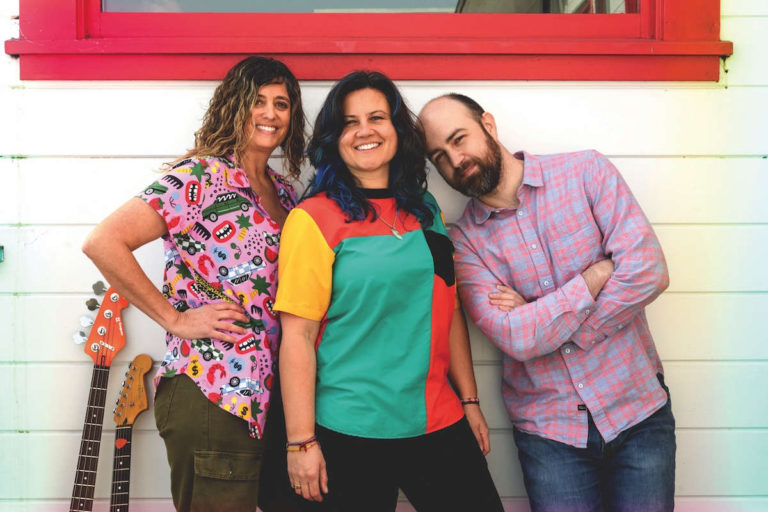
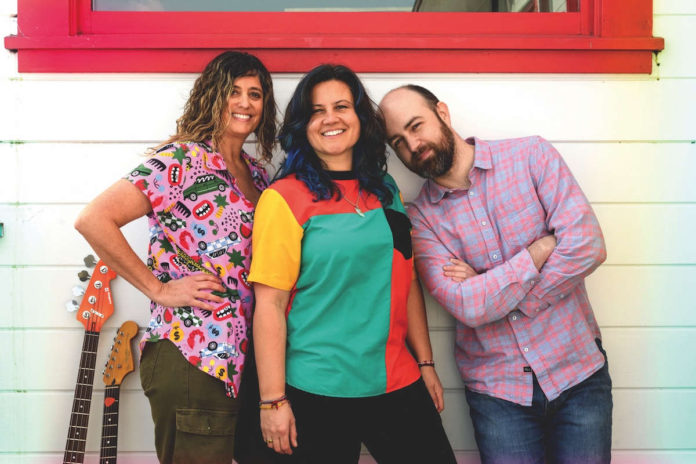
Intergenerational connectivity. It’s a key component for what drives I’m With Her, the three-person outfit made up of Sara Watkins (Nickel Creek), Aoife O’Donovan (Crooked Still) and Texas singer/writer Sarah Jarosz.

The trio is currently on the road promoting their sophomore bow, Wild and Clear and Blue, the follow-up to their 2018 Ethan Johns-produced debut, See You Around. While Watkins admits the first record was “very bare, written in about a week and a half and had material we performed basically as they were written,” the new collection of songs found the longtime friends adding more complexity to the process with help from multi-instrumentalist/producer Josh Kaufman, who is also a member of the collaborative ensemble Bonny Light Horseman.

“From the outset, we wanted to be open to playing with other people on this album,” Watkins said in a recent interview. “And we weren’t sure if that meant doing a full production on all the songs or if that would mean less than that. We ended up feeling like these songs were totally full and complete as we wrote them with just the three of us in a room. But we also wanted to have support on some songs.”

The auditory manna on this collection of songs runs deep. Highlights range from the soaring “Mother Eagle (Sing Me Alive),” which glistens with the group’s harmonies intertwining with Jarosz’s ringing octave mandolin and Watkins’ mournful fiddle runs, to the joyful melancholy of the glistening opener “Ancient Light,” to “Standing On the Fault Line,” a solemn meditation that speaks of choosing between sticking with a dream or moving on when expectations don’t work out. The arrangements that build from a solitary guitar to a hypnotic crescendo of dreamy vocals make it worth the price of admission.

Ask Watkins about the key to this kind of organic intimacy that goes far beyond the fact that the three members have relationships dating back years, and she says it hinges on the collective decision to hunker down and live with each song during the creative process. It’s on full display in the video snippets interspersed on the clips from the album posted on YouTube.

“It was a really enjoyable record to make all in all,” Watkins said. “We were all isolated in upstate New York in both studios [Rhinebeck’s The Clubhouse and The Outlier Inn in the Catskills]. That was good for us, to be out on our own and to be in our own little world. We’d get a bunch of groceries, do meals together and be in the same rhythm while making this thing out of our shared experiences and our collaborative songwriting process. It’s a beautiful thing to get to work with people you love and respect and that challenge you. It’s kind of magic. That’s how we like to do it versus having our work hours and then going our separate ways.”

While recording Wild and Clear and Blue in two separate chunks—in April and July of 2024—the passing of John Prine and Nanci Griffith, who both died during the pandemic, provided an inspirational spark while the album was being written.

“During the first writing sessions we did in November 2021, we were reconnecting and catching up on each other’s lives and things that were in our hearts and what was going on with our families and all of that stuff,” Watkins said. “The pandemic had happened and I think a lot of people were taking stock of what’s really important, as we do in various times throughout our lives. It felt like a pretty cultural moment. Certainly, losing mentors and people that are these flagships in your life—we just started writing about those magical moments we shared with our family and these people. I didn’t know Nanci, but we knew John some. These people hold places in our lives and our families’ lives and have been a structure in some of our most fundamental memories.”

She added, “’Wild and Clear and Blue,’ as well as ‘Sisters of the Night Watch’ and ‘Only Daughter’ were the first three songs we started writing. Out of the gate, there ended up being these narratives of the people who have taught us so much at a young age of learning to trust our intuitions that feel connected to our past and the wisdom the people have given us over the course of our lives and how we’re living in this moment where we’re reaching back toward that wisdom and trying to reach forward to the people coming up. All while we’re living in this present, while doing other things.”

Having already accrued plenty of mileage touring for a year and a half behind the first album—not to mention the years prior when all three musicians shared stages at different festivals and gigs—I’m With Her are raring to further share their creative chemistry with the world. 

“We’re very excited to be out there. It’s going to be the three of us on stage, and it’s been really neat to see how the two records work together,” Watkins said. “Putting the material together kind of shines a light and creates a different picture because we have more songs to relate to each other.

“It’s just a bigger picture because of the context of the many years that we know each other and the writing that has happened,” she added. “We are delighted to be getting out there and playing shows almost all year.”

I’m With Her performs at Hardly Strictly Bluegrass at Golden Gate Park, San Francisco, on Oct. 5 at 2:10pm. hardlystrictlybluegrass.com

CoCoCo sheriff stiff-arms protests

1

Contra Costa County Sheriff David Livingston’s cooperation with ICE, and controversy about that cooperation, is not new. In October 2018, The Washington Post published an article which led with: “Activists in Alexandria, Va., are pressing the sheriff to drop an agreement to detain migrants for ICE. The sheriff in Contra Costa County, Calif., canceled a similar contract in July, soon after at least 1,000 protesters marched on the local jail.”

In July of this year, before a public forum and the Contra Costa Board of Supervisors (BOS), Livingston stated in a report that his office was alerting ICE about anticipated release dates for detainees on ICE watchlists, sparking renewed controversy. This notification is not mandatory in California under SB54, the “California Values Act,” but unlike Alameda County, Contra Costa does not have a “non-cooperation” with ICE policy affecting the sheriff’s office.

In August, immigrant rights activists, under the group title Indivisible Resisters Contra Costa (IRCC), protested at the Martinez county administrative building before a supervisors’ meeting, demanding that the county implement a non-cooperation policy. At the meeting, despite intense criticism from several BOS members, Livingston refused to back off his interactions with ICE and was quoted in multiple news sources saying, “When you have individuals that are in the country illegally, undocumented, and they commit new crimes in this county in my case, we have an obligation, I believe, to notify ICE.”

In a telephone interview, Contra Costa County Supervisor John Gioia stated, “Murderers and rapists are not being released from detention … to notify ICE when someone is released after committing a minor property crime, such as graffiti, has a chilling effect on our immigrant community, including legal immigrants.”

Reimagine Richmond is part of Contra Costa Immigrant Rights Alliance, “a coalition of community, faith, advocacy and immigrant-led organizations formed in spring 2017 to provide a platform to support actions by multiple players across the county.”

Andrew Melendez, a community organizer for Reimagine Richmond, said, “[Sheriff Livingston] has been complying with ICE agents. These compliances are a violation of people’s rights.”

The fear and anxiety generated by the sheriff’s office actions have made people afraid “to send their kids to school, or to go to businesses,” he said.

“Every meeting of [the BOS], we mobilize in front. We are using community pressure to pass a sanctuary ordinance,” he said. In Richmond, he said, pressure on the city council helped pass a March 25, 2025, reinforcement of the existing “sanctuary city” ordinance, titled “An Ordinance of the City Council of the City of Richmond Limiting the Use of City Resources for Federal Immigration Enforcement.”

But, county-wide, additional oversight of the sheriff’s office has yet to be implemented by the BOS despite calls for it by Gioia who, at the August meeting, proposed civilian oversight or an inspector general, according to published reports. “I have always publicly supported oversight of the sheriff’s office, preferably civilian oversight,” Gioia said. “However, the board voted 3-2 against it.”

Instead, the full BOS agreed to refer the discussion to the county’s equity committee, which oversees the Office of Racial Equity and Social Justice. “The committee has met and begun this discussion,” said Gioia, but no decision about recommendations has been made.

“There is a need for oversight to encourage trust in law enforcement,” said Melendez, and IRCC will continue to press for it. There is a procedure under state law that allows for the recall of elected officials, including the sheriff, but at this time no organization is pursuing this option.

The 2018 Washington Post article also quoted a statement from ICE “former acting director” Tom Homan in which he said that California’s sanctuary laws “would undermine public safety…ICE will have no choice but to conduct at-large arrests in local neighborhoods and at worksites, which will inevitably result in additional collateral arrests.”

This same Tom Homan, currently the Trump administration’s “border czar,” was taped in a 2024 FBI sting “in which he allegedly accepted a $50,000 cash bribe from two undercover agents posing as businessmen, in exchange for getting those agents federal contracts in a potential Trump administration,” according to The New York Times and MSNBC. 

The Trump administration is attempting to quash a further probe.

Two romances offer contrasting visual voyages

0

Movies are a visual medium. That little cliche nugget of wisdom about cinema that people like to bandy around has been stuck in my head since I watched two romances back to back this week.

Obviously it’s a true statement, because the illusion of a motion picture doesn’t even work unless one looks at it. Still, I’m not sure the visual component is actually more important than any other aspect of the cinematic experience. Give me a second and I’ll try to show my work.

Even though he’s only made two previous feature films, Kogonada is a genuinely exciting voice in cinema. His first film, Columbus, is a walk-and-talk, meet-cute romantic drama similar to Before Sunrise, but with a sly fascination with architecture and aesthetic beauty. His follow-up, After Yang, is one of my top 50 movies of the decade so far and a stunningly gorgeous sci-fi heartbreaker that luxuriates in the quiet beauty of its futuristic landscapes. 

Kogonada is a student and an obsessive on the form of motion pictures. For years before making his first film, he released brilliant video essays analyzing specific films and television series that changed my appreciation and understanding of the art form. So to say I was looking forward to his new romance, A Big Bold Beautiful Journey, would be an understatement. I instinctively didn’t like the title—it reminds me a little too much of a Bill I pretty much despise—and something about the trailers seemed off to me, but this is Kogonada. It can’t be bad, can it?

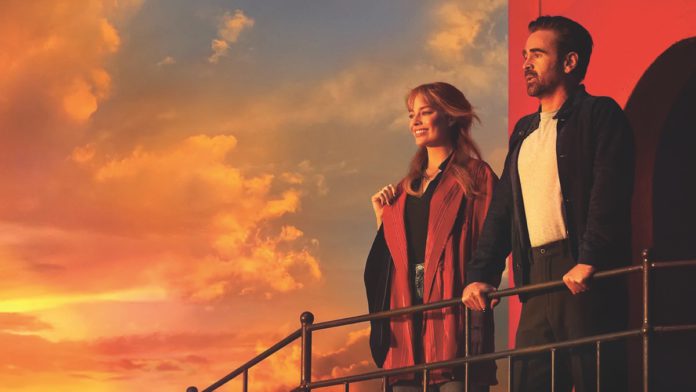
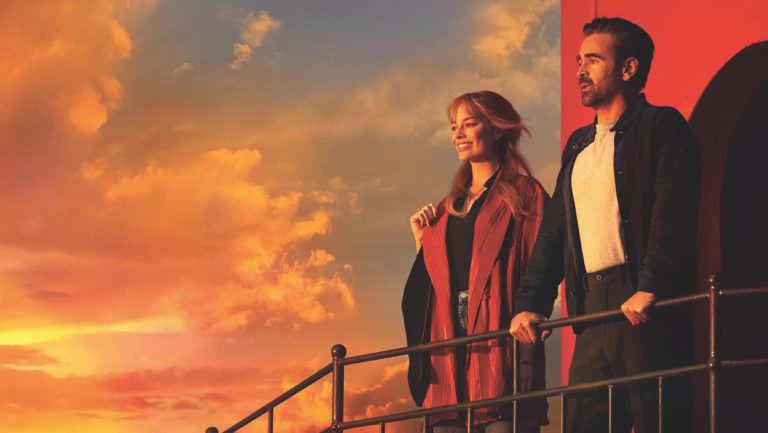
Oh, but it can. A Big Bold Beautiful Journey follows Margot Robbie and Colin Farrell as two mildly broken people, more bent than anything, who meet at a wedding and during a single road trip visit several literal doors to their past that help them understand their respective deep-seated traumas and show them the path to healing. Yes, that sounds like a cheesy set-up for a movie, but under the gentle and visionary guidance of Kogonada it still should have worked. But it doesn’t even come close.

Here’s what I mean about the limitations of film being seen primarily as a visual medium: Every single frame of A Big Bold Beautiful Journey is painterly and sumptuous. Kogonada and cinematographer Benjamin Loeb crafted a movie so beautiful to look at that it almost makes one forget the empty platitudes being foisted on the audience as apparent humanist truths. The script of this movie is so shallow, so empty of genuine human emotion and honesty, that it feels like the cinematic equivalent of a “Live, Laugh, Love” towel holder.

Still, it’s a visual buffet for the audience even while it cringe-watches the most blatant Burger King product placement one can imagine or while seeing Farrell and Robbie, who both do as well as they can with what they have to work with, look like they’re genuinely questioning their career choices. They are movie stars wandering around in what can only be generously considered a movie.

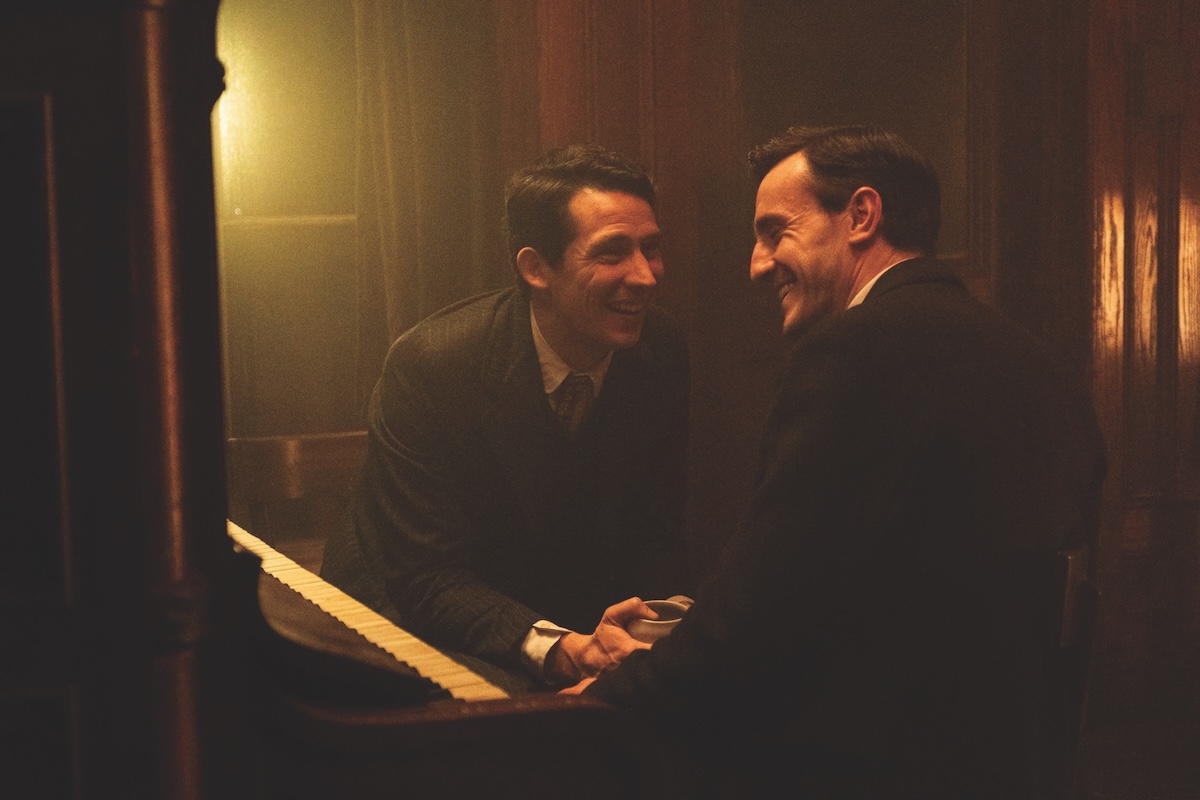
UNDERSTATED POWER ‘The History of Sound’ finds empathetic inroads to the characters’ inner lives rather than creating something visually transportive and without emotional resonance. (Photo courtesy of Mubi)

Then there is the other romance I watched, a quiet love letter to the eternal power of music and how it draws disparate aspects of humanity together, called The History of Sound. Two of the finest young actors working right now, Paul Mescal and Josh O’Connor, play two music students, one with an ear and one with a voice, who meet in a New England pub in 1917 and spend months of their lives walking across rural America and recording folk songs on wax cylinders while growing to hesitantly love one another. 

Instead of shepherds, the main characters are ethnomusicologists. Their love is forbidden in the early 20th century, and they were both raised to believe they should marry and start families. So even as they make tentative steps toward intimacy and love with each other, neither of them knows how to fully commit to their connection.

And here’s where I try to tie it all together: Director Oliver Hermanus crafts the film with a gentle and unassuming eye. The film is handsome to look at, but it’s still mostly understated in its framing and compositions. He builds The History of Sound to find empathetic inroads to the characters’ inner lives rather than creating something visually transportive and without emotional resonance.

Because O’Connor and Mescal are so in the pocket and dialed in to the inner turmoil of these men and because the script from Ben Shattuck is so compassionate, and even though we’ve seen movies like this before and even though this one subtly avoids some of the more manipulative aspects of visual language of cinema, I was destroyed by the end of the film anyway. And so, it seemed, was everyone else in the theater. There was “not a dry eye in the house” that day, and I say that without hyperbole.

With performance, dialogue, subtext and emotion, The History of Sound tells a story more powerfully than A Big Bold Beautiful Journey and its expertly crafted visual voyage. Sure, at the end of the day, it’s the images we remember most from movies, but those images mean nothing if we don’t care about the feelings they summon in us. I’m still in awe of Kogonada as a storyteller and am going to chalk up ABBBJ as a well-meaning misfire in a career that will span many more singular works of art. But I’ll remember The History of Sound, and how it made me feel, forever. I bet everyone who watches it will, too.

A Big Bold Beautiful Journey

Grade: D+

The History of Sound

Grade: A-

Understory reopens in Fruitvale

Driving past the San Francisco Panhandle last month, I saw a crowd of young adults gathering to celebrate three days of Grateful Dead concerts. The vibe of the tribe was unmistakable. Most of them were sitting in a circle. Others wandered back and forth between the group and a row of camper vans. Similarly attired in loose, flowing, earth-toned outfits, they looked like models enjoying the aftermath of a successful retro-themed runway show. From an idealized distance, they embodied that old catchphrase from the 1960s countercultural movement, “Turn on, tune in, drop out.” None of them looked stressed out or pressed for time.

Florencio Esquivel and Jenabi Pareja, two of Understory’s principals, don’t self-identify as hippies but their restaurant collective is a descendant of that particular cultural era in America. One that proposed an alternate reality in which the 99% could make a living without having to genuflect toward CEOs, their avaricious boards of directors and multinational corporations in general. In collectives and cooperatives—legally structured collectives—commerce serves the greater good of the group and, in Understory’s case, the community as well.

This “socialist” approach to doing business in America hasn’t flourished in the way that, since I was a child, I naively imagined it would. Group dynamics are tricky enough without government indifference or antagonism. The Cheeseboard in Berkeley, that East Bay stalwart, has been worker-owned since 1971. And, instead of quashing the notion of a competitor, the owner-workers there helped Arizmendi get off the ground. Since 2020, Understory has kept going even after moving out of its first location in Old Oakland without a new place to land.

Pareja said that closing the doors last year was sad. “But we wanted to prioritise the workers the most and our values and really brainstorm it out—how can we reopen at a new space?” he asked. Before moving into the Fruitvale location, they tried pop-ups in different places and a catering program. “That time was really difficult for us to close a successful restaurant, to put a pause on it, but good things come to those who wait,” he said. 

Esquivel added that they closed the restaurant at the end of June, one of the cafe’s highest grossing months. “We were in a tough spot having to decide [whether or not] to keep this profitable business going,” they said. But they made the decision to close down rather than compromise the collective’s values. “We might have to close down, but at least we will conserve what this project is about,” Esquivel said. “Staying together and really honoring what this work is.”

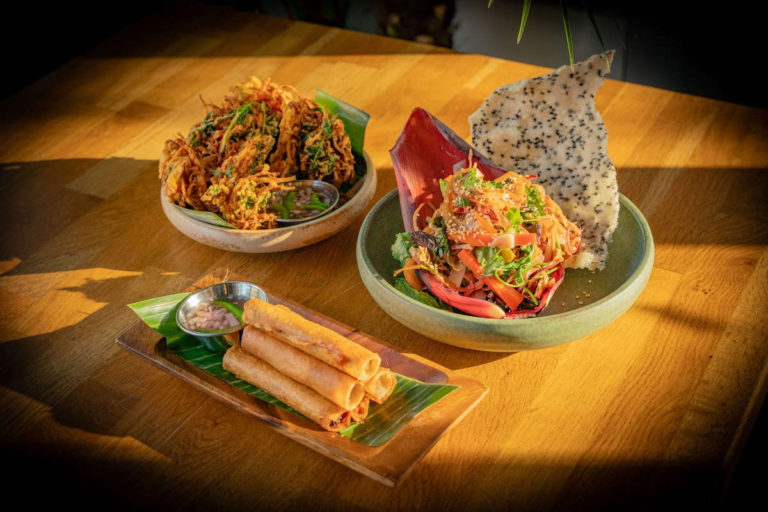
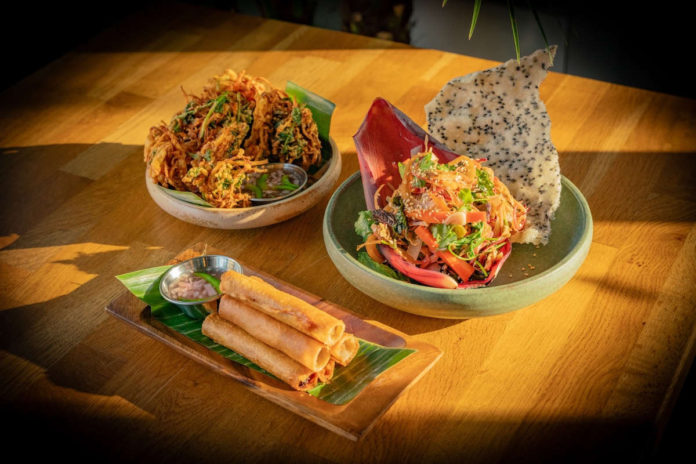
Understory started with four worker-owners. The team has since added 10 candidate members. “The menu reflects the folks that work here,” Pareja said. But they’re still making some of the house favorites—such as fried oyster mushrooms—from the first iteration.

“When we have tried to take them off the menu in the past, people would get upset or protest,” he said. The ube waffles, vegan and gluten-free, have also returned, as has the papaya burger. Esquivel explained that, whether it’s on top of a pork or bean patty, the papaya adds a nice crunch. “We caramelise green papaya so it’s really an unexpected flavor and texture.”

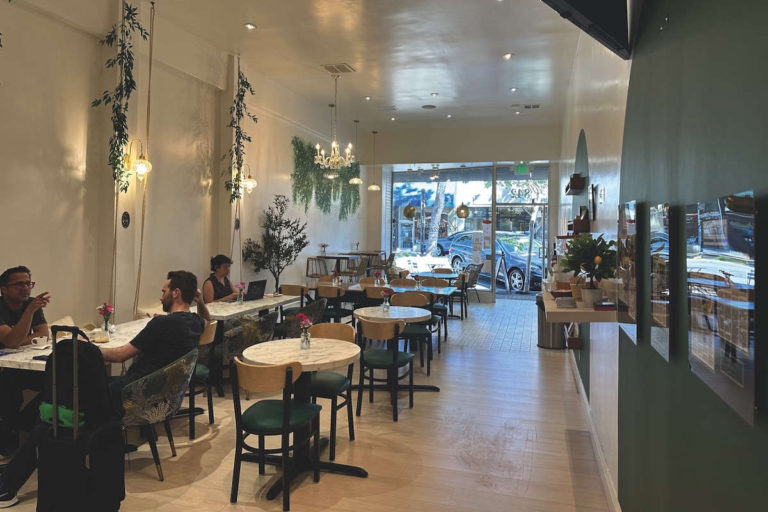
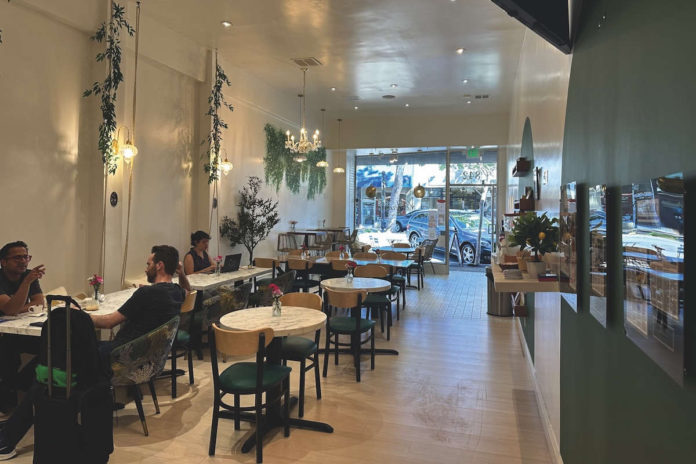
The new space on International Boulevard is more expansive than the previous one. Pareja said Understory can host community events, work gatherings and parties. A community art gallery is set up as a separate curtained room at the back of the dining room.

“I want to invite folks to let them know we’ve reopened,” Pareja said. “We’ve seen people stay here just to crochet or have a meeting.” He said that some ride-sharing companies have taken customers to the old location, but Yelp does have the updated address.

“This is an immigrant, working-class neighborhood,” Esquivel said. “Being here at this point in time, that resonates with our collective. Being in solidarity when we’re experiencing a lot of economic uncertainty and terror from immigration and ICE, it’s been really wonderful to be in this neighborhood.”

Understory, 3340 International Blvd., Oakland, Ohlone Territory. Cafe Tue-Fri, 9am to 2pm; dinner Wed-Fri, 5–9pm; brunch Sat-Sun, 11am to 3pm. understoryoakland.com. No one will be turned away for lack of funds.

Free Will Astrology: Week of Oct. 1

0

ARIES (March 21-April 19): In Zen Buddhism, satoris are sudden flashes of illumination that are fun and clarifying. I’m happy to tell you that you’re in a phase when these sweet breakthroughs are extra likely to visit you. They may barge in while you’re washing dishes, in the grocery store checkout line or during your fantasies before sleep. Be on high alert for intimations from the Great Mystery. P.S.: Some satoris could be gems you already half-knew.

TAURUS (April 20-May 20): You are eligible to be named “The Most Brilliant and Effective Complainer” for October. If you want to secure this prestigious award, spend time organizing plans for changing what’s amiss or awry. Decide which irritating off-kilter situations are most worthy of your thoughtful attention. Figure out how to express your critiques in ways that will engage the constructive help of others. And then implement a detailed strategy to compassionately achieve the intriguing transformations.

GEMINI (May 21-June 20): On certain medieval maps, an island paradise known as Hy-Brasil had a fuzzy presence west of Ireland. Did it truly exist? If so, it was said to be a blessed land that could restore lost youth and offer extravagant happiness. The place was thought to be rarely visible, and only under certain magical or auspicious conditions. I suspect you Geminis are within range of an experience like this. It won’t appear in a specific location but as a state of mind that settles over you. Don’t chase it. Allow it to find you.

CANCER (June 21-July 22): A stalactite is a stony formation that hangs like an icicle from the ceiling of a cave. It forms over long periods as mineral-rich water drips down and incrementally deposits hard calcium carbonate through precipitation. This marvel is an example of earth’s creativity at its most leisurely. A four-inch-long stalactite might take a thousand years to make. With that as your seed thought, Cancerian, I invite you to attune yourself to the slowest, deepest, most ancient parts of your soul. Important developments are unfolding there. A wound that’s ripening into wisdom? A mysterious yearning that’s finally speaking in your native tongue? Be patient and vigilant with it. Don’t demand clarity all at once. Your transformation is tectonic, not flashy. Your assignment is to listen and be receptive.

LEO (July 23-Aug. 22): When bilingual speakers engage in the behavior known as “code-switching,” they may begin a sentence in one language and finish it in another. Or they may move back and forth between two different languages as they deliver a discourse. Why do they do it? To enrich their meaning, to dazzle their audience, to play and experiment. In a larger sense, we could say that code-switching happens anytime we swivel between different styles of presenting ourselves: from formal to casual, serious to humorous, cheerful to skeptical. I bring this up, Leo, because you are in the heart of the code-switching season. Have fun!

VIRGO (Aug. 23-Sept. 22): In the Arctic, polar bears move through the world not by sight alone, but through scent trails that stretch miles across the ice. Their sense of direction is olfactory, intuitive and primal. If I’m reading the omens correctly, Virgo, your navigation system will also be more animal than logical in the coming weeks. I advise you to trust subtle cues—like goosebumps, a sweet or sour taste in your mouth, or an uncanny pull toward or away from things. Your rational mind might not be fully helpful, but your body will know the way. Sniff the trail. Access your instincts.

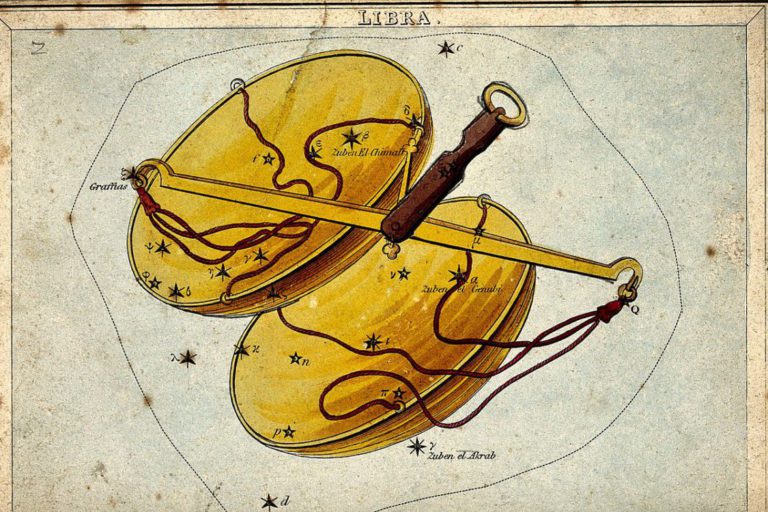
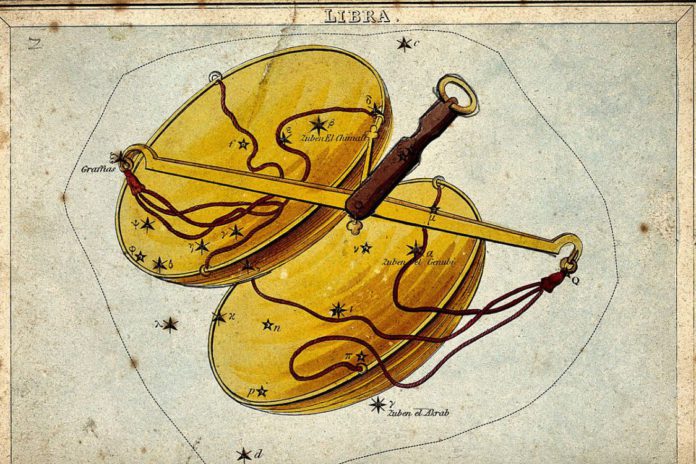
LIBRA (Sept. 23-Oct. 22): In ancient Egyptian myth, the goddess Maat ruled truth, divine law, harmony and moral order. After death, each person’s heart was weighed against Maat’s feather of truth on a scale in the Hall of Judgment. If the heart, which embodied the essence of a person’s actions in life, was equal in weight to the feather, the deceased was assessed as virtuous and cleared to continue to the glorious afterlife. If it was heavier … well, I’ll spare you the details. Maat’s scales were not symbols of punishment, but of fairness and justice. That’s also your special power right now, Libra. You have subtle insight into every choice. You understand that your wisdom is best used to bless, not censure. My hope is that you will foster gentle clarity and offer forgiveness to all, including yourself. Lay down the old guilt! Let grace be the law!

SCORPIO (Oct. 23-Nov. 21): The I Ching is an ancient divinatory book compiled in China over 2,500 years ago. Amazingly, it’s still quite useful. In accordance with astrological omens, I call your attention to one of its oracles: “Work on What Has Been Spoiled.” It tenderly counsels us to be brave as we repair what’s broken. But it’s crucial that we make the correction with patient grace, not blame and anger. The good news, Scorpio, is that you now have an uncanny ability to discern what’s out of tune, what’s crooked, what has been wrongfully abandoned. I hope you will offer your genius for re-weaving. A frayed friendship? A neglected dream? A forgotten promise? You can play the role of restorer: not to make things as they were, but to render them better than they’ve ever been.

SAGITTARIUS (Nov. 22-Dec. 21): In ancient Egypt, the lion-headed goddess Sekhmet wielded both intense heat and nourishing warmth. She had the power to destroy and heal. When outbreaks of chaos threatened, she incinerated them. Once order and balance returned, she served as a physician. I dare you to summon your inner Sekhmet, Sagittarius. Give your bold attention to an obstacle that needs to be crushed or an injustice that needs to be erased. If necessary, invoke sacred rage on behalf of sacred order. But remember that the goal is not merely combustion. It’s transmutation. Once the fire has cleared the way, unleash your gorgeous cure.

CAPRICORN (Dec. 22-Jan. 19): In Nepal, there’s a tradition among Sherpa mountaineers. Before ascending Mt. Everest, they perform a ceremony led by a Buddhist monk or Lama. It’s a way to honor the sacredness of the mountain, ask for grace during their climb, and return from the journey in good health. As you eye the peak ahead of you, Capricorn, consider making similar preparation. Ritualize your intention. Direct it with clarity and care. Bless your journey before you surge forward.

AQUARIUS (Jan. 20-Feb. 18): When people call something “glamorous,” they usually mean it has an elegant, captivating style. Its beauty is sophisticated and luxurious. But the original meaning of “glamour” was different. It referred to a deceptive magical enchantment designed to disguise the truth, whipped up by a conjurer or supernatural being. That’s the sense I want to invoke now, Aquarius. You have been seeing through the glamour lately—of the media, of consensus reality, of false stories. Now it’s time to go even further: to actively tear down illusions and dismantle pretense, preferably with tact. When you see through the spell, don’t just call it out—transmute it into clarity.

PISCES (Feb. 19-March 20): Pisces-born Nina Simone (1933–2003) started playing piano when she was three years old. At age 12, her debut concert was a classical recital. She developed a yearning to become the first Black female classical concert pianist. But her dream collapsed when the prestigious Curtis Institute of Music refused to let her study there. Then came the plot twist. She redirected her disappointment ingeniously, launching a brilliant career as a singer, composer and pianist that won her global fame. The rebuff from the Curtis Institute was ultimately a stroke of good luck! It became a catalyst for her greatness. In accordance with astrological omens, I invite you to designate a frustration that you will use to fuel future success.

Homework: Make sweet amends to yourself for an error you made. Newsletter.FreeWillAstrology.com

Arab bakeries revive community and cuisine

An Instagram reel from Levant Dessert’s Sunnyvale location pans across a buzzing Eid celebration: tables packed with customers, plates of various sweets, and live musicians filling the room with Arabic melodies as guests clap and sing along. The scene feels more like a festive community gathering than a storefront bakery—a place where food, music and culture intertwine. As Levant Dessert cements its role as a hub for Bay Area Arab diaspora in the South Bay, another beloved institution called Reem’s prepares for a return to Oakland, hinting at a wider regional resurgence of Arab-owned food spaces.

Arab bakeries are emerging as cultural touchstones across the Bay Area, serving not just desserts but a sense of belonging. Levant Dessert—a Sunnyvale shop founded in 2017 that has expanded to Menlo Park—reflects this shift through its blend of hospitality, heritage and community-building. Its growing presence in the South Bay comes amid the highly anticipated return of Reem’s in Oakland, suggesting a broader revival of Arab-owned food spaces and their role in shaping the region’s culinary and social landscape.

Arab and Middle Eastern North African communities have long been part of Northern California’s diverse fabric, with waves of immigration dating back decades. Recently, there’s been a notable surge in popularity of Arab culinary ventures across the Bay Area, fueled by a growing second-generation population eager to reconnect with its heritage and by wider local interest in authentic, regional flavors. This has led to increased demand for traditional Arab desserts and breads, from flaky baklava to za’atar-spiced flatbreads.

Founded in 2017 by Maya Fezzani, who is half Lebanese and half Syrian, Levant Dessert began spontaneously. Friends praised her traditional family-style sweets, but she assumed Bay Area Arabs already had access to such recipes in their own kitchens. It wasn’t until she started making smaller, café-friendly portions for catering events that she realized the wider market potential. Demand “took off very quickly,” she recalls, prompting her move from a home operation to a storefront.

Today, most of Levant Dessert’s customers are non-Arabs drawn to the unfamiliar flavor profiles—orange blossom, rose water, salep—and modern presentation of classic treats. Bite-size knafeh became an early bestseller, while items like pistachio-rose cake and booza Middle Eastern ice cream now routinely sell out. Fezzani says she never set out to serve only her own community. 

“Back home, everyone makes these desserts—I wanted to introduce them to people who don’t,” Fezzani says.

Beyond its sweets, Levant Dessert has evolved into a cultural gathering point in the South Bay. Fezzani sees the cafe as a space for celebration and connection—from Eid catering orders to afternoon meet-ups over coffee and baklava. She emphasizes that Levantine pastries are rooted in ingredients rarely used in Western baking, like shredded phyllo for knafeh, orange blossom syrup and mastic, which gives the desserts a distinct identity while also sparking curiosity among new diners. 

Balancing tradition with innovation has helped the shop thrive: recipes are inherited from grandmothers, but presentation and size are adapted for American cafe culture. Fezzani says the most rewarding part of the business is watching people gather around her desserts. 

“I get to see people loving what I grew up with,” she says.

When Reem’s first opened its Arab street bakery in Oakland’s Fruitvale neighborhood in 2017, it quickly became both a culinary destination and a symbol, celebrated for its mana’eesh flatbreads, political murals and community-focused mission. The pandemic forced the beloved space to close, leaving a void for loyal East Bay regulars who saw the bakery as more than a place to eat. Now, after several years away, local news outlets report Reem’s is preparing a long-awaited return to Oakland. For many longtime customers, its comeback represents more than nostalgia; it signals a re-investment in Arab visibility and hospitality in the Bay Area, and underscores how much the region’s food landscape has changed during its absence.

In a post-9/11, post-Trump 1.0 America, and against the backdrop of ongoing conflict in the Middle East, Arab-owned bakeries have taken on an outsized symbolic power. These spaces offer not just knafeh and baklava, but pride, cultural safety and public presence. 

At Levant Dessert, owner Maya Fezzani says customers are often curious first—then delighted—by ingredients they’ve never tasted before.

“People enjoy discovering something different,” she notes, adding that introducing new flavors is part of her mission. Reem’s, meanwhile, has long embraced a politicized identity, fusing Palestinian food with calls for liberation and justice. Together, the two represent a quiet yet powerful form of resistance, insisting that Arab culture belongs boldly on Bay Area streets.

Running an Arab bakery in the Bay Area comes with unique pressures. Commercial rents are sky-high, ingredients such as pistachios, salep and orange blossom water are expensive to import, and many customers still need to be educated about what, exactly, they’re eating. Staffing, especially with people familiar with the nuances of Middle Eastern desserts, has been another hurdle. Yet Fezzani remains ambitious.

“We’re still young, but growing,” she says, adding that expansion could someday include locations in the East Bay, San Francisco or Los Gatos. For now, she’s focused on extending her menu, reaching new audiences and making Levant Dessert a staple in an increasingly globalized local food scene.

Social Eyes: Week of Sept. 25-Oct. 1

THURSDAY, SEPT. 25

INDIE

BIG THIEF

The indie-folk trio makes a splashdown with a new album, Double Infinity. As daylight disappears in the outdoor venue, Big Thief’s catalog of warm, metaphysical, spirit-stimulating songs shines. Vocalist-guitarist Adrianne Lenker is luminous, guitarist Buck Meek rolls out a rich melodic tapestry and drummer James Krivchenia rides his role like a humble hero—ever-present and strong, but never egocentric. Is there a better way to spend an evening than with people, not to mention award-winning artists with five heralded studio albums, who work in harmony and speak words of healing, acceptance, accessibility and hope without skirting the horrors of our human reality? Nope. Joined by L.A. singer/songwriter Steven van Betten. LOU FANCHER

INFO: Thu, 7pm, Greek Theatre, 2001 Gayley Rd., Berkeley. $80. 510.871.9225.

FRIDAY, SEPT. 26

INDIE

CLEM SNIDE

Clem Snide, the shapeshifting vessel for songwriter Eef Barzelay, has lived many lives since emerging from Boston as a three-piece in the early ’90s. In the 2010s, Barzelay weathered bankruptcy, the loss of his home and the near-collapse of the band itself. What followed was an unlikely rebirth: the 2020 album Forever Just Beyond, a record that wrestles with faith and despair in spare, spacious arrangements. Last year’s Oh Smokey deepens the palette into something slower and more intimate. Named after a satirical William S. Burroughs character, Clem Snide has always blurred humor and heartbreak, but the latest chapter feels especially hard-won. SONYA BENNETT-BRANDT 

INFO:  Fri, 7:30pm, Ivy Room, 860 San Pablo Ave., Albany. $25. 510.526.5888.

FRIDAY, SEPT. 26

INSTRUMENTAL

ANGOISSE MAGAZINE

Angoisse Magazine makes instrumental music that feels like it slips in and out of the wrong century. Formed in a Belleville apartment through free-form recording sessions, the Paris-based trio—Aurelien Fradagrada, Marius Atherton and Danny Kendrick—splice crooked grooves, fractured samples and offbeat rhythms into songs that hover between rock and ambient. Their performances move like collages, with textures that peel back to reveal strange images underneath: chase scenes, daydreams, broken transmissions. It’s music that suggests cinema without ever having to land on a single story. – SBB 

INFO: Fri, 8pm, Thee Stork Club, 2330 Telegraph Ave., Oakland. $12-$15. 510.859.8709.

FRIDAY, SEPT. 26

BLUES

CORKY SIEGEL & ERNIE WATTS

Harmonica ace, pianist and songwriter Corky Siegel came up on Chicago’s blues scene in the mid-1960s, part of a wave of white teenagers besotted with the visceral sound of Southside Black blues masters. In recent years, Siegel has performed widely with his Chamber Blues group featuring a string quartet, but when he wants to cut loose, he rejoins forces with tenor saxophone great Ernie Watts. Possessing one of the most immediately recognizable sounds in jazz, Watts is a studio maestro who’s played on hundreds of albums and film scores. On this two-night engagement with Siegel, the 79-year-old Watts draws on his R&B roots while leaning into the lush lyricism that makes his lines so potently memorable. ANDREW GILBERT

INFO: Fri, 8pm, Back Room, 1984 Bonita Ave., Berkeley. $40. 510.654.3808.

SATURDAY, SEPT. 27

ELECTRONIC

DISCLOSURE

Nine-time Grammy-nominated, and barely in their 30s. That would all be beyond some people’s wildest dreams, but for Disclosure, it’s just another day. Formed by brothers Howard and Guy Lawrence, Disclosure started releasing music in 2010, but it took three years for them to drop their debut album, Settle. That album brought them huge commercial success and gave them the opportunity to play career-changing festivals like Coachella, Lollapalooza and Sasquatch! In 2023, they released their latest, Alchemy, which Pitchfork called “fresher and more fun than the brothers have sounded in ages.” MAT WEIR

INFO: Sat, 7pm, Greek Theatre, 2001 Gayley Rd., Berkeley. $149. 510.871.9225.

SATURDAY, SEPT. 27

POST-HARDCORE

MILITARIE GUN

Militarie Gun started as a solo project for singer Ian Shelton in 2020. As soon as the lockdowns were lifted, he got a band together and started playing the tracks live. From house shows to warehouses, small venues to medium-sized, Militarie Gun has built their reputation and audience on their own terms and no one else’s. Although they have four EPs under their belt, they only have one album—Life Under the Gun. But they are ready to release their second album on Oct. 17. Those lucky enough to attend this show, which was moved from the New Parish to Brick & Mortar, will get to hear the tracks before anyone else. – MW

INFO: Sat, 10:30pm, Brick & Mortar Music Hall, 1710 Mission St., San Francisco. $29. 415.817.1479. 

SUNDAY, SEPT. 28

CLASSICAL

DANIIL TRIFONOV

As Daniil Trifonov’s long, agile fingers fly over the keyboard, they seem to persuade the notes to come into being, to emanate from the piano before he has finished touching the keys. Russian-born Trifonov, now an ancient 34, was a piano prodigy, performing his first solo concert at age 7. He’s gone on to become a Grammy-winning artist and is considered one of the finest concert pianists in the world—if not the finest. His Zellerbach Hall recital will feature Schumann’s “Piano Sonata No.1 in F-sharp minor,” as well as works by Prokofiev, Myaskovsky and Taneyev. Prepare to be mesmerized. JANIS HASHE

INFO: Sun, 3pm, Cal Performances at Zellerbach Hall, 101 Zellerbach Hall #4800, Berkeley. $48-$135. 510.642.9988.

MONDAY, SEPT. 29

POP

LAUFEY

Currently touring in support of her third album, A Matter of Time, Laufey stands in sharp contrast to the many young female singers whose voices sound like children’s. Laufey can embrace poignant themes, as in the August-issued single and video, “Snow White.” The Icelandic/Chinese singer looks in a mirror as she lifts the corner of one eye, sadly mocking the enduring white-and-blonde female beauty ideal. Yet her idols, alongside Ella Fitzgerald and Chet Baker, also include Taylor Swift, whom she salutes for the ability to bring the world together. Hear the jazzy, handclap side of Laufey in “Lover Girl.” She’s no flash in the pan. – JH

INFO: Mon, 7:30pm, Oakland Arena, 7000 S. Coliseum Way, Oakland. $84-477. 510.569.2121.

TUESDAY, SEPT. 30

DESERT-BLUES

TARWA N-TINIRI

Following in the sandy footsteps of Tinariwen, the Moroccan desert rockers Tarwa N-Tiniri hail from the southeastern city of Ouarzazate, gateway to the Sahara. Since coming together in 2012, the five friends and self-taught musicians have sought to celebrate hard-pressed Amazigh (Berber) culture. Their galloping music evokes the vast, sunblasted landscape that has sustained the traditionally nomadic people for countless centuries. While steeped in traditional Amazigh and North African scales and melodies, they draw on a potent palette of blues, jazz, reggae, rock and the West African-derived Gnaoua grooves brought by the intra-African slave trade. Themes of love, friendship, cultural pride and the desire for peace pervade Tarwa N-Tiniri’s incantatory songs. – AG

INFO: Tue, 8pm, The Freight, 2020 Addison St., Berkeley. $34-$39. 510.644.2020.

WEDNESDAY, OCT. 1

FILM

16th ANNUAL FIST UP FILM FESTIVAL

Honoring ancestors and celebrating voices and vision coming from the next generation is the focus of the five-day event. From the Oakland A’s to Filipino history to Harry Belafonte’s last 12 years of life; from the exploitive use of rap in the criminal justice system to funk music’s role in culture writ large, feature-length and short films provide stimulating cinema. Even better, these films are ideal for watching in a community, where conversations before and after offer chances to connect, confront, confide and come to understand and appreciate each other’s perspectives. Admission is free with suggested donations, meaning no one needs to be left out. Goes until Oct. 5. – LF

INFO: Wed, 7pm, La Peña, 3105 Shattuck Ave., Berkeley. $0-25. 510.849.2568.

Chaos Fiction finds steadiness in sound

0

Guitarist/singer Linda Moody and bass player/vocalist Tori Fulkerson-Jones have played together in bands for almost a decade. They perform in Fleetwood Macramé doing covers of Fleetwood Mac tunes; in Proud Mary: A Creedence Queerwater Revival, presenting CCR’s hits; and Excuses for Skipping, a queer, post-punk band that released their final album last year.

When the Covid pandemic began, they had to stop performing. “Our drummer in Macramé has a house in Sonoma,” Moody said. During the lockdown, they formed a pod with their families, moved north and found themselves in a welcoming sanctuary.

“Since we couldn’t perform, we had time to write and jam together,” Moody said. “The idea was to improvise, have fun and make chaos. While other band members were enjoying the countryside, Tori and I played all the time. Sometimes I’d pop onto the drums and we’d jam. After some time, we came up with a few songs and a band name—Chaos Fiction.”

As the pandemic eased, the duo enlisted Steve Landey to play drums. They call their sound “noise pop,” since it weaves together rhythmic complexity, poetic lyrics and multilayered instrumental parts. Fulkerson-Jones, whose bass-playing heroes include Kim Deal (Pixies, the Breeders) and Tina Weymouth (Talking Heads), added abstract sounds to the foundation, while Moody crafts lyrics that emerge from the music itself.

“As a three-piece, we can all explore our creative impulses,” Fulkerson-Jones said. “The arrangements have a lot of open space so there’s room for each of us to be expressive.” 

Moody agreed: “In bands with more members, it’s about making space so everyone can have a voice in the music. In a three-piece, it’s: ‘How do I fill up more space?’”

As they played live shows, the arrangements evolved into the sounds on Steady Nerves, their self-produced debut album.

“The title points to that feeling of finding steadiness within yourself as you set out on something new, different, hard or exciting,” Fulkerson-Jones said. It’s a fitting description of their songwriting and their performances as a band.

They recorded, mixed and produced the album themselves. They began by laying down basic tracks in their rehearsal space at Secret Studios in San Francisco. They re-recorded Landey’s drums at Sharkbite Studios in Oakland, then mixed it all at Fulkerson-Jones’ home studio.

“Tear Gas Hockey” uses a touch of ironic humor to describe the uncertainty people felt during the early days of the pandemic and the George Floyd demonstrations. Fulkerson-Jones lays down a rolling bass line, driven by Landey’s crackling backbeat. Moody’s shimmering lead guitar leads up to the hopeful message of the chorus: “Revolution’s on!”

The hesitation one feels at the beginning of a relationship is explored in “Duckweed Daydream.” Moody’s guitar fills and a jittery backbeat highlight a spoken telephone conversation as the singer asks: “Maybe we could get together?” The “sha la la’s” of the chorus give the tune a bright, pop feel.

A slow, soothing rhythm lays the foundation for “Space Cowboy,” a meditation on the end of earthly life, or perhaps the opening of the mind to a universe of limitless possibility. Images drawn from mythology, Moody’s atmospheric guitar lines and the slow pulse of the rhythm section support her soft crooning.

The album came out digitally, on the usual platforms, in April. They’ll celebrate the release of the album on vinyl with their upcoming show at the Ivy Room. “We made an LP because we wanted to have something physical,” Moody said. “A lot of music lovers like listening to their favorite bands on vinyl.

“Music at its best is a place you can go to find solace, feel connected with others, escape reality and expand your imagination. I’m excited to explore more punk rock and dancy vibes, but with an attitude! These are dark times, and people are angry. In fact, we are enraged. This will definitely affect what we write, going forward,” Moody continued.

“It’s an amazing gift to get to know someone so well through music,” Fulkerson-Jones said. “I’m stoked to keep learning and exploring with Linda. In our writing, I honor the power we all have to shift the systems and narratives that lie to us and keep us separate.”

Chaos Fiction will play Thursday, Oct. 9, at the Ivy Room, 860 San Pablo Ave., Albany. 510.470.2162. ivyroom.com. Listen to the band’s music at: chaosfiction.bandcamp.com/album/steady-nerves.

Performers relay magic of the spoken poem

Born in Persia in 1207 C.E., Jalal al-Din Muhammad Rumi was a Sufi mystic and poet who is known in the West simply as “Rumi.” He is currently the bestselling poet in the U.S., famous for his work’s beauty, wisdom and compassion.

One of his most famous quotes is: “Be like the sun for grace and mercy. Be like the night to cover others’ faults. Be like running water for generosity. Be like death for rage and anger. Be like the Earth for modesty. Appear as you are. Be as you appear.”

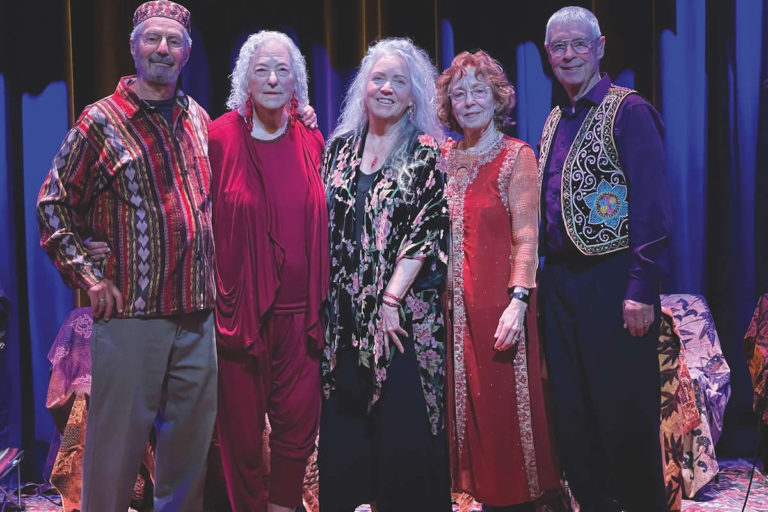
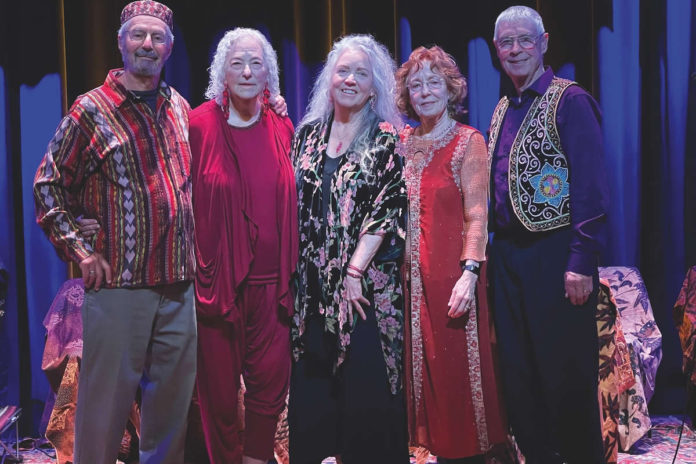
Some 30 years ago in Sebastopol, people who loved Rumi began assembling a group to celebrate the spoken-word tradition of poetry. “We were also inspired by [American poet] Robert Bly,” said Barry Spector, producer/performer of the group that evolved into Rumi’s Caravan, which returns to Freight & Salvage on Sept. 28.

Spector, and fellow performer and wife Maya, explained that the intentions were to support local community benefit organizations, to build community and, most importantly, “to help restore the oral tradition of poetry, to inspire audiences with a new imagination of the possible.”

Poems are not read aloud, but learned by heart and spoken. “The poem works us,” said Barry Spector. “[The audience] hears it much more fully.” Each of the five or six performers has a number of memorized poems, and as one performer finishes speaking, another is inspired to follow with another poem related by subject or rhythm or tone. Once, remembered Barry Spector, someone told a poem about a bird, and it was followed by 14 or 15 other poems about birds.

There are no rehearsals. In the tradition of ecstatic poetry, “The poems emerge constantly in the flow,” said Maya Spector. “It’s a magic that happens one time.” Works by modern poets, as well as those by classic writers, are included. Poets that have found their way into Rumi’s Caravan events include Hafiz, Mary Oliver, Kabir, Wendell Berry, Neruda, Rilke, Robert Bly, Yeats, Naomi Shehab Nye, William Stafford, Maya Angelou, Leonard Cohen, Seamus Heaney, Denise Levertov, Antonio Machado, May Sarton and others.

Two musicians, Jason Parmar and Arshad Seyed, accompany the performers, one on percussion and the other using a guitar/sitar hybrid instrument. “They are very talented, and extremely sensitive to what is going on with the language,” Maya Spector said. “What we do is something like jazz improvisation,” added Barry Spector.  

Listening to a poem spoken, when it has been learned by heart, is an entirely different experience than hearing it read aloud, they both emphasized. “It will take you to unexpected places,” Barry Spector said.

He recalled the story of one audience member who, after attending Rumi’s Caravan performances for years, became motivated to write her own poem—“Upon Hearing A Poem Recited, Not Read”—about the inspiration of hearing poetry spoken aloud.

“We hope to inspire everyone to memorize poems,” he said. “The oral tradition can contribute to restoring the soul of the world.”

All Rumi’s Caravan performances are fundraisers for nonprofit organizations, which over the years have included the Center for Climate Protection, the Siskiyou County Public Library, the Gualala Arts Council, the Ceres Community Project and Youth Speaks. The Freight event will benefit the Berkeley-based Middle East Children’s Alliance (MECA).

Among other support, MECA provides direct aid, including food, medicine, medical supplies and clothes as well as books, toys and school supplies. Since 1988, it has sent more than $42 million in aid to children in Palestine, Iraq and Lebanon, according to its website.

“MECA has been on the ground in Palestine for 30 years,” Barry Spector said. “They have lost many workers [especially in the recent violence]. We can feel so helpless … but this will raise some money and contribute to the sense of community.”

As Rumi wrote: “Listen with the ears of tolerance! See through the eyes of compassion! Speak with the language of love!”

Rumi’s Caravan, 7:30pm, Sept. 28, $30-35. Freight & Salvage, 2020 Addison St., Berkeley. 510.644.2020. thefreight.org

‘The Reservoir’ offers hope and healing

Seekers of hope for humanity and healing without overthinking are well-served by playwright Jake Brasch’s The Reservoir. Presented by Berkeley Rep in the Peet’s Theatre through Oct. 12, director Mike Donahue combines forces with a spectacular seven-member cast.

Of course, for every actor to provide connection and relatability for audiences, a play must tell a story that’s both universal and personal; timeless and yet of its time. For dramatic depth, it must present believable characters who at some moment find themselves flung by life against a brick wall. Allowed to be shown splattered, broken and bleeding, raw truth is the rubric. In some plays, a beacon of hope emerges from the murk, a shiny force that picks up the wounded and begins to heal their pain, often with humor and attention to life’s tiniest and grandest joys, be they in relationships, nature, tradition, culture or community.

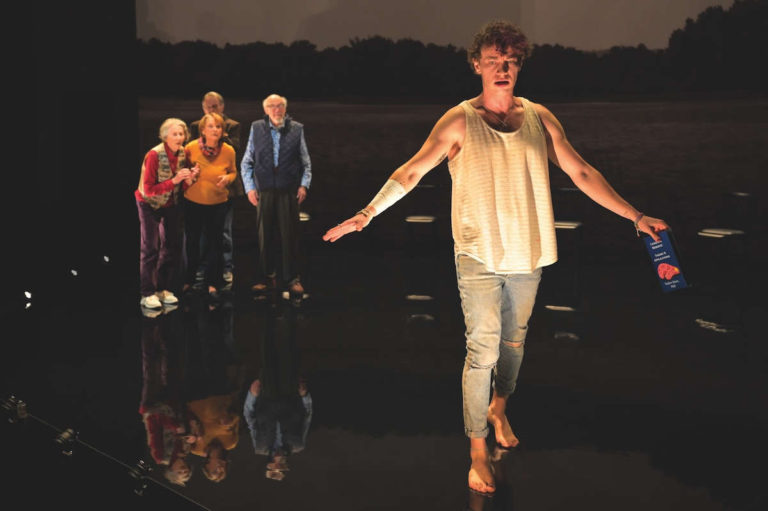
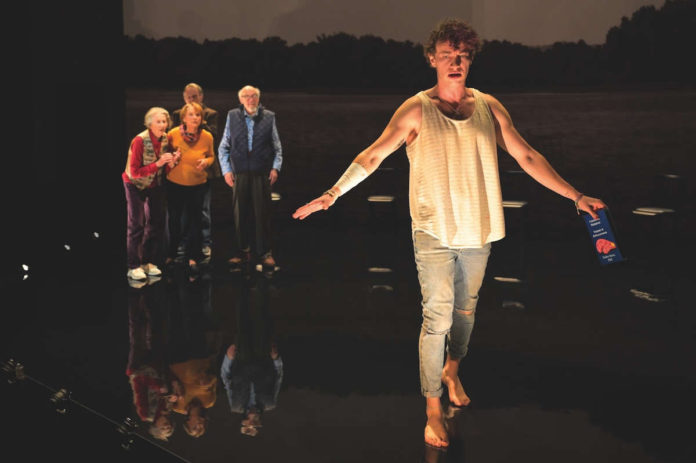
For the most part, The Reservoir hits these touchpoints with the story of NYU dropout Josh, played by a likable Ben Hirschhorn as a desperately addicted, misguided young alcoholic. Raised by a single mother—his Jewish father is largely absent—Josh has been kicked out of a rehab house and finds himself back home in Colorado. Waking from a blackout on the shore of a tree-lined lake, he has no memory of how he acquired a serious laceration on his forearm, and no idea of what to do next other than to find and consume another bottle of booze.

Self-centeredly pushing his mother’s guilt buttons and exploiting her I-want-to-believe-my-son’s lies about sobriety, Josh gains temporary harbor in his childhood home. He decides the way to overcome addiction is by “fixing” not only himself, but his grandparents. Working part-time in a bookstore where he’s so brain-addled he files books by smell, not the alphabet, Josh co-opts his grandparents’ lives.

They present the perfect temptation to an avoidant recovery type like Josh with their Alzheimer’s, dementia, age-related health conditions, fractured family relationships and more. Soon, he’s subjecting himself and them to nefarious, semi-scientific remedies. The gamut includes binging on spinach, Jazzercise classes, brain games reliant on remembering miscellaneous facts and numbers, memorizing text from the Torah and so on.

As Josh’s mom, Patricia—and several additional roles—Brenda Withers is convincing and marvelously differentiated. Pamela Reed provides the play’s greatest performance highlights as grandma Bev, a former electrical engineer unafraid to speak the truth who shines intense light on Josh’s lies with a habit of downing bottles of Wild Turkey or vanilla extract as if they were water drunk by someone dehydrated.

Barbara Kinglsey displays a delicate, adroitly measured pastel counterpart to grandma Bev as Nana. She is submerged in the end stages of Alzheimer’s and “wakes up” sporadically, but poignantly. Her husband, Hank, has actor Michael Cullen simmering under a caregiver’s surface of pain, depression, avoidance and fear, arguably the darkest character.

Lightening the load is Peer Van Wagner’s spirited Shrimpy, Josh’s 83-year-old grandpa, who struggles to prepare for his bar mitzvah 2.0. A late addition to the cast, Jeffrey Omura dexterously juggles the role of bookstore manager Hugo, among other characters.

While some of the finest acting—especially by Reed and Van Wagner—rises to the surface, a bit of magic is lost, despite Afsoon Pajoufar’s visually dynamic mirrored floor and projected backdrop continuing to transfix the eyes and stimulate the imagination. Erika Chong Such’s delightful, witty choreography is also reduced to ripples instead of joyous waves and Josh’s queer identity is used increasingly like a feint.

Even so, Brasch is a young playwright and The Reservoir is a strong indication of a singular voice in contemporary theater and greater works to come. The cast’s handling of humor and heartbreak along with the fine design make it a live production not to miss.

‘The Reservoir,’ through Oct. 12 at Peet’s Theatre, 2025 Addison St., Berkeley.  510.647.2949. berkeleyrep.org

I’m With Her comes to Hardly Strictly Bluegrass

I'm With Her comes to Hardly Strictly Bluegrass
Intergenerational connectivity. It’s a key component for what drives I’m With Her, the three-person outfit made up of Sara Watkins (Nickel Creek), Aoife O’Donovan (Crooked Still) and Texas singer/writer Sarah Jarosz. The trio is currently on the road promoting their sophomore bow, Wild and Clear and Blue, the follow-up to their 2018 Ethan Johns-produced debut, See You Around. While Watkins...

CoCoCo sheriff stiff-arms protests

CoCoCo sheriff stiff-arms protests
Contra Costa County Sheriff David Livingston’s cooperation with ICE, and controversy about that cooperation, is not new. In October 2018, The Washington Post published an article which led with: “Activists in Alexandria, Va., are pressing the sheriff to drop an agreement to detain migrants for ICE. The sheriff in Contra Costa County, Calif., canceled a similar contract in July,...

Two romances offer contrasting visual voyages

Two romances offer contrasting visual voyages
Movies are a visual medium. That little cliche nugget of wisdom about cinema that people like to bandy around has been stuck in my head since I watched two romances back to back this week. Obviously it’s a true statement, because the illusion of a motion picture doesn’t even work unless one looks at it. Still, I’m not sure the...

Understory reopens in Fruitvale

Understory reopens in Fruitvale
Driving past the San Francisco Panhandle last month, I saw a crowd of young adults gathering to celebrate three days of Grateful Dead concerts. The vibe of the tribe was unmistakable. Most of them were sitting in a circle. Others wandered back and forth between the group and a row of camper vans. Similarly attired in loose, flowing, earth-toned...

Free Will Astrology: Week of Oct. 1

Free Will Astrology: Week of Oct. 15
What designated frustration will you use to fuel future success?

Arab bakeries revive community and cuisine

Arab bakeries revive community and cuisine
An Instagram reel from Levant Dessert’s Sunnyvale location pans across a buzzing Eid celebration: tables packed with customers, plates of various sweets, and live musicians filling the room with Arabic melodies as guests clap and sing along. The scene feels more like a festive community gathering than a storefront bakery—a place where food, music and culture intertwine. As Levant...

Social Eyes: Week of Sept. 25-Oct. 1

Social Eyes: Week of Sept. 25-Oct. 1
THURSDAY, SEPT. 25 INDIE BIG THIEF The indie-folk trio makes a splashdown with a new album, Double Infinity. As daylight disappears in the outdoor venue, Big Thief’s catalog of warm, metaphysical, spirit-stimulating songs shines. Vocalist-guitarist Adrianne Lenker is luminous, guitarist Buck Meek rolls out a rich melodic tapestry and drummer James Krivchenia rides his role like a humble hero—ever-present and strong, but...

Chaos Fiction finds steadiness in sound

Chaos Fiction finds steadiness in sound
Guitarist/singer Linda Moody and bass player/vocalist Tori Fulkerson-Jones have played together in bands for almost a decade. They perform in Fleetwood Macramé doing covers of Fleetwood Mac tunes; in Proud Mary: A Creedence Queerwater Revival, presenting CCR’s hits; and Excuses for Skipping, a queer, post-punk band that released their final album last year. When the Covid pandemic began, they had...

Performers relay magic of the spoken poem

Performers relay magic of the spoken poem
Born in Persia in 1207 C.E., Jalal al-Din Muhammad Rumi was a Sufi mystic and poet who is known in the West simply as “Rumi.” He is currently the bestselling poet in the U.S., famous for his work’s beauty, wisdom and compassion. One of his most famous quotes is: “Be like the sun for grace and mercy. Be like the...

‘The Reservoir’ offers hope and healing

'The Reservoir' offers hope and healing
Seekers of hope for humanity and healing without overthinking are well-served by playwright Jake Brasch’s The Reservoir. Presented by Berkeley Rep in the Peet’s Theatre through Oct. 12, director Mike Donahue combines forces with a spectacular seven-member cast. Of course, for every actor to provide connection and relatability for audiences, a play must tell a story that’s both universal and...
19,045FansLike
17,709FollowersFollow
61,790FollowersFollow