
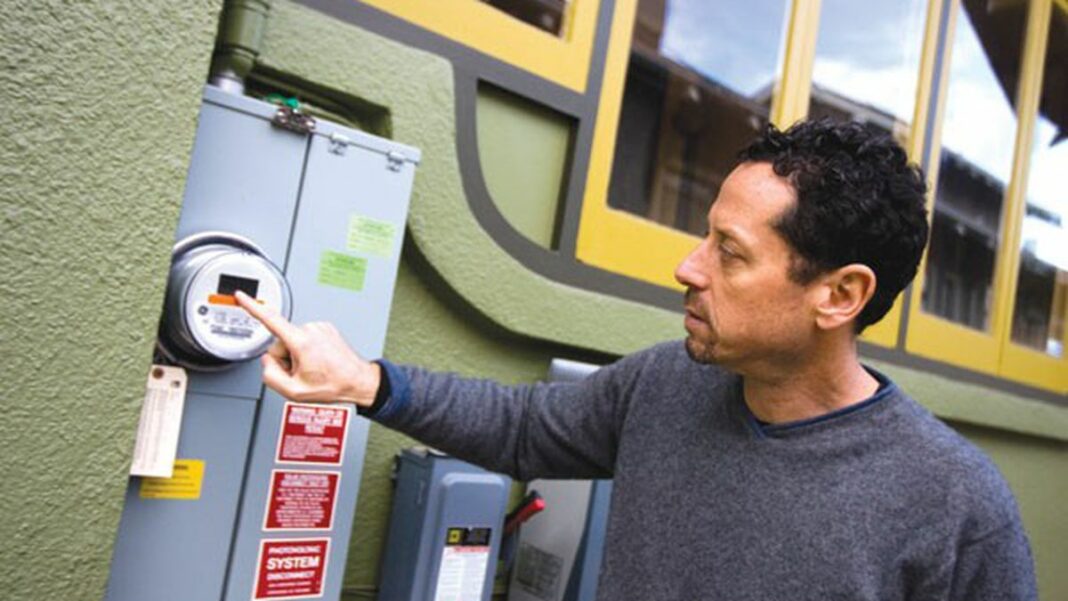
David Gottfried may know more about building green than anyone in
the country. He lectures around the world about eco-conscious
construction and was the founder of the US Green Building Council,
which developed the LEED rating system, the gold standard for
certifying eco-friendly homes and buildings. But living in a large, not
very environmentally friendly house in the Berkeley hills, Gottfried
wasn’t really practicing the life he preached. So he and his wife
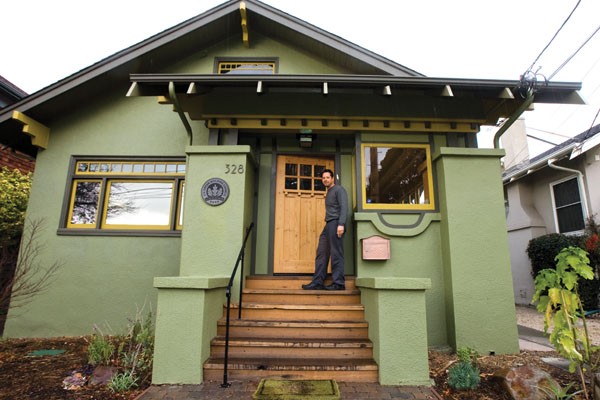
bought a modest Craftsman home in Oakland’s Rockridge district and
turned it into the greenest house in America.
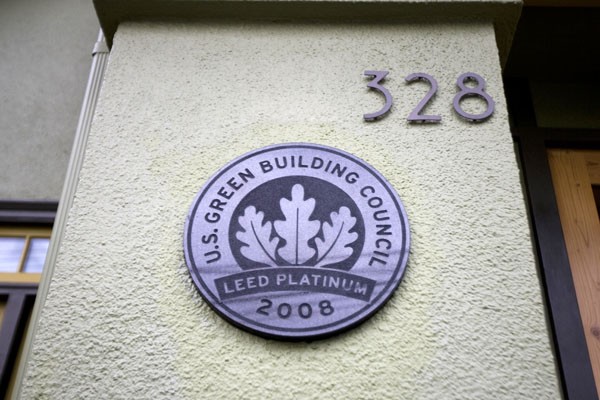
Gottfried’s home on 63rd Street, just below College Avenue, posted
the highest score ever — a 106.5 — in the LEED
certification program. To put that in perspective, a remodeled home or
building must score at least 32 to 39 points to become LEED certified.
To achieve “silver” certification, you need 40 to 47 points. “Gold”
certification is 48 to 63 points. And “platinum,” the highest
certification, requires 64 to 85 points. LEED stands for Leadership in
Energy and Environmental Design, and its certification system is used
in more than 120 cities nationwide, plus forty other countries around
the globe. In other words, Gottfried’s house scored more than 20 points
above the highest ranking possible in the largest, and most widely
recognized green certification system in the world. “We went a little
crazy,” said Gottfried, while giving a recent tour of his home.

Credits: Ali Thanawalla


Gottfried focused the remodel of his 1,500-square-foot house on four
primary areas — energy efficiency, solar power, eco-friendly
heating and lighting, and maximum water conservation and reuse. He also
built “a solar shed” in his backyard that serves as his home office for
his consulting company, Regenerative Ventures, which assists green
start-ups. The shed is made of steel and he put it up in one day,
topping it with solar panels that supply all the heating and lighting
energy it needs. “The idea is to work from home,” and not waste fossil
fuels commuting, he said. “I commute from the backyard to the dinner
table.”
Inside the three-bedroom main house, Gottfried’s first job was to
stop all of the energy loss in the drafty old craftsman. Not only did
he caulk and close every crack, but he drilled holes in the walls and
blew in cellulose insulation. He replaced all of the windows with new
dual panes designed to resemble the original 1915 style. And throughout
the inside and outside of the house, he used recycled wood certified by
the Forest Stewardship Council. The result is seamless; much of the
interior looks like it must have nearly a century ago. His wife, Sara
Gottfried, a physician trained in Western medicine who teaches yoga and
runs her own holistic medicine center in Oakland, the Gottfried Center
for Integrative Medicine, decorated exquisitely, painting the walls in
vibrant colors. “We call it ‘eco-bling,'” he said. “The idea is that
the house isn’t just green, but that green can be pretty.”
For heating, Gottfried installed eco-friendly radiators just above
the baseboards in each room. They’re powered by solar panels on the
roof, and each room has its own thermostat. That way, energy isn’t
wasted heating unoccupied spaces. The house’s water heater also is
partially heated by solar power, and all of the electricity is
solar-powered as well. Gottfried, of course, also uses compact
florescent bulbs in each lighting fixture. In addition to the LEED
platinum rating, the house scored a record 179 points in the GreenPoint
rating system, a competing eco-certification developed by the
environmental nonprofit Build It Green. There may be greener homes in
America than the Gottfried’s, but none that is certified.
As impressive as the house is on the inside, the outside may have
the coolest technology. Circling the home are nine fifty-gallon water
storage tanks. Seven of them are hooked up to the house’s downspouts to
capture rainwater. These tanks connect to the bathroom toilet so it can
be flushed without wasting precious tap water. Gottfried also pipes
excess rainwater to his garden. The two remaining tanks collect gray
water from the shower and sinks. Gottfried then pipes the gray water to
an elaborate, below-ground filtration system, which cleans it for use
in the family vegetable garden. The rest of the garden, meanwhile, is
planted with drought-resistant shrubs and trees. And finally, Gottfried
installed permeable pavers on the driveway on top of gravel to allow
rainwater to soak into the ground, thereby cutting down on runoff.
Gottfried, who also founded and serves on the board of the World
Green Building Council, reported to be the world’s fastest-growing
nonprofit, believes homes throughout the East Bay and around the
country can be modeled after his. People may not be able to afford all
of the upgrades he put in, but at the very least, they can make their
homes more energy efficient. He also thinks that President Obama’s
promise to spend $150 billion over the next decade on renewable energy
technology is a step in the right direction. But he thinks that the
money could be spent more effectively by installing solar panels and
rainwater storage tanks on homes and buildings throughout the
nation.