
Zoe Muth’s songs are saturated with sadness and a sense of loss. Her voice reaches Iris DeMent’s level of earnestness and the way she yearns for the possibility of a better world. Muth’s sorrowful tone isn’t yet as fiercely defined as Patty Griffin’s, but given time and heartbreak she’ll get there. Muth’s vocals and the eerie, echoing twang of several other alt-country guitar licks haunt the soundtrack of Rustin Thompson’s documentary, The Last Picture Shows.
Thompson is a filmmaker and a DJ. His soundtrack is carefully curated to wring out emotion in concert with the film’s main subject. The director traveled through 10 Western states to take stock of the crumbling movie houses that used to inhabit small-town America. In a series of montages, sepia-colored postcards of those bygone theaters fade on- and off-screen like the “in memoriam” segments on TV awards shows. Cutting between those nostalgic images and interviews with present-day theater owners, Thompson gathers new footage of their scrappy movie houses. No one brags about the profits they’re making.
The documentary focuses on Cinema Paradiso (1988) and Peter Bogdanovich’s 1971 film, The Last Picture Show, as its main cinematic reference points. Both films are elegies to the end of innocence, as well as commentaries on a shift away from the shared cultural experience of sitting in the dark with one’s friends and neighbors. Included are excerpts from films like Hud (1963) which highlight the old-fashioned pleasures of moviegoing. But Thompson’s dust-laden landscapes recall Sam Shepard’s depiction of an American West overpopulated with troubled souls. And Wim Wenders’ too, in those desolating scenes of heartbreak in Paris, Texas (1984).
To make sense of this post-Covid streaming-on-the-sofa story, he speaks with Ross Melnick. A film and media studies professor, Melnick explains why “cinema deserts” lie at the root of the problem. Without an active downtown movie theater, younger generations will never pick up the habit of going there for weekend date nights or for group outings to see Practical Magic 2.
Melnick also reiterates a debate that’s been playing on a perpetual loop since the invention of celluloid: “Movies are the biggest thing ever. Movies are going away.” In The Last Picture Shows, the die-hard movie fans and preservationists are the theater owners themselves.
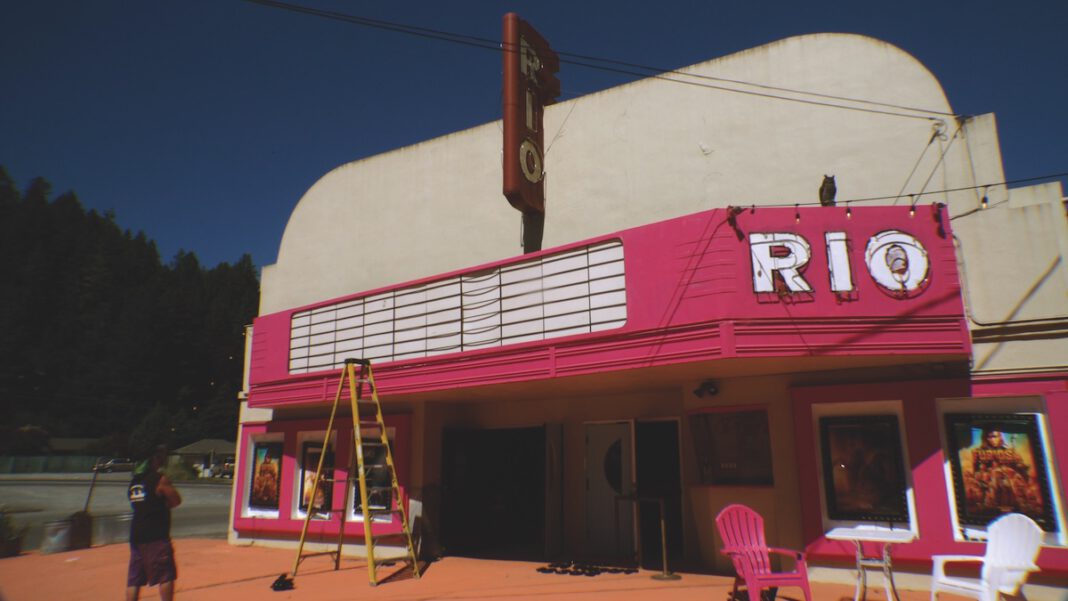
In places like Susanville and Monte Rio, 40 customers represents a solid night of ticket sales. Those happy few still willing to dedicate themselves to the profession still have stars in their eyes when they talk about their work on camera. Dave Lockhart bought the Rio Theatre—since renamed as the Monte Rio Theatre & Extravaganza—knowing he’d have to quickly find investors to create a viable business.
“The future’s in flux at the moment,” Lockhart said, acknowledging the need to diversify. “Can’t survive on movies alone in this particular situation, in this particular town with this one screen. It’s an effort. But if you can make it work, it’s the best thing.” Later this month, the Monte Rio Theatre will host the River + Redwoods Film Festival from Sept. 25–27.
All the theater owners interviewed professed universal puzzlement at the Hollywood studios’ outdated approach to film distribution. Keeping a movie like Shazam 2 (2023) for two weeks in a small market only activated the law of diminishing returns. But the movie industry’s general state of health no longer depends upon filling seats in rural theaters.
Over the course of the last century, Thompson notes, the number of movie theaters has dwindled from 22,000 down to 3,000. While he’s found a handful that remain open, The Last Picture Shows pays homage to the 19,000 theaters whose neon signs went dim. They offered a pre-digital communal space before we collectively decided to stay home and go steady with our remote controls.
‘The Last Picture Shows’ will show at Rialto Cinemas Elmwood in Berkeley on Sept. 23, followed by a Q&A with the filmmaker.









I am beyond thrilled that the Rio still exists. The Dead played there. And back in the early ’70s when I lived in Fulton, friends and I would fill a car and drive to the Rio on a Tuesday night when second or 10th run movies, often double bills, were shown for $1 or sometimes 50 cents. We hit all of those Tuesday nights in Monte Rio, Guerneville, Sonoma. Thanks for the story, and the delightful memories it stirred up for me.