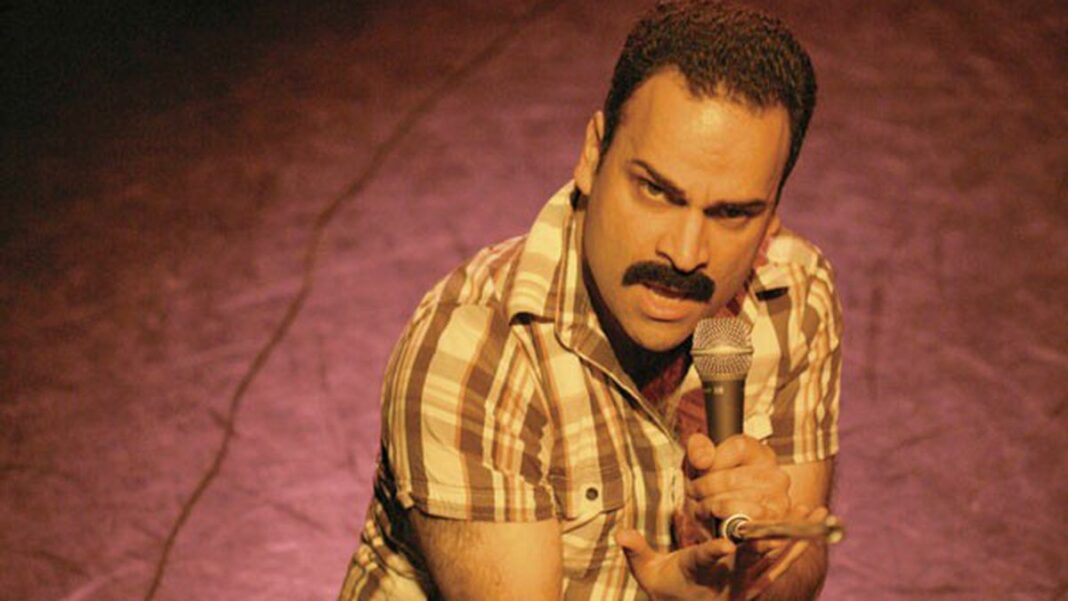
Playwright Robert Farid Karimi likes comparing himself to “the
missing piece” from a famous Shel Silverstein poem — the one
about a lone scrap trying to find a “Big O” in which to belong. In
Karimi’s case, that Big O has to accommodate many discrete parts: his
Iranian and Guatemalan heritage, his masculinity, his rootedness in the
East Bay (specifically Newark), his writerly sensibility. Over the
years, his quest for the ineffable whole has inspired a series of
fascinating performance pieces. The first, “Self (The Remix),” used the
1979 Iranian Hostage Crisis as a launching point. From there, Karimi
tried to navigate a world framed by Reaganite conservatism on the one
hand and 1980s-era hip-hop, on the other. Years later, he would develop
The Cooking Show con Karimi y Comrades, which spawned from
Karimi’s interest in PBS culinary programs but ultimately dealt with
culture and ethnicity. (Its next iteration will focus on Type 2
diabetes in the inner city.) His new show, Farid Mercury,
is the most imaginative yet. Inspired by the late Queen frontman
Freddie Mercury — a 1970s-1980s rock star with Zoroastrian roots
— it’s a mash-up musical about Persian-ness, sexuality, and a
“self” that resists caricature.
To Karimi, Mercury was the consummate interloper — a gay,
androgynous rock singer who grew up off the coast of Tanzania, went to
school in India, and became a megastar in the UK. He brought together
widely varied influences (disco, Jimi Hendrix, Indian playback singers)
to create immortal rock music, and managed to reach legend status even
though his persona went entirely against the grain. Karimi found that
oddly satisfying, especially in the face of all the Persian male
stereotypes he currently sees in pop culture. Most obvious is that of
the Iranian terrorist, which existed long before Bush coined the phrase
“axis of evil.” “It was as if America hadn’t gotten over 1979,” Karimi
said. “Even Timothy McVeigh — first thing: ‘Iranians!’ I always
trip out on that.” But that image doesn’t exist in isolation. In fact,
said Karimi, it’s just one in a huge catalog: “There’s Mad TV’s angry
Iranian tow-truck driver guy, the soup Nazi from Seinfeld, and the
oversexualized guy with his three buttons down, showing his chest hair,
with too much perfume on,” he said. “There’s also the usual: the
foreigner, the idea that every Persian’s a Muslim.”
In developing Farid Mercury, Karimi interviewed a bunch of
people about their conceptions of Persian masculinity, then did his own
research on Mercury the pop star, a character who seemed to live
outside these definitions. His show, which premieres this weekend as
part of La Peña’s 10th Annual Hecho en Califas Festival,
will channel the spirit of Freddie Mercury. But it’s not “The Freddie
Mercury Story,” said Karimi. It’s actually the story of the missing
piece — i.e., a playwright’s quest for affirmation and belonging.
Farid Mercury runs Friday, Nov. 13, and Saturday, Nov. 14, at
Berkeley’s Ashby Stage (1901 Ashby Ave.). Hecho en Califas runs
Nov. 11-15, with events ranging from Weyland Southon’s HomeMade arts
showcase to a requiem for slain LGBT artists by Bay Area organization
Mangos with Chili. It kicks off Wednesday at La Peña Cultural
Center (3105 Shattuck Ave., Berkeley) with a new commission by
theater group headRUSH, called Raw-Dios: Behind the Pigpen in the
Morning. $10-$12. LaPena.org