
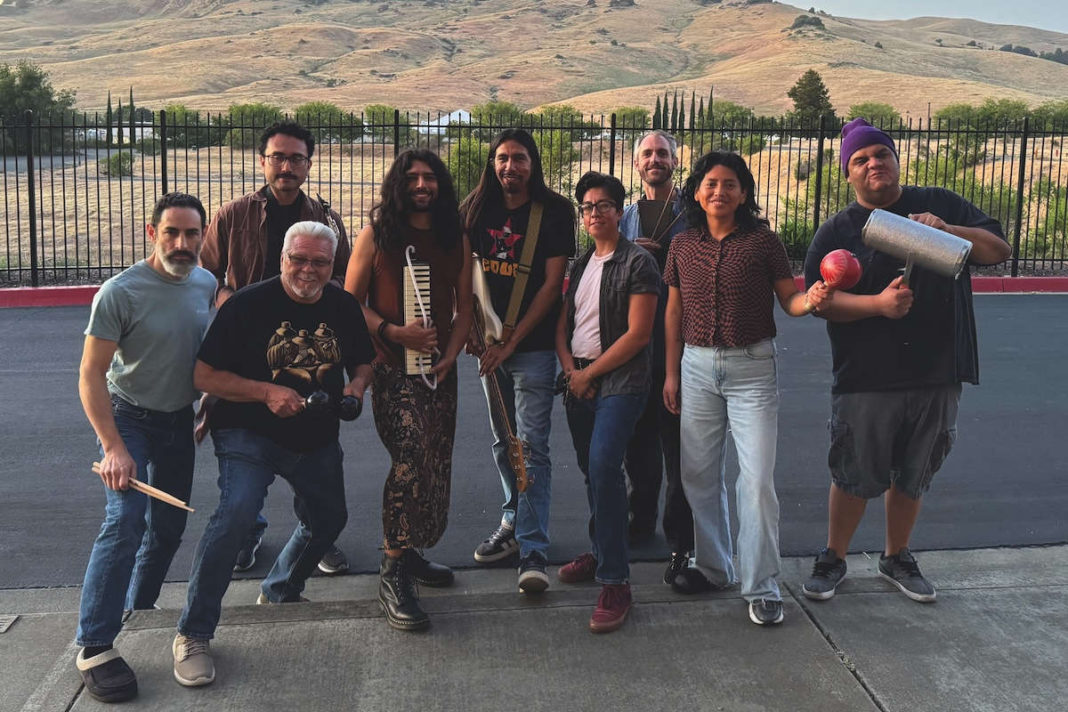
When I asked Michael Rodriguez why they decided to name their band Mala Greña, they chuckled over the phone. “Apparently, it translates more accurately to ‘messy hair’ in Spanish,” they said. When I initially searched the term, Google returned “dirty mop,” but the real meaning reflects the group’s identity—unruly, rebellious and unconcerned with tidying up for convention.
Mala Greña, a Bay Area–based band, uses cumbia as a vehicle for activism. Composed of nine members—four of whom are nonbinary—ranging in age from their 30s to their 70s, the group calls their sound “psychedelic cumbia,” blending traditional rhythms with styles like rock, huapango and salsa. Their lyrics often explore themes of LGBTQIA+ identity, decolonization and resistance.
Cumbia itself is a genre born out of resistance. It originated on Colombia’s Caribbean coast during the colonial era, as a fusion of Indigenous, African and Spanish influences. According to ethnomusicologist Peter Wade, author of Music, Race, and Nation, cumbia emerged in the 17th century from the blending of African drumming and dance with Indigenous melodies and Spanish lyrical forms. Originally a courtship dance among enslaved Africans, cumbia evolved into a cultural expression of survival and celebration—and eventually spread across Latin America, mutating into various regional styles.
For Mala Greña, cumbia is a living, breathing genre; one that offers room for experimentation while staying grounded in tradition. It also allows space for political expression.
“I try to incorporate that activist energy into the lyrics,” Rodriguez said.
Music has long served as a powerful tool for protest, allowing marginalized communities to voice resistance, preserve cultural identity and imagine alternative futures. According to musicologist Reebee Garofalo, author of Rockin’ Out: Popular Music in the USA, protest music functions as both a reflection of social movements and a force that helps mobilize them, offering emotional resonance and collective empowerment. Mala Greña is part of a broader tradition of artists who understand music not just as entertainment, but as a tool for collective memory, resistance and transformation. Whether they’re calling out oppressive systems or reclaiming queer joy, their sound is a reminder: Messy doesn’t mean broken. It means alive, in motion and full of power.
Rodriguez, the band’s composer, started Mala Greña in 2014. They recorded a demo album by themself, laying down the drums, keyboard and percussion before posting it online. One by one, collaborators found the music and joined in. The group grew organically, eventually forming a full ensemble committed not only to creating art but also to community work. The decision to make activism central to their music was sparked during Rodriguez’s time in college.
“Just seeing how the government was working [inspired the decision],” they said.
A quick glance at the band’s Instagram page reveals their ethos. Their bio includes demands for the return of Indigenous land and hashtags condemning police violence. But their activism is far from performative. They’ve organized and participated in community events such as fundraisers, including an arts and drag show in Santa Cruz that raised money for immigrant families. Their shows often double as mutual aid spaces, bringing people together not just to dance, but to heal, resist and imagine new worlds.
The band’s song “Movimientos de la Serpiente” stands out as a powerful declaration of bodily autonomy, gender freedom and refusal to conform. The lyrics push back against accusations of being “indecent” or “immoral” for how they dance, dress or love. With lines like “yo bailo y no más” (“I dance, and that’s it”), Mala Greña turns movement into defiance. The song’s imagery—blood, fire, rebirth—evokes both trauma and transcendence, especially for those navigating queerness, gender ambiguity and cultural hybridity. It’s not just about celebration—it’s about surviving and existing without apology.
Like many bands, Mala Greña faced major setbacks during the Covid pandemic. With performances paused and members scattered, much of their early momentum stalled. Rodriguez explained that they are still in the recuperation phase. That’s one reason their music isn’t widely available online. But now they’re rebuilding and reclaiming their place.
Rodriguez says audiences can expect new releases later this year, with fresh material that continues to reflect their political vision and genre-bending sound.
“We have a lot in the works,” they said.
Instagram: @malagrena