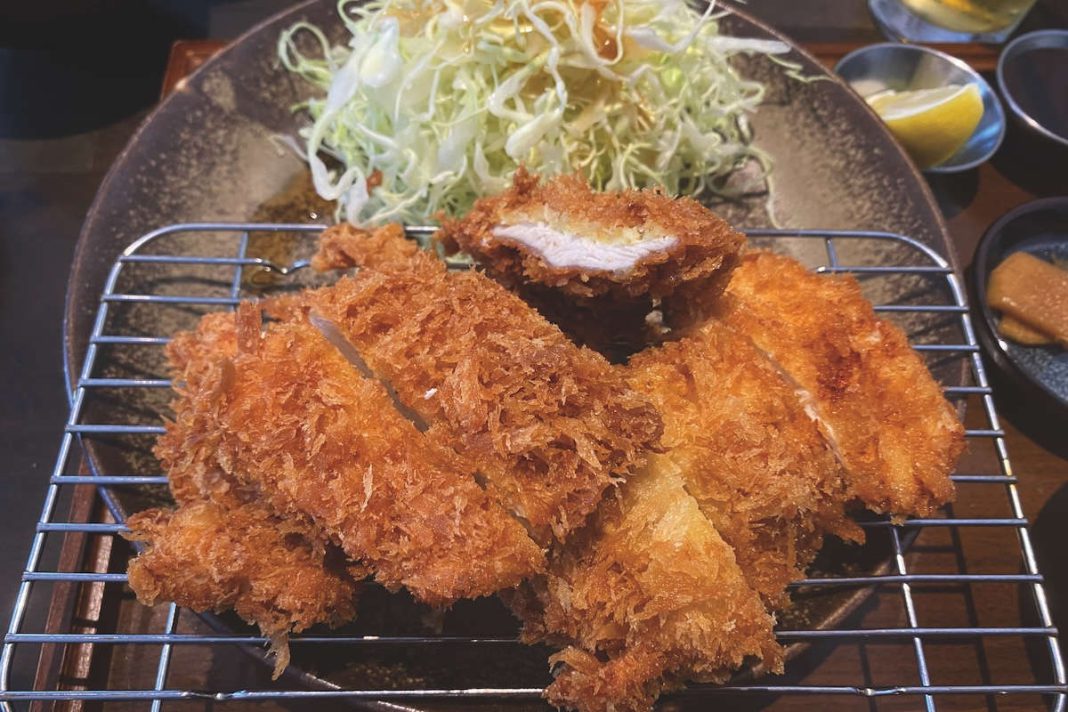
At Joyce Kim’s Jungdon Katsu, the fresh breading makes all the difference in her crispy katsu. The chef’s daughter, Nicole, explained that some Asian markets and restaurants use dried panko. Kim uses milk bread then shreds it into long strips. “We’d been wanting to eat that kind of katsu, and then she was able to find a Korean bread distributor,” she said.
Panko-crusted katsu is often pre-breaded and pre-fried. “It’s been out for a really long time, and that’s why it gets this cardboardy exterior,” Nicole said. And the meat itself can get overcooked. “That’s why curry katsu is really popular—the curry re-softens the katsu so people can’t really tell,” Nicole said. “But my mom makes everything separately and then she cuts the meat throughout the entire day.” As the orders come in, chef Kim tenderizes each cutlet à la minute so none of the dishes are made in advance.
“She’s just constantly working,” Nicole said. “I mean her hands look like she’s been through a lot, but that’s what she does every day.” After a fire last year in Danville closed the first iteration of Jungdon Katsu, Kim signed a lease at the new location in Emeryville. Both of Kim’s daughters help out. “I have a full-time job, but after I’m done I walk over to the restaurant,” Nicole said. The family lives just a few blocks away. “She’s worked so hard so I don’t want anything getting tarnished by something stupid like bad service,” she added.
Nicole told me that her mother has always been a really good cook. “I thought everyone’s mom cooked like that, but I was just really spoiled,” she said. Chef Kim’s first restaurant in California was Taru Sushi in Danville. After 10 years in business, she wanted to step away from making sushi. “She just wanted to do something she actually likes more, that’s not just trendy,” Nicole said.
Kim felt there weren’t any restaurants that really focused on making katsu. To perfect the recipe, the chef decided to work out of a ghost kitchen on Adeline Street. She experimented with the breading so the skin wouldn’t fall off the meat. “I think that really adds to why ours is really good,” Nicole said.
Nicole said she wasn’t an expert on the origin story of katsu. “But from what I know, Japan got the idea from German schnitzels,” she said. The Kim family is Korean. “We’ve been invaded by Japan so many times our cuisines mix,” she said. Korean katsu is slightly different, but Kim’s version is a best-of-both-worlds situation.
“It has some of the aesthetics of Japanese katsu, but it’s not as thick or as rare because they undercook it,” Nicole said. Korean people, she added, are sensitive to the specific smell that pork has. “That’s why my mom tenderizes it. She wants them [the cutlets] to be cooked well, but still moist, and then not have that pork smell at all.”
Post-Covid was the perfect time for Kim to take a break from her Danville customers and devote herself to her new venture. Once word got out about the ghost kitchen’s golden fried chicken katsu, the business got “crazy busy.” Nicole said, “We had to upgrade all of our equipment for all the orders that were coming in, and that’s when I started helping out more.”
Kim’s approach to the vegetable sides is just as rigorous. The chef shreds the cabbage every day to make sure it’s thin enough to hold its shape and texture. She pickles all of the radishes and cucumbers as well as making all of the dipping sauces, such as tonkatsu and tartar, and the sweet creamy salad dressings. When the restaurant runs out of cabbage—the portions are voluminous—Nicole sometimes picks up supplemental cases at Berkeley Bowl.
Jungdon Katsu’s menu also includes udon and soba. “The udon’s really good,” Nicole said. “If I could eat it every day, I would.”
Kim, though, does not make the noodles in-house. “No, that would be insane, but my mom only tries to outsource stuff that she would personally eat—she cares about quality,” Nicole added.
Jungdon Katsu, 6485 Hollis St., Emeryville. Open every day 11:30am to 9pm. jungdonkatsu.com. Jungdon Katsu will be closed for a family vacation through April 21.