Jamal Perry has been managing bars for the last sixteen years. Most
recently, he ran a couple of Oakland dives: Bigum’s Silver Lion and the
Golden Bull. Both have since closed, but Perry is now launching a more
luxurious venue just north of Chinatown. Perry hopes to attract a share
of the area’s burgeoning nightlife while drawing in the 9-to-5 crowd
for power lunches and after-work drinks. He’s set to open before the
end of the year — but some people in the neighborhood are less
than thrilled.
At issue is the bar’s name, “Geisha,” a word that Perry’s detractors
say props up a demeaning image of women of Asian ancestry as
submissive, erotic playthings, readily available to fulfill every man’s
wanton desire.
Beginning almost two hundred years ago in Japan, the word identified
a type of female entertainer. Wearing ornate kimonos and distinctive
white makeup, geishas in the original sense are known for giving dance,
music, and song performances at formal parties, where part of their
role is also to engage guests in conversation. They still practice
their craft, but their numbers have dwindled from a peak of 80,000 in
the 1920s to fewer than 5,000 today.
During the American occupation of Japan in the late 1940s, the word
became defiled when the booming flesh trade appropriated it to solicit
US servicemen, who started referring to prostitutes as “geesha girls.”
Incensed by this development, some true geishas actually considered
dropping the name altogether. Co-opted since then by all manner of
exploitative interests beyond Japan, it has collected permanent
baggage, as anthropologist Liza Dalby wrote in her essay “The Exotic
Geisha.” “The seemingly indelible definition, ‘a Japanese prostitute,’
has finally faded from newer English dictionaries, replaced by
‘artists’ and ‘traditional entertainers’ … [but] the portrait of the
geisha as sexual toy, groomed in ornate traditional fashion, trained in
the arts of pleasing men, remains firmly framed in the western gallery
of female icons.”
Perry, who is biracially Korean and black, dismisses the notion that
he is milking a stereotype that plays off his own Asian heritage. “It’s
not just like … I’m going to run with the theme of ‘me love you long
time’ type of thing,” he maintained. “It’s just not a marketing
ploy.”
His own interest certainly seems genuine. Claiming a deep affinity
for Asian culture, Perry sports tattoos of geishas on both arms. Asked
when he was first drawn to them, he responded, “I don’t really have a
moment where I was like, ‘Oh, geishas!’ It’s just something I’ve always
gravitated to and thought, sexy and classy, you know what I mean?
Exotic.”
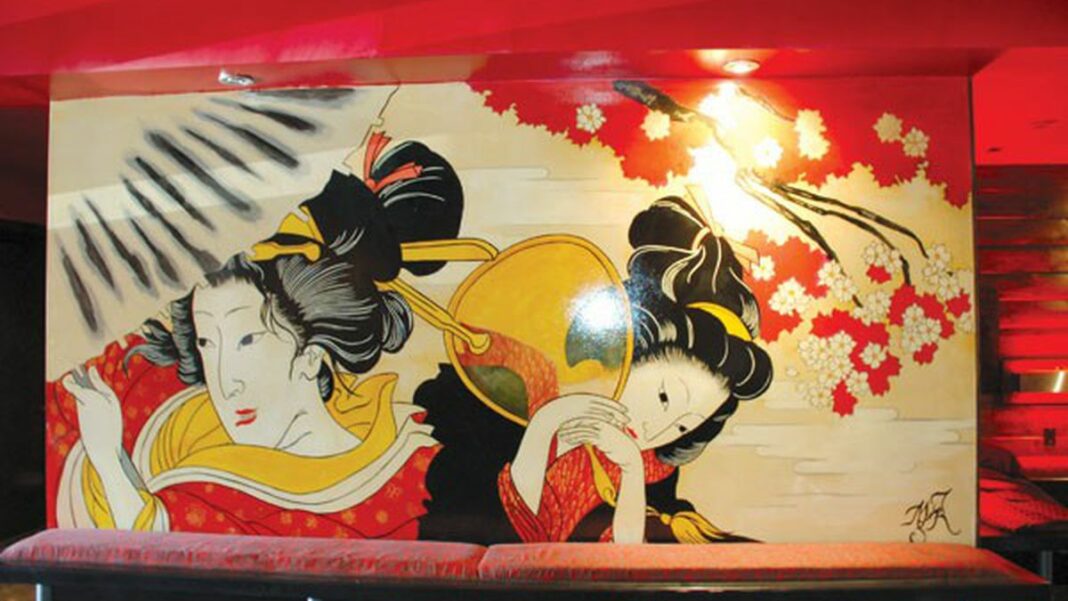
His bar features two massive geisha murals in what appears an
emulation of classical Japanese style. Painted by artists from Temple
Tattoo, the colorful murals dominate an otherwise black interior.
Although it is not entirely clear how else the name will manifest
itself in the establishment, the prospective menu features several
Asian-fusion dishes and a range of sake-based cocktails.
Namie Shin, Perry’s collaborator and a chef who will be managing the
bar’s kitchen, explained, “We’re trying to remove the word ‘geisha’
from the derogatory association that it had in the past. People think
of it in a negative way, they think of brothels and whatnot, but they
can now have a positive association with it.”
However, Diana Pei Wu, who lives near the bar and serves as a
faculty lecturer in UC Berkeley’s ethnic studies department, said the
health and well-being of area residents is threatened by having this
word quite literally hanging over their heads — as it does in
dark metallic lettering at the establishment’s 316 14th Street
location. Pointing out that young women of color in Oakland face
“racialized, gendered violence” every day, she asserted, “I can’t
condone that kind of environment, and a bar named Geisha would actually
contribute to that atmosphere.”
Wu has been dismayed to hear “friends of friends” inquire if the bar
will be haven to prostitutes. “This is what is in the public mind about
this word, and regardless of what the intention of the owners is
— or what they say their intention is — the word conjures
up the stereotype,” she said. “The goal is to get people to come in
based on whatever their stereotypes are.”
Many other social-justice proponents echo her sentiment; Perry’s bar
has already drawn harsh criticism across the Internet from popular web
sites such as Asian Pacific Americans for Progress, reappropriate, and
Angry Asian Man. Geisha even has a preemptive Yelp listing where
scathing reviews have been piling up (for instance: “Offensive to the
Asian American community. Please do not support unless they TOTALLY
restructure their image/marketing AND apologize”).
“I’m not even of Asian descent and I’m pretty horrified by the
name,” said Richard Wright, a local DJ who used to spin right around
the corner from Geisha at the Breakroom Cafe. As a sort of neighborhood
emissary, Wright met with Perry months ago inside of 316 14th Street to
negotiate a name change on behalf of concerned residents. The two had a
cordial meeting, but Perry declined to consider changing the name and
Wright came away dissatisfied.
“The kind of justification that [Perry] gives is just like, well
there are beautiful paintings on the wall … focusing on the art of
the geisha,” he recounted. Wright, who is Black, argued that “if a
place was opening up called the ‘Happy Mammy,’ and they said that they
had beautiful vistas of plantations on the wall, that wouldn’t help
anything. … I do believe if it was a name that was considered
derogatory to black folks, there actually may be more action around
it.”
Not that there hasn’t been action. Wright, Wu, and four other
community members recently pled their case in front of the Oakland
Planning Commission on October 7, when Perry was scheduled for a
hearing on his application for the bar’s required Major Conditional Use
Permit. After the group’s passionate testimony in the public comment
period, Commissioner Blake Huntsman marveled, “I don’t think anything’s
come before us where just the name itself, as far as a business, has
inflamed people in this way,” and asked Perry to consider “if in fact
you want to open on such a note.” Planning Commission Chair Michael
Colbruno cautioned, “I just know if I were starting a health drink and
I thought the name ‘E. Coli Drink’ sounded cool, I’d kind of want
someone to come and tell me that it’s got some ramifications that
aren’t good.”
While each of the six commissioners expressed such reservations,
they ultimately awarded Perry with the permit on the grounds that his
choice of name lay beyond their purview. However, the only two female
commissioners in attendance did not vote in favor of this action;
Sandra Galvez abstained, and Vien Truong dissented, declaring, “We have
the responsibility to protect the citizens of Oakland.”
Perry contends his bar will help execute that same responsibility in
its own manner. His application paperwork for the permit promises
security officers at the door who “will deter, impede, and report
criminal activities such as vandalism, car break-ins, assaults,
robberies, etc.”
This setup, while likely beneficial in a general sense, does not
alleviate Wright’s biggest fear: “If this place opens up with this
name, I have this nasty image of people going, drinking, getting drunk,
leaving the establishment and looking for a ‘geisha’ for the evening,
you know? I’m sure that’s not going to be the typical experience, but I
am concerned that it will contribute to harassment of women of Asian
descent in the area.”
Both Wright and Wu emphasized that they want to see more commercial
development in their neighborhood — just not at the expense of
public safety. They intend to continue pressuring Perry to change the
name of his establishment, which they would eventually hope to
patronize if he does.
“I would love to have a place to kick it, where we could be creating
the kind of Oakland that we want, all of us collectively,” Wu said.