Ten days before Christmas, the four-foot-tall Santa Claus in the doorway of Minda Dudley’s chiropractic office giggled and danced, moving spasmodically to the Christmas carols emanating from its guts. The lampposts in the central plaza were wrapped in red and green ribbon, and the fountain at the middle of the plaza splashed pleasantly. It was a tidy, agreeable scene at the Fruitvale Village, the one-year-old cluster of retail shops, offices, and apartments near the Fruitvale BART station. The only missing element was customers.
Nearby church bells struck noon, but the Burger One restaurant was empty, its Formica tables glistening forlornly. At the shoe store next door, the lone salesgirl swept the floor. And inside Dudley’s office, the chiropractor vented the frustration she has held in check for more than a year.
Credits: Claudia Ward

Credits: Claudia Ward
Credits: Claudia Ward
Credits: Justin Page
“There’s a huge problem for merchants here,” said Dudley, a tall woman in earth tones who perched on the gray chiropractic table in the back room. “It’s time to face up to facts. The reality is, it’s not working. The plaza isn’t working.”
Dudley’s stark assessment may surprise many people. When Fruitvale Village opened in May 2004, newspapers, environmental groups, and government officials all lined up to hail the project as a national model for “smart growth.” By clustering moderately priced housing near BART stations, such so-called “transit villages” would increase mass transit use and cut down on the number of cars on already clogged highways. By building in densely populated quadrants of the city, they would reduce suburban sprawl, and therefore help preserve open space. And by combining housing with retail and community services, they would create walkable neighborhoods, street life, and a sense of community.
Fruitvale Village was so well received that the Sierra Club lauded it last month as one of the nation’s twelve best new development projects. Officials have come to study the project “from across the country and around the world,” according to its developer, a nonprofit organization called the Unity Council. And other Bay Area government agencies are so enamored of the model that they’ve made future transit extensions contingent on planning such transit-oriented developments.
Almost every BART station throughout the Bay Area has a transit village project in some stage of planning or development. Four are already partially completed — in Fruitvale, Castro Valley, Hayward, and Richmond — and plans have been approved or partially approved at seven other stations, including Ashby, Dublin/Pleasanton, and Pleasant Hill. At 25 other locations, the process is one or more steps behind. Bay Area governments are preparing to spend tens of millions of dollars on a development model that has not been studied, tested, or proven.
Yet the many boosters of smart growth have been too busy applauding the concept to notice that back at Fruitvale Village, the movement’s flagship is taking on water. The first 47 apartments were rented quickly, and community-oriented tenants such as the public library branch and the Head Start program have had plenty of clients. But many of the merchants who serve as the village’s public face are growing increasingly desperate. Already, a restaurant and a Curves fitness center have closed. At least six other merchants say they are struggling, and two of those will likely shutter their shops in the next few months. If retail doesn’t succeed at Fruitvale Village, it could bring down the whole project.
Fruitvale Village depends on rental income from three main sources: residences, offices, and retail storefronts. “In terms of basic, functioning economics, the retail component is critical,” conceded Jeff Pace, the Unity Council’s vice president of finance and business operations. “The project is mortgaged as a whole, so all the revenues go to pay the same loans. If any component doesn’t succeed, the whole project is at risk.”
As with most developments, retail tenants at Fruitvale Village generate higher revenues than either residential or office tenants. Most of the apartment dwellers pay around $1.10 per square foot in monthly rent, except for the ten renters who occupy the affordable-housing units and pay less. In the office sector, the Unity Council pays itself about $2 per square foot, but still hasn’t found any other office tenants willing to pay that rate; a 21,000-square-foot office is still empty after two years. Retail was intended to do the heavy lifting, with rates around $2.20 per square foot.
If retail tenants were important to the economics of Fruitvale Village, they will be absolutely essential to many of the Bay Area’s other proposed transit villages. Unlike the Fruitvale project, which was developed by a nonprofit with a deep and abiding interest in the overall health of its neighborhood, most other projects will be spearheaded by private developers with a deep and abiding interest in making a profit. “Therein lies the difference between the Fruitvale transit village and most other transit villages that I’m aware of,” said Scott Harriman, a senior planner at Walnut Creek’s community development department. “It was a unique beast in that it was driven by a nonprofit whose goal was to revitalize the neighborhood.”
Private developers also can’t count on the same level of federal and local government support that the Unity Council received. As a nonprofit launching a test case for a new type of development, the Unity Council received about $10 million in grant money. But as similar proposals from private developers pile up, the government’s largesse is likely to decrease.
Such “mixed-use development” projects have been a popular recent trend in city planning. The idea is that combining retail and residential creates a lively streetscape and an improved quality of life for residents. “The whole motif is retail on the bottom, residential units up,” Harriman said. “They serve each other, they feed on each other.” But this scenario may be imperiled if other developers are spooked by the Fruitvale Village example.
Dudley believes the problem with Fruitvale Village is a layout that allows BART commuters to go straight from the trains to their cars in the parking garage without passing through the plaza. She thinks there aren’t enough attractions to entice customers to the plaza, a problem exacerbated by stores that have been slow to open and others that are still vacant. While a bit of foot traffic trickles in from bustling International Boulevard one block away, the tastes of those shoppers differ significantly from those of the BART commuters the merchants expected to cater to. “We feel misled,” Dudley said. “When I talked to the Realtor about opening up here, they promised there would be six thousand people coming through here per day to shop. It was supposed to be this booming place.”
If, however, assumptions about the viability of retail development turn out to be invalid, the economics of the entire movement may have to be reconsidered. To make the economic model work, developers might choose to build purely residential developments instead, or developments punctuated only by coffeeshops or convenience stores. That would be the end of the Bay Area’s grand urban experiment, which was only just getting started. Rather than being lively social spaces where neighbors stroll between shops and bump into each other on sidewalks, transit villages could turn into boring apartment complexes. East Bay communities such as San Leandro, Pleasanton, and Union City that are considering transit village proposals might get the antidote for sprawl they need, but they wouldn’t get the new urban utopia they’ve been dreaming of.
The struggling merchants at Fruitvale say that before every Bay Area community rushes to build a transit village of its own, city planners should study their example. “Learn from your mistakes!” said merchant Gustavo Loza. “There’s nothing wrong with the concept; the concept is fantastic. It’s the follow-through.”
Loza should know. He owns The Shoe Spot, the too-quiet shoe store that sells black designer high heels for $59. The weekend before Christmas, he said, his store made only four sales. “The basic problem is that the population they told us would be shopping there does not shop there,” he said. “That is the core of the problem. The numbers and the customers we were promised are not there. We were promised an affluent, upscale customer base. Instead we have immigrants who are looking for bargains: ‘Your shoes are so expensive!’ It gets old real quick.”
Maria Barajas sat in the office above Acapulco Records, the busy music store she owns with her husband. This location, four blocks away from Fruitvale Village on International Boulevard, was doing just fine, even on a rainy weekday afternoon. A lively version of “Feliz Navidad” poured from the speakers, and the Christmas tree twinkling in the doorway drew in customers for some last-minute shopping. Upstairs, Barajas sat beneath a banner that proudly proclaimed the family’s business success: fifteen years in Oakland.
“We started at the Coliseum flea market,” Barajas said, “and just tried to grow over the years, little by little.” They opened their shop on International Boulevard in the early 1990s, and quickly became known for a broad selection of Mexican pop and Latin music. When they heard about the opening of Fruitvale Village, it seemed like the next move up. They could expand their clientele by selling to BART commuters, while still satisfying their core customers with music from Latin America.
The village looked like a beautiful place to do business, Barajas said. Built in a modern Spanish style, the four-story stucco buildings surround the central plaza, with another wing that stretches along 12th Street. The buildings are painted in desert colors of tan, sandy yellow, and glowing orange, and elegant arches frame shop doors on the first floor. Barajas expected her new customers to include office workers from the second floor and apartment residents from the top two levels. Eventually, she planned to close the International Boulevard store and move the entire operation to the Village.
Instead, twenty months after opening their new shop, the Barajas are giving up. Just before Christmas, they sent a letter to the Unity Council, asking to be released from their lease as of the end of January. “We feel that this is the best business decision for Acapulco Records, given past and current facility issues and the lack of business environment at the Fruitvale Village,” the letter stated. It described a leak in the ceiling that began in October 2004 and took six months to get repaired. When the drops started splashing down on the CD cases again at the start of this December’s rainy season, the Barajas decided they had had enough.
“At this point, I don’t know what else to do,” she said, the corners of her mouth tugging downward. “I’m losing money every month.” If they have to pay a fine for breaking the lease, Barajas is willing: “How do you say — estoy cansada? I’m very tired. I feel I can do no more.”
In Barajas’ eyes, the plaza has failed because it’s stuck squarely between two demographics: It doesn’t appeal to lower-income Fruitvale residents and there aren’t enough events or the right gestalt of shops to attract higher-income BART commuters. “They put advertising for it at the Oakland A’s stadium. I don’t go see the Oakland A’s, my family doesn’t go see the Oakland A’s. Why not put advertising on Channel 14 or Channel 48?” she asked, referring to two Spanish-language television stations.
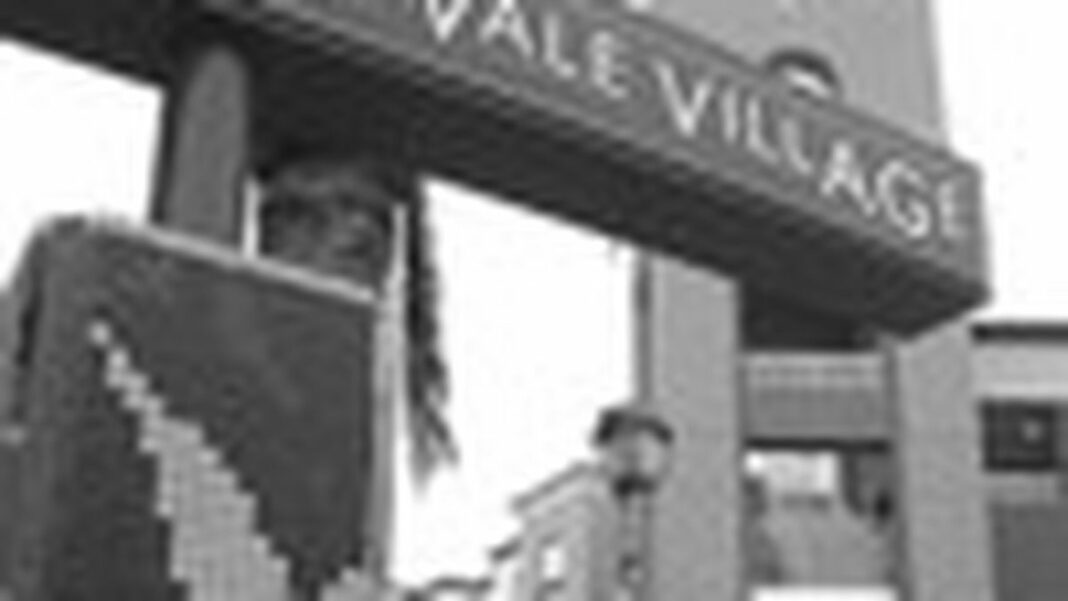
Developers did try to link the plaza to the lively stretch of International Boulevard with an imposing gateway that frames a path from the street to the plaza. But most shoppers on International Boulevard breeze by the arched entryway, en route to the next taqueria or the Payless Shoe Source — where sparkly blue high heels go for $17, tops.
Before its recent troubles, Fruitvale Village was an Oakland feel-good story with the requisite elements of community empowerment, a long fight, and a happy ending.
In 1991, BART announced plans to build a tall parking garage smack up against the Fruitvale station. Local residents protested vehemently, saying the hulking structure would symbolically cut off the station from the community, and might add to existing problems with traffic and crime. The packed public meetings held to discuss the proposal were a turning point, said Arabella Martinez, who was then CEO of the Unity Council. “It was the first major event that really brought the community out, people from all walks of the community,” she said. Faced with staunch opposition, BART withdrew its plan and the city of Oakland gave the Unity Council a grant to come up with an alternate development scheme.
The council’s new plan emphasized the need for revitalization in the surrounding neighborhood, which was then struggling to get back on its feet. At the time, storefront vacancy rates were high on International Boulevard, and the streets were dirty and dangerous. The Unity Council argued that local businesses should be given space in the BART station area so that they could participate in the revival. The development team also came up with the idea of using services such as a senior center, health clinic, and public library as “anchor tenants” that would simultaneously serve the community and generate foot traffic for the retail stores.
Over the ensuing years, Martinez cobbled together more than $53 million for construction of the “central core” of the plaza. When you add in funds raised independently for a BART parking garage and for La Clínica de la Raza, the family health clinic, the project costs topped $100 million, Martinez said. The complex arrangement involved more than thirty sources of funds, including grants from private foundations and federal and local government agencies. Martinez, who worked in the Carter administration in the 1970s, leveraged her Washington contacts to wrangle more than $5 million from the Federal Transit Administration.
At the local level, Fruitvale Village had no better champion than Ignacio De La Fuente. From his seat on the Oakland City Council, Fruitvale’s representative shepherded the project through numerous city reviews and deals, and eventually cajoled the city into contributing more than $16.5 million, much of that in the form of prepaid leases for the library branch and senior center. Finally, Citibank sponsored tax-exempt bonds to make up the balance of almost $20 million.
When the plans were finalized in 1999, the US Secretary of Transportation himself came out to say congratulations. “Transportation planning should be about more than concrete and steel,” Rodney Slater intoned. “It should be about building communities, and we are all looking to Fruitvale as an example of how that can happen.” In 2001, one decade after the Unity Council first raised its concerns about the parking garage, construction began on Fruitvale Village.
To Gilda Gonzales, the new CEO of the Unity Council, the village’s mere existence is thus a major triumph. “It’s exciting, and it has really put Oakland and Fruitvale on the map, and I don’t want to diminish any part of that,” she said. “Because I’m telling you, there was blood, sweat, and too many tears to have this diminished by people who are irresponsible business owners. I’m getting a little emotional and intense about this point, because it’s true.”
Gonzales maintains that Fruitvale Village is experiencing growing pains — no more, no less. She noted that the village has switched both leasing agents and property managers, and said the Unity Council has learned important lessons about how to make such a project succeed. “We probably have another year to prove whether we are going to excel or not,” she said. “This is a critical year. ’06 is the make-or-break year for all of us.”
Sitting in the Unity Council’s conference room on the second floor of the Fruitvale Village complex, Gonzales insisted that overall, the plaza was healthy: “Of course, merchants and retailers are always going to want more business, but they’re doing fine.” Only one or two “bad apples” are having trouble with their businesses, she said. The rest are succeeding, she said, citing the cell-phone store Digicom Wireless and the coffee and beignet shop Powderface as success stories.
Indeed, Lauren Tran, who owns Powderface with her husband, said that while business isn’t “awesome,” they’re making a go of it. Their location right next to the BART station helps, she said, and a big part of their business is providing commuters with their morning cup of coffee. And as word spreads about their beignets, the traditional New Orleans doughnuts covered in powdered sugar, the shop is becoming a destination, she said. “For us, I know it’s just a matter of time,” Tran said. “I’m not really worried.”
While Gonzales is proud of shops like Powderface, she acknowledged that not all of the Unity Council’s cheery assumptions about Fruitvale Village have come to pass. “We are going to make it work,” she said. “It’s been lessons learned for the past year, and we’re making adjustments.”
The Unity Council is eyeing one obvious adjustment that can be made quickly. A large chunk of office space in one of the Fruitvale Village buildings is empty, still not leased after almost two years of trying. Council vice president Jeff Pace blames macroeconomic forces for this failure; while the complex was being built, the bottom dropped out of the Bay Area office market. The council is now considering whether to convert the space into apartments.
The current thinking around the council’s office is that more residential units can solve many of the village’s problems. In the conference room, a map showed the possible outlines of the next phase of Fruitvale Village’s development: a large block of apartments and condos that will replace a parking lot along two blocks of 12th Street. While the final numbers have yet to be decided, the Unity Council hopes to build 250 to 450 residential units. Gonzales is convinced that increasing the number of very local residents will give businesses the boost they need. “There’s going to be a remarkable change in this situation, even for the people who are the complainers right now,” she said.
However, even if it builds the maximum number of apartments, an extra 450 apartments aren’t likely to make the difference to a struggling specialty shop that serves customers in multiple neighborhoods. “This could be a daily needs center; that’s probably the best fit for this space,” said Danielle Woods, Fruitvale Village’s new retail leasing agent. “We need to do a better job of catering to the neighborhood residents and the BART passengers,” she said, citing restaurants and a dry cleaner as businesses that might succeed in the space.
Sheyla Albanes-Garcia hopes that a refurbished Fruitvale Village will breathe new life into her struggling business, but admits that the mantra of “just wait and things will improve” has a familiar ring.
Albanes-Garcia has been part of the Fruitvale Village experiment since the beginning. Standing in her florist shop in the center of the plaza, a tiny place bursting with vivid blooms, she said the developers originally told her the plaza would have a grand opening in February 2004. She made plans to set up shop that month, but was surprised when she arrived and found that hers was the only store ready to throw open its doors. She was more alarmed when the grand opening got pushed back to May 5, and downright nervous when Cinco de Mayo came and only four businesses were open. “I was expecting a full house,” she said.
Despite her misgivings, Albanes-Garcia threw herself into the project, and tried to attract the 6,500 daily BART passengers often mentioned as the plaza’s intended customers. “They said all these people would be shopping here after work when they come off of BART,” she remembers. “So at the beginning I put a lot of money into advertising. I put fliers on all the cars in the parking lot, trying to get the people from Alameda who park here. The fliers said, ‘Bring in this flier for a special deal!’ Out of a thousand fliers, not even one person came in.”
This fall, Albanes-Garcia wondered if her business would survive until its two-year anniversary. She wasn’t able to pay rent for several months, and nervously waited for an eviction notice. But in the last week of December she got good news from the Unity Council: they wanted her to stay, and would give her an extension on her rent payments. “They are willing to help me,” she said. “For the first time, I feel like I’m happy.”
She’s thankful to the Unity Council for extending a hand to her, and hopes they’ll work with the other merchants as well. “If one business can’t make it, you say, okay, they messed up,” she said. “But when you have three or four businesses ready to go, you know something is wrong.” The vacancies on the plaza don’t help anyone, she said. Its two rows of bright storefronts are punctuated by the dark windows of vacant units, like a boxer’s set of teeth.
Of the seventeen shops that front the plaza, four spaces have yet to be leased, and two prime restaurant spaces have “Coming Soon!” posters in their windows. Los Cantaros Taqueria, the Mexican restaurant that will replace the closed Jalisco’s II, seems to have a credible chance of fulfilling the poster’s promise — the bar inside is fully stocked, and its menu is posted on the door. But a peek past the brown paper in the windows of the future Korean barbecue restaurant, the K Grill, reveals an establishment that has farther to go. The walls are stripped down to the frames, and a tall ladder stands alone in the middle of the bare concrete floor. The Unity Council had promised that both would be open by December, Albanes-Garcia said, and now pledges that they’ll open in January. “It’s always next month, or next year.”
Mohammed Elamain, who owns Burger One and the Market One convenience store, said he worked seven days a week for eighteen months and spent $150,000 to ready his two shops for business. Because the new retail spaces were essentially empty shells, Elamain installed plumbing, electricity, heat, and restaurant equipment, he said, and finally opened up in August 2004. “We were expecting in the first six months to not make any money,” he said. “I did my charts, and waited for things to improve, but nothing got better. I kept putting more money into it from my own pocket, but after seven months, I said, ‘Guys, I have kids, I have a family. I can’t keep going like this. You guys need to do something.'”
Elamain told the Unity Council he was concerned about the number of storefronts that were still vacant. There weren’t enough businesses open to attract customers to his restaurant, he told them. But the council’s response only frustrated him more. “They said, ‘You need to change the color of the walls,'” an apparent critique of his restaurant’s turquoise decor. “I said, ‘Okay, guys, I don’t think that’s the main problem.'”
Fed up, Elamain tried to sell the restaurant. But three potential buyers observed the business and then declined, saying that it had no business value. “I tell them I make $200 a day, maybe $250 on a good day,” he explained. “Then they say, what’s the rent, and I say $5,000 a month. They say, I’m sorry.” Unable to sell the business and unwilling to break his lease, he recently borrowed $12,000 from the bank to pay the rent on his two locations.
As for Dudley, she plans to close her chiropractic office when her lease is up at the end of February. She made two entrepreneurial attempts at Fruitvale Village, first opening a mailbox and shipping store with a friend. When that failed, she opened the chiropractor’s office in the same space, to complement her thriving San Francisco practice. She’ll start scouting for a new location in Oakland this spring, but is eager to leave Fruitvale Village behind. “It’s a shame, because everyone came in very enthusiastic,” Dudley said. “We were excited about being part of this model project.”
With the Bay Area’s population projected to grow by almost two million by 2030, development-as-usual is like a poor choice. In the East Bay, the ever-eastward creep of highways and suburban sprawl have led to the loss of open spaces and agricultural land, and frustrated commuters who spend more time on crowded highways than they do with their families.
Environmentalists and progressive government officials who have been casting about for a new model view transit-oriented development as the answer. The nonprofit Greenbelt Alliance has long championed transit villages as part of its mission to preserve open space in the Bay Area. Its organizers are thrilled by the current governmental and public enthusiasm for such projects.
“There really is a building momentum for transit villages in the Bay Area, and the East Bay in particular, because of their potential to ease the existing crisis the region is facing, and allow for healthy, continuing growth,” said Kate O’Hara, a regional organizer with the alliance. “We’ve got a severe housing crisis, and terrible traffic congestion, and here’s a positive way to deal with these problems. Fruitvale is one that many people in the Bay Area are very proud of. We want to make this kind of development the norm rather than the exception.”
A new policy by the Metropolitan Transportation Commission, the regional planning agency, will be one catalyst toward making that happen. This past July, the MTC approved a policy to link the expansion of public transit to transit-oriented developments. Before construction can begin on a new BART station, ferry terminal, or light rail line, the sponsoring agencies and local governments are required to come up with a plan for the station area which includes a certain number of housing units, and preferably also retail, neighborhood services, and parks. “We’re going to see an explosion of planning and development around transit villages over the next twenty, thirty years,” O’Hara said.
The effects of the policy will be felt throughout the Bay Area: It applies to the proposed BART extension to San Jose and a proposed rail extension of BART to Antioch and Brentwood, as well as a planned bus rapid transit system in Oakland and Berkeley, the Transbay Terminal project in San Francisco, the Muni extension on 3rd Street in San Francisco that is known as the Central Subway, and new ferry terminals planned for the East Bay coastline.
MTC senior planner James Corless said the new policy not only encourages smart growth, it’s also a practical move to take care of the transit agency’s investments. “The extension of transit in the Bay Area, which includes BART, bus rapid transit, the ferry, the central subway, is $11.7 billion in new transit investments in the next 25 years,” he said. “That’s a lot of money. From our perspective, to take care of the bottom line, we need to make sure we have people to ride those systems. The policy calls for, at a minimum, 42,000 new housing units to be built around all of these stations.”
Meanwhile, the mammoth $10 billion transportation bond measure proposed by state Senators Tom Torlakson and Don Perata earmarks $275 million in incentives for transit-oriented development. The money would be used for infrastructure grants to help local agencies put in sidewalks, sewage, water, and power lines to encourage private development around BART stations and other transit hubs. “Our overall approach is to pump as much money as we can into smart-growth oriented projects,” said Robert Oakes, Torlakson’s press secretary. “Senator Torlakson and Senator Perata worked on having a major chunk just for transit-oriented development because we think it has so much potential not just for the Bay Area, but also for Southern California.
“Transit-oriented development has been around a long time, but we’ve always taken an incremental approach,” he continued. “Now Senators Torlakson and Perata are suggesting we take a big step, because a lot of cities have told us, we want to do this, but we need the tools. This is an unprecedented investment — $275 million for developments within a quarter-mile of a transit hub.”
The bond measure, which will end up on either the June or November ballot, also includes $300 million to fund local planning efforts that focus on smart growth. Those dollar amounts may increase, as Governor Schwarzenegger has suggested he may push for a larger bond. “We’re all waiting with bated breath,” Oakes said.
The question to ask now, before the cranes and Bobcats get working, is what lessons can be learned from the retail failures at Fruitvale. Not all the problems can be generalized across the board: Building a retail plaza at a suburban BART station in Pleasanton or Walnut Creek is a very different proposition from wedging one into a city neighborhood like Fruitvale. Other developers and planners should take heed and be careful with the proportions of their projects, said Rick Juarez of BRE Properties, the developer working on the Walnut Creek transit village. “Retail helps activate the area, but it’s not what drives the project,” he said. “Other projects may reconsider the extent of the retail they do.”
At Walnut Creek, the developers have already established that retail will be a relatively small component, and that the shops will serve quotidian needs. “We’re not building destination retail; it’s really oriented to providing services to the residents of those 500 to 575 units and the BART passengers,” Juarez said. “It’s the coffeeshop, the cleaners, maybe a florist.”
To guarantee that the florist succeeds, a few mandates can be laid down. Foot traffic should be guaranteed by leading commuters through the retail area on the way to their cars. Housing should be built right away, to create built-in demand for restaurants, shops, and services. Businesses should be helped get up and running quickly, as a kindness to the merchants. Finally, developers need to pick their demographic and target customers wisely.
The real shame of Fruitvale is that it may well settle out in time. The property managers might arrive at a mix of medical offices, shops, and restaurants that has the power to bring people down the path from International Boulevard. A sprinkling of BART commuters may alter their routines and augment business by browsing through the plaza. But it will be too late for some of the entrepreneurs who came to Fruitvale Village with high hopes and good intentions.
Clarification
This story has been corrected since it first appeared. See below for details.
This story originally stated that a transit village project had been approved at Ashby BART. Although a transit-village-related center for disability advocacy and services was indeed approved by BART for the station’s east side, and has received a use permit from Berkeley’s Planning and Development Department, the transit village proper proposed for the station’s west side has not yet gotten the green light.