Dowling Street between 84th and 85th Avenue in East Oakland is
unsettlingly quiet. Piles of garbage, a single car, and multiple “for
sale” signs decorate this once-noisy flatlands street. For one of the
block’s few remaining tenants, the silence, which is broken only by
loud police sirens or gunshots, serves as a dreary relief from the
violent and illegal activity that increasingly defines the block he
calls home.
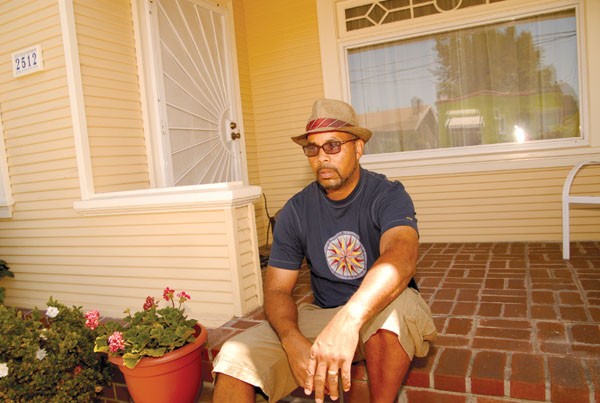
Over the last two years, Calvin Brown has watched his neighborhood
become a ghost town. Across from the small house where Brown lives with
his girlfriend and fourteen-month old son, there is a five-unit
apartment complex with only two tenants remaining and a complex with
eight apartments now housing only one resident. “Some are moving out,
some choosing to leave, some being foreclosed on,” Brown said. “But
this place is pretty empty.” The result is a stretch of East Oakland
filled with ringing silence.
Credits: Craig Merrill
Credits: Craig Merrill

Credits: Craig Merrill
Credits: Craig Merrill
Credits: Craig Merrill
Foreclosures have created a domino effect of disappearance here on
Dowling Street. As coverage of the foreclosure crisis has tended to
focus on the eastern suburbs of the East Bay, often overlooked are the
inner-city neighborhoods of East and West Oakland — which also
have proven to be dangerously vulnerable to foreclosure and its
devastation.
“East and West Oakland are ground zero for foreclosures,” said Anne
Omura, executive director of the Eviction Defense Center. “The cultural
diversity in Oakland is really endangered.”
A disproportionate number of those affected by the crisis are
low-income families and the elderly, said Maeve Elise Brown, executive
director of Housing and Economic Rights Advocates in Oakland. As a
result, the character of entire communities is being sacrificed, she
said. “We are seeing established communities getting wiped out,” Brown
said. “And it is tremendous pain for a lot of older folks who just
don’t have an option.”
According to Michele Byrd, Oakland’s acting deputy director of
housing and community development, 5,677 properties in the city fell
into foreclosure between January 2007 and April 2009. And the rate
climbed precipitously last December, so the official numbers don’t
include another 7,500 reported notices of foreclosure that have not yet
completed the process.
Banks are ill equipped to handle the role of landlord for all these
properties. Lawyers representing homeowners and lenders agree that
lenders do not want to invest either time or money in maintaining
properties — especially if the property is still someone’s home.
Ishmael Amin of the Amin Law group, which represents several major
banks in California foreclosure cases, said his lender clients “have
been overwhelmed, absolutely overwhelmed.” In his firm’s cases, 10 to
15 percent of banks generally take on the role of landlord and allow
tenants to stay. But the rest result in eviction, even if the tenants
have been paying rent and are able to continue doing so.
While tenant eviction is often considered the most pressing part of
Oakland’s foreclosure crisis, another lingering consequence is the sea
of vacant homes left behind by evicted tenants. Foreclosed homes can
rapidly devolve into eyesores or blight. And as communities
deteriorate, the potential for violence grows. Yet as these growing
ghost towns slowly contribute to the destruction of established
neighborhoods, the persistent citizens of these areas are struggling to
keep a sense of dignity. Residents, police officers, and city officials
are all fighting desperately to maintain order.
Snapshots from the Oakland flatlands paint a picture of the growing
desperation many residents are feeling as the foreclosures spread. On
Holly Street at 87th Avenue, a group of local residents hanging out on
the corner pointed out vacant homes with scarlet-letter “For Sale”
signs across the street in both directions. “It just gets worse —
it’s like there is nothing here,” said Justin Agualo, who was
socializing with friends and playing with a young neighbor.
“My friend left and now people go into that place, breaking glass,”
added his seven-year-old companion, Dai-Janae Mitchell, pointing to a
vacant home that Agualo and the others said was probably bank-owned. “I
miss her,” Dai-Janae said. “We used to play all the time.”
Or consider Ney Avenue, just east of MacArthur Boulevard, between
73rd and 75th Avenue. Four ‘for sale’ signs have popped up over the
last year, and the effect it has had on the block is tangible. “It
makes it tough,” said resident Marvin Franklin. “Would you want to live
on a block where five police cars are driving up regularly?” he asked
as sirens from multiple police cars rang loudly.
Samuel L., a resident of Ney Avenue for 52 years who declined to
provide his full name, said the crisis has forced families to come
together. “What happens is family has to come to family with these
loans falling through — a niece moving in here, cousins moving in
with cousins. Family here is coming together when everyone is
struggling.”
But as vacant homes become neighborhood party houses, homes for
squatters, or worse, other families find cause for despair. For
instance, several crack houses have taken residency on Calvin Brown’s
block of Dowling Street. According to Brown, some dealers have recently
left, but others are still lingering. “Drug dealers are here,” said
Brown, who worries about protecting his son from the influx of illegal
activity. “It is dangerous for me and my son. It brings people from out
of the neighborhood into here. They need money for their drugs, and if
they don’t have it, who knows what they’ll do.” Brown said that he has
heard more gunshots in the neighborhood since the dealers moved in. “In
a neighborhood shooting, a bullet could ricochet and come through the
window.”
From the perspective of the Oakland Police Department, these
deteriorating blocks are indeed breeding grounds for crime. “If the
opportunity presents itself, crime occurs,” said OPD Lieutenant James
Meeks. He believes in a so-called “triangle of crime” consisting of
location, victim, and suspect. When all three overlap, crimes are much
more likely to occur. “If a house is vacant and unkempt, one person may
break a window,” Meeks said. “When someone sees this, they think, ‘No
one cares.’ Once this happens, criminal activity begins, and they think
‘Why don’t I go ahead and take dominion?’ They hide from the police and
external crimes become internal crimes, and we don’t know about them
unless we are informed.” Meeks said crimes in vacant homes range from
drug-dealing to sexual assault.
Rehabilitating such properties and reestablishing them as affordable
housing has proven to be a difficult process that involves layer upon
layer of city bureaucracy. With ambiguous or absent owners, the
economic burden of thwarting blight ultimately falls to a city
government deeply entangled in staff and budget cuts.
As recently as three years ago, annual complaints from Oakland
residents about residential blight numbered 3,000, noted Ray Derania,
the deputy director of building services with the city. In response to
the foreclosure crisis they have doubled to 6,000 — at the very
same time that his agency’s staffing has been cut by 15 percent. “It
creates an interesting challenge that calls on our ability to respond,”
Derania said. “It is very labor intensive.”
Because of foreclosures, property owners such as banks and other
lenders, foreclosed-upon homeowners, or unknown parties often do not
respond to the city’s demand for property improvements. This delays the
rehabilitation process and makes it difficult to fund the cleanup.
“Most of the time, it’s ‘Who the heck do you mail it to?'” Derania
said. In that case, the city must finance the property cleanup, a
process that can be expedited if the police have reported criminal
activity.
So what is being done to move forward? The city hires contractors in
response to residential blight complaints, funded primarily by permit
fees and code enforcement charges. When there is no landlord response,
Derania’s department pays for the work, and the money it is forced to
spend becomes a lien on the property. When a new buyer takes over, they
inherit that financial burden in their property taxes. But until a home
is sold — and in this market, many are not selling — the
building department has no choice but to wait to be reimbursed. The lag
time between the city’s outlay and its payback can be four or five
years or longer. Derania said that over the last four years, roughly 80
percent of these liens have been paid back.
The rapid-fire succession of foreclosure means that the high number
of blight cases far exceeds the city’s conventional method of
responding to them. Derania said his department’s traditional
complaint-based system is no longer capable of handling the volume of
blighted properties it is seeing. “We need to do sweeps of geographic
areas,” he said. “The trick is to assemble the data. But we have to
— regardless of resource cuts — take care of this.”
Derania said his department plans to form small task forces that
would proactively identify and rehab specific geographic areas of
Oakland that face a large volume of blight. This would involve teams of
city employees doing sweeps of neighborhoods and accounting for as many
homes as possible in a large-scale effort to actively clean up blighted
properties, even in the absence of complaints. With blight consistently
on the rise, complaining neighbors can no longer keep up with a
majority of the blighted properties, he said. By Labor Day, Derania
hopes to get these cleanup teams on their feet.
The economic issues are complicated enough, but the actual task of
cleanup is messier still. Trimming weeds, transporting debris and trash
to proper disposal sites, and boarding up broken windows and doors are
essential first steps in nearly every case, Derania said. Dead trees
must be removed. Graffiti requires a paintjob. Often, hazardous
materials are found, and the city is then forced to hire specialized
teams to determine the identity of the waste materials and relocate
them to classified landfills. And all of these actions only restore
external blight.
“If the building has been breached, we must go inside,” Derania
said. And more often that not, it has. The property inside is often
trashed; squatters and others may have used it as a dumping zone.
Homeless people are attracted often to abandoned properties because
utilities have been left on. For Derania, this means the water must be
disconnected, the gas must be turned off, and circuit breakers must be
disassembled. Bathrooms often need to be sanitized. Finally, security
fences must be erected so that in a week they don’t have to come back
and start all over again. The cost per blighted unit can range from as
little as $300 to as much as $13,000, he said.
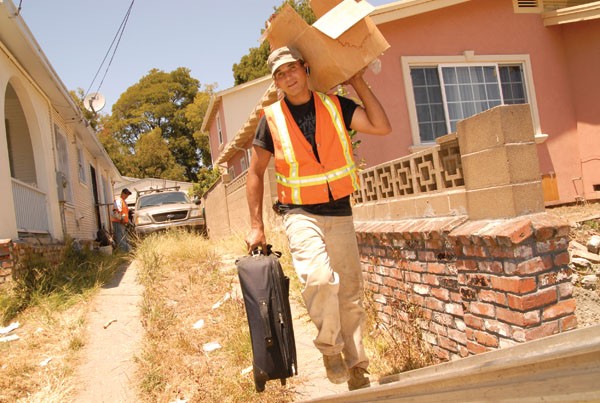
According to Martiniano Flores, the inspector for the Building
Services Division who oversees site cleanups and scheduling, this week
his department has ten different crews working on twenty-seven blighted
properties. And this Friday, they will get a whole new list for the
following week. A year ago, Flores said his department handled an
average of fifteen maintenance projects a week. In the best case
scenario, Flores sends a small crew to remove trash and animal
droppings. In the worse cast scenario — which occurred two months
ago — Flores said one crew found a dead body of a woman who had
been missing for seven years.
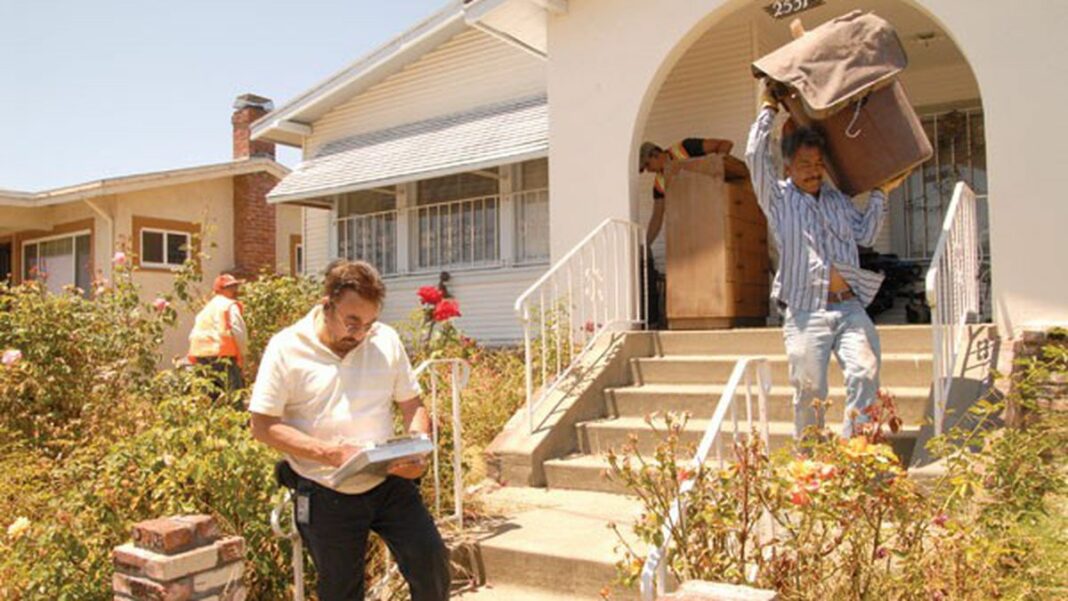
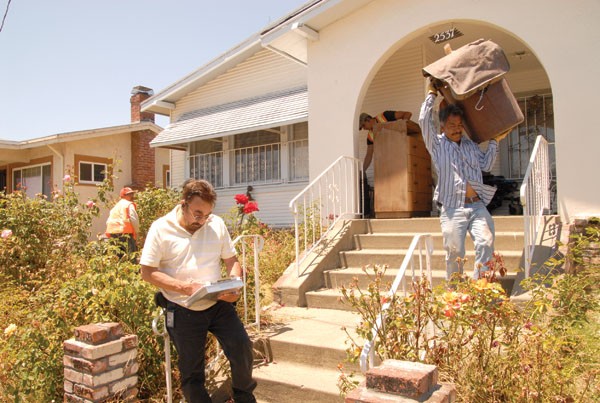
At 2537 64th Ave. in East Oakland, a blighted foreclosed property
— now housing overgrown weeds, broken televisions, small gasoline
containers, pots, pans, paint cans, and much more — required a
crew of five workers, trimming weeds and shoveling out loads of trash.
The back of the house, which faces the most structural decay, may have
to be fully demolished in the future due to its fragile condition,
Flores said. Bobby Thompson, who lives across the street, said that the
husband at that home died and his struggling widow subsequently faced
foreclosure. Thompson’s neighbor, homeowner Gerald Garcia, was one of
four people on the street who placed numerous calls to the city to
request a cleanup at 2537 64th Ave. As Flores confirmed, the city has a
large volume of requests and cannot address each one immediately.
Although relieved that the cleanup crew was finally doing its work,
Garcia expressed frustration over the two-and-a-half-month delay
between his request and the crew’s arrival. “I’m not worried about a
lot of places; I’m worried about this one,” he said of the city’s
explanation for delay. “I feel sorry for my neighbors who have to live
next to this garbage.”
The sheer volume of community devastation is so great, observers
agree, that it can no longer be ignored. Neighborhoods are falling
apart, and banks are far from done with all the foreclosures, they say.
“How much suffering do people have to have shoveled at their doorstep?”
asked Brown from Housing and Economic Rights Advocates. “What is it
going to take?” Groups like hers are working to hold the banks
accountable and prevent illegal eviction. Many say they have been very
successful in fighting the cases that they take on — but all
agree that for every tenant or homeowner they protect, so many more do
not make it to their door. These helpless residents leave behind their
properties and the neighborhoods they once called home. At every step
of the way there are efforts to pick up the pieces, but as the housing
crisis persists, so does the growing silence.