

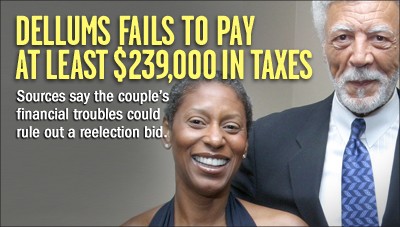
Oakland Mayor Ron Dellums and his wife Cynthia Dellums
owe at least $239,000 in back income taxes, according to the Internal
Revenue Service. Sources say the couple’s serious financial troubles
could rule out a reelection bid next year and force him to return to
his once-lucrative Washington, DC lobbying practice.
The IRS says the Dellumses failed to pay enough personal income
taxes in 2005, 2006, and 2007. On October 14, the IRS placed an
official lien against all of the couple’s personal property for failure
to pay adequate taxes in each of those years, according to records
filed with the Alameda County Recorder’s Office. Typically such liens
remain in place until the back taxes are paid off.

Credits: Jim Dennis
In a statement made through his spokesman Paul Rose, Dellums
disputed that he and his wife owe as much money as the IRS contends,
although he acknowledged that they have not paid as much taxes as they
should have. “There are previous disagreements with the IRS, regarding
the amount owed,” Dellums said. “The issue is being addressed and the
matter will be resolved in short order.”
Jesse Weller, a spokesman for the Bay Area office of the IRS,
declined to comment on the Dellumses’ case, citing the agency’s rules
on taxpayer confidentiality. But a knowledgeable source says Dellums
and his wife have faced financial difficulties ever since they moved
back to Oakland and he took over as mayor. “Their financial issues have
weighed heavily on his mind from day one,” the source said. “There’s no
question.”
The mayor’s federal income tax delinquency doesn’t speak well for
his ability to steward public resources in a city facing severe
financial challenges. It also raises serious doubts about his ability
to make good decisions. And being a tax delinquent violates his civic
duty as both a public official and a citizen. “Public officials are
supposed to be leaders for the rest of us,” noted Oakland
good-government activist Charlie Pine, a frequent critic of the
mayor.
The revelations about the mayor’s failure to pay taxes — first
revealed Monday on the East Bay Express web site — also
could sink his chances of winning reelection if he still harbors any
plans of running again.
But that looks highly unlikely because he and his wife apparently
don’t earn enough from his official Oakland salary of about $184,000 a
year to sustain the lifestyle to which they have become accustomed. For
example, the couple rent a stately four-bedroom, three-bath home on
Skyline Boulevard in the Oakland hills that appears to be out of their
price range. The Dellumses don’t have to reveal how much rent they pay
each month, but according to public records, their home is rather
large. It’s 3,204 square feet and sits on 9,667-square-foot lot.
According to Zillow.com, it’s valued
at $924,500, and was likely worth much more than that before the
housing crash.
The Dellumses also are well known for their expensive tastes. The
mayor dresses in exquisitely tailored suits, and his official mayoral
calendar reveals that they eat out often, usually in upscale
restaurants. In addition, Cynthia Dellums has held no paid positions
since he became mayor, sources said. Instead, she acts as his unpaid
advisor and is a fixture at City Hall.
Dellums took an unpaid leave of absence from his DC lobbying firm,
Dellums and Associates, when he became mayor. Oakland’s City Charter
requires that the mayor have no outside jobs while in office. A source
said the couple took a big financial hit when they came to Oakland
because he was making much more money as a lobbyist.
But that doesn’t square with the IRS lien and other public records.
The Dellumses appear to have gotten into serious financial trouble at
least a year before he became mayor and while he was still a lobbyist.
In 2005, the couple, who file jointly, failed to pay $124,199 in
federal income taxes, according to the lien. In addition, federal
lobbying records culled by the nonpartisan Center for Responsive
Politics reveal that Dellums and Associates reported only $90,000 in
lobbying income that year. As a result, it’s unclear exactly how the
Dellumses incurred so much tax trouble on so little income. (Although
Dellums also likely gets a congressional pension in excess of $100,000
annually, exactly how much he receives is unknown because he does not
have to report it on his official statements of economic interests
filed with the city.) In short, it appears that Dellums’ lobbying firm
wasn’t doing well, and he was in serious tax trouble long before he
took his mayoral oath.
The IRS lien states that the Dellumses failed to pay $66,554 in
taxes in 2006, which was also before he became mayor in January 2007.
Lobbying records, however, show his lobbying firm did much better that
year — earning $240,000 in income. But that’s still substantially
lower than the $370,000 the firm reported making in 2004. The IRS also
maintains that the Dellumses failed to pay $48,247 in personal income
taxes in 2007 — his first year as mayor.
Regardless of when the Dellumses’ tax problems began, they likely
have known about them for several years. The IRS routinely sends
repeated notices to tax delinquents, demanding payment, before placing
liens on their personal property.
Jerry Brown Escapes Scrutiny?
As Ron Dellums’ fortunes plummet, the chances of his predecessor
winning the California governorship received a significant boost late
last week. San Francisco Mayor Gavin Newsom dropped out of the
2010 race, leaving Jerry Brown as the only major Democratic
candidate running for governor. Newsom’s announcement also came at just
the right moment for the attorney general because he was weathering a
mini-scandal at the time.
Brown’s spokesman Scott Gerber had been under fire for
secretly taping a phone call with San Francisco Chronicle
reporter Carla Marinucci. It is illegal in California to tape a
conversation without the consent of all parties involved, and Gerber
later resigned after Brown placed him on administrative leave.
At the time of the taping, Marinucci was working on a story about
Brown allegedly doing a favor for an influential campaign donor. Brown
and his office have maintained that no favors were given, but Gerber’s
decision to secretly tape a reporter working on a possibly damaging
story raises doubts about their truth telling. “They knew what they
were doing was wrong,” said Doug Heller, executive director of
Consumer Watchdog. “And when it became clear that someone was looking
into it, they decided to break the law.”
The controversy at the heart of the secret-taping incident involved
a statewide ballot measure sponsored by Mercury Insurance, the state’s
third largest auto insurer. The measure would allow insurance companies
to lower rates for some motorists, while raising rates for others,
depending on whether they have let their car insurance lapse. The
measure is regarded as being bad news for low-income drivers. It also
contains almost exactly the same wording as a law backed by Mercury
Insurance and carried by former State Senator Don Perata in 2003
that was later invalidated by the courts. Perata had agreed to sponsor
the law after Mercury poured $75,000 into one of his campaign
accounts.
At first, it looked as if Brown’s office wasn’t going to play ball
with Mercury as Perata had. When Mercury submitted its new ballot
measure to Brown’s office in July for certification, the attorney
general responded with official ballot language that the insurance
company didn’t like. Brown’s office at the time stated correctly that
Mercury’s initiative would result in lower premiums for some people and
higher premiums for others.
Because Mercury officials knew that such wording would doom their
initiative, they withdrew it. But in September, the company came back
to Brown with a slightly altered version. Brown’s office, in turn,
responded with new a new ballot summary that highlighted the positive
side of the measure — that some people would qualify for
discounts — while omitting the negative part, which was that
others, particularly low-income motorists, would probably see their
insurance rates go up.
Consumer groups, including Consumer Watchdog, immediately cried
foul, alleging that Brown had changed the official ballot wording
because Mercury had given him a $13,000 campaign donation. That’s when
Marinucci called Brown’s office for comment, and his spokesman decided
to secretly tape her. Officials from Brown’s office did not return a
phone call seeking comment for this story, but in their interview with
Marinucci, they maintained that there was no quid pro quo with Mercury
and that they altered the official ballot measure wording because the
insurance company had made substantial changes to its initiative.
But did it? Copies of the two initiatives reviewed by Full
Disclosure reveal that while Mercury made a few minor changes between
July and September, none altered the basic meaning of the measure. Both
initiatives clearly allow auto insurance companies to give discounts to
people who don’t let their insurance lapse while also allowing rates to
go up for people who do.
Although Mercury’s initiative doesn’t specifically mention raising
rates, the 2005 California appellate court ruling that invalidated
Perata’s law revealed that rates automatically go up for some drivers
when they go down for others. The court specifically cited testimony
from two industry experts who explained that insurance companies are
required by law to bring in enough revenue to cover their potential
losses, so that if they award discounts to some customers, they’ll have
to charge more to others.
The court also pointed out that Perata’s law ultimately would have
led to higher rates for everyone. The court cited testimony from
experts who said that because Perata’s law would result in much higher
rates for some motorists, particularly poor people who are more likely
to let their insurance lapse, then those drivers would be less likely
to buy car insurance at all. And if fewer people get insurance, then
rates automatically rise for everyone else, the court noted.
Heller of Consumer Watchdog believes that this is Mercury’s ultimate
goal. The company claims that it supports the measure to promote
“competition.” That is, Mercury wants to attract customers from other
insurers by offering them discounts. But that will also allow Mercury
to raise rates for people it considers too risky. But raising rates on
low-income drivers will force more of them to drop their insurance,
which will allow Mercury to raise rates across the board. “It’s not
about getting new market share,” Heller said. “It’s about getting rid
of the people they don’t like.”
The court invalidated Perata’s law because it said the state
Legislature could not alter Proposition 103 — a statewide
initiative passed by voters in 1988 that prohibited insurers from
giving discounts to people who don’t let their insurance lapse. The
court ruled that only state voters could amend Prop. 103, which is why
Mercury is now sponsoring its new initiative.