
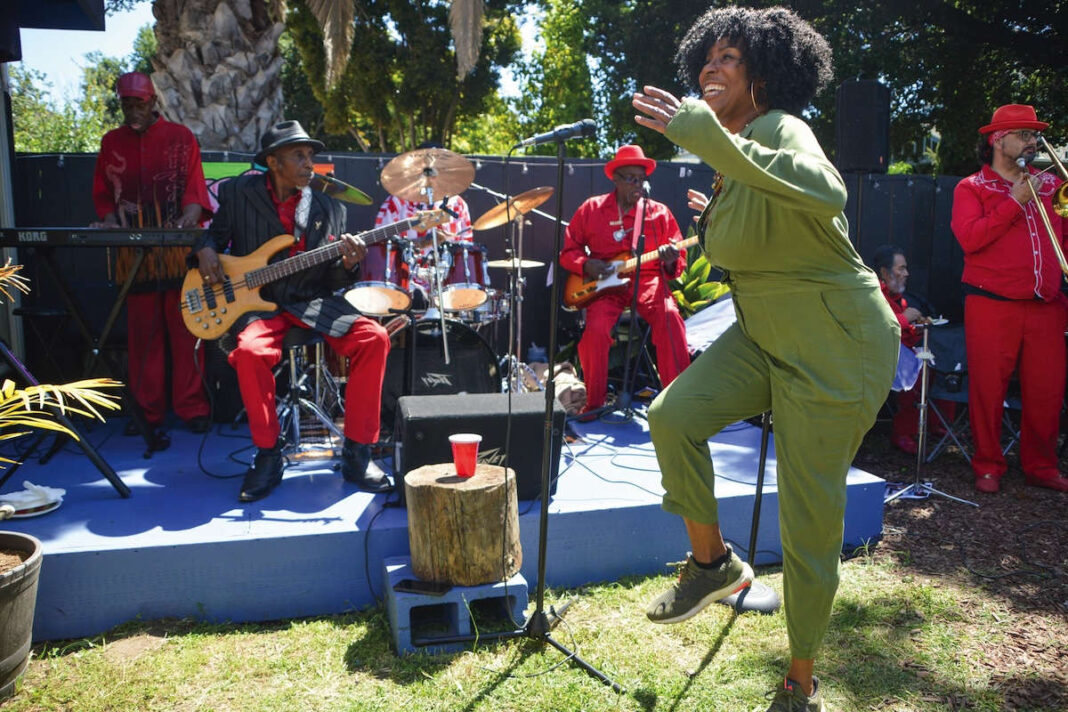
A map is drawn to lay claim to a place. This one is drawn to recover it: By walking ground that already belonged to someone and naming what survived the three-headed blaze of divestment, disorganization and gentrification.
Not everything about fire is destruction. The native ancestors of this land teach us that fire is a preparation—ash worked back into soil so the manzanita comes back sweeter, the redbud comes back taller, a meadow opens for whatever needs the light. BLACspace Cooperative’s The BLAC Map Tour runs on the same instinct. What was cleared here on purpose is growing back—a reforestation of the artistic landscape, one stop at a time, by the people who refuse to stop claiming it as their own.
The bus leaves San Francisco’s Museum of the African Diaspora (MoAD) at noon and, by 8pm, will have circled through two cities, six neighborhoods—one long sutra about growing something back from cleared ground, ending at the BLAC Map Party. Call it a root system mapped in real time: a tour of Seed Members—BLACspace Cooperative’s initial members, billed as “an expression of our love for the people, places and cultural work that make the Bay what it is”—with their seed members standing at every joint.
Start at MoAD. Big, funded, formal. Zakiya Harris chose it on purpose. She co-founded Impact Hub Oakland, Grind for the Green and Hack the Hood before co-founding BLACSpace.
“San Francisco is the canary in the coal mine of what happens to Black folks when you don’t organize,” she said—fitting, since the city’s arts ecosystem has been shrinking for a decade. Oct. 2 falls in the middle of Nexus, MoAD’s own Black Art Week, built on the same premise BLACspace is testing on wheels: that Black art in the Bay only survives if San Francisco and Oakland stop treating each other as separate scenes.
Swing ’round to the Minnesota Street Project. Ashara Ekundayo, founder of Artist As First Responder (AAFR), runs two studios, her own and AAFR’s in the gentrified Dogpatch, a historically Black neighborhood now owned, gallery by gallery, by the wealthy. She’ll sit down with Baba Emory Douglas, the Black Panther Party’s original artist.
“It is our honor to spend any time with him at all,” Ekundayo said. She reached for a different phrase for this reforestation of the arts community; “the edge” carried since she trained as a permaculture designer. “The space between the water and the shore, the space between the highway and the dirt. That’s where all the jewels pop up.” She said all she has to do is reach down and pick them up.
Then east into West Oakland’s Seventh Street, the old Harlem of the West. Next is East Bay Permanent Real Estate Cooperative (EB PREC). “They have purchased over 10 different levels of real estate that are all cooperatively run,” Harris said. Not rented—owned, collectively, on paper.
Next is B-Love’s Guest House, the Victorian of photographer and dancer Traci Bartlow. When asked why she fought for it, she began with childhood. “It’s a part of how I grew up,” Bartlow said, “holding space for people, holding space for family and friends … there’s a way that family receives you when you go and stay at their house.”
She added, “I better do something with this big-ass Victorian house.” She quoted a meme that stopped her cold—“When God gives you the ball, you better ball.” Then, quieter, she said: “There are things that this property honors. That is the legacy of my ancestors. My family, my ancestors, they had this, or they strived for this. This was their vision.”
Harris framed it from the outside: “Traci was the Airbnb before Airbnb ever existed. People didn’t even know what Airbnb was.”
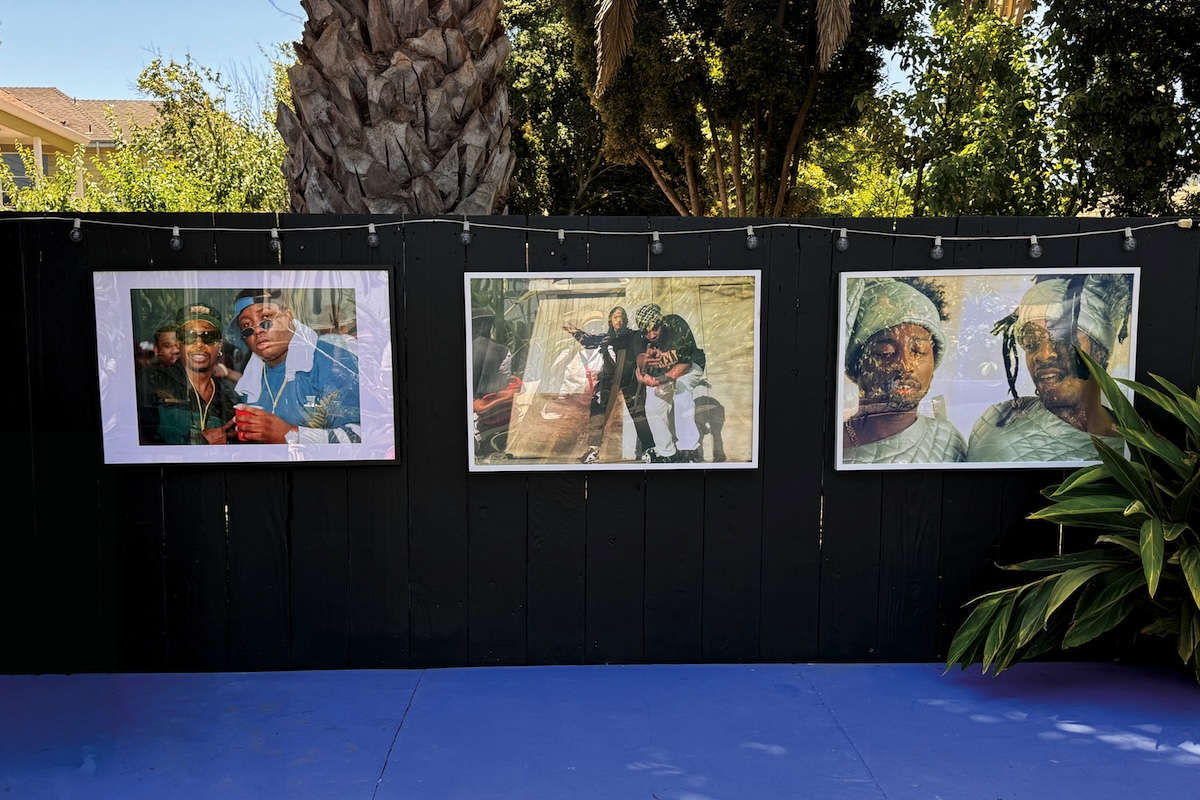
Then Koo Labs, the youth stop run by Kingmakers of Oakland. “A lot of their programming is run by young people,” Harris said. “It’s important that we also make sure that safe spaces for young people are just as important as part of this conversation.” A forest that only feeds its oldest trees won’t grow in depth—it needs new energy.
Downtown, Black Arts Movement Business District (BAMBD) House—Harris called it “an example of what happens when community comes together to organize.” BAMBD is the only Black-led black box theater in Oakland.
Finally, we arrive at BlaQyard, Fruitvale—a queer-run collective, chosen as the final destination. The event here will culminate in the BLAC Map Party, featuring a ceremony by Omnira Institute and an arts installation by 7000COILS and Tiffani Marie. Wanda Ravernell, a Lucumí priest who leads the Omnira Institute, will open the closing celebration with a salute to the ancestors, sung in Yoruba, backed by sacred drums.
“There’s a difference between ancestor worship and ancestor veneration,” Ravernell said. “Nobody does ancestor worship. That is saved for the creator. But the veneration, the appreciation for all the people who once lived, and the appreciation for your ancestors and their accomplishments, or their mistakes, are all present in the body that you carry now.”
By 8pm, the metaphor that’s been building all day steps forward in ceremony. Harris named it plainly, weeks before the bus ever moved.
“Our North Star and our goal of success is this idea of cultural reforestation,” Harris said. “Because Black culture is a currency that is extracted out of our communities, and it is used to benefit the entire world. Reforestation, because our ecosystem is a forest, and a forest takes 50 to 100 years to regenerate itself.” Harris said the work right now appears less visible at times on the surface. “We’re focusing on the soil, the soil repair of our community, which a lot of that is healing and trust, before we’re going to be able to even see the fruits.”
Ekundayo reached for the same ground when speaking of Arts as First Responders work with the collective. “Culture and nature mirror each other,” she said. “As a permaculture designer and as a curator, it makes sense that we would bring forth the language of nature.” She talked about a creative abundance that never runs dry, only a funding stream that does. “There is clearly a deficit of financial resources available to cultural workers. There is not a creative deficit at all. Not at all.”
Ravernell also reached for the same word. “One of the things that I was attracted to with the very idea of Black Space is reforestation of our cultural environment,” she said. “We used to have West Oakland. We used to have Fillmore. We used to have Bayview. And for various reasons we no longer tend to have a geographical area that could be called an area where Black people live.” Then, quietly, she added the hope underneath it. “In some ways we are going to regrow geography.”
The route refuses a straight line from big to small. It braids instead, museum, studio, home, lab, theater, drums. Harris has a word for the braid: infrastructure. “This tour is highlighting the infrastructure,” she said. “It’s not just the organizations, and it’s not just the programming. It’s the actual infrastructure that these organizations have said, ‘You know what, I might be a nonprofit, I might be a for-profit, I might be a cooperative, but I understand that me by myself is not going to be sufficient.’”
Harris said it best when asked what she wanted a first-time rider to walk away believing. “I want them to walk away with the fact that another world is possible,” she said. “If they are an organization, I want them to join our membership. If they are a consultant or a small-business owner, I want them to join our consultant list. If they are a funder, I want them to fund us. The most important thing is we want them to be connected to our ecosystem.”
That ecosystem has a name and a door into it: BLACspace Cooperative Membership. A movement of cultural and creative leaders shaping the world we live in and the future we want to create. Rooted in the Black cooperative tradition and cultural stewardship, BLACspace seeks to build the infrastructure for a new arts economy through collective power, shared resources and community care. The vision is shared. The resources are shared. The future is built together.
Sasha Kelley, BLACspace’s mutual aid steward, traced that same throughline back through her own years in Bay Area collectives. “Being a part of collectives strengthened my confidence as a visual and sound artist, in addition to really building my social practice,” Kelley said. She called the Malidoma Collective and the House of Malico her true foundation, places that taught her “how to intimately work and support various artists as we build the plane and fly the plane at the same time.”
Watching spaces like Omiiroo, the Living Room Project 510 and the Alena Museum around Oakland showed Kelley the same strength BLACspace is scaling now. “Our membership program and our ecosystem requires collaboration and cooperativism,” Kelley said, “which feels like the next level of our collective curriculum.”
Every stop on this route sits exactly on one of Ekundayo’s edges, the border where the water meets the shore. Not an accident of scheduling. The whole design: a map of a forest that was supposed to disappear, drawn instead in bus stops and drum circles. This event is sponsored in part by Culture Strike Network and The Center for Cultural Power.
The next tour meets on Friday, Oct. 2, 11:30am at MoAD, 685 Mission St., San Francisco. $100. For more info, visit blacspace.coop/events/the-blac-map-tour.