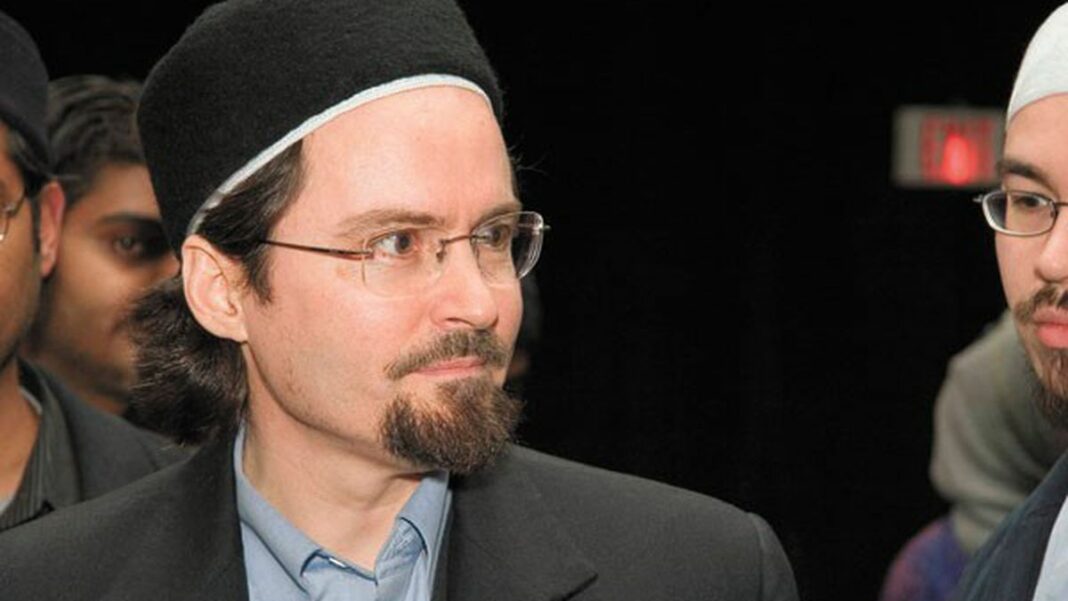
Hamza Yusuf and Zaid Shakir aren’t well known in mainstream Bay Area
circles. But these two Muslim converts — one white and one black
— are fast becoming household names in many Islamic homes around
the world. They are the founding fathers of Zaytuna College in downtown
Berkeley, which hopes to turn itself into this country’s first fully
accredited Muslim college.
Yusuf and Shakir aspire for Zaytuna to promote an American
alternative to traditional Muslim education. Their school’s approach is
designed to be more inclusive than the path offered by some Shiite
extremists or certain followers of Wahhabism, a reactionary Sunni sect
whose teachings have been spread around the world by many scholars and
religious leaders bankrolled by ultraconservative Saudi-Arabian
Muslims.
Credits: Umar Shahzad
Credits: Zaytuna Institute
Credits: Zaytuna Institute

“They are rooted in tradition, but have a narrow view of tradition,”
Shakir said of those movements. “We are rooted in tradition, but have a
wider view of it. We are trying to present Islam as an organized whole.
That makes it more difficult to distort, harder to use in
less-than-productive ways.”
It is not by accident that Yusuf and Shakir named their school
“Zaytuna,” the Arabic word for “olive,” a tree considered blessed in
the Jewish, Christian, and Islamic traditions. The olive branch is of
course a well-known symbol of peace — something all three of
those religions can use today in their encounters with each other.
Yusuf is particularly well suited to promote peace between
Christians and Muslims. He was raised in an Orthodox Christian family
before converting to Islam, and was known as Mark Hanson when he was
growing up in Marin County. After a near-fatal car accident in 1977, he
turned to the Muslim faith and later went abroad for four years to
study Arabic and Islamic theology. He returned to the Bay Area, got a
degree in religious studies from San Jose State University, and in 1996
set up a small Muslim think tank in Hayward called the Zaytuna
Institute.
Over the last decade, his knowledge of Islamic tradition and life in
the West, combined with a charismatic personality and riveting lecture
style, has turned him into an international Muslim superstar. In the
aftermath of 9-11, his criticism of Muslim extremists won him an
invitation to the White House, but he drew attacks from other Muslims
who derided him as George W. Bush’s “pet Muslim.” However, others had a
more positive assessment.
A story in the English-language monthly Egypt Today called
the goateed scholar “the Elvis Presley of Western Muslims.” In an
interview that ran with that story, Yusuf complained that the world has
too many “half-baked, weekend muftis calling for jihad after looking up
its meaning on Google.” There is a dire need, he says, for “renewal and
reinterpretation” in Islamic scholarship. “There are many things that
need to be revisited,” he said. “The problem is that we no longer have
qualified people to do the revisiting. Most of the so-called scholars
are rejects from the school system.”
Yusuf says he will counter this trend by offering students a solid
education in Arabic, the Koran, theology, jurisprudence, and Islamic
spirituality. A prospectus on the new curriculum promises that “Zaytuna
College will train students to relate to the world in all its
multiplicities, while not losing sight of divine purpose.”
“By comprehending the philosophical foundations of western
civilization, by becoming familiar with the intellectual currents that
shape our world, and by understanding the forces at work in the social,
cultural, and political life of modern societies, we believe our
students will be able to contextualize Islamic knowledge in a dynamic
and productive way.”
One of the college’s lead instructors will be Shakir, who was born
in 1956 in Berkeley with the given name of Ricky Mitchell. Ricky and
his family bounced around the country — Michigan, Georgia,
Connecticut — each time his parents split up, reunited, and then
split up again. Mitchell’s mother raised him in the black Baptist
church, trying as hard as she could to shield him from the drugs,
alcoholism, random violence, and other realities of life in the housing
projects in New Britain, Connecticut.
Mitchell enlisted in the Air Force in the 1970s, where he met his
wife, Saliha, and the religion that would change their lives. “I was a
seeker,” he recalled in an interview at the college library, on an
upper floor overlooking busy Shattuck Avenue.
He had read books on Buddhism. He’d spent two years practicing
Transcendental Mediation. He went though phases as an atheist and a
Communist. Then someone suggested he read a book called Islam in
Focus.
“Islam was the complete package,” he recalled. “Meditation had made
me very calm and relaxed, but I started to see it as a selfish way of
life. It wasn’t doing anything for the people around me. Islam stresses
charity, and offers very structured rules for family life. It addressed
in very clear terms a lot of the social anarchy that I saw all around
me while I was growing up.”
Shakir converted to Islam in 1977 and wound up leading an
African-American mosque in New Haven, Connecticut. Then he traveled to
Syria to immerse himself in the Arabic language, the Koran, and other
traditional Muslim texts.
It’s not all that surprising, he said, that two Muslim converts have
taken on themselves to revive Islamic traditions — and do it in
the United States. “Converts tend to be zealous,” Shakir observed.
Zaytuna College plans to welcome its first regular class of twenty
students in the fall of 2010. Five trailblazing students graduated in
the summer of 2008 after completing a four-year pilot program. In the
meantime, Zaytuna Institute continues to offer several freestanding
courses along with an intensive study program in the summer for
students seeking a “complete immersion experience” in Arabic.
Over the next year, the college hopes to raise money to launch its
ambitious new program. According to a glossy fifty-page brochure given
to prospective students and donors, Zaytuna is committed to furthering
“Islam’s critical role in the modern world.”
“At the heart of our mission is the Islamic legal, intellectual and
spiritual tradition, which we believe to be derived from the Qur’an and
the words and deeds of the Prophet Muhammad,” the prospectus states.
“Unfortunately, the modern world has not been kind to the Islamic
educational institutions that were once the envy of the world. As a
result, Muslim scholarship has been reduced to an anemic state.”
The supporters of Zaytuna College see it as offering a new kind of
higher education for Muslims growing up in the Bay Area — whether
they are the children of immigrant families from Pakistan, Iran, or
other Muslim countries, or kids raised by African-American
converts.
Hatem Bazian, a Palestinian-American lecturer at UC Berkeley, is
helping Zaytuna get through the lengthy and complicated process of
establishing itself as the first fully accredited Muslim college in the
United States. They hope to have those accreditation papers by next
year.
Bazian sees the Bay Area as the perfect place for a new generation
of homegrown Muslim students to deepen their knowledge of their culture
and religion. Silicon Valley jobs have drawn thousands to the Bay Area
from Muslim lands around the world. Many of these workers’ children
have now reached college age. Some are showing up at UC Berkeley, but
others would favor a more traditional Islamic education.
“We are seeing students now who grew up in Muslim schools in the Bay
Area and are very comfortable with their identity as American Muslims,”
Bazian said. “They are now able to maintain [religious] continuity from
kindergarten all the way through the university.”
At the same time, many non-Muslim students are curious about Islam.
Bazian began the fall 2008 quarter expecting about sixty students to
sign up for his undergraduate course at UC Berkeley on Islam in
America. More than twice that many wound up in the class.
Meanwhile, while Zaytuna plans to start its undergraduate program,
the Graduate Theological Union (GTU), a consortium of Catholic and
Protestant seminaries in the Berkeley’s Northside neighborhood, has
started its own Center for Islamic Studies.
Together, these three Muslim study centers — Zaytuna, UC
Berkeley, and GTU — could soon make Berkeley a mecca for serious
Muslim scholarship.
The GTU program is already attracting young Muslims from immigrant
families, and American converts who first became interested in Islam
through the black Muslim movement of the 1960s and 1970s, or through a
fascination with Sufism, a mystical Muslim tradition popular among some
New Age seekers.
Abdul Hamid Robinson-Royal grew up in the black Pentecostal church
in Milwaukee and embraced Islam four years ago. He came to the GTU to
work on a Ph.D in Cultural and Historical Studies of Religion. He does
not refer to himself as a convert, but as “a Muslim who is culturally
and experientially Pentecostal.” One of the things he hopes to do at
the GTU is study other people with “transdenominational or
transreligious identities.”
Robinson-Royal was attracted to GTU’s interdisciplinary approach,
and plans to draw on the rich academic resources on the UC Berkeley
campus, which accepts GTU students into its classes. Most Islamic
studies programs in the United States focus on the history of Islam,
but these student-scholars are more interested in Muslim life
today.
“We are trying to speak to the American Muslim identity,”
Robinson-Royal said. “This is not the kind of stuff you read about
Islam on the front page of the newspaper. It’s not so exciting to find
out that your Muslim neighbor cuts his grass just like you do. You
can’t ‘other’ and exoticize people as easily once they become part of
the fabric of the culture. When most people think of Islam they think
of a religion that was founded in Arabia by and for Arabs. Yet only
about 15 percent of the world’s Muslims are Arabs.”
Program leaders at all three of these schools say they are committed
to helping a new generation of Muslim leaders get a classical Islamic
education and the skills and knowledge they need to operate in
puzzling, spiritually diverse places like the San Francisco Bay
Area.
There are now some four dozen mosques operating in the Bay Area, yet
only a fraction of those employ a full-time imam for spiritual
guidance. Many of those imams are brought in from overseas, and have no
idea how to operate in a contemporary American context.
“We are setting them up for failure,” Bazian said. “All of a sudden
they have to deal with a person on drugs. They don’t even speak
English. Many of these imams are brought in by the older generations
who want a taste of back home. They have this nostalgic attachment to
someone who can speak to them in Arabic, but then the mosque becomes a
border against the outside world.”
Bazian sees Berkeley as the perfect place for the new college. “The
university is a gravity center that brings in a lot of intellectual
resources, ideas, and ways for people to connect,” he said. Bazian
looks forward to the day that Zaytuna can be fully incorporated into
the GTU, operating just like its other member schools. Those seminaries
include the (liberal Protestant) Pacific School of Religion, the (Roman
Catholic) Jesuit School of Theology, and the (Episcopalian) Church
Divinity School of the Pacific. “Conceptually speaking, I think it
would also be good for Zaytuna to become one of the GTU schools as a
way to recognize the Islamic faith within the GTU.”
Such an arrangement would take many years to develop, but Hamza
Yusuf — who is now studying for his Ph.D at the GTU — is
working to forge new ties between Zaytuna and Northside seminaries. He
was the keynote speaker at a recent invitation-only conference the GTU
titled “Who Speaks for Islam? Media and Muslim Networks.”
In his public remarks, Yusuf presents himself as a harsh critic of
violent Muslim extremists and an impassioned advocate for increased
tolerance and respect for Americans who make Islamic practice an
integral part of their lives.
“Evil is never done with more enthusiasm as when it is done in the
name of God,” Yusuf said. “That is why it is so important for us to
have enlightened religious leadership and enlightened seminaries.
Religious leadership has to try to limit the toxic externalization of
religion. … When you are looking at the madness in the Muslim world,
look at the states and the failure of the states to address the real
needs of millions and millions of people. … There is so much
frustration in many Muslim countries about the inability for them to do
anything in society, and there is a segment that resorts to
violence.'”
Yusuf, who now lives in Danville with his wife and four children,
spoke following a reception in Easton Hall, which once served as a
Dominican school but is now owned by the Episcopal seminary. Prior to
his talk, Yusuf led about two dozen Muslim men in their evening
prayers, pointing toward Mecca.
It was a sign that the times are changing at the Graduate
Theological Union.
“One of the things that so intrigued me about Islam is that, in
Islam, Jesus comes back at the end of time,” Yusef told his newfound
Christian brethren. “The prophet Mohammed said that Christians who
become Muslims get double the reward of anyone else. In the Koran, it
says one of the things that Christians bring into Islam is the teaching
about turning the other cheek — deflecting wrongs with rights.
And that is what is so needed today. Christians need to learn that.
Muslims need to learn that, too.”