
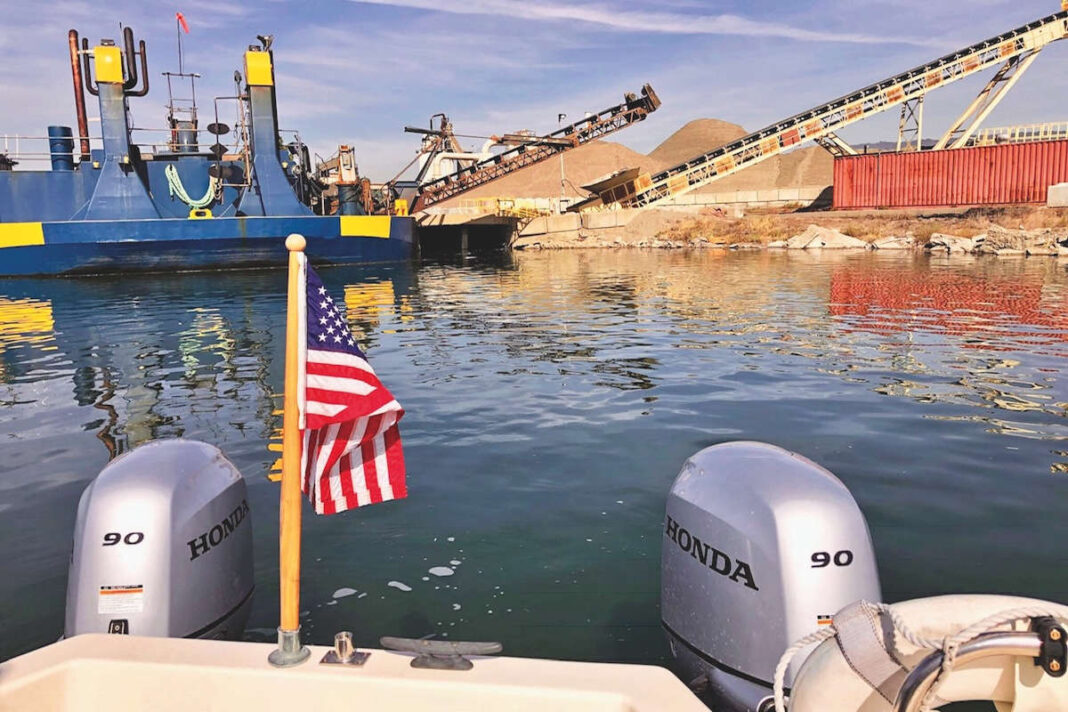
Sejal Choksi-Chugh is the executive director of San Francisco Baykeeper, which is based in Oakland. “Sand mining is happening right near San Francisco and Treasure Island, but it doesn’t look alarming,” she said. “Most people assume the vessels are doing routine maintenance.” But they aren’t.
Instead, two for-profit companies, Martin Marietta and Lind Marine, continue a decades-long practice of extracting sand from the Bay floor to be used in making concrete and asphalt. The environmental problems associated with this, Choksi-Chugh said, include not only harm being done to native species, such as Dungeness crab, which live and migrate along the sandy floor, but also that this sand is ancient, irreplaceable, and protects the Bay’s shorelines from erosion and sea-level rise.
Baykeeper managing attorney Eric Buescher described the mining process as like a “giant vacuum cleaner,” sucking up sand, as well as tiny creatures and plants, and directly impacting marine habitats, including those of some endangered species.
Baykeeper discovered that the State Lands Commission (SLC), in reauthorizing the leases that permit the two companies to continue to mine the Bay, was using faulty baseline data to claim that the total volume of sand mined would decrease under the new leases, when the opposite is in fact true. The leases would approve the taking of more sand out of the Bay. Therefore, on March 12, the nonprofit filed a lawsuit against the SLC in California Superior Court for the County of Alameda, which asserts that the new, 10-year leases violate “both the California Environmental Quality Act (CEQA) and the agency’s public trust obligations.”
Buescher said, “There was a cap on how much sand could be extracted. The companies never hit that cap.” In authorizing the current leases, he said, the SLC is using the cap data to claim that less sand would be extracted, which would not be the case unless the cap was also changed. “In doing so, the SLC disguises the actual impact. Research shows that the sand is not being replenished,” he added.
“Once it’s gone, it’s gone,” Choksi-Chugh said. “We’re already short on sand. San Francisco spends millions of dollars a year trucking in sand to replenish Ocean Beach, while the state is selling off the Bay’s own supply.”
She continued, “The consequences are not yet fully known. What we do know, based on the most recent studies, is that they’re irreversible.”
Asked how long it will take for the lawsuit to be heard and adjudicated, Buescher noted that Alameda County has a dedicated judge for CEQA cases, but that it could still take more than a year for the case to work its way through the court. That does not take into account the appeals process.
An important meeting was scheduled to take place April 16 at the Bay Conservation and Development Commission (BCDC), in which, according to the BCDC site, “the Commission [will receive] a briefing that gives a concise overview of sand mining activities in San Francisco Bay, the process the Commission has undertaken to better understand mining effects on the sand supply, transport, and source.”
Representatives from Martin Marietta and Lind Marine were scheduled to give a presentation, then Baykeeper was scheduled to “share [its] perspectives on the process and findings with the Commission.” Also according to the BCDC site, “Commission staff is currently working with the mining company representatives in a pre-application process, with full permit applications anticipated in Spring 2026.”
Choksi-Chugh urged people concerned about this issue to take action. “People can sign our alert, baykeeper.org/take-action-tell-ca-to-stop-selling-the-bays-sand-for-concrete, urging the BCDC to step in and limit sand mining in the Bay. This is one of the local agencies that has the authority to limit the amount of sand that can be mined,” she said.
“Just as important, talk about the issue! More people need to understand that the Bay’s floor is being mined and sold off for private gain,” she added. “Awareness is what drives action, and we need both right now.”










We cannot afford to line billionaire pockets.