It was the corn soup that did it.
We’d picked up a few perfect ears of white corn from the farmers’
market that morning. I’d been eyeing a recipe in the latest Bon
Appétit magazine. My husband agreed to keep the kids out of
the kitchen for a bit while I pieced together the dish. Soon, I
imagined, we would sit down to an early dinner of fresh corn soup
— really the essence of late summer — and the kids would
smile at each other, my husband would remark on my superb culinary
skills, and we would all appreciate the glory that is farm fresh food
and a home-cooked meal.

Credits: Sierra Filucci
Credits: Sierra Filucci

Credits: Tony Contreras
Credits: Sierra Filucci
Credits: Sierra Filucci

Credits: Sierra Filucci

I sliced the kernels off the first ear. Nearly half fell onto the
floor. Then I ground the remaining ears through a cheese grater. Milky
residue dripped into my shoes. Navigating around my cramped little
kitchen began to get more dangerous as the corn detritus on the floor
made a slippery mess. I added the corn to steamed milk and poured half
the mixture into my food processor. As I pushed down on the lever, a
hot stream of corn milk splurted out the container’s seam, drenching my
shirt and nearly scalding my torso. My husband checked on me
periodically, saying, “Why don’t we just have spaghetti?”
After several more steps to the perfect corn soup, I strained the
now-blended milky mixture through a fine sieve, leaving about four cups
of faintly yellow fluid in a pot. It was a meager return on my
investment. Sweaty, wet, dirty, and smelling of an Iowa farm field, I
called the family together and ladled out the warm liquid into
beautiful blue china bowls.
“I don’t like soup!” was the first remark from my four-year-old
daughter. The two-year-old took one look and shoved the bowl across the
table, slopping some. He began to dance on his chair. My husband stayed
quiet. He slurped a spoonful. Then he got up, went into the kitchen,
and returned with three types of hot sauce, a bag of cilantro, some
diced onions, and a stack of tortillas.
I sat glumly spooning lukewarm milkiness into my mouth. I tuned out
the complaints whined by the kids and the eye-contact avoidance
practiced by my husband and I entered a contemplative moment.
My problem is that I’ve been reading too many books. That’s what got
me into this mess in the first place. First, it was Eric Schlosser’s
Fast Food Nation. That put an end to Happy Meals on road trips
to Grandma’s. Then it was The Omnivore’s Dilemma. No more chewy
Oroweat bread with high-fructose corn syrup. And finally, Barbara
Kingsolver’s Animal, Vegetable, Miracle banned the beloved
banana, whose carbon footprint was just too large.
But while I was thinking about what kinds of foods are good for my
kids’ bodies and our Earth, my family was seeing less and less of me.
Why? Because I was flailing around in the kitchen guiltily trying to
slow-food my way to dinner before the kids had low-blood-sugar
meltdowns and started doing backflips off the couch. I was not having
any fun in the kitchen. While cooking was once a joy, and eating still
is, having kids afoot puts a particular pressure on a chef to outdo
even Rachael Ray’s feats of speed-cooking. What I was learning was that
Rachael Ray and Michael Pollan don’t mix.
That’s when it came to me: I’m not going to cook anymore. And like
some rebellious housewife from the 1960s getting her first taste of
feminism, I made an announcement.
“I’m on strike.”
My strike progressed for a week, then two, then four, and my
husband, Tony, stepped up valiantly. Among my friends, Tony is famous
for his sensitivity and his rejection of stereotypical male attributes.
He does most of the housecleaning, was a stay-at-home dad, likes to
bake, and has always put my career ahead of his own. He was raised by a
single mom and his grandmother, and he doesn’t hesitate to call himself
a feminist.
But he can’t cook.
So we struck a bargain: He didn’t complain about making dinner every
night, and I didn’t complain about his repertoire of burritos, pizza,
and nachos. The arrangement worked. I got to hang out with my kids in
the evening, they got meals they loved to eat, and my husband was able
to prove to both of us that he was as generous and understanding as we
had always boasted.
And while on strike I started to think more about this slow-food,
back-to-the-land ideal so righteously propagated on bookshelves and
middle-class playgrounds from Rockridge to the Upper West Side. Was it
really working for families like ours, where both parents are busy
outside the home? Can we cook wholesome meals, grow some of our own
food, make bread, and maybe raise a backyard chicken without
sacrificing too much time that might be better spent doing something
else — like playing with our kids or going to grad school?
Maybe, I thought, this elevation of food to a holy plain is a noble
movement that is simply ignorant of the real lives of modern working
families. And without realizing it, this movement, one that’s so
appealing to young progressives, is actually pushing for a more
traditional family structure, gently nudging women back to a place our
forebears fought so hard to escape: the kitchen.
I soon grew tired of my husband’s nachos. (Really, how long can you
pretend that tortilla chips are a suitable carbohydrate?) So I
refocused my dinner frustrations. Since neither I nor my husband was
satisfied with this one-sided approach to feeding our family, we had to
find another way. Let’s push up against both extremes, we decided, one
that values speed and one that values flavor, and see what we get.
I quit my strike, and we set off in hopes that an experiment would
lead us to a solution. For one entire month, we would eat dinners that
were easy and fast — and, to an extent, bad. If it came frozen,
wrapped in cellophane, in a plastic tub, or with a pop-top —
things Michael Pollan doesn’t even consider “food” — we would buy
it and eat it. If it came in individual servings, all the better.
The following month, we would live out the locavore’s dream. We
would soak beans; braise grass-fed meat; forage for herbs; plant a
garden; and make our own bread, cheese, and pasta. Maybe we’d adopt a
chicken. We would buy our food exclusively from farmers’ markets, local
farms, and our neighborhood mom-and-pop market looking for local and
organic brands. We would compost our trash, too.
This would be a battle between the frozen chicken piccata with 38
ingredients and the BLT made from Prather Ranch bacon, hand-kneaded
bread, farm-fresh veggies, and home-blended mayonnaise. But more than
that, it would be a test of what it means to be a mother — a
mother who wants to feed her family and keep them healthy, but who also
wants more from life than kneading dough and a sink full of dishes.
The Trader Joe’s supermarket by Lake Merritt is constantly busy.
People flock to the store to buy food that is an ideal combination of
cheap, convenient, and, at least ostensibly, healthy. The aisles are
filled with bagged salad mix, individual containers of yogurt, and
pocket-size packets of almonds: the perfect place to begin our month of
convenience foods. With four-year-old Lola strapped in the shopping
cart, the two of us headed to the frozen aisle. Lola wanted everything
we saw — BBQ Blue Cheese Chicken Wings, Coconut Curry Chicken
Stix, Marinated Fish Tacos, and Philly Cheesesteak Pizza.
The snazzy names and colorful boxes reminded me of a study I read
last year that showed kids preferred carrots wrapped in McDonald’s
packaging to the same carrots in generic packaging. And it wasn’t just
that they liked the packaging; they said the carrots actually tasted
better. In a different study by NBC, kids chose a rock covered with
cartoon characters over a banana for breakfast. A rock.
With all these thoughts in mind — what the kids would actually
eat once the wrapper is discarded, what my husband and I would enjoy,
and what met a modicum of nutrition standards — we settled on
rice biriyani, spanakopita, chicken enchiladas, green-chili tamales,
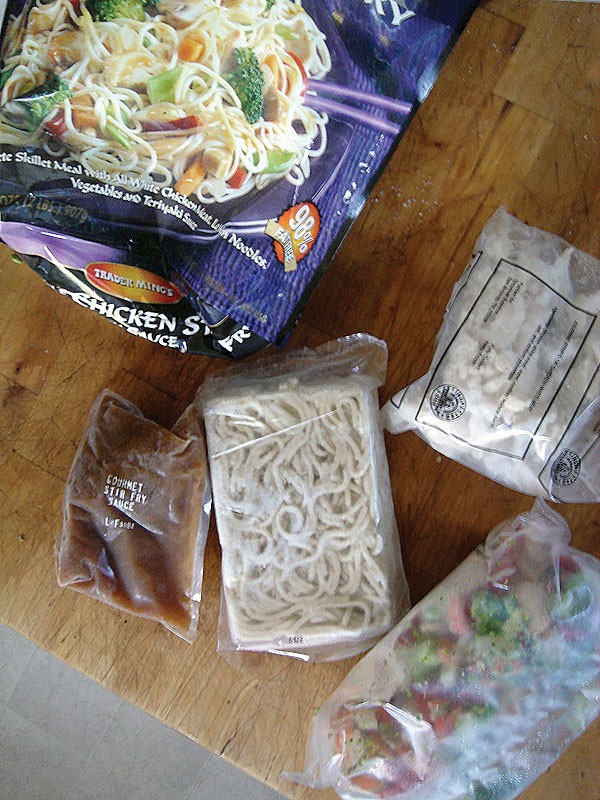
Asian-style chicken stir-fry with sauce, and penne pepperonata.
I steered our cart toward the checkout with our frosty bounty in
tow. Waiting in line I thought of the list of “quick meals” Trader
Joe’s advertises on its web site with the promise: “You can do it all
AND eat well too!” Well, that sure sounded good; I wondered if rice
biriyani could really fulfill that pledge. But Trader Joe’s “do-it-all”
message was eerily familiar. It reminded me of my mother in the 1980s,
when magazines showed yuppie moms in crocodile pumps and
shoulder-padded blazers on their march to investment banks, advertising
agencies, and real estate offices. This was just after 1978, when the
balance between American women staying home and working had just tipped
to the latter’s side. My mom balanced a full-time nursing career, a
house, a husband, a teenager, and my baby brother and sister.
I remembered a phone call I made to my mother right before I got
pregnant. “I don’t understand how it works,” I said to her. Her
response surprised me: “It doesn’t.” Now, standing there in Trader
Joe’s, I thought that maybe a microwave would have helped.
On a Tuesday night, soon after the Trader Joe’s shopping experience,
the four of us arrived home and the kids pinballed around our small
two-bedroom house, knocking papers off my desk, rifling through piles
of books, and playing tug-of-war with a baby doll. I rushed into the
kitchen to prepare dinner, leaving my husband to referee, when I heard
Lola’s voice calling me. “Mommy, can I help you make dinner?”
Where before this plea caused me to panic, staring at a butcher
knife and pile of raw chicken while thinking of small fingers getting
lopped off in a salmonella nightmare, today I felt much more relaxed.
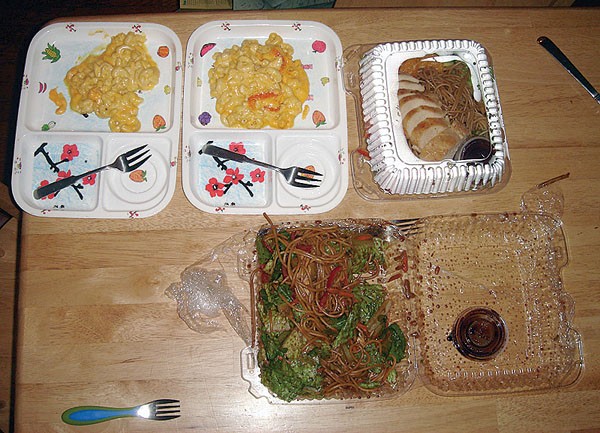
Lola’s “help” involved grabbing a bag of salad mix and dressing from
the fridge and plopping a few pieces of pre-cooked “Just Chicken” on
top while I pressed a few buttons on the microwave. While this probably
wasn’t what Alice Waters imagined when she urged parents to involve
kids in cooking to teach them patience and self-discipline, it was a
lot easier than letting a four-year-old wield a Wüsthof chef’s
knife.
As the month of quick cooking progressed, food faded into the
background. I shopped once a week at Trader Joe’s, with one midweek
stop at the corner store when we ran out of milk. Driving home, when I
used to alternate talking to the kids, listening to the radio, and
piecing together dinner in my mind, was much more peaceful. With dinner
always tucked away in the freezer, I never worried about ingredients
going bad or how to muster the perfect combination of protein, carbs,
and vitamins.
With more weekend time, we started going out more. One Saturday we
packed the kids in the minivan and took off for the San Francisco
coast. When we arrived we found a bunch of people cleaning the beach,
so we volunteered to help. Lola held the plastic bag while her younger
brother donned oversize rubber gloves and scoured the sand for
cigarette butts. I thought this would make up, at least karmically, for
all the plastic packaging we were tossing out each night.
Besides the packaging, though, there were other things that didn’t
feel quite right about the quick meals. First of all, they weren’t
always quick. While dinner took less time to prepare than usual —
on average 14.2 minutes — several meals took just as long to fix
as a non-frozen counterpart. For instance, one night we ate rice (from
frozen packets), beans (from a can), with a vegetable medley (also
frozen) and a salad (bagged), and, because we microwaved each bowl
individually, it took 31 minutes to get everything to the ideal
temperature. Another night we ran into a similar problem with frozen
meals from a delivery service. Because each entrée had to be
defrosted and cooked in the microwave for 5 to 6 minutes, total prep
time was 22 minutes. And in both cases, what we sat down to eat was
disappointing.
For one thing, everything sort of tasted the same. Whether it was
Indian or Thai, Italian or Mexican, each frozen dinner had a cloying
sweetness. Perhaps that explains why the children were eating so
enthusiastically. When I spoke to Michael Pollan about our experiment,
he warned that my kids would probably love the processed food, thanks
to its high sugar and salt content, and then rebel when we started
serving what he calls, simply, “food” — items with fewer than
five ingredients.
What we were eating definitely had more than five ingredients,
although because we chose Trader Joe’s over a mainstream supermarket,
the ingredients were not as frightening as they could have been. Yes,
the chicken piccata had 38 ingredients, but the bulk of the list
consisted of recognizable items like white wine, lemon juice, shallots,
and butter. The strangest ingredients were “manufacturing cream,”
“calcium chloride,” and “spice extractives.” But what Pollan and other
locavores emphasize is not so much the harm of multiple ingredients,
but the distance and process the ingredients have undergone before they
are popped into the microwave. They believe it’s this distance —
both literal and figurative — that leaches out all that’s good
and wholesome about food.
Taste wasn’t the only casualty. The experience of cooking, which
held such pleasure, at least before I had kids, was relegated to
standing in front of the microwave and opening and closing its door.
And it was standing there one night, watching a potpie rotate under its
spotlight like a pageant winner wearing a crown, that I thought about
what it means to be a mother feeding her children.
Before I was even pregnant, I knew I would forgo formula for breast
milk. I was so proud when my daughter gained a pound at her one-week
checkup instead of losing weight like most new babies. My role in
keeping her healthy wasn’t academic, it was physical. It was about
skin-to-skin contact and putting enough calories and fluids into my own
body to be able to nourish hers. When she started eating solid foods, I
steamed sweet potatoes and cranked them through a food mill, just as my
mother had done for me. But now, instead of my body, I was passing food
through God knows what countries, with God knows what food-safety
standards. How far I’d come. From breast milk to potpie.
That night, staring at the spinning microwave, wishing it would go
faster because I could hear Nico beating something against the computer
while Lola urged him on, I felt pressed into an unworkable space. The
space between a smashed keyboard and preservatives — between time
and health.
When Michael Pollan published The Omnivore’s Dilemma in 2006,
he planted the book in fertile ground. While the populist energy of the
organic food movement of the 1960s and 1970s had long since disappeared
from all but the most dedicated communities, a growing fascination with
food and cooking (spurred on by the Food Network and celebrity chefs)
along with a resurgence of attention to food sources (thanks to
food-borne-illness scares) had brought organic food into the
mainstream. Whole Foods, which started in Texas in 1980, had bloomed to
some 270 stores across the country, Canada, and the United Kingdom.
World organic food sales had nearly doubled between 2002 and 2006,
becoming a $40 billion business.
And so, when Omnivore hit the shelves, moms, grandpas,
farmers, and urbanites bought it. They devoured it. And it changed
their lives. Pollan made the connection between a ludicrous national
farm policy and troubling consequences for the environment and health.
And, like Al Gore’s recommendation to swap out lightbulbs, Pollan
brought the solution to people’s doorstep: Change the way you eat. Grow
a garden. Buy from farmers’ markets. Cook your own food. And people
thought: This is something I can do. I can change what’s wrong
with our world just by planting some tomatoes. “This is about how you
live your lives and how you encourage your children to live their
lives,” Pollan said.
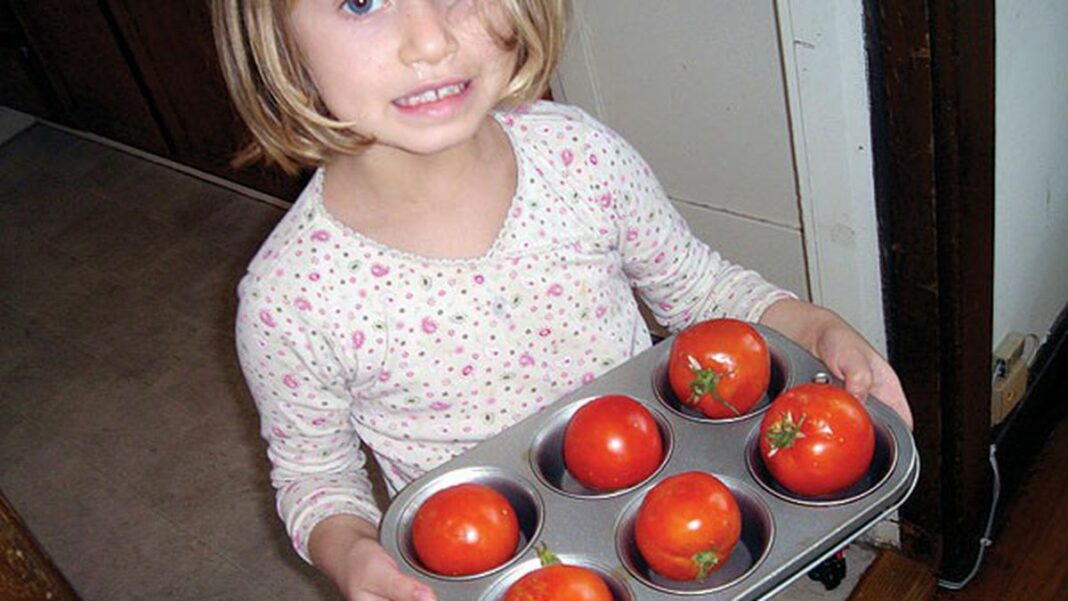
On the first night of cooking month, we had tomatoes galore. I’d
ordered a 20-pound box of Early Girls along with a weekly crate of
farm-fresh produce from Riverdog Farm, a small, family-run operation
from the Capay Valley, just west of Sacramento. The kids straggled
behind as I clomped up the stairs with the heavy boxes; I kept
straining my neck to look behind me to make sure Nico wasn’t running
into the street. Once we were all safely inside, with hands washed and
arguments settled, I put on a video for the kids so I could get to work
in the kitchen — a vitamin-versus-pixel trade-off.
Because the ingredients in each week’s veggie box are a mystery
until they arrive, planning ahead is difficult. So I channeled my inner
Iron Chef and pulled together a stir-fry of Japanese eggplant, red bell
peppers, and tomatoes. With some quick whole-wheat couscous on the
side, and a squeeze of lemon from our neighbor’s tree, I was done in a
respectable 28 minutes (and just within the time frame Pollan says he
works with on most evenings).
At the table, Lola picked at her tomatoes while Nico chomped on the
bread my husband had brought home from our neighborhood bakery. After
five minutes both kids were climbing off their seats, begging for
dessert. Nico grabbed a jug of milk off the kitchen counter and lodged
the cap firmly in his mouth. I jumped off my chair and grabbed the jug
out of his mouth, dislodging the cap and spilling milk down his face
and shirt. “I wet!” he cried. That’s when I remembered that the
pleasure of cooking is soon overwhelmed by the reality of eating with
two small children. Dinner was over. We’d been at the table for less
than fifteen minutes.
We were off to a rocky beginning. But I was feeling optimistic.
After day care and preschool, the kids were snacking on cherry tomatoes
and carrots from the farm box. Vitamins were flowing into their little
bodies. We all had a project ahead of us.
With so much work to do, we had to delegate tasks. No longer could
one person man the microwave. We had to plan. We had to prioritize. We
had to work together. Given Tony’s limited dinner-making skills, he
chose to be our family’s bread maker. Thanks to a borrowed bread
machine, he would provide us with sandwich bread, hamburger buns, pizza
dough, and sourdough from a starter. As usual, I would plan meals and
shop, focusing on farmers’ markets. But I would also make cheese,
crackers, fresh pasta, and a bunch of tomato sauce to freeze. And I’d
figure out how to keep a chicken so we could have fresh eggs.
It was one night during the first week of our cooking month that
reminded us what we had missed during our microwave month. We came home
in a rush, as usual, but instead of putting the kids in front of a
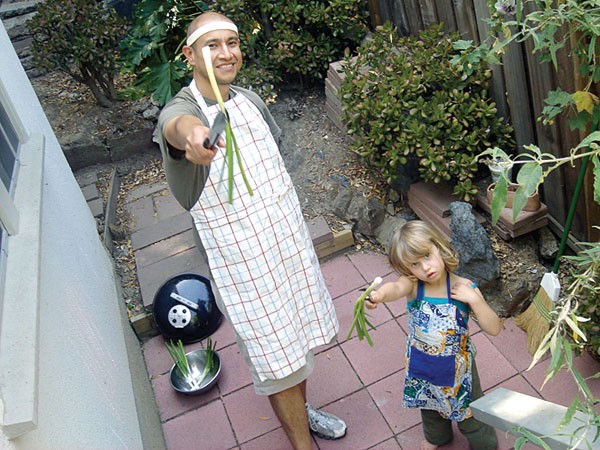
video while one of us made dinner, we all got to work. My husband
brought out a round of pizza dough that he’d made the night before. He
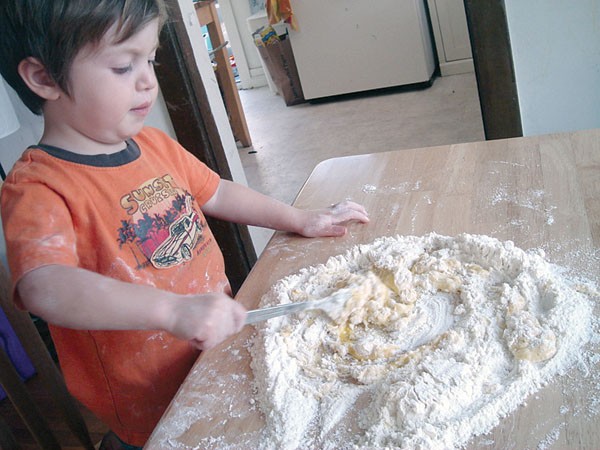
and Lola started rolling out dough in the kitchen. I gave Nico a big
bowl, some dry pasta, and a spatula to play with at the dining room
table while I minced lemon zest and garlic for a salad dressing. I took
out a pan of cubed butternut squash I’d roasted the night before and a
jar of slow-roasted tomatoes made on the weekend to add to the pizza.
On the porch, Nico and I picked basil and sage leaves from our herb
garden. While my husband arranged the pizza dough and toppings onto a
cookie sheet, the kids put plain dough on their pan. I washed baby gem
lettuces from our farm box and tossed them with my vinaigrette while
the pizza cooked.
Forty-nine minutes after we walked in the door, we sat down at the
table to a gorgeous pizza and salad. We followed our regular routine of
thanking the cook — but this time I told the kids we could thank
everyone, because we made the dinner as a family.
“Let’s do this another night,” Lola suggested.
“We will do it another night,” I answered.
“Yay!” she shouted, pumping her fist up and down like Tom Cruise on
a couch. “I like that plan!”
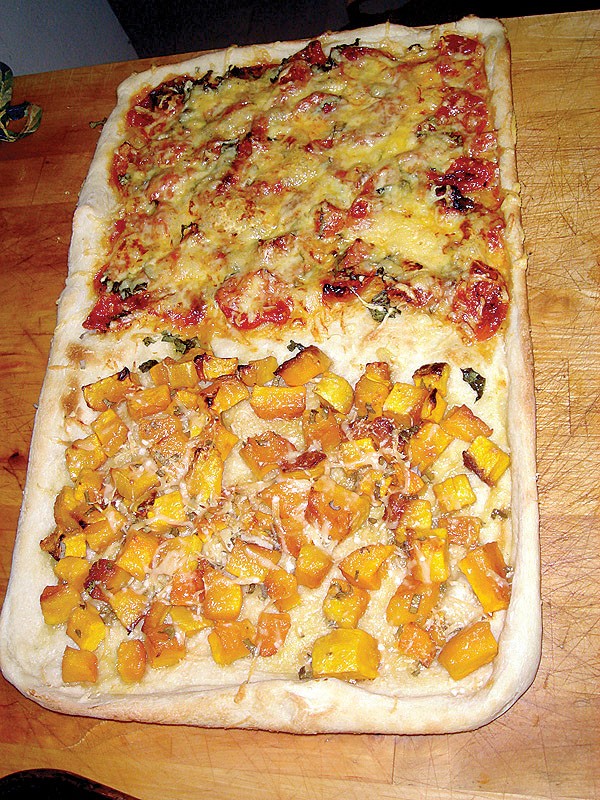
The kids munched on their plain dough and my husband and I cut into
the pizza — half golden with squash, sage, and melted parmesan
cheese and the other half bright with red tomatoes, basil, and a
sprinkling of mozzarella. As I took my first bite, something wonderful
happened. My ears muted, my eyes glazed over, and all my senses seemed
to focus onto my tongue. It was like I could hear and see and touch and
smell and taste the tomato and the cheese and the dough in a tiny
little symphony. The kids were off their seats and running around at
this point, but it didn’t matter. I looked over at my husband, who
slowly shook his head in disbelief, overcome by the same sensations. If
the Trader Joe’s food was monotone, this was polyphonic, with the
volume cranked up high. It didn’t even matter that the kids had
consumed only flour, water, and yeast for dinner. Later, as we cleaned,
my husband said, “That was one of the most amazing dinners —
ever.”
While flavor had returned to our household, we soon found we had to
adjust our experiment. The chicken idea wasn’t working. An evening
visit to a friend’s backyard garden and chicken coop had proved so
disastrous — Nico smashed a precious little brown egg and Lola
two-stepped on heirloom tomatoes — that I abandoned the idea. We
also decided to focus exclusively on dinner — primarily because
we couldn’t manage the quantity of dishes from three scratch-cooked
meals. And while throughout the month I held on to my dream of making
cheese, it never happened.
Slow food takes time. Alice Waters says this time is a sacrifice.
“Making these sacrifices nurtures both family and society,” she has
said. During the previous month it had been easy to calculate how much
time it took to make dinner — beginning with tearing off the
packaging and ending when the microwave dinged. But that proved
impossible during our “from-scratch” month. How to calculate the time
spent soaking beans and slow-roasting grass-fed beef or tomatoes or
butternut squash? What about the time my husband spent creating a
sourdough starter from scratch, then kneading the dough and letting it
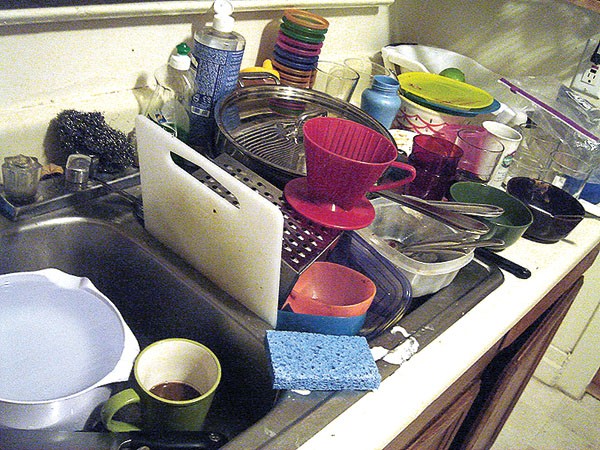
rise? And how do you count the hours and hours spent scrubbing meat
grease and doughy Cuisinart blades? On Saturdays we would take turns in
the kitchen, occasionally both squeezing into the small space to check
on bubbling beans or braising meat. And while we were both busy trying
to navigate between the kitchen and the kids, we were having fun
— at least sometimes. That doesn’t count the time my husband
called off the experiment in a huff, saying he was tired of washing
dishes and tired of making bread. He brought home a rotisserie chicken
and a loaf of sourdough from the supermarket that night.
Although I was disappointed with my husband’s rebellion, I
recognized that a little moderation was called for. Especially for him;
he had taken up bread making with such a passion, it had veered into
obsession. Following Pollan’s example, he’d created his own sourdough
starter. In the first week of the starter’s life, Tony would wake in
the middle of the night with a jolt, afraid that he had forgotten to
add enough flour to the stinky burbling mixture. Once the starter took
hold, he began to make bread with abandon. The baguettes were divine,
the hamburger buns bouncy, and the pizza dough chewy. But his time in
the kitchen was almost entirely bread-related. When I complained that I
was the only one focused on creating complete meals, he agreed to cook
the whole day’s meals. We had brioche for breakfast, focaccia for
lunch, and pizza for dinner. Some carbohydrate respite was
essential.
Right around this time I called Laura Shapiro, a historian and the
author of books about women and cooking. She and I talked about
groceries and guilt and how the food industry had long marketed
time-saving kitchen products to women. She acknowledged what we’d found
during our microwave month — that cooking from scratch didn’t
necessarily take any longer than ordering a pizza. But Shapiro pointed
out something else that I’d known intuitively but never quite
acknowledged: that the problem wasn’t time, it was exhaustion. It
wasn’t that you needed to eat right away, but that you were so darn
tired from work that you didn’t want to stand at the stove, or clean up
beyond stuffing a pizza box into the recycling bin.
While both men and women are tired at the end of the day, in most
American households women still bear the brunt of the housework.
Sociologist Arlie Hochschild calls this the “second shift” —
where women leave work only to punch in on a different time clock. On
an average day in 2007, according to the Department of Labor, men did
just 37 percent of food preparation or cleanup. This statistic is
something the slow-food movement doesn’t talk about much. In fact
there’s an almost startling silence around gender, aside from some
nostalgic yearning for the good old days when women cooked from
scratch. Pollan told me his teenage son is growing up in a world in
which cooking is not a gendered act — an experience certainly
believable in his case, but clearly not shared by all.
Eventually, my husband experimented more with stir-fries and cut
down on all the baking. Sharing the responsibility for meals made the
process easier. I wasn’t carrying the whole load of feeding the family,
as much as I might sometimes crave that responsibility (and scowl at my
husband’s less-than-gourmet contributions). And this arrangement felt
better and lighter — like letting go of some old family
resentment. But we had only gotten to this place because we had to.
There was no way to carry out the experiment with only one parent
involved.
And that’s when the experiment ended. The results were clear: If the
sustainable-food movement is to succeed — not just in drawing in
the small segment of society that has the luxury of time, but in
persuading modern working families to garden, buy local, and cook from
scratch — then it needs to promote fully the idea of shared
labor, and perhaps even a remodeling of the work world to allow men
more time at home to garden, cook, and care for children. In his books
and talks, Pollan weaves a romantic ideal of wholesomeness based on
individual acts. He and his compatriots create a mythology around
farming and cooking that seems achievable — as though you could
reach it if you just stretched enough, tried hard enough, and
sacrificed enough. But who exactly is sacrificing? The reality is as
unworkable today as it was in the 1950s, when women’s lives were
limited to the kitchen and kids. And it’s still as unworkable as it was
in the 1980s, when my mom tried to manage the house, the family, and
the job. It will remain unworkable now, unless all adults in a family
participate, and participate fully.
For me, that means letting go of the notion that I can forever
control everything that feeds my children’s precious little bodies. For
my husband, that means acknowledging how tricky it is to plan meals and
execute them with whiny children around. And for the slow-food
movement, it means realizing that what they ask of communities and
households — while worthy and noble — falls unequally at
women’s feet.
With the cooking month over, I thought we would continue our
slow-foodie ways. But without the confines of the experiment, we
drifted back to familiar territory — some combination of frozen
pizzas and tofu stir-fries. We have made some changes, though, besides
taking turns cooking dinner and becoming oddly fond of microwaveable
rice. We eat much less meat, and we buy most of it at the farmers’
market. We also invite the kids to help cook whenever we can,
acknowledging that it’s not always practical. Lola has learned to use a
butter knife to cut vegetables. Nico will soon follow. I still find it
hard to align my belief in the environmental, political, and health
aspects of the sustainable-food movement with my dependence on a more
moderate cooking practice. I try to remind myself that we have not
failed if we don’t go whole hog. We play our part, however small.
The other night Lola helped me chop zucchini for a stuffed-squash
recipe. After I sautéed the vegetables and set them aside, Lola
popped a slice of soft zucchini, glistening with olive oil, into her
mouth. Then she ate another. Then another.
“Mmmmmmm,” she said, as she continued grabbing from the bowl. “This
is woweeee.”
“What does that mean?” I asked.
“That means I want zucchini every night!” she said, and ate another
slice.
Well, maybe not every night, I thought. But I’ll do my best.