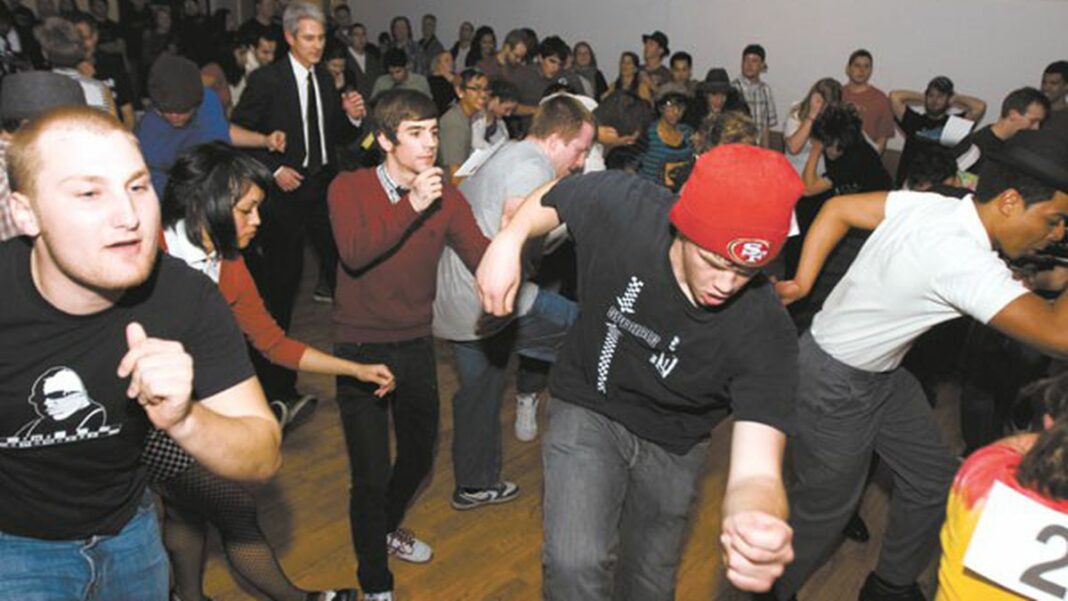
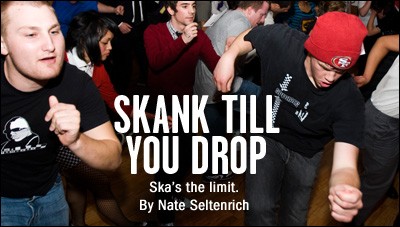
Two minutes into the first song by the opening act, forty teenagers
and a few adults spontaneously erupt into a single skanking mass in the
center of the dance floor. Just a moment ago they stood mostly still
while sizing up the band, a ska outfit from Sacramento called the
Street Vendors, and now they’ve transformed as if through an inexorable
scientific reaction into a writhing jumble of knees and elbows. That’s
what they’re here for, after all. With $500 on the line during a ska
dancing competition later in the evening, they may as well get warmed
up.
Here at Berkeley’s La Peña Cultural Center, local ska band
the Uptones are holding their third Skankin’ Fools Dance Contest.
During the Uptones’ upcoming set, contestants with numbers pinned to
their backs will dance their hearts out for a chance at the $500 prize.
Two previous Skankin’ Fools contests held in the East Bay in 2007 and
2008 offered prizes of $100 and drew hundreds of kids from around the
Bay Area. This year, with the addition of sponsor SonicSwap.com, the increased award has only
intensified the competition.
Credits: Ali Thanawalla
“Are there any rude girls in the house?” the Street Vendors’ lead
singer asks into the mic, and although men outnumber women at least
two-to-one, a big cheer goes up. The reaction bears out a sense that
the crowd tonight is truly unlike any other: a tight-knit, proudly
geeky subculture that celebrates its cultishness and unique language
even within the insular independent music world.
The prize money is nice, but the real draw tonight, and likewise at
all ska shows, is simply having a good time with like-minded fans. Ska
developed out of jazz, R&B, and Caribbean rhythms in Jamaica in the
late 1950s, predating both rocksteady and reggae by a decade. It was
the dominant form of music in Jamaica for years before spreading to
England in the late 1970s and across the United States during the
short-lived revival of the mid-’90s through bands such as No Doubt,
Reel Big Fish, and the Mighty Mighty Bosstones. All along, ska remained
primarily a dance genre, with lyrics either secondary or absent
altogether. It’s the up-tempo, syncopated rhythm that matters most: a
beat that inspires the carefree, energetic, almost irresistible move
known as the skank.
One of skanking’s greatest attractions is there’s no right or wrong
way to do it. Over the past five decades, ska dancing has evolved along
with ska music so that myriad styles now mingle under the same tent.
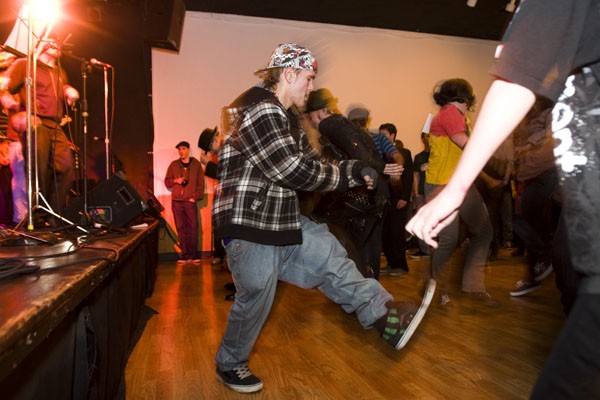
The basic form is a full swing of the elbow paired with a high-knee
skip, shifting from one side to the other every second beat. At La
Peña, some dancers lift their legs then kick back their feet,
while others point their toes or stomp the floor. Some raise their
hands high, while others stoop over and punch closed fists toward the
ground. This freedom of expression and lack of rules explains why
otherwise self-conscious teens often find skanking therapeutic.
By the time the second group, an Operation Ivy cover band from the
North Bay called Hectic, concludes its set, dancing has been going on
for two hours. Many kids guzzle water and rest up while waiting for the
start of the contest with the arrival of the Uptones, an eight-piece
band that formed at Berkeley High in 1981 as one of the West Coast’s
first ska groups, disbanded a few years later, and recently reunited.
Four friends from Moraga and Orinda are among them, huddled at the edge
of the dance floor. “I came for the Uptones and because I love to
skank,” said Sunflower Wittenberg, 18. “It’s a really good way to let
your energy out.” Kelsey Bergman, 18, and Deena Duffy, 17, prefer
reggae and punk music, respectively, but enjoy ska dancing as a safe
and friendly way to “let it all out.”
When the Uptones finally appear after 11 p.m., the energy in the
room seems to peak. “Y’all ready to skank? ‘Cause that’s what we’re
here for,” announces guitarist Musashi “Moose” Lethridge. Fifty-eight
people among a couple hundred total have signed up to compete in the
dance contest, and no matter how tired, they’re eager to do their best.
Again the dance floor is abuzz with energetic young skankers, a flurry
of flailing limbs and bobbing bodies.
The three judges will decide a winner largely by style and
enthusiasm, and some entrants have tried to improve their odds by
wearing ska’s trademark black-and-white checkerboard pattern on shoes,
suspenders, or shirts. One of the more devoted skankers wears the
traditional ska uniform of a full black suit with a skinny tie. Many
also wear fedora or trilby hats. Onstage, the Uptones sport their own
array of black, brown, and even sequined suits.
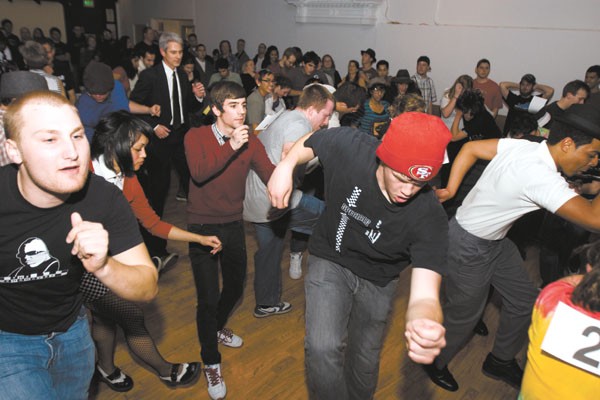
With the contest underway, at floor level it’s a sea of shuffling
feet and flying shadows. Even over the music you can hear the sound of
one hundred squeaking sneakers on the hardwood dance floor. The
temperature in the room begins to rise, and with it the scent of sweat.
One teen’s gray T-shirt is entirely soaked. “How you holdin’ up?”
another skanker asks his girlfriend after a song ends. Five minutes
later, visibly worn out, she takes a seat. The contest may as well be
titled “Last Skanker Standing.”
Shortly after midnight, it’s time to announce the winner. A
representative of SonicSwap.com
appears on stage bearing an oversize check for $500. He calls out #34
and seventeen-year-old Leslie Watson from Pleasanton climbs onstage
with a look of complete surprise. “Oh my gosh, thank you so much,” she
says backstage as five one-hundred dollar bills are counted out before
her. “Now my parents won’t have to bug me about not having any
money.”
“I wasn’t expecting that at all!” she exclaims. While eight
runners-up skank onstage during two more Uptones songs, Watson explains
that she hadn’t even planned to enter the contest. Some of the ten
friends with whom she’d caravanned over convinced her to sign up
— even after she’d promised her running coach she wouldn’t on
account of an injury she was nursing and an upcoming half-marathon. In
the end, that long-distance conditioning likely helped secure her
victory.
The money would go toward gas, college, and a late-night snack with
friends at IHOP, she said. But even without this unexpected windfall,
ska offered plenty to keep her coming back. “Ska isn’t very popular at
my school, so whenever people want to know what it’s like, I always
tell them the same thing: It’s just fun.” She said the last few words
as if there was nothing more to say, and judging by tonight’s concert
she couldn’t have been more right.