
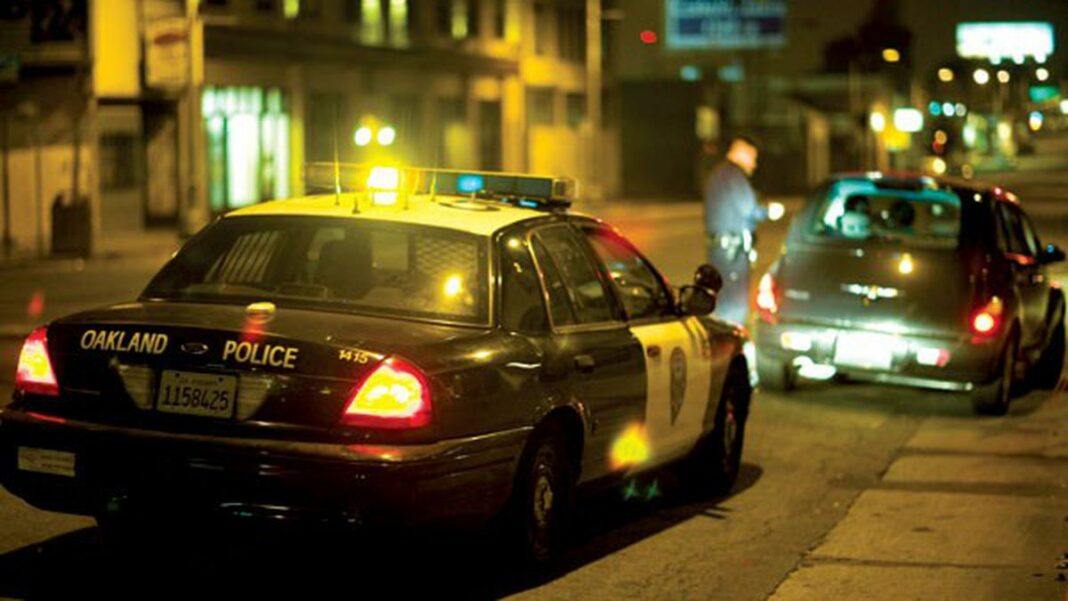
Armed robbers terrorized Oakland restaurants and small businesses in
three separate crime sprees over the past year. The first wave targeted
Asian eateries and struck during the 2007 holiday season. The second
arrived last spring and was more indiscriminate. The third struck in
July and August. All three made newspaper headlines and led television
newscasts, shining a spotlight on the city’s out-of-control crime
problem and the Oakland Police Department’s apparent inability to cope
with it. In fact, the department’s public response to the takeover
robberies was both odd and illuminating.
The department’s mantra for dealing with the city’s crime spike has
been: “We can’t arrest our way out of this problem.” Top brass has
repeated this declaration in public meetings or whenever a reporter was
within earshot, as if it were a common sense, widely accepted response
to this sort of crisis. “Right now, it’s pretty clear we are in a time
of increased crime,” said Deputy Police Chief Dave Kozicki, just before
he summed up the department’s official response to the Oakland City
Council in April. “But the bottom line is we believe we cannot arrest
our way out of these problems.”

Credits: Jamie Soja

Credits: Robert Gammon


Credits: Robert Gammon



So instead of employing old-fashioned detective work to solve the
restaurant robberies and arrest criminals, the department doubled down
on a policing philosophy that it has employed repeatedly in recent
years. It beefed up patrols and focused on so-called “hot spots.” But
this time it targeted the city’s upscale shopping districts — and
not the violent flatlands of West and East Oakland. It was an attempt
at crime suppression, the security-guard approach to policing that the
department successfully used to quell the sideshows several years ago.
It’s based on the premise that criminals are less likely to offend if
they see a police car driving by. During the third crime spree, Mayor
Ron Dellums even invited the Guardian Angels, a national vigilante
group, to march around commercial districts in their red berets.
Yet the crime waves persisted, much like crime overall has remained
at historically high levels in Oakland during the past three years.
Then something interesting happened. Each crime wave abruptly ended
when police arrested the perpetrators. It turned out that the
department could arrest its way out of the problem after all.
Each time police put the criminals behind bars, the takeover robberies
stopped, the screaming headlines and breathless newscasts ended, and
public fear faded away. People started patronizing restaurants
again.
A closer look at the Oakland Police Department’s response to the
overall spike in violent crime that began three years ago reveals an
agency with a policing philosophy that appears to have exacerbated the
city’s problems. An analysis of crime statistics by this newspaper
reveals that Oakland’s police department has the worst record in recent
years among large cities statewide for solving violent crimes and
homicides. In fact, Oakland’s violent crime rate skyrocketed after the
agency’s ability to capture violent criminals fell off a cliff.
Oakland police once had a strong record for solving violent crimes
and homicides, but during the three years since Police Chief Wayne
Tucker took over the department it has solved less than one-quarter of
the violent crimes and homicides in the city, according to figures from
the state Department of Justice. The steep decline actually began under
Tucker’s predecessor Richard Word, and has worsened since 2005. And
once the department’s record for capturing criminals and putting them
behind bars plummeted, the number of violent crimes citywide jumped
sharply — 27 percent from 2005 through 2007 compared to the
previous three years — far outpacing other large California
cities.
Part of the problem is that Oakland’s investigative unit is
drastically understaffed. And the defeat last month of Measure NN
— a parcel tax that would have paid for 180 new police personnel
— will limit the department’s ability to significantly expand its
investigative staff anytime soon. But interviews and public records
also show that there is much more to the department’s crime-solving
woes than a lack of investigators. Over the past few years, the Oakland
Police Department has not made investigating crimes and capturing
criminals a top priority — even as the city’s crime rate soared
to its highest level since the crack epidemic of the late 1980s and
early ’90s.
Oakland’s homicide clearance rate — that is, the percentage of
killings that the department solves — used to be impressive for a
city with a lot of crime. From 1997 through 2000, it averaged 58
percent. But under Tucker, it has been abysmal. In 2005, his first year
as police chief, the department solved only 12 of its 93 homicides, a
clearance rate of just 13 percent. By comparison, the homicide
clearance rates of other large California cities, such as Fresno, Long
Beach, Sacramento, and San Francisco have remained fairly steady over
the past decade.
From 2005 through 2007, the last year in which complete data is
available, Oakland police only solved 86 homicides out of 357 total, or
just 24 percent. In other words, since Tucker took command of the
department, the perpetrators responsible for more than three-quarters
of the killings in Oakland remain at large. “You want to get those
folks off the street,” said Franklin Zimring, a criminal justice
professor at UC Berkeley’s Boalt School of Law. “Twenty-four percent is
very low.”
By comparison, San Francisco has cleared 45 percent of its homicide
cases in the past three years; Long Beach, 52 percent; Fresno, 67
percent; and Sacramento, 70 percent. The Express compared
Oakland to those cities because they are the four closest in California
in terms of population and demographics. The four cities also have
similar homicide rates, although all are lower than Oakland’s. We
excluded Los Angeles, San Diego, and San Jose, the state’s three most
populous cities, because they’re so much larger than Oakland and
because both San Diego and San Jose have much lower violent crime
rates.
Overall, the nationwide homicide clearance rate has hovered around
60 percent for many years. According to FBI uniform crime reporting
rules, police agencies can’t call a case “cleared” or solved unless
they make an arrest and charges are filed. Exceptions include when a
perpetrator dies before he’s apprehended, a prime witness recants
testimony after an arrest, or a suspect has fled the jurisdiction and
cannot be extradited.
Clearance rates are not only good indicators of how well a police
agency investigates and solves crimes but they’re also strong
predictors of future spikes or dips in crime. “Investigative work, the
search for and arrest of perpetrators of past crimes, is also one of
the most effective ways to prevent future crimes,” Patrick Harnett, a
former high-ranking official in the New York City Police Department,
wrote in a study about the Oakland Police Department in late 2006.
Harnett, who was commissioned by former Mayor Jerry Brown, believes
that putting criminals behind bars stops them from committing more
crimes and leads to a lower crime rate, while the failure to catch them
leads to a higher crime rate.
In Oakland, the numbers support Harnett’s assertion. During the past
decade, whenever the city’s clearance rate has declined, homicides have
gone up the following year, and vice versa. In fact, during the past
decade, every time the department’s clearance rate decreased by at
least 5 percent from the previous year, the number of homicides
increased the following year. And every time the clearance rate
improved by at least 5 percent from the previous year, the number of
killings dropped the following year. This phenomenon occurred seven
times in the past eleven years.
After Oakland’s ability to solve crime started to worsen, the number
of killings in the city jumped sharply. From 2005 through 2007, Oakland
averaged 119 homicides a year compared to an average of 87 from 1997
through 2004. Last year, the city had 119 homicides and is on track to
exceed that number this year.
Oakland’s clearance rate also has declined for all violent crimes
over the past decade, and is lower than other large California cities.
From 2005 through 2007, it was just 24 percent, while San Francisco’s
was 27 percent; Sacramento, 39 percent; Long Beach, 48 percent; and
Fresno, 49 percent. Violent crimes include homicides, rapes, robberies,
and aggravated assaults. The number of violent crimes in Oakland also
has jumped dramatically in the past two years, and now is nearly as
high it was in the mid-1990s. Of the other four cities, only Sacramento
experienced a similar recent increase.
So what’s going on in Oakland? In an interview last week, Oakland’s
Assistant Police Chief Howard Jordan rejected a linkage between the
department’s declining clearance rates and skyrocketing crime, and
instead blamed several other factors. Jordan oversees the department’s
entire investigations bureau. Increased crime, he said, has been caused
by myriad societal problems, from the downturn in the economy, to the
city’s poor school system, and the high number of ex-felons living in
Oakland. “We have a high concentration of parolees and people on
probation in the city,” he noted.
As for the declining clearance cases, he blamed the no-snitching
culture of today’s youth. “We have a very, very difficult time
convincing people to talk to police,” he said. “It makes it very
difficult for us to solve cases.” Jordan also criticized the FBI’s
definition of clearances, saying that internally, the department also
considers a case cleared when it has identified a prime suspect, but
doesn’t have enough evidence for an arrest and conviction. However,
those types of “clearances” are not allowed under FBI rules.
But Jordan’s explanations don’t hold up under scrutiny. Refusing to
snitch is not a problem unique to Oakland. Plus, other police agencies
also are prohibited from calling a no-arrest case “cleared” and their
clearance rates are better than Oakland’s. Moreover, Jordan’s
contention that cases in which investigators haven’t gathered enough
evidence for an arrest should then still be counted as solved just
enshrines failure as success. His reasoning also doesn’t explain why
Oakland’s clearance rates are so much lower than they used to be. After
all, the definition of a clearance is the same as it was a decade ago
when the department used to do a good job solving crimes. The same is
true of Jordan’s explanations for today’s high crime rate. Oakland has
been home to lots of ex-cons for decades, and its public school system
has long been among the worst in the state. And finally, crime spiked
in Oakland well before the housing bubble burst and the current
recession began.
According to Harnett, the expert hired by Jerry Brown,
Oakland’s investigative unit is incapable of solving most crimes
because it’s woefully understaffed and overwhelmed, leaving it no time
to clear difficult cases. “The lieutenants who manage the department’s
investigative units are forced to triage cases, assigning for
investigation only those cases that present a very strong probability
of being solved,” he explained in his 2006 report.
So how understaffed is Oakland? Plenty. It has, for example, the
same number of homicide investigators as Sacramento — ten. That
may seem reasonable considering the two cities are similar in size and
have a similar number of total sworn personnel. But Oakland is a much
more dangerous city. Sacramento has averaged just 51 homicides per year
from 2005 through 2007 compared to Oakland’s 119. In other words, the
workload of each Oakland homicide investigator is more than double of
those in Sacramento. “It would be extremely difficult under those
circumstances to expect a high clearance rate,” said one California law
enforcement officer, who asked not to be named because he didn’t want
to criticize the Oakland Police Department publicly. “With that
staffing and number of homicides, I don’t know how the detectives would
find time to sleep.” Not surprisingly, Sacramento solved 21 more
homicide cases than Oakland from 2005 through 2007.
In an interview last week, Chief Tucker acknowledged that his
investigative team is overworked. That would have changed if voters had
approved the parcel tax last month. “We’re really skinny over there,”
he said. “If Measure NN had passed, we would have really beefed up the
investigative unit.” Jordan said that under optimal conditions
Oakland’s homicide team would have twenty investigators.
Now that the entire department has more than 800 officers, up from
about 730 at the beginning of 2008, Jordan said it plans to add four
investigators to the investigative unit in the coming weeks, bringing
the total to 37. In addition to the ten investigators in homicide,
there are currently just seven detectives investigating more than 3,600
aggravated assaults a year; only nine detectives investigating about
3,500 robberies annually; and just seven detectives handling more than
16,000 felony property crimes each year, including burglary, grand
theft, and auto theft. Jordan said he has not decided where to assign
the new officers, but he ruled out homicide because that unit only
accepts veteran cops with years of investigative experience.
The recent influx of new cops has not really altered Tucker’s
ability to transfer more officers to the investigative team. Tucker has
always had the ability to transfer officers into investigations, but
has chosen not to do so. The addition of new cops hasn’t changed that.
Under Measure Y, a 2004 ballot measure that paid for most of the new
officers, the cops are to be deployed in community policing duties.
The one division that is top-heavy with investigators is internal
affairs — the unit that examines alleged wrongdoing by cops.
According to Jordan, it has fourteen investigators, plus another
fourteen sworn officers who perform administrative duties, for a total
of 28. The unit was enlarged following the 2003 Riders’ settlement. The
Riders were a group of rogue officers accused of abusing and planting
drugs on suspects. As part of a federal consent decree stemming from a
lawsuit against the city, the police department must now thoroughly
investigate allegations of officer misconduct. Jordan, who commanded
internal affairs in 2005, said the unit is on track to investigate
about 1,700 cases this year.
In recent years, top police brass have blamed the size of internal
affairs and the Riders settlement for why the department doesn’t have
enough people investigating homicides, robberies, and the rest. But in
the past several months, Oakland City Attorney John Russo, who
negotiated the settlement on behalf of the city, and Jim Chanin, a
private attorney who represented the Riders’ alleged victims, both said
the department could replace some sworn officers in internal affairs
with lesser-paid civilians, just as other police agencies have done
around the country. That way, Oakland could have more investigators on
the streets to clear cases. “There’s no reason they can’t use civilian
investigators,” Chanin said. “They could do it, but they don’t choose
to do that.”
Jordan said the department was open to the idea, but that the police
officers’ union opposes it. The union is against replacing dues-paying
officers with civilians, he said. However, he also said he didn’t think
the department could afford to hire civilian investigators at a time
the city is grappling with a $42 million deficit. Ultimately, it could
be up to the mayor and the city council to decide.
But Oakland’s inability to solve crimes isn’t just a personnel
issue. It’s also about focus. Tucker acknowledged that since he took
over the department in 2005, his main priority has not been to
investigate and solve crimes, but to improve Oakland’s response to
calls for service. The department gets so many calls from residents
every day that the 300 officers on patrol spend most of their time
driving to people’s homes and businesses and filling out crime reports,
he said. But that’s a service-oriented tactic that seems more suitable
for a suburban sheriff’s department than for an urban police force.
Tucker and the department have yet to produce a detailed plan for
reducing crime. In addition, the department has de-emphasized juvenile
crime investigations and arrests over the past half-decade, and it
obviously has not learned its lesson from the takeover robberies. Plus,
there is no indication that Oakland’s stratospherically high crime rate
is close to subsiding. Last week, CQ Press (Congressional Quarterly)
named Oakland the fifth-most dangerous city in the nation based on 2007
crime figures. Oakland was fourth in last year’s ranking, which was
based on 2006 stats. And as of last week, 2008 was slightly higher than
2007 in terms of violent crime.
In addition to concentrating on service calls, the department has
spent considerable resources on crime suppression in recent years,
targeting “hot spots” throughout the city, like it did with the
sideshows and the takeover robberies. It’s about blanketing the
roughest areas of the city with patrol cars, and pulling over people
who act “suspicious.” “It’s ridiculous,” said Ron Oz, a former Oakland
police officer, department ombudsman, and 2006 mayoral candidate who
was once friends with Tucker, but now is his most prolific critic.
“We’re chasing hot spots all over town.”
And it isn’t working. If Tucker had listened to Harnett and focused
more on investigating crimes, catching criminals, and putting them
behind bars, there’s strong evidence that the city’s crime rate would
now be declining, as would the number of “hot spots” and calls the
department receives from crime victims.
If Jerry Brown had had his way, Oakland would have a different
police chief and possibly a different philosophy for fighting crime. In
late 2006, Brown was fed up with the city’s soaring crime rate. Never
known as patient man, Brown had ousted two prior police chiefs, Joseph
Samuels and Richard Word, because they didn’t lower crime fast enough.
In fact, he replaced Word with Tucker in late 2004 in an attempt to
finally bring the city’s crime problem under control.
But within two years, crime under Tucker worsened dramatically. In
fact, Word’s tenure looks pretty good right now. In his last year in
office, the total number of violent crimes was 5,151. By 2006, it leapt
to 7,599, and has remained high ever since — a 48 percent
increase. No other large California city studied by the Express
experienced such a huge jump. So Brown decided that before he left City
Hall, he would replace Tucker with one of his deputies, Captain Frank
Lowe. According to Lowe, a 28-year veteran of the department, Brown
called him to his condo just before Christmas of 2006 for a job
interview. Lowe said he told the mayor: “We need to be in crisis mode,
crime is the worst I’ve seen in Oakland and I was born and raised
here.” After the interview, Brown said, “Frank, I think you’re the man
for the job,” Lowe told the Express.
But then the deal unraveled. According to Lowe, Brown said that he
had told City Administrator Deborah Edgerly about his plan to change
police chiefs. Edgerly, who was fired earlier this year by Dellums
after she apparently interfered in a police investigation, then told
Tucker what Brown wanted to do. Tucker became upset and refused to step
down, so Brown gave up on the idea, deciding that he didn’t need
another City Hall power struggle just before leaving office. “Jerry
said, ‘Sorry Frank, it didn’t work out,'” said Lowe, who retired from
the department in 2007 and is now the chief of police for the Federal
Reserve Bank in San Francisco.
But before Brown went to Sacramento, he left a parting gift —
the Harnett report. In addition to critiquing the department’s
investigative shortcomings, Harnett recommended that the agency adopt
geographic policing, in which the city would be divided into three to
five large districts commanded by captains responsible for crime in
their respective areas. Harnett also recommended that the department
begin using CompStat, a crime accountability and data tracking system
that originated in New York and has spread to cities around the
nation.
Tucker deserves credit for instituting geographic policing. After
Word had abandoned it at the start of the decade, the department’s
record for solving crimes began to tumble. Tucker said that with
geographic policing and the higher number of cops in the department, he
thinks the city will experience a substantial decrease in crime during
the second half of next year. “That’s when all the new staff will all
be trained and on board,” he said.
But it’s hard to envision crime plummeting, considering that Tucker
has dragged his feet with CompStat and has no plans to significantly
expand the investigative unit. Moreover, the department has lurched
from one scandal to the next under his tenure, from the botched murder
investigation of journalist Chauncey Bailey to the recent revelation
that officers had lied on search warrant affidavits. And all the while,
violent criminals have continued to roam free in Oakland in increasing
numbers, offending again and again.
The search warrant scandal, which was revealed by the Oakland
Tribune in October, could ultimately lead to about three dozen
criminal drug cases being thrown out of court, according to Assistant
Public Defender Drew Steckler. At least eight officers have already
been suspended. The cops involved are known as “problem-solving
officers,” and are not part of the investigative team. The officers are
under investigation by internal affairs, although top police officials
have made excuses for them, maintaining that it was the result of poor
“training” and that the officers simply made “misstatements” when they
swore under oath that drugs had been tested in the police crime lab
when they had not.
As for the Bailey murder investigation, it appeared at first to be a
remarkable feat for a police department that has trouble solving
crimes. Less than 36 hours after the editor of the Oakland Post
and former reporter for the Oakland Tribune was assassinated,
homicide investigators had a prime suspect in custody and a confession
in hand. Prosecutors quickly filed murder charges against Devaughndre
Broussard, a handyman at Your Black Muslim Bakery in North Oakland.
Bailey had been investigating the bakery’s financial problems when he
was killed.
But then the San Francisco Chronicle revealed that the lead
homicide investigator in the case, Sergeant Derwin Longmire, was
friends with Yusuf Bey IV, the bakery’s CEO and the man that Broussard
claimed had told him to confess. Then, the Chauncey Bailey Project, a
consortium of news organizations dedicated to investigating Bailey’s
death, revealed that Bey IV had kept the murder weapon in his closet
and had stalked Bailey just hours before the killing. In late October,
Dellums asked state Attorney General Brown’s office to investigate the
police department’s handling of the case. The agency’s own internal
affairs division is also looking into it.
But as troubled as the Bailey murder investigation was, the
department still recorded it as a success. It was one of 30 homicides
the department reported as being solved in 2007 out of 119 total
— a dismal 25 percent clearance rate.
The Oakland Police Department employs many excellent officers in its
ranks. But for several city leaders, the search warrant scandal and the
Bailey affair are just the latest examples of how dysfunctional the
department has become under Tucker. City Council President Ignacio De
La Fuente, who opposed the recent police services tax, stopped short of
saying the police chief should be fired. But he made it clear that he
believes there’s no accountability in the department or from City Hall
when arrests nosedived and crime spiked. “It takes political will,” he
said. “It takes a willingness to make the decisions that need to be
made, whether it’s the mayor or the chief of police.”
A few months ago, there was widespread speculation that Tucker might
retire soon to take care of his sick wife. But he said he recently
promised Dellums he will stay for one more year. The mayor and the
police chief have a strong relationship and there is no indication that
Dellums is unhappy with Tucker’s performance or holds him responsible
for crime being at historically high levels. Moreover, the mayor
doesn’t have a track record of acting decisively. After all, it’s taken
him months to replace Edgerly, and he has yet to hire a new director of
economic development.
De La Fuente believes that the mayor or the new city administrator
— if and when that person is finally brought on board —
should conduct a national search for Tucker’s eventual replacement. In
terms of the chain of command, Jordan would be next in line for
Tucker’s position, but De La Fuente believes the department needs new
blood, an outsider who is not afraid to shake things up. “We need to
get a chief of police who can manage this department and reduce crime,”
he said.
The council president’s analysis appears to make sense in light of
Jordan’s recent actions. The assistant chief has shown that he is
jealously protective of the department and may have trouble changing
its culture. For example, in late October, he issued a public statement
staunchly defending the lead investigator in the Bailey murder,
claiming “there is no evidence Longmire interfered in any criminal
investigations” involving Bey IV. The statement not only contradicted
reporting by both the Chronicle and the Chauncey Bailey Project,
but it showed Jordan’s bias, considering that both the internal affairs
and the state attorney general’s investigations into Longmire’s actions
have not yet been completed.
But regardless of who becomes the next police chief, it’s apparent
that the department needs to greatly expand its investigative team and
refocus on solving crime. Crime suppression and worrying about
responding to calls for service simply hasn’t worked. Right now, crime
pays in Oakland, and it’s clear the only way that will change is if we
arrest our way out of the problem.