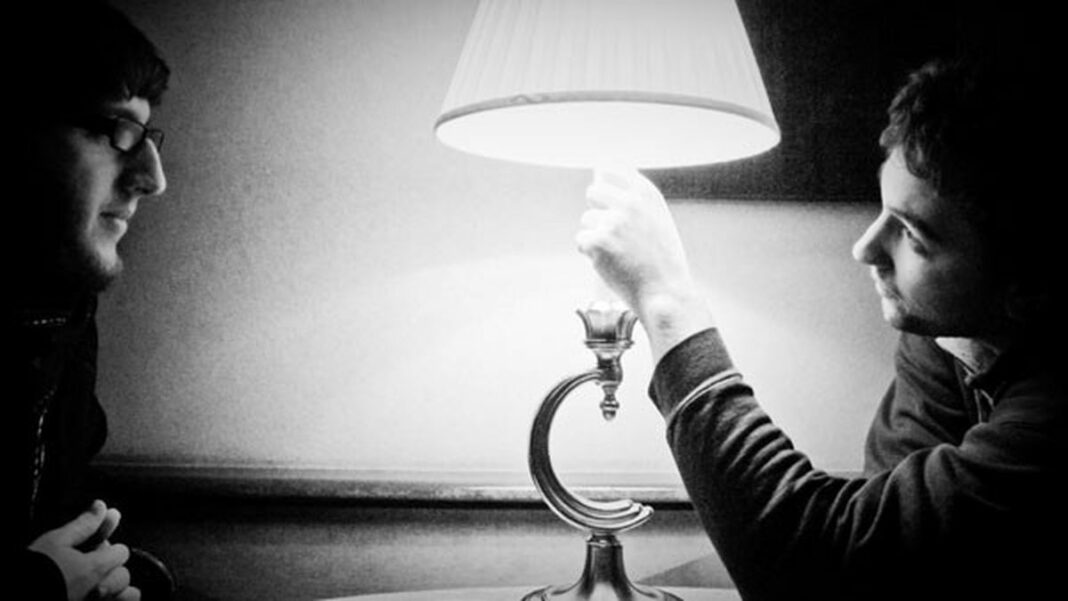
A common theme persists throughout Max Lewis’ discussion of his
Cambridge, Mass.-based electronic duo, Arms and Sleepers: doing what
feels right.
“We do whatever comes to us, whatever we enjoy at the moment, and
that varies,” he said, in more than one way, on more than one
occasion.
This informs every choice Lewis and Mirza Ramic make as they create
music. Their intuitive sensibilities are sharp: Their music is
consistently cinematic, subtle, beautiful, and arresting.
Trusting their gut has led to all sorts of changes and fluctuations
in the artistic project that is Arms and Sleepers. The story of how
Lewis and Ramic began working together as musicians seemed boring to
them, so they made up a new story, one that more accurately matched
their music, involving a dying man in a dark alley listening to music
— music that lives on and becomes a soundtrack for the man’s
death.
The name is another case in point: There’s the real story, and the
one that feels more accurate. “Mirza came up with this,” explained
Lewis. “It refers to, in tough situations, [how] some people take up
arms and fight for things, and some people just ignore it and sleep.
It’s the balance of what people do when push comes to shove.”
The mythology behind Arms and Sleepers goes a long way in helping to
describe their music. “We’re influenced a lot by film, so there’s
always a sort of overarching story or theme that goes throughout our
music,” explained Lewis. The dying man in the alley story is cinematic,
and brings up how music can inform the dramatics of a situation. The
name story gives an epic weight to the music. Arms and Sleepers are
fascinated by the emotional connection between sound and image: They
make music that feels right for a certain scene, mood, image, idea.
That’s what Lewis means when he says that film influences his and
Ramic’s music.
“When you watch a movie you enjoy, and there’s not necessarily music
going on, you might hear something in your head and just say, ‘I like
what’s going on here; I like the way this looks; I feel like there
should be some sounds here,'” he explained — in other words,
creating the music that feels right for that visual in that particular
moment.
“Or you’re struck by a scene, or a theme of the movie, and you just
want to work on music,” he continued. “There have been a couple of
songs where we have taken a scene from a movie and looped it on our
computer, and as we were playing music, we were looking at it. Without
sound, of course.”
The pieces they create are soundtracks, aural representations of
visual images. Because, really, as Lewis pointed out, music is almost
never experienced just through the ears alone.
“Both Mirza and I definitely like music, but I think we almost like
music better when it’s in a film or with video. Not that music can’t be
on its own — and sometimes, it can be great on its own —
but the combination of the two is just so effective most of the time
that it almost feels like you’re losing something when it’s just
music,” he said. “Most of the time, when you’re listening to music
anyway, you’re looking at something, unless you’re going to sleep and
listening to music. But if you’re listening to music on your headphones
as you’re traveling the subway or the bus or walking somewhere, there’s
always a visual stimulus.”
For their live show, Arms and Sleepers create this kind of
multimedia experience: They project images a friend of theirs has
created, based on the images or ideas Lewis and Ramic had in mind when
they wrote the songs.
Because of these ideas that inform their music, calling them a
“band” just doesn’t feel right. “We normally say we’re a band, but I
don’t think that’s the proper word for it,” Lewis agreed. “That’s one
of the things we’ve struggled with. Also, [we struggle] when people ask
us, ‘What kind of music do we play?’ I mean, it might be easy enough to
say electronic, and I think that’s normally what we say — ambient
electronic — but we’ve done stuff like more modern classical
stuff, and we’ve done more sort of poppy music.
“We do whatever comes to us, whatever we enjoy at the moment, and
that varies. That’s been one of the toughest things: defining what we
are and what kind of music we play.”