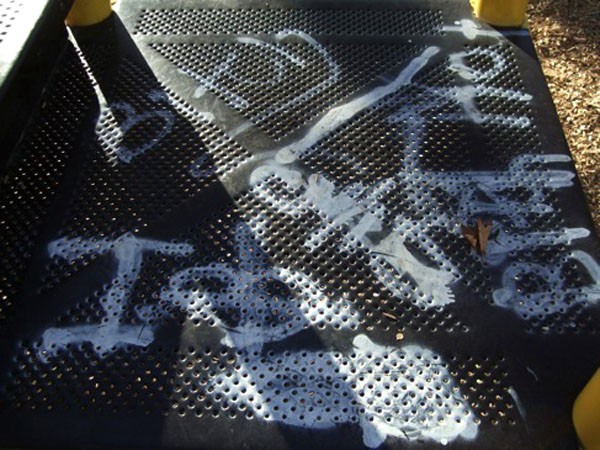
Bitch bitch I ♥–%$#@ — hot bitch” is scrawled in white
spray paint on the jungle gym at Richmond’s Elm Playlot. Used condoms
and empty gin bottles lie beneath a slide, and two swings are frayed
from canine tooth marks. The jungle gym is a sad focal point of the
playground’s current role: as a gathering spot for pit bulls, drug
dealers, and junkies.
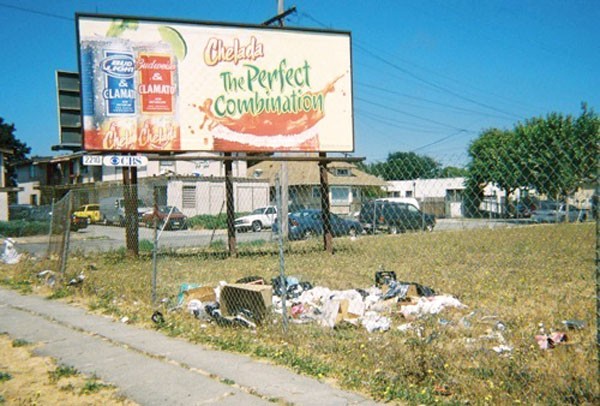
Piles of broken glass and kitchen trash blight the adjacent
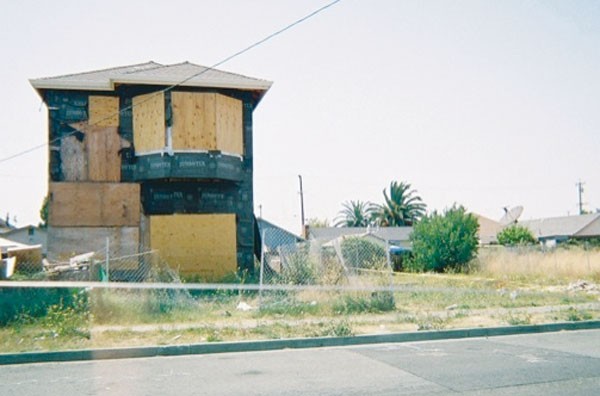
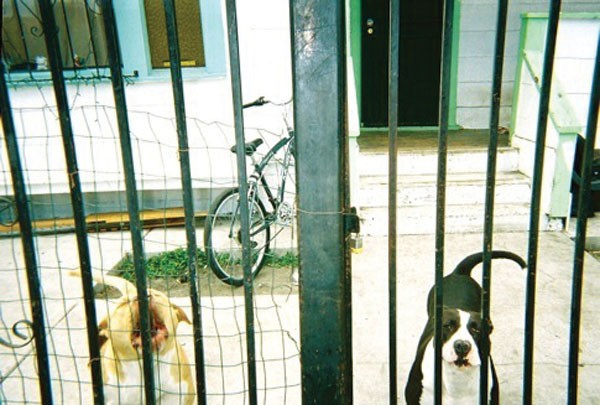
neighborhood. Many nearby houses sport sturdy iron fences and grates or
plywood on the windows and doors. People walking by contort their faces
into guarded masks, and small children soon become authorities on
needles and guns. More than 1,500 children under the age of six live
within ten blocks of this corner at Elm Avenue and 8th Street, but they
and their parents typically avoid this tiny park in Richmond’s
notorious Iron Triangle.
Credits: Chris Duffey
Credits: Toody Maher
Credits: Photovoice

Credits: Chris Duffey

Credits: Chris Duffey
Credits: Photovoice
Credits: Photovoice
Credits: Photovoice
Credits: Photovoice
Credits: Photovoice

Credits: Photovoice
Credits: Chris Duffey
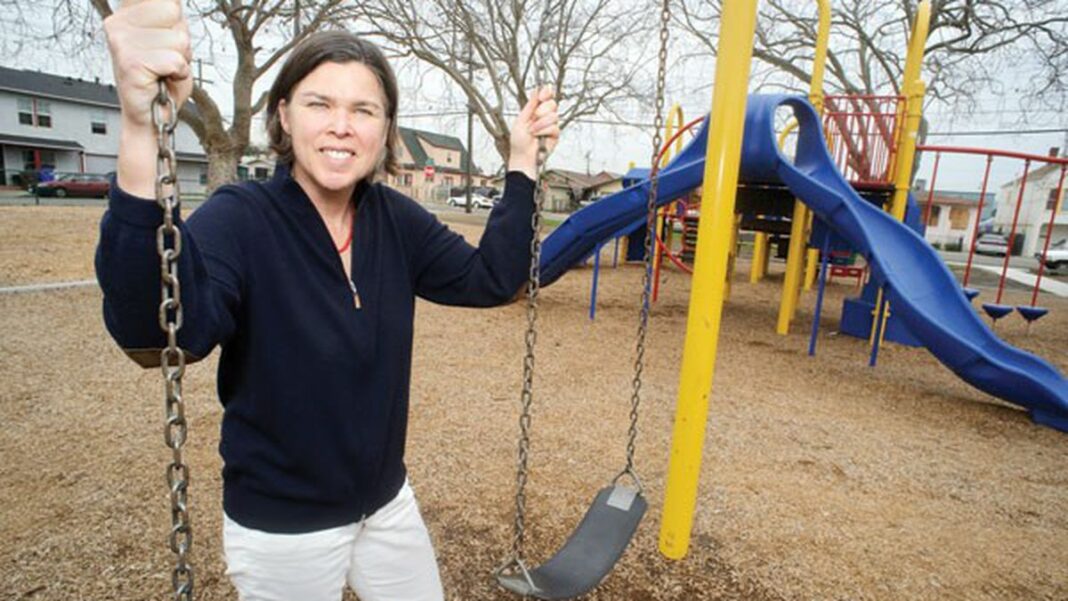
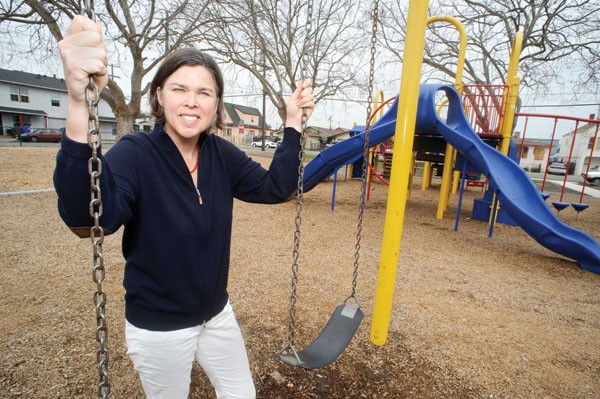
It’s a rare person who can look at such desolation and see a patch
of light. But Toody Maher is such a person. The tall, square-shouldered
Richmond resident has assigned herself the seemingly hopeless task of
rehabilitating the playground and resurrecting the community. Armed
with an unwavering belief that every child deserves have a safe place
to play, Maher hopes to revive Elm Playlot and renew the surrounding
neighborhood in the process.
Maher’s own Canadian childhood was marked by long days at the
neighborhood park, a safe, thriving centerpiece of her Montreal
community. “Even in the middle of winter, my mom would give me and my
three brothers and sisters breakfast, dress us in our snow clothes,
walk us two blocks to the park,” she recalled. “Everyone who had
children went there. It’s where friendships were formed, where parents
met their closest friends. So much of our growing up was play, and we
were never bored. I think that’s why I’ve always been magnetized to
parks. Parks are power spots to me, and when I see them not reaching
their potential, I can’t stand it.”
Today, at Elm Playlot, Maher is trying to create a similar space for
thousands of deserving kids to play meaningfully. Her vision revolves
around a radical idea she calls a “park host” or “play leader.” In
thousands of European parks, a park host is a full-time job for trained
professionals who create play opportunities for children while watching
over their park. Studies indicate that play increases any time someone
staffs a park, she says.
Maher vowed long ago that if she became wealthy she’d build a
community playground and serve as its park host. “One day my partner
said, ‘Why are you waiting to get rich?'” Maher recalled in an
interview. “And I didn’t have an answer. My consulting contracts had
ended, I had the time, and I thought, ‘Why am I waiting? I’m going to
start building this playground, right now.’ It was the light-bulb
moment.”
So in January 2007, she took action. For four months, she immersed
herself in the city’s parks. She did some research and discovered that
22 percent of Richmond’s land area lies in 54 separate parks and eight
playlots. The parks were there — but, by and large, the people
weren’t. Maher learned where the new play structures were, and
discovered how infrequently kids used them. She also went to parks that
worked, and watched children play among groups of seniors gathering for
tai chi classes. She began to imagine the mix of fixed and varied
elements that she would build into her park: a bubble machine, an herb
and butterfly garden, running water for streams.
“Everything in my work life has been about one thing: take an idea
and make it happen,” she said. “So that’s what I’m doing: taking a
run-down, seldom used, little neighborhood park and attempting to
transform it into an outdoor play space where kids want to come to play
every day.”
But can a well-intentioned white lady who lives across town from a
tough inner-city park really make a difference? After all, Richmond’s
own park improvement efforts had failed to make any real progress in
many troubled neighborhoods. And ideas as radical and costly as a
full-time park host or kid-sized teepees and streams were received with
understandable cynicism when Maher first shared them. The money alone
was daunting. She would need at least $400,000 just to think about her
project.
But as Maher’s persistence slowly proved her mettle, the community’s
initial skepticism began to melt. Little did neighbors know that making
things happen is Toody Maher’s specialty.
Maher describes herself as an action-oriented, connect-the-dots kind
of person. She is brimming with ideas and inspiration; words tend to
spill out from her with a breathless quality made more endearing by her
mild stutter. She’s the kind of person who instantly responds to
e-mails at 10:30 p.m., and squeezes long thoughts into her text
messages.
Yet straight out of UC Berkeley, she spent four paralyzing months
climbing the walls in the backroom of a soulless Los Angeles office
that sold bonds. Terrified of spending her life squeezing her
size-twelve feet into stiff leather pumps and breathing recirculated
air, she reached for an idea that would help her escape.
One year before, while playing pro volleyball in Switzerland, Maher
had met the originator of Swatch. She saw potential in the plastic
watches with bright wristbands, and believed they would take off in the
United States. She began spending nights at the library reading up on
how to craft a business plan, and eventually convinced the president of
Swatch to meet her in Los Angeles to hear her pitch. In a bungalow at
the Beverly Hills Hotel, Maher pitched her plan. Her earnest passion
didn’t entirely sway the blunt Swiss president. “Your plan is
bullshit,” he told her when she was done. “But I like your
chutzpah.”
And so, at age 23, Maher had won the right to distribute Swatch in
eleven Western states. Within three years, her sales had topped $30
million. Maher later moved on to start Fun Products, a Berkeley company
that created the world’s first clear telephone. That emblem of the
early 1990s, with its colored innards and flashing lights, was named
Fortune magazine’s 1990 Product of the Year, and Maher was honored by
Inc. magazine as its Entrepreneur of the Year. “I realized I was good
at product sensing,” she said. “I knew what people wanted.”
Around the same time, she also began striving to give something back
to her community. She worked with SF nonprofit JUMA Ventures to employ
at-risk youth at ballpark concessions. And while working as a
consultant for a UCLA research institute, she helped translate studies
about children’s wellbeing into information easily usable by
parents.
To Maher, it is only common sense that thriving communities and
neighborhoods revolve around a nucleus of activity. But driving through
the Iron Triangle, entire blocks suggest that people have lost hope.
Elm Playlot is one such place. A semi-circle of empty benches faces the
plastic play structure, and a concrete path cuts between untended grass
and a groundcover of woodchips. Five massive and beautiful sycamore
trees curve over the land, but beneath them lie dog feces and
hypodermic needles. The colorful but unused play structure stands in
stark contrast to its surroundings, a testament to failed good
intentions.
Even if Elm Playlot were clean, Maher believes kids need a place
that facilitates growth and the development of life skills. She calls
this notion “meaningful play.” The concept is based on research that
suggests how a child’s brain is hard-wired early in life. Research
suggests that a child’s linguistic, social, cognitive, physical, and
creative development — or lack thereof — is based on their
early experiences. Through play, kids practice skills they will need
throughout life. Waiting in line for the slide teaches social
cooperation; building a fort develops cognitive skills; climbing up
ropes strengthens physical acuity. When children lack a safe,
stimulating place to play, they fall behind developmentally.
Middle- and upper-class families can inspire their kids with
Gymboree, art classes, and lessons in the sport or activity of their
choice. But in low-income communities, children are generally limited
to playing at school and in their neighborhoods. And when those
neighborhoods are dangerous, they’re more likely to fall behind or get
into trouble. In her research, Maher encountered a study that suggests
living in a blighted area is the equivalent to taking away a year of
school.
In the emerging world of meaningful play, play leaders supervise and
guide children in inspiring and ever-changing types of play. Research
suggests that guiding children in free play by giving them the elements
to built forts, create sandcastles, or just play hide-and-seek
increases their development. Maher believes the most essential play
element for young children is a simple sandbox stocked with buckets,
shovels, and water. Yet cities have largely stopped installing them
because of the hassle of cleaning and maintenance.
“The play leader concept is unheard of in this country because we
don’t deeply value the environments we put our children in,” Maher
said. “So we’re stuck in inertia. We bolt the same prefab jungle gym to
the ground, over and over. We put costly play equipment in parks that
people stop using over time because there’s no challenge involved. You
go up, you walk across, you slide down. This isn’t unique to Richmond;
every city in the country is putting up equipment that is sterile,
static, and doesn’t fit in with the environment. For children to be
able to grow and thrive, we must carve out safe, stimulating, and
soulful places for them to play. We know this, but changing the way we
do business is hard to do.”
Because Richmond’s eight playlots are located in the city’s densest
urban areas, Maher concluded that they were in the direst need of help.
She was immediately drawn to Elm Playlot, a corner lot easily
accessible to children.
“When I started meeting with Toody, I told her that of all the
parks, the one that needs her the most is Elm,” said Cheryl Maier, the
executive director of the nonprofit group Opportunity West, which is
involved with a four-year-old initiative called Building Blocks for
Kids. “Toody is a dreamer and a pit bull rolled into one. She doesn’t
take no for an answer, and she has made this park her full-time job.
She has the time to be tenacious enough to see the right people. Can
she do it? Yes, she is doing it.”
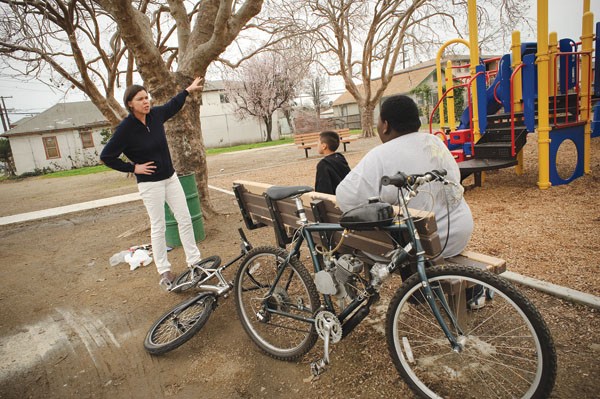
During the day, Maher would visit the park and sit there. But on
visit after visit she never saw kids playing. She did see people
running the stop sign on 8th Street, trash building up in driveways and
yards, and abandoned houses falling into further disrepair. The park’s
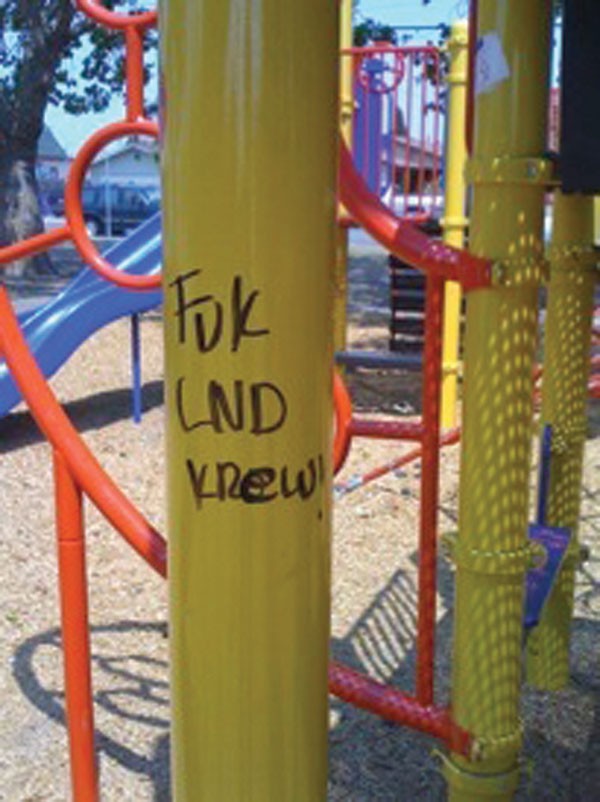
most frequent visitors were men drinking and shooting guns into the sky
at night, and the bright play structure was tagged weekly.
Because the surrounding neighborhood was a microcosm of Richmond’s
worst neighborhoods, Maher wanted Elm Playlot to be the first park she
transformed. If her idea succeeded there, in the worst of places, she
knew it would succeed elsewhere. So she started talking to
neighbors.
Mother of four Carmen Lee was one of them. Lee, whose house on Elm
Avenue is about ten steps from the park, is fed up with the
neighborhood’s crime. “Too many people I know get killed here,” she
said in an interview. “My friend got killed in the spring; a week
before that happened it was someone else. Everyone’s dyin’ around here.
It’s too easy for people here to get guns; they get ’em like you can
get a candy bar. That’s the thing I hate. I hate that my five-year-old
baby has to grow up like this, knowing about guns and death. She knows
more about guns than I ever did. It’s just senseless.”
A safe gathering place is what many of Lee’s neighbors desire.
“Hopefully the park will change things at least a little bit,” Lee said
of Maher’s efforts. “There are a lot of people in the neighborhood I
don’t know, and I have neighbors I should know. There’s a lot of
separation around here, too much negativity. Maybe this park will be a
place where we can get together.”
Despite the self-enforced racial segregation visible throughout the
neighborhood, Lee’s comments highlight the tangible longing of the
neighborhood’s largely black and Hispanic residents to connect. “The
boot of circumstance is around people’s necks,” Maher said. But below
the surface, she believes, people yearn for something better.
“One thing that surprised me about Richmond is that there’s a
perception that it’s this blank slate of awfulness, when, in fact,
there’s a world full of dedicated community activists working here,”
Maher said.
People want to help Richmond, and people are helping Richmond.
Community leaders, city leaders, and a few people with inexhaustible
passion fight the good fight against a tide of crime and despondency.
By infusing funds into schools and community centers, more and more
good has been etched out against the city’s patchwork landscape. But as
Maher would learn, there’s a long way to go.
When Maher first presented her concept of park hosts and play
elements, she was met with cynicism. Her vision seemed like a big pipe
dream for a place often so devoid of hope. At a community meeting on
January 24, she got some skeptical looks and snickers at the mention of
butterflies and bubble machines.
But in spite of all the snickers, it didn’t take Maher long to begin
mobilizing people. She has gotten nothing but support from city
officials, who already wanted to rethink their playlots but didn’t know
where to start. They immediately agreed to her pilot plan, and she
dived head first into meetings with city council members, budget
analysts, the city manager, and anyone else who would talk to her.
“I started to see how the city was working and how things
connected,” Maher recalled. “And when I went outside that circle of
leaders and talked to people in the neighborhood, I really realized
that so many people were in their own little bubbles. But I saw how we
could work together if we all collaborated.”
In March of last year, Maher presented a 31-page park prospectus to
the city and won approval to begin work to improve the park. After the
city endorsed the reinvention of Elm Playlot as Pogo Park, Maher turned
to the monumental task of fund-raising.
The city’s Redevelopment Agency took care of one major hurdle when
it pledged 100 percent of the capital costs necessary to renovate the
playlot, estimated at $400,000. Meanwhile, City Manager Bill Lindsey is
committed to having the city’s Public Works Department coordinate
street improvements around renovations of the playlot.
To redesign the park, Maher raised $37,750 from individual donors
— an amount that was matched by the city and awarded to Urban
Ecology, an organization dedicated to building ecologically and
socially healthy cities. Many talented playground experts are lending
their eye to the design of the park; including Ron Hothuysen and his
Scientific Art Studio, which is responsible for the play elements at
the Bay Area Discovery Museum and the huge baseball glove towering over
left field at AT&T Park. As luck would have it, Hothuysen’s
business is located in the Iron Triangle. With the help of Richmond
residents in his employ, he is creating unique play elements for the
new Pogo Park.
In fact, the city is seeking out local businesses to contract and
build each and every park element, from the fence to the office. “We
are right at the crest of doing something so different, in such a
better way,” Maher said. “Everything will be local; people who live in
the neighborhood will get the building contracts, bringing the money
back to them. It is an instant economic stimulus plan.”
Urban Ecology has involved the community in the design of play
elements and park layouts. Community members also will be hired for the
park’s construction. Maher believes that the more threads that are
weaved back into the neighborhood, the more chance the park has to
succeed. If the park is designed by the mothers living down the street,
built by teenagers whose little brothers will play there, and watched
over by the grandmother who lives next door, the collective assumption
is that people will be less likely to mess it up.
Playground designer Jay Beckwith, who is based in Sebastopol and is
one of his industry’s most respected figures, is acting as Pogo Park’s
advisor and planner. The California Endowment awarded $25,000 to the
urban design and land planning experts at MIG, who are considering how
to make the biggest possible impact on public health in the park’s
design. To support educational programs at nearby Peres Elementary
School that will mirror the programs at the park, the Irene S. Scully
Family Foundation granted the project $20,000. And she convinced Kaiser
Permanente to award $20,000 to support development of the play leader
program.
But even if she managed to create a utopia among parks, Maher soon
realized that Pogo Park alone couldn’t solve all the community’s
problems.
During Maher’s many visits to 8th Street and Elm Avenue, she began
to realize that the desolation of the surrounding neighborhood fed the
problems afflicting the Elm Playlot. After all, the neighborhood
surrounding Elm Playlot was a far cry from the one where Maher spent
her own childhood.
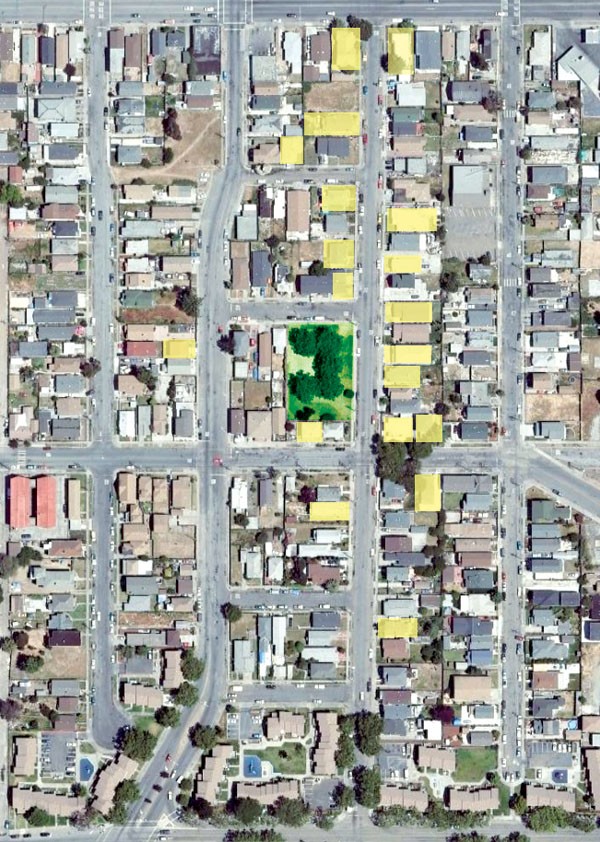
Eight out of ten houses immediately surrounding the park sit
unoccupied, serving as magnets for vandals and drug users. No one
bothers to clean up the waste piled behind low front-yard fences.
Keep-out signs and bright yellow auction notices are tacked over the
plywood on windows and doors. The park’s shiny jungle gym is just a
tempting beacon in a dangerous landscape.
So when UC Berkeley doctorate student Joe Griffin approached Maher
with an idea for a project to document the decay and danger of park’s
immediate neighborhood, she leapt at the chance to participate.
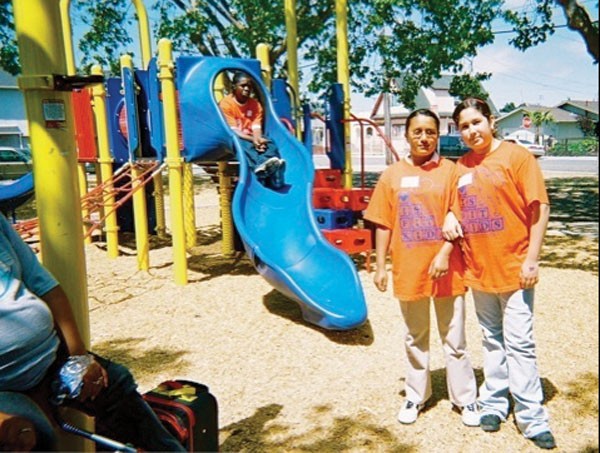
Griffin, a native of Richmond, initiated his Photovoice project as a
way to reach out to the community he grew up in. The project put
cameras in the hands of Triangle residents and asked them to photograph
what they liked and didn’t like about their neighborhood. The
photographs were paired with their recorded observations to create a
valuable illustration of life in the Triangle.
Many photographed the houses: “It’s not a good look for our
daughters and sons to walk through and see where they live at. And when
their teacher asks them, ‘Can you just draw us a picture of your
neighborhood?’ they’re just going to draw old, rusty, broken-down, or
undone houses that, you know, we cannot explain why this is
happening.”
Others depicted the trash: “You look at a model of another
neighborhood, and then you see your neighborhood. You see it as being
hopeless. I mean, it’s not spoken, it’s just implied. Every day. But,
we should just refuse to live like, you know, with something like
this.”
Still others captured the Nevin Community Center: “I like this
picture because these are all of my family members and … everybody’s
in here doing something constructive. Just showing that people actually
come here and do something, you know, it’s people that try to better
themselves.”
Another celebrated a local community garden: “This is a beautiful
community garden that the Iron Triangle has. I’d really like to see
more gardens, more flora, in the city of Richmond.”
Maher used the project as a tool to bring more city officials over
to her side. After Photovoice, she had a new bottom line: the park
could only be safe if the immediate neighborhood was safe, too. The
Redevelopment Agency agreed, and city Housing Director Patrick Lynch
responded by pledging a portion of the city’s $3.6 million federal
grant under the Urban Development Neighborhood Stabilization Program
(NSP) to buy the abandoned houses that surround the park and remodel
them into affordable housing.
“The NSP components will purchase and rehab blighted, foreclosed and
abandoned properties and demolish blighted structures all in order to
stabilize our most economically challenged neighborhoods,” Lynch
explained. “Pogo Park is an excellent example of a neighborhood
reestablishing families’ lives by merging supportive services with real
property rehabilitation.”
There’s no magic wand to turn a vacant park in the middle of a
low-income neighborhood into a safe haven for children and their
families. The Pogo Park plan acknowledges what’s happening in Richmond
and answers each challenge with a solution. For safety, install an
attractive fence that will be open during the day and locked at night.
For organization, build an office that will stock play supplies and
healthy snacks. For meaningful play, provide children with a park host.
To bring people together, schedule activities for children and exercise
classes for parents.
“What started from a critical need to provide children with a place
to play has turned into the catalyst for transforming the
neighborhood,” Maher said. “My job is to create a safe place for kids
to play and to become a link in this long chain of efforts by folks
devoted to Richmond to make this a better place for everyone.”
Maher envisions the park as a gathering center for parents, and
plans to offer outdoor exercise classes and monthly health clinics. She
imagines it as a community hub, with visits from Richmond’s public
bookmobile. She plans to work with teachers at Peres School to create
activities that mirror and support what kids are doing at school.
“We want to have readings of books at the park that kids are reading
in school, bridge some of the education through music that starts in
school,” she said. “By tapping into the existing network at Peres,
activities at the park will help get kids ready for school.”
With funding secured for the design and construction of the park,
Maher is still seeking funds to develop, and operate Pogo Park. Chief
among her needs are funds to support the play leader program and newly
formed Elm Playlot Action Committee. The committee will consist of six
neighborhood parents who will approve goings-on at the park, from the
selection of the play leader to the choice of park activities.
Once Pogo Park is finished, Maher hopes to apply the same model to
the city’s seven other playlots. She wants Richmond to prove that parks
can be a catalyst for change and thus serve as an example to other
cities with the same problems. To possibly justify the rehabilitation
of more parks after this one, UC Berkeley’s School of Public Health
will use a grant from the Robert Wood Johnson Foundation to conduct a
study that measures the impact of the revitalized playlot on overall
community health. Maher hopes that the result of the study will
eventually influence government policy surrounding funding for public
parks around the country.
Nothing is fixed overnight, but if you obliterate the trash, drugs,
and blight that stains a neighborhood, perhaps at least one corner of
this troubled city will be on its way up. Groundbreaking for Pogo Park
is on track for August, and with Maher’s heavyweight army of supporters
to fall back on, all signs point to success.