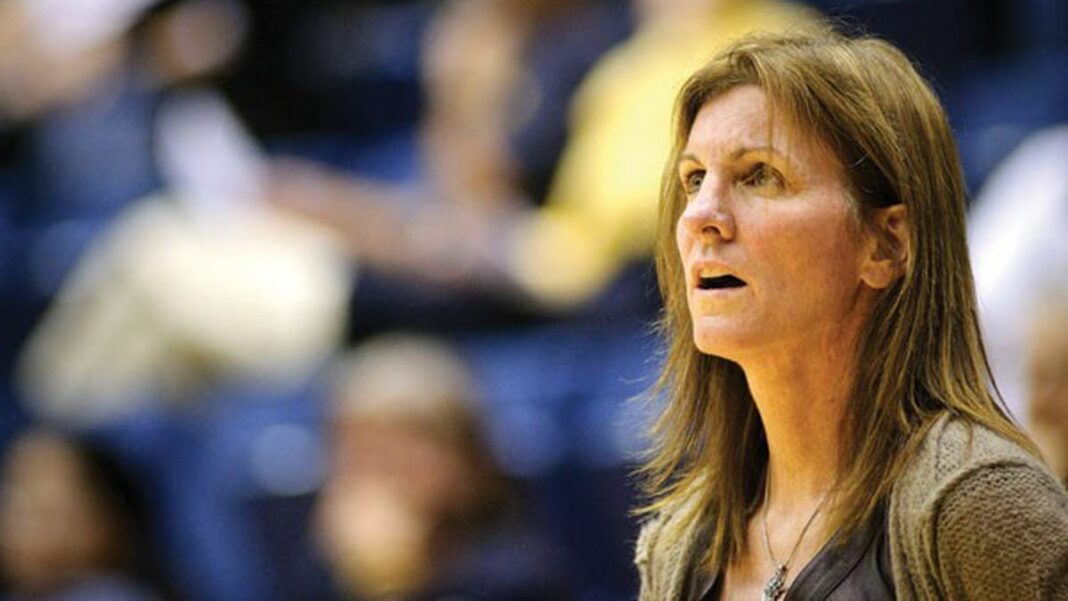
When Joanne Boyle became head coach of UC Berkeley’s women’s
basketball team, her program was an afterthought. Cal had gone twelve
seasons without a winning record or a finish in the top half of the
Pac-10 conference. During games, Haas Pavilion was another quiet place
students could go to and study.
But in the four years since, Boyle has resurrected Cal’s program.
Since 2005, her teams have won at least twenty games three times, and
made NCAA tournament appearances every year. Last season, the Bears had
the best season in the university’s history, winning 27 games and
advancing to the NCAA Sweet 16 for the first time ever.
Credits: Chris Duffey

Credits: Chris Duffey

Credits: Chris Duffey
Credits: Chris Duffey
Credits: Chris Duffey

Boyle’s predecessor, Caren Horstmeyer, had recruited well for the
2005 season. Devanei Hampton and Alexis Gray-Lawson were nationally
rated recruits from nearby Oakland Tech who liked the idea of turning a
perennial loser into a winner. Horstmeyer had then wooed Jene Morris
from San Francisco, Shantrell Sneed from Berkeley, and Ashley Walker
from Modesto, a recruiting class ranked in the top five nationally. Yet
before the quintet hit the court, Horstmeyer was let go by new athletic
director Sandy Barbour. She had committed the cardinal sin, overseeing
five losing seasons during her tenure at Cal. And she also didn’t beat
the Cardinal, Cal’s arch rival Stanford.
A national search ensued, and more than one hundred coaches applied,
intrigued by an opportunity at a name-brand institution with top
players all ready on board. Eight to ten were considered seriously, and
five came to Berkeley for a thorough look-see. Boyle, a rising star,
was hired, following three impressive seasons at the University of
Richmond, a school with no prior tradition in women’s basketball.
It was Boyle’s big break — if only she could find common
ground with a close-knit and probably skeptical group of players. But
the situation was difficult, Barbour said. “She recognized the dynamic
right away,” the athletic director recalled, “and then she did all the
right things.”
Lindsay Gottlieb, Boyle’s top assistant at Richmond and also for her
first three years at Cal, remembers a rougher transition. “That first
year was unlike anything else we had experienced,” Gottlieb said.
“Those players looked at us like aliens from another planet. But Joanne
worked day after day to gain their trust.”
Boyle stood by a simple pitch, and made it stick in her daily
interactions with the team: “I know how to do this. We can do it
together.”
Yet along with her easygoing mantra, she also required her players
to have perfect class attendance, physically demanding workouts, and
daily practices topped off with unappealing study sessions. Boyle
didn’t sugarcoat it, but instead helped her players find the joy in the
grind. “She never let them operate at a level one iota removed from
what was expected,” Gottlieb said. “And they appreciated that.” While
other Cal students found their stride more casually, blending academics
and social interactions, Boyle led her team on a structured path,
forcing them to find peace in concert with each other.
The women’s basketball team became a family, with Boyle as the
surrogate parent.
“She is a great person,” Gray-Lawson said. “I think you don’t get
that from a lot of people. If I ever had a problem or an issue, or
whatever is going on in my life, I can always go and talk to her. I
don’t think that a lot of people can say that about their coach.
[She’s] like my second mom.”
The growth process was complicated. Gray-Lawson wore here her
changing emotions on her sleeve, but eventually became Boyle’s steady
leader on the floor. In close games where will and talent take
precedence over a coach’s complicated playbook, she took the big
shots.
Meanwhile, Hampton broke team rules and started her career with a
highly publicized suspension. Yet by her sophomore year, she had
matured on and off the court and was named the Pac-10 Player of the
Year.
Walker made the biggest jump as a player, becoming good enough to be
the first Cal player to be drafted by and then play in the WNBA. In her
final two years, Walker emerged as the team’s focal point, forcing a
team of stars on the high-school level to adjust their egos. Morris, a
singular star in high school at San Francisco’s upscale, private Urban
School, flourished on the court but failed to mesh with her teammates
or Boyle. She transferred to San Diego State, a program more destitute
than Cal, and became the centerpiece in the Aztecs’ dramatic
transformation. Sneed didn’t develop as a player, spending the majority
of her career on the bench, but she never soured on Boyle or her
teammates.
“Those guys wanted it,” Boyle said. “They came to Cal because they
were local kids and they really wanted to put this program on the map.
In four short years, they really did that.”
Boyle’s early teams developed a reputation for sticky defense while
stubbornly feeding the ball to Walker and Hampton, their stars in the
post. With superior talent, winning came immediately. But the real
difference maker was Boyle’s people skills. The varied and nuanced
relationships she forged with her players created a cohesive
atmosphere. And, as the first group has graduated and other talented
players have arrived, the atmosphere has remained constant.
“If you’re going to be a coach and invest this much time in young
adult’s lives, you have to be about who they are,” Boyle said. “I just
don’t think, the way this business presents itself today, you can walk
into the gym and be with them for a couple of hours and walk out.
That’s not who I am, that’s not why I got into the business.”
A critical moment occurred in April 2007, following Boyle’s second
year in Berkeley. Gail Goestenkors, Boyle’s mentor at Duke University,
resigned and took the head coaching job at the University of Texas.
Boyle was an assistant under Goestenkors for nine years prior to going
to Richmond, a period during which Duke was wildly successful, becoming
known along with Tennessee, Connecticut, and Stanford as one of the
signature programs of the sport. Everyone in the sport assumed Boyle
would leave Cal and take the opening at Duke, her alma mater.
After all, Boyle was from the East, growing up a few hundred miles
away in Philadelphia and suburban Pittsburgh. Her extended family
remained in pockets on the East Coast. And Boyle’s mom was living
alone, one year after Boyle’s father had passed away in 2006. If she
took the Duke position, her mother could attend Boyle’s games, helping
her through the grieving process.
For two weeks, Boyle weighed the factors. Her mom encouraged her to
follow her heart. And Boyle did, deciding to stay at Cal and fulfill
her original promise to her players: “I know how to do this. We can
do it together.”
Boyle’s team had assumed she was going to Duke. When she didn’t,
they knew she had stayed for them. Her forthrightness was unblemished.
The team returned the favor, winning 27 games and earning a top-10
national ranking for the first time in school history. The team
faltered in the NCAA tournament, losing to George Washington in the
second round, as it still lacked the depth needed to make a deep
run.
But with her decision to stay, Boyle could hit the recruiting trail
with enormous power. No longer could other Pac-10 coaches recruit
against her by saying she’s got one foot out the door. And with two
winning campaigns in the bank, incoming players could envision
themselves as the missing piece.
No longer was Cal just a good team. Now it was a good program.
This year, after a pair of second-place finishes in the conference,
Cal is picked to finish second again. UC Berkeley’s three revenue
sports — football and men’s and women’s basketball — have
never captured an outright Pac-10 conference title, dating back to
1978, when the original eight schools welcomed Arizona and Arizona
State.
This lack of recent success is one disadvantage the programs face.
High admission standards are also both a source of pride and a
challenge in recruiting. Finally, African-American student athletes
visit the campus and don’t see that many similar faces. Currently,
black students comprise just 4 percent of the student population.
And those are just the internal obstacles. Across the bay, Stanford
has dominated women’s basketball on the West Coast, capturing nine
consecutive Pac-10 championships beginning in 2001. It’s not a stretch
to say that every aspiring female prep athlete in the country is
familiar with Stanford because of Tara VanDerveer and her successful
teams. This year, with superstar center Jayne Appel of Pleasant Hill,
Stanford could field its best team ever. “She’s got 25 years of history
over there,” Boyle said. “She’s done it year after year after year. And
we’re still new”
In the last two years, 10,000 fans have packed Haas Pavilion for the
Stanford game in hopes that Cal could bring about a changing of the
guard. In January, with Gray-Lawson scoring a career-best 37 points,
the Bears managed a narrow three-point win. The crowd roared with
approval, while the Bears rushed the court to congratulate each other.
The scene didn’t go unnoticed by VanDerveer.
“It was as loud as I’ve ever heard it over here,” she said. “It was
a great crowd. People were into it.”
Still it was just a bump in the road for the Cardinal. After the
narrow loss, Stanford ripped off 18 wins in a row and went to the NCAA
Final Four for the second straight season. Cal went on to win 27 games,
but had to settle for second place.
“Competing for a Pac-10 title is a monster of a challenge,” Barbour
said. “You’re not talking about an easy feat.”
After several winning seasons on the court, Boyle has parlayed her
success on the recruiting trail. According to Glenn Nelson of
HoopGurlz, a web site that chronicles college basketball recruiting,
Boyle and her new assistants, Charmin Smith, a Stanford player who went
on to play in the WNBA, and Kevin Morrison, a successful prep coach
with an extensive background in Southern California and on the AAU
circuit, have mastered the process. Seven new recruits, all rated in
the top 150, have joined the Bears this semester. Last week, three more
blue-chippers committed for 2010. Nationally, Cal is the only school to
attract consecutive top-10 recruiting classes. At the highest levels of
college basketball, there is no substitute for top-notch talent.
But attracting ten top talents in a two-year span creates a delicate
balancing act for Boyle. Big-time players don’t like watching from the
sidelines, and in the coming years that likely will be the case.
Following last year’s breakout season, three reserves transferred,
stating that they were looking for a campus that was a better fit. In
the college game, that’s often a euphemism used by players who want
more time on the court. Boyle adroitly doesn’t make any promises in the
recruiting process, and with increased numbers, the Bears will play
faster and make more substitutions, in attempt to wear down opponents
in a transition game. And that’s no small point. Boyle’s Cal teams thus
far have been talented but thin, suffering several notable late-game
collapses.
Tierra Rogers was the most heralded of the seven freshmen. She made
her mark as the defensive whiz for San Francisco’s Sacred Heart
Cathedral, a team so talented that it was undefeated and ranked number
one nationally in Rogers’ junior year. Like a lot of coaches, Boyle had
Rogers in her sights early in the process. With proximity in Cal’s
favor, Rogers and her father, Terrell, became regular visitors to
Berkeley, enamored with Boyle’s successes.
But on a crystal-clear January night in 2008, during one of Rogers’
games on the school campus, Terrell was murdered across the street from
the gym as he took his customary halftime cigarette break. Two gunmen
approached Terrell and another man, and opened fire. Terrell’s
acquaintance, unharmed and untargeted, watched in horror. When the game
resumed, Tierra was removed by her coach and notified by her principal
in an adjacent classroom. Inside the gym, a gloom enveloped the crowd
as the news spread.
Terrell’s role as a community activist and mediator between gangs in
San Francisco’s Hunters Point neighborhood apparently led to his
murder. And nearly two years later, the murder remains unsolved. On an
ESPN Outside the Lines report, Guy Hudson, Terrell’s close
friend and Tierra’s godfather, eerily declared that “everyone knows
what happened.” Sadly, in Terrell’s case, the code of the streets
trumped a murder investigation.
Boyle was there at courtside for Rogers’ first game following her
father’s death. According to a column in Sports Illustrated by
Chris Ballard, Rogers started the game, but looked uncomfortable and
never returned to the court once the second period began. But after the
game, outside in the parking lot, Boyle and Tierra spoke.
The coach’s dialogue with Rogers continued after the murder, but
Boyle says the conversations between her and the young player never
touched on basketball. Boyle came to know a girl who spoke in the
undeveloped rhythms of a teenager, but with the depth of an old soul,
the product of her difficult circumstances. Without her mentor,
cheerleader, and father, Rogers considered giving up basketball
entirely. But eventually, her evolving relationship with Boyle won out,
and she committed to Cal during her senior year.
During an unsupervised on-campus workout this semester, Rogers,
playing with her Cal teammates, grew short of breath and then collapsed
in the hallway of the gym as medical staff attended to her. Rogers was
hospitalized for more than two weeks and it was discovered she has a
rare heart condition that could have been fatal under the physical
stress of a college season. Rogers was implanted with a defribillator
to maintain her heart’s rhythm, and doctors told her she can never play
basketball again.
A press conference was arranged, at which Boyle and Rogers made
statements about how Rogers would have to give up the game she loved.
By the conclusion, Boyle was in tears, no doubt thinking about her own
2001 brush with mortality, when she was diagnosed with a genetic
neurological condition that required brain surgery and a lengthy
recovery process. Within that fight, Boyle gained an increased focus,
which eventually brought her to Berkeley and kept her at Cal when Duke
came calling.
“This is obviously devastating news for Tierra and her family,”
Boyle said in a statement. “We are here to stand by her 100 percent
with whatever she needs. Obviously, basketball was a very precious part
of her life, but she has a higher purpose here than just being a
basketball player, and her health and well-being are our primary
concern. Right now, she can really use all the support and prayers she
can get to help her through these trying times.”
Privately, Boyle has tried to help Rogers realize a new purpose, a
journey that she herself was quite familiar with. Rogers seems likely
to retain her scholarship, and if the school needs that funding at some
point, her education evidently will be paid for by a medical hardship
program. Rogers also continues to attend team practices, and she and
Boyle have apparently discussed coaching as a possible option.
The loss of Rogers on the court has left the Cal basketball family
needing to fill a void. At a recent practice, while Rogers was away for
a medical appointment, Boyle stood at the court’s perimeter, teaching
the intricacies of the trap and the full-court press. Unlike previous
years, when Boyle’s passion in teaching might cross into menacing
yelling, the coach’s voice was calm; only the player she was
instructing could hear her words in the cavernous gym. Eventually, each
of the six freshmen received patient advice from Boyle during breaks.
Meanwhile, assistants Smith, Morrison, and Jen Hoover focused on
getting the team to react to how the opponent is moving the basketball,
getting their feet pointed in the right direction and having the
correct stance. These defenses are central to the Bears’ new, faster
scheme, and on this day, the process of absorption took the lion’s
share of the team’s time on the court. It was at these very defenses
that Rogers excelled at in high school.
Like the transition from defense to offense, Rogers now has Boyle to
lead her in the transition from athletics to whatever comes next. Boyle
went through a similar transition after leaving Duke as a standout
player, and since then she’s helped steer numerous other players
through the process. The difference is Rogers’ transition will be more
dramatic, and filled with highs and lows. Already, Boyle says Rogers
has had tough days coping, but on those days the coach makes sure she’s
with the team, still a part of Boyle’s structured environment.
“I’m so glad she’s here,” Boyle confided. “I’m sick to my stomach
about what’s going on with her. She’s supported, she’s got great
teammates, an administration that cares about her. What if she was
somewhere else and didn’t have the support system, sort of the new
freshman on campus?”
On the court and off the court, in difficult circumstances, Boyle
knows how to do this. And at Cal, like she promised, she and the Bears
are doing it together.