
Last October, as economies tanked around the world, one local sign
of global recession managed to go mostly unnoticed. The “mosquito
fleet” — those rickety pickups tricked out with plywood sides and
packed with piles of cardboard — began to vanish from East Bay
streets. Nicknamed by the waste industry for its relentless peskiness,
the mosquito fleet isn’t prone to staying gone long. The disappearance
lasted only a few weeks before the scavengers showed up again. But
their brief absence was indicative of just how bad things got for the
recycling sector, which saw the bottom fall out so hard and so fast
that even its scrappiest freelancers stayed home.
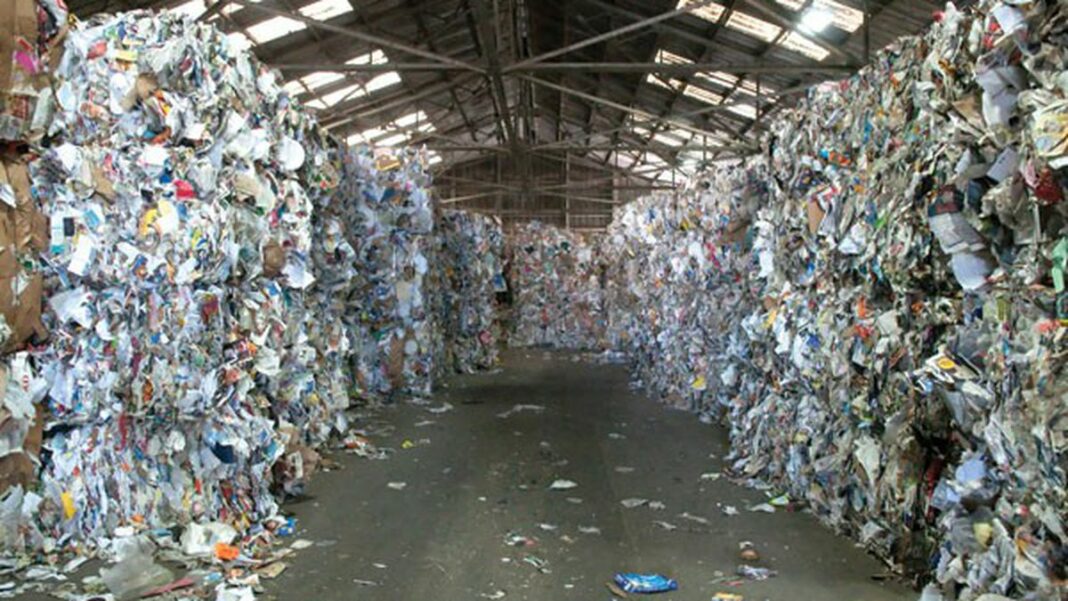
“That crash was stunning even by the standards of the recycling
markets, which are accustomed to volatility,” said Peter Slote, a
recycling specialist for the City of Oakland. In the course of six
weeks, the price of used cardboard — the “bellwether grade” of
recycled paper commodities, according to Slote — dropped from
almost $200 per ton in September to between $30 and $40 per ton in
early November. By mid-November, the price of mixed office paper was
down 52 percent, newspaper was also down 52 percent, and scrap steel
had fallen 80 percent in four months’ time.
Benicia-based Pacific Rim Recycling had taken to leasing warehouse
space in Oakland to store its suddenly unmarketable recyclables from
Contra Costa curbsides. Berkeley’s Ecology Center, the nonprofit that
in 1973 began one of the nation’s first curbside recycling programs,
found itself having to pay a materials processor to take its
commodities for the first time in its history. Not long before, those
same commodities, collected from more than 36,000 Berkeley households,
had been netting the center around $80,000 each month. A percentage of
that then went to the city.
Such high returns were as historic as the crash that finally
flattened them, Ecology Center Executive Director Martin Bourque
explained. “We’re expecting prices to come back, but we don’t know if
they’ll ever get back to $200 a ton in the near future. That was in
some sense part of the whole bubble of consumerism and borrow-and-spend
that was going on in the US.” As consumer demand in the West grew, so
did China’s demand for recycled fiber for use in packaging consumer
goods for export.
The collapse of American buying power was another part of the
equation. “The transportation costs of all of our recyclables that go
overseas to Asia are kept extraordinarily low because of the trade
imbalance,” Bourque explained. “The flow of goods of West to East, from
China to the West Coast, means that there has been this surplus of
shipping going from the US to China, and that makes it very inexpensive
to ship these materials that direction. If we had to pay the prices
that they pay from China to the US, our recyclables wouldn’t be going
to China.”
Louie Pellegrini, vice president of the private waste-collection
company Alameda County Industries, agrees. “We’ve gotten dependent on
China to accept our waste paper and commodities and recyclable
commodities because they have so few natural resources over there and
their economy was growing.” And when the credit crisis hit, China
halted nearly all purchases of such commodities — and in some
cases even left ships full of recyclables bobbing in market limbo off
its coasts. “The total waste stream probably in one week dropped to 20
percent of its value.” In addition, a reduction in Chinese shipments to
the West means fewer shipping containers arriving in the Port of
Oakland, ratcheting up the price of operating in the export-dependent
recyclables market at a time when credit was practically frozen.
Because of these factors, Pellegrini says ACI must raise rates by
about 10 percent in Alameda and San Leandro, where the company provides
residential and commercial solid waste and recycling collection. Unlike
the Ecology Center, ACI — like most local waste-management
companies — accepts all market risk and reaps all reward. “Any of
the value we receive from those commodities we use to offset the cost
we charge to our customers,” Pellegrini offered. Because recycling
value represents 10 percent of the revenue stream necessary to cover
costs, the company says it must implement the rate increase on July
1.
“Labor costs are going to increase beyond the [Consumer Price
Index],” Pellegrini argued. “We can no longer absorb those labor
increases because the commodity value wasn’t there.” He noted that ACI
never approached San Leandro or Alameda about a rate increase during
the 2008 fuel crisis even though fuel prices doubled. “We were able to
maintain that because we had commodity prices,” he said.
Berkeley also is moving to hike rates for garbage services,
including the recycling it contracts to the Ecology Center. In an April
21 report to the city council, the city manager proposed increasing
residential and commercial rates by about 20 percent in order to
generate $4 million, an average increase of $4.20 per residence per
month. The city will hold a public hearing on the issue July 7; the
rate hike is scheduled to take effect the next day. “Costs have
increased since the last rate increase in July 2006,” read the report,
which offered a number of reasons for the change, including the
collapse of commodity prices, recycling contract costs, and labor cost
increases.
Bourque classifies the 2008 drop in commodities prices “pretty
shocking to our system” but rejects arguments like that of ACI. “In
most private sector arrangements, the hauler absorbs all the risk and
all of the rewards,” he said. “And for the last decade that’s been all
gravy, that’s been all reward. … If prices stayed low for an extended
period of time it would genuinely be legitimate to say ‘We need to
adjust our rates.'”
Slote of Oakland says neither of Oakland’s contracted private-sector
collection companies, Waste Management nor California Waste Solutions,
has approached the city about raising rates. “There’s no contractual
basis for them to say, ‘We’re not making as much as we used to: We want
to raise rates.'”
As for hopes that the market will rebound, Pellegrini says prices
have recovered somewhat. “It’s come back slowly where we’re probably at
50 percent of the value for that material that we were enjoying in
October of last year. No one has a crystal ball for the long-term
outlook; it’s all tied to the worldwide economy.”
Brook Edwards, a recyclables-market analyst and author of industry
newsletter The Brown Sheet, agrees that predictions can be
difficult. “Not in a million years would we have thought it would all
go to hell like it did,” he offered. But his research indicates that
prices are indeed picking up: Cardboard exports are at $115 to $117 per
ton in Northern California, and residents of the East Bay are “sitting
in the ideal spot because you have the port, and with China the main
manufacturer in the world right now — and they do not have enough
raw material — they’re going to be knocking on your door every
month regardless. … They don’t want to be shipping back empty
containers.”
California also mandates that its cities divert half of its waste
from landfills, and individuals from the public, private, and nonprofit
sectors say that market prices have not affected this important
underlying issue.
“People’s biggest concern was that they wouldn’t be able to get rid
of the recyclables at any price,” said Tom Padia, recycling director
for Alameda County’s waste management and recycling agency, StopWaste.org. “And that has not
materialized so far. People have been able to move the material into
recycling markets. So the last thing we want is for people to get
turned off to recycling because they think that it is ending up in the
dump. … It’s important in the long run to keep the resource
conservation ethic.”