
Willem de Kooning stepped outside, looked up at the stars briefly,
and then told his wife, “Let’s go back to the party. The universe gives
me the creeps.” Contemporary secular Americans like to believe that
science puts us in control, although that jaunty confidence depends in
part on our knowing, like de Kooning, where not to look. Premodern
artists believed instead in myth and religion — outworn creeds
these days (and thankfully so, after our millennial debacle) —
but were able to look penetratingly at aspects of life that we shun as
“depressing.” Such traditional magical thinking also inspired, we
should remember, for all its follies, abuses, and crimes, sublime art
like Michelangelo’s Sistine Chapel frescoes, which a certain
Dutch-American painter admired as “perhaps the greatest thing ever
done.”
San Francisco painter Eva Bovenzi finds the religious art of
old Europe more simpatico than the conceptual-based art of
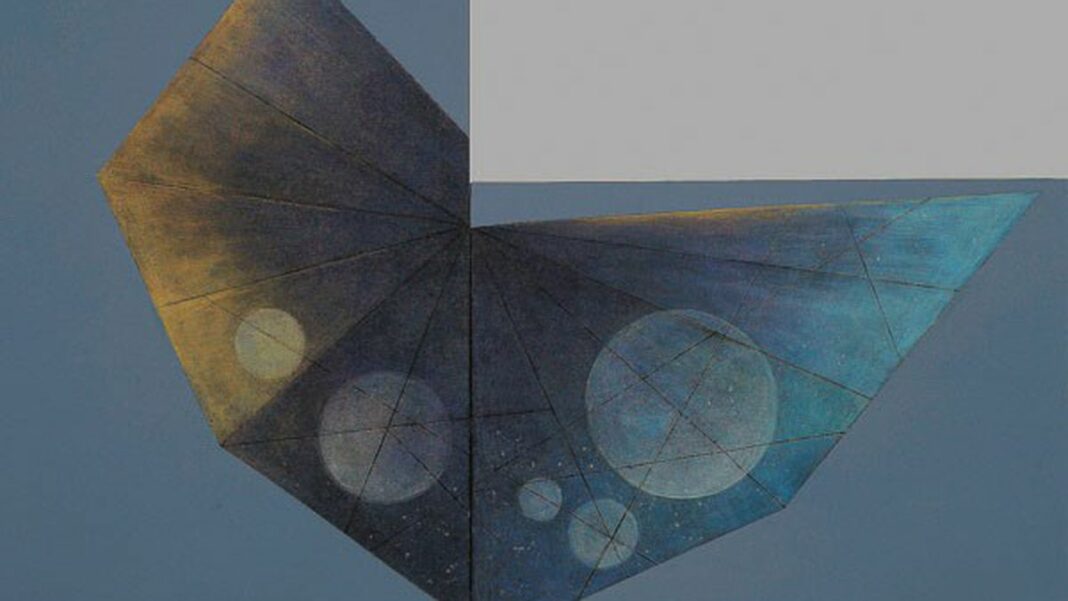
third-millennium America. Her Messenger oil paintings at
Berkeley’s Graduate Theological Union depict what appear to be
mechanical wings, membranes supported by ribs or struts, splayed on
horizontal and vertical canvases that have been butted together,
forming L shapes. The Greek word for messenger is angelos, and
these irregular diptychs invoke the divine intermediaries of past
religious art. With their subtle shades of purple and rose, and their
glints of silver and gold, Bovenzi’s seraphic images invoke,
respectively, the magic, transformative hours of dawn and dusk and the
eternal stasis of heaven; they’re about becoming an eternal being.
Overt spirituality in art these days, however, is an anomaly. Most
contemporary artists are skeptics, and whatever raptures or epiphanies
they experience are accounted as purely biochemical; the old idea that
art should or could inspire moral uplift now seems laughably naive.
Bovenzi shows us, accordingly, not the semidivine winged messenger of a
religious age, but bits of wreckage salvaged from ornithopters like
Leonardo’s, ironically adorned with clouds, celestial bodies, and
cartographic meridians. Bovenzi’s wing paintings symbolize the
elevation and extension of human consciousness and also warn of hubris
— Icarus’ crash into the Aegean seen through an abstract,
modernist, skeptical (but somewhat nostalgic) temperament. Bruce Nauman
declared ironically in a 1967 neon sculpture that “The True Artist
Helps the World by Revealing Mystic Truths.” Did we fly too high or too
low? Through June 15 at Graduate Theological Union (Hewlett Library,
2400 Ridge Rd., Berkeley). GTU.edu or
510-649-2400.