It Came From Berkeley, Dave Weinstein’s lively history of one
American college town’s contributions to American society, tells the
story of how the city played a principal role in the following
innovations: the atom bomb, the wet suit, the hot tub, yuppies,
listener-sponsored radio, California cuisine, school integration,
women’s rights, prohibition, the commercialization of LSD, and more. In
57 separate chapters, Weinstein charted Berkeley’s course from
Republican-leaning “Athens of the Pacific” to the infamous “People’s
Republic of Berkeley” so hated by Fox News. Here is some of what he
came up with. The rest is in his book, It Came from Berkeley: How
Berkeley Changed the World, published by Gibbs Smith.
How Berkeley Took to the Hills

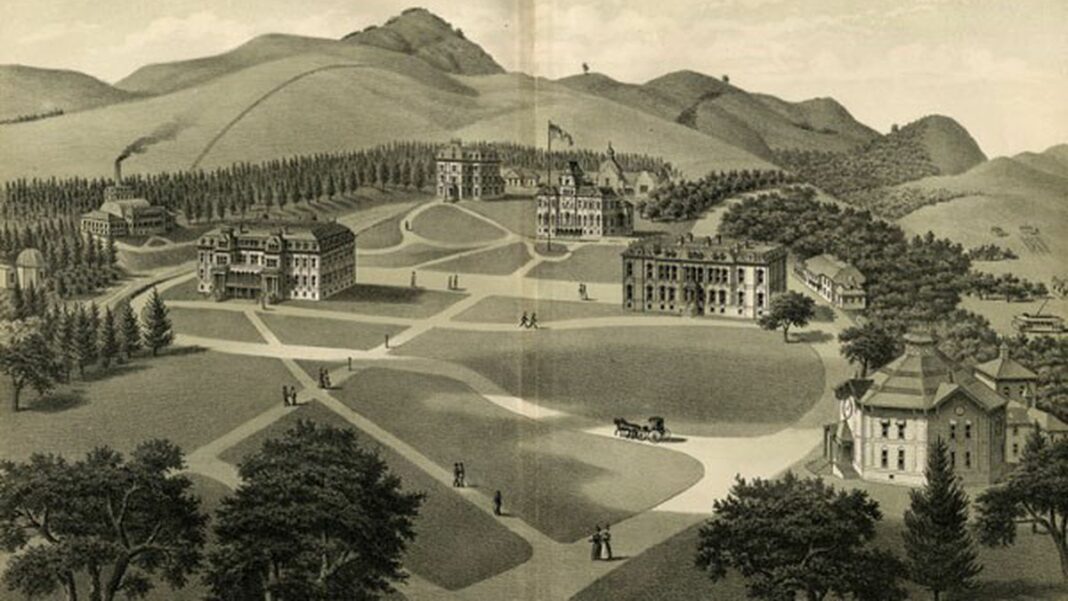
of Berkeley.
Credits: San Francisco History Center of the San Francisco Public Library.

Credits: Berkeley Historical Center
Credits: Bancroft Library of the University of California, Berkeley

Credits: Bancroft Library of the University of California, Berkeley
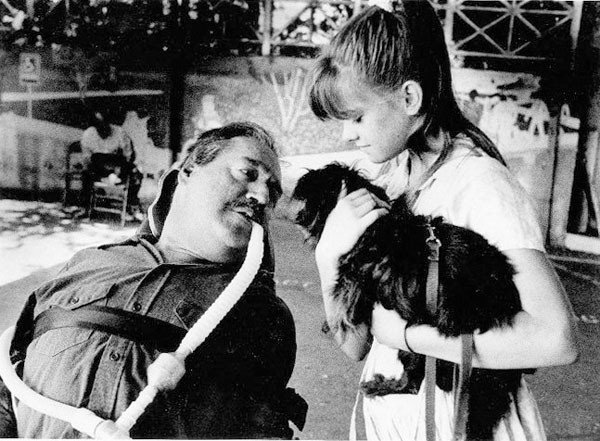
Credits: Center for Independent Living
No one considering the history of Berkeley can ignore the hills
— because nothing had more effect on the city’s development, nor
on its social and cultural life, than the hills. Without the hills,
Berkeley would never have become Berkeley — a town that glories
in the beauty of its wilderness and in wilderness everywhere.
The founders of the University of California knew they’d lucked upon
the most beautiful site in the world, better than the Italian lakes and
closer in spirit to the Olympian home of the gods. Poet Joaquin Miller
agreed. “It sits in the lap of huge emerald hills, and in the heart of
a young forest,” Miller wrote in 1886, “with little mountain streams
bawling and tumbling about, wild oats up to your waist in the
playgrounds and walks, and a sense of largeness and strength grander
than I ever felt in and about any university before.”
And every house built in the town’s upper reaches, residents
bragged, had a view through the Golden Gate. Berkeleyans could sit on
their porches and watch buildings going up in San Francisco. The
Berkeley Hills were wilderness. Bears roamed and salmon spawned in
Strawberry Creek.
Berkeley became a city of hikers. Cornelius Beach Bradley described
some favorite hikes in the 1898 book A Berkeley Year. “The quiet
saunter up Strawberry Canyon, the long afternoon ramble over the hills
to Orindo Park, the all-day tramp by the Fish Ranch to Redwood Canon
and Maraga Peak, or more strenuous still, the cross-country trip to
Diablo.”
Twenty years later, the lively coed Agnes Edwards headed for the
hills whenever she could. “I don’t think there’s another place in the
world where you can see so many different kinds of scenery,” she wrote
her folks in letters that have been collected in the delightful book
Student Life at the University of California Berkeley During and
After World War I. “The Bay is all spread out before us, the hills
rise out of our yards almost, and altho’ we’re within an hour’s
distance of as citified a city as you could want, in ten minutes’ walk
we can get so far from civilization that we’d never know we were near a
city.”
Perhaps nothing — not bohemianism, free speech, citizen
activism, spirituality, nor good food — defines Berkeley so much
as its beauty, which attracted the men who first made up the faculty
and the poets, artists, architects, business people, real estate
developers, and scientists who followed. In 1903, when President Teddy
Roosevelt came to speak during commencement, the university’s beloved
president, Benjamin Ide Wheeler, invited him to gallop on horseback
through the hills. Over the years, Berkeley’s thinkers did their
thinking while walking in the hills — none more so than
physicists Ernest Lawrence and Robert Oppenheimer. It was on these
strolls that they hashed out details for Berkeley’s biggest
contribution to history, the atomic bomb.
William Keith, argubly Berkeley’s finest painter and certainly its
most successful, walked every day through a forest of campus oaks on
the way to the ferry and his San Francisco studio. Many of those oaks
turned up later in paintings of the Sierra. The Sierra Nevada itself
was no stranger to Keith. He hiked there often with his friend John
Muir.
Thanks to Muir, Professor Joseph Le Conte and his son, Professor
Little Joe, as well as biblical scholar William Badè and other
Berkeleyans who helped found the Sierra Club, the Sierra became a
Berkeley outpost, with locals like Bill Colby leading trekkers on
monthlong stays, complete with mules and slabs of bacon.
Colby recalled one of those trips with Little Joe. “Joe bought a
mule and it was black. He called it Blackie. And before he got through
with his trips, that mule was white — perfectly white. Everybody
said that Joe would take the mule up to the top of a pass and put his
head over the edge. When the mule looked down and saw where he had to
go, he got so frightened that it scared him white.”
Another Berkeley mountain man was artist and professor Worth Ryder,
who introduced modern art to Berkeley in the 1920s, later bringing in
the abstractionist Hans Hofmann. Ryder loved the outdoors. “There is
something primordial in the joy it gives me,” he wrote of the Sierra.
“Standing naked and alone in the wilderness, facing the sun and the
wind. And such a wind it is. Hurrying across vast untrodden spaces,
ozoned by fragrant forests, and cooled by crystal ice fields. It
ripples across my back like joyous laughter.”
How Berkeley Promoted the Good
Life
Few men set their goals so early or stuck to them so consistently as
Charles Keeler, who decided as a boy to become a naturalist and poet,
and spent the rest of his life pursuing both goals — despite
notable failures.
Although he wrote one book, The Simple Home, which helped
define the Berkeley look and remains a classic, Keeler’s other poetical
productions — ballads, pageants, children’s verse (Elfin Songs
of Sunland), novels, nature books, journalism, and radio plays
— are forgotten. And though his homes in Berkeley were showpieces
of his harmonious natural lifestyle, Keeler often lived
hand-to-mouth.
Still, no one came closer than Keeler to formulating or acting out a
Theory of Berkeley: Life is best when lived out of doors. Your home
should belong to nature. Fine art should be inhaled like air. Figure
out what is best for your community and make it happen. Study nature
but don’t ignore spirit. An evening is best spent with friends
listening to music or attending the theater, or making your own music
and theater. Ready for bed? First pull out your pen and describe your
day and your thoughts and your dreams.
Bernard Maybeck designed a brown-shingled home for Keeler in 1895,
helping set the rustic yet playful and sophisticated look of the
Berkeley Hills for decades to come. Keeler put Maybeck’s Arts and
Crafts aesthetic into words and turned it into a crusade.
Keeler made his mark at Cal by establishing the Evolution Club to
promote Darwin’s theory, which was so controversial it split
friendships. For Keeler, though, evolution led to love. After spotting
the club’s leader, with his long hair and intense brown eyes, coed
Louise Mapes Bunnell developed a sudden interest in Darwin. She and
Keeler married a few years later and collaborated — Louise as
designer — on some of the best Arts and Crafts publications
produced in the Bay Area.
By 1892 Keeler was working at the California Academy of Sciences and
exploring the fauna of the Farallon Islands. His first book came out
the next year, The Evolution of Colors of North American Land
Birds. In 1899, he accompanied Muir, naturalist John Burroughs, and
other scientists on the Harriman expedition to Alaska, forming
friendships that would last. He hiked with Muir in the Sierra and
helped form the Sierra Club.
In Berkeley, when the women who founded the Hillside Club to
advocate naturalistic planning in the hills needed men in their
organization to give it political clout (this was before women had the
vote), Keeler became president and molded the group into an activist
organization and political force. The club fought for winding streets
that followed the contours of the land, for tree preservation, and for
architecture that blended with the landscape. The club’s principles
were based on Maybeck’s architecture and Keeler’s theories. Keeler’s
ambitions, as ever, were huge. He saw the club becoming a statewide
movement. It never did, but its principles and successes still inspire
anyone who visits the Berkeley Hills.
Like most of Berkeley’s artists and writers, Keeler was
stylistically conservative. “The great problem with regard to beauty as
I see it today,” he wrote a friend in 1929, “is that the so-called ‘new
art,’ modernistic art, encourages and glorifies ugliness in the name of
art.” About modern artists, Keeler added: “They are in fact
psychopathic schizophrenics in whom the normal standards of beauty in
nature have been swept away and their grotesque fantasies have
supplanted them.”
After Louise died in 1907 — she had been ill and weakened
after spending weeks helping San Francisco earthquake refugees in
Berkeley — Keeler found himself raising three children by
himself. (He finally remarried in 1921, after staving off his
wife-to-be for years, pleading poverty.) His mother watched the
children while Keeler took his show on the road, attracting 250
Europeans to a reading at Tokyo’s Imperial Hotel in 1911, followed by
successes in Hong Kong and Manila. He appeared in Paris and London, met
every literary figure he cared to, and settled in New York. But Keeler
had little luck outside Berkeley, as revealed through his letters to
family and friends. He spent his days hustling after his one big break
and his nights writing in a series of increasingly shabby rooms. “My
days are so very full that I go from one appointment to the next with
the regularity of a machine,” he wrote home. “It is all in the line of
making my work known, but so far without decisive result.”
Keeler had successes now and again. His poem “The Enchanted Forest,”
which he wrote in three nights between midnight and 2 a.m., attracted a
full audience to the Waldorf-Astoria. His daughter, “poor little
Eloise,” fainted from the excitement. Still, without his mother’s
checks, he would have been unable to pay the rent, and by 1917, Keeler
“really feared I might find myself here with no money to pay for my
room or to buy food.”
Returning to Berkeley by the start of World War I, Keeler was back
to form, involving himself with the Rotary and Bohemian clubs,
attending salons, and writing incessantly. For seven years Keeler had
the unusual experience, for a poet, of managing the Chamber of
Commerce. It was a job he handled well, boosting dues while quadrupling
membership and tackling such divisive issues as the future of the
Berkeley waterfront, which he hoped to preserve largely as open space.
His stance cost him the job.
“The work was most uncongenial to me in many respects,” he wrote
several years later, while seeking work as the city librarian, “but I
stayed with it for seven years and was finally unceremoniously turned
out by a minority group who wished to extend the industrial zone in a
manner that seems to me and to many others a great misfortune to
Berkeley.”
Keeler had already embarked on a project he hoped would gain him
worldwide acclaim, or at least a dependable salary — the Cosmic
Society. “If civilization is to survive, a new religious consciousness
must help to unite the world,” he wrote. His religion was based on “the
common religious bond in which all religions share,” “the trinity of
love, truth and beauty.”
Keeler based the society’s organization on that of the Chamber and
the Rotary Club, and expected to serve as its paid director. He tried
to start branches in Los Angeles and Washington, DC, and insisted, “If
Cosmic Religion societies are organized, they will be required to
receive their charters from the Berkeley headquarters.”
The society often met before the fireplace at Charles and Sulgwynn
Quitzow’s Passmore studio or at Mary McHenry Keith’s hillside home.
Evenings featured piano, violin, or vocal recitals. Members —
about fifty, including Berkeley police chief Gus Vollmer — would
also talk about their lives and would patronize each others’
businesses. Keeler’s plans for a Cosmic Temple were characteristically
ambitious. “Within such a temple would be the magic of modern lighting
producing strangely beautiful effects falling upon moving water,
stained glass designs, mural paintings symbolic of Cosmic Religion,
sculpture and carvings,” Keeler wrote. “There would be organ music,
chamber music, a symphony orchestra and choir, dramatic pageants and
allegories rendered.” The temple, in other words, would not have been
brown shingled.
Keeler never flagged. Although a novel about a chamber of commerce,
“Bayville Boosters,” failed to find a publisher, his radio plays
— Skipper Brown’s Yarns, Tales in a California
Garden, Around the World with Keeler — proved popular.
Still, the Keeler household, which remained at his wonderful studio in
the hills, required regular checks from his son Leonarde. “I have lost
influence in the last few years,” Keeler confessed to Leonarde a year
before his death in 1937, “and not many people who count in the world
are anymore interested in me.”
How Berkeley Pioneered Modern Crime
Fighting
Thieves “have learned that they can work in this city without
molestation by the police,” the Berkeley Gazette reported
in 1903, citing a recent jewelry heist at the home of Mr. and Mrs.
Morgan. “Realizing that it was useless to ask the local police to
apprehend the marauders, the Morgans telephoned the occurrence to the
Oakland department.”
“Strictly speaking,” the Courier wrote in 1905, “the town has no police force.” There
was one marshal and four officers, none of them professionally trained.
For a time, none of them worked at night. That all changed in 1905,
when August Vollmer — a Marine veteran of the Spanish-American
War’s bloody Philippines campaign and a town firefighter — was
elected marshal. He was already a local hero for averting disaster when
a loose railcar threatened to plow into a passenger train.
The 25-year-old “boy marshal” looked silly when he raided several
Chinese opium dens and found himself in court “up against the old
difficulty of being unable to identify the Chinamen,” the
Courier wrote.
And Vollmer’s face turned red at a party during his first months in
office. Surrounded by a gaggle of pretty girls, Vollmer decided to show
off his handcuffs — snapping them around one miss’ wrist —
before realizing he didn’t have the key. But Vollmer wised up. Although
he claimed to have no education, education is what he based his
policing on. That, plus technology and science — sometimes,
pseudoscience. By 1906, Berkeley had its first bicycle patrol, a
centralized record system that tracked criminals’ modi operandi, and a
system of electric lights spaced throughout town to communicate with
officers. It was said to be the first electric police communications
system in the country.
By 1913, Berkeley had the nation’s earliest all-motorized police
department, and by 1919, the city equipped some of its cars with
radios. In 1915, Berkeley had its own crime detection lab. Vollmer
subjected would-be recruits to intelligence tests and, in 1908, started
the Berkeley Police School — also an American first. By 1917, the
school — run in conjunction with the university — taught
physics, chemistry, biology, “criminology, anthropology and heredity,”
and “criminological psychology.” The force was known nationwide as
“Berkeley’s College Cops.”
A fan of Cesare Lombroso, who believed criminals could be identified
by such characteristics as large jaws, Vollmer provided instruction on
“race degeneration,” “eugenics,” and “hereditary crime and criminal
tendencies.” Students learned about such “indirect factors” in crime as
saloons, gambling, prostitution, “dime novels,” and “daily papers.”
They also learned about preventing crime through education, art,
sanitation, and “intelligent police.”
“Criminologists know that a policeman’s energies should be devoted
to removing causes of crime, not to pursuing criminals,” Vollmer said.
“But the average policeman doesn’t know that.”
“We must deal with the child in the early and plastic period of his
life, when his attitudes, his religious, social, and personal ideals
are being developed,” he told the Gazette in 1930. Vollmer sent
policewomen into Berkeley schools to inculcate the young.
One of the first lie detectors was developed in Berkeley by John A.
Larsen, a Ph.D in physiology whom Vollmer brought to the department.
The machine was improved in 1920 by Leonarde Keeler, the son of
Berkeley poet Charles Keeler, who was a friend of the chief.
Eloise Keeler, Leonarde’s sister, watched as seventeen-year-old
“Narde” first tried out his machine, “a strange contraption consisting
of tubes, wires, glass bulb and a wide strip of black smoked paper
which moved.” The “suspect” was Eloise’s best friend, Chickie.
“Do you love Charlie?” Narde asked. “The needles recording Chickie’s
blood pressure and breathing had suddenly lurched.”
“It’s true. I do have a kind of crush on Charlie.”
Eloise revealed why Vollmer was interested in such a machine: “The
chief would not tolerate third-degree methods such as beating with a
rubber hose.”
“The Keeler Polygraph” became one of the most used in the country,
and Leonarde became a leading criminologist.
Vollmer, “an iron-gray man,” according to Colliers magazine,
“with iron in his face and gray in his hair,” opposed capital
punishment, and treated panhandlers leniently. Police officers, he
said, need to possess “moral impregnability.” He also believed in free
speech, backing the YMCA’s decision to open its meeting rooms to
everyone, even Communists, whose philosophy he had no truck with.
Believers in socialism, bolshevism, and “IWW-ism” he consigned to the
“paranoiac” and “mentally twisted” personality types.
By 1924, according to Colliers, Vollmer was “the most famous
policeman in the world.”
Vollmer, who retired as chief in 1932, continued teaching at the
university until 1937. He remained active in the community, helping
create the East Bay Regional Park District. In 1955, nearly blind and
suffering from cancer and Parkinson’s disease, he took his own life
after telling his housekeeper, “Call the Berkeley Police. I’m going to
shoot myself.”
How Berkeley Went Socialist
Today, outsiders may call Berkeley “the People’s Republic.” During
its early-20th-century heyday, however, the city was run primarily by
Republicans. But Berkeleyans — even then — were not immune
to the call of the Socialists for a more equitable divvying of life’s
spoils.
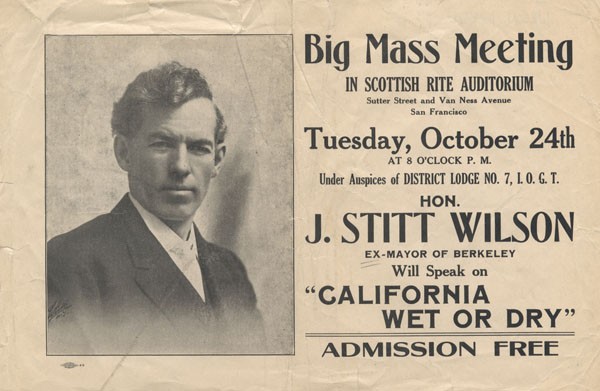
In 1911, when Socialist J. Stitt Wilson ran for mayor, even a paper
not known for its radical opinions supported his cause. “His
well-rounded sentences, polished rhetoric and telling logic drove home
the truth with great power,” the Gazette said of his kickoff
speech.
Wilson, then a boyish 43, called for public ownership of lighting
and electricity, streetcars, water, and phones, and a public
kindergarten, with all these services provided at minimal cost. The
battle, he said, set private citizens against “a mere handful of
individuals who control the resources of the nation.” Wilson, a backer
of women’s suffrage, already had the support of Berkeley’s progressive
women.
“You know what I am standing for,” he said to rousing cheers,
“cheaper water, cheaper gas, cheaper lights, cheaper phones.”
It was five years before the Bolshevik Revolution, and “socialism”
had yet to become a dirty word. The years before the Great War were a
high time for Socialists in America, with seventy or so cities electing
Socialist mayors, and Eugene V. Debs, the perennial presidential
candidate, providing the party with a charismatic face.
Wilson, once a preacher in Canada, made his name in town in 1905 as
a leader of the Berkeley Anti-Vaccination League. Wilson took the stump
against small-pox vaccinations, claiming they caused disease. He did so
effectively. “Vaccination an evil,” the Courier trumpeted in a
headline.
His socialist exhortations often took on biblical overtones.
Consider his lecture “The Barbary Coast in a Barbarous Land: Or the
Harlots and the Pharisees.” “Prostitution,” he intoned, “is the rotten
pus running out of your respectable, legalized church-sanctioned
capitalist system of industry.”
As mayor — he won by a mere 281 votes — Wilson fought
his first battle with his own party. The Socialists required party
members to sign resignation papers upon taking office and put them in
the hands of the party so it could turn those out of office who
disobeyed its edicts. Wilson told them to take a hike.
Wilson paid heed to his constituents’ quotidian needs. When folks in
West Berkeley complained about the fire danger posed by a lack of
water, in two days Wilson made sure they had access to a water
tank.
His ally on the city council, John A. Wilson, proposed to ban
smoking in any “restaurant, waiting room, office, store, streetcar or
any other place used by the public” — a measure whose time didn’t
come for another ninety years. “Berkeley smokers who like to take a
puff of the fragrant weed are in for the most uncomfortable time of
their lives,” the Berkeley Independent warned.
Another failed initiative was the mayor’s plan to build a municipal
lighting plant. Wilson and city attorney Redmond (“Reddy”) Staats also
failed in their attempt to block the merger of Home Telephone and
Pacific States Telephone companies.
Wilson didn’t mind making enemies. When the realty men asked the
city to ease their tax burden, he faced them at a public meeting and
said, “A laundryman is more valuable to the community than a real
estate man.”
By 1912, Wilson was ready for bigger things — Congress. His
chances looked good. After all, he’d pulled in 12 percent of the votes
in his try for governor in 1910. The Independent got into his
corner, painting incumbent Rep. Joe Knowland as a pawn of the
monopolists and the trusts, and printing Wilson’s exhortations in their
entirety.
Wilson’s program for the United States much resembled his program
for Berkeley: collective ownership of rail, wire, wireless, phone,
mines, quarries, oil wells, forests, water power, steamboats,
stockyards, “and all large-scale industries.”
He called for the conservation of timber, the reclamation of swamps,
and the creation of new highways and waterways. The Supreme Court
should no longer be allowed to overturn legislation. Children under
sixteen shouldn’t work. The workweek should be shortened to six and a
half days, and there should be a minimum wage.
Knowland won by 9,100 votes. Wilson lost his hometown by 419 votes.
Wilson, who chose not to run for reelection as mayor in 1913, ran
unsuccessfully as a Socialist for Congress in 1932 and for governor in
1936 and 1940.
Berkeley had to wait 66 years — until Gus Newport in 1979
— to have another socialist (small “s” this time) mayor.
How Berkeley Invented Regional
Parks
Berkeley dearly loved its hills but wasn’t always willing to pay for
them. Back in 1908, a plan to turn much of what became the Thousand
Oaks neighborhood into a 98-acre wilderness park was defeated by 560
votes — even though the park was supported by everyone from real
estate developer Duncan McDuffie and the Chamber of Commerce to
Benjamin Ide Wheeler and Mary McHenry Keith.
Stakes were higher twenty years later when rumors circulated that
the East Bay’s publicly owned water company planned to sell to real
estate speculators its land along the Berkeley-Oakland hilltops —
land that provided the East Bay with its natural backdrop.
The property — 11,000 acres stretching from Oakland’s Chabot
Reservoir in the south to Richmond in the north — had been
squirreled away by a series of private water companies to ensure the
cleanliness of creek water that flowed into their reservoirs. The East
Bay Municipal Utility District no longer needed the acreage because it
was replacing local water with purer stuff from the Mokelumne River in
the Sierra.
Hill lovers quickly united to make sure that “Keep Out: Beware of
Arrest” signs became a memory. “If we allow these properties to be
subdivided and sold to private individuals,” Robert Sibley, the
chairman of the new East Bay Metropolitan Park Association wrote, “we
will have lost forever an opportunity to build a chain of parks as
beautiful as any owned by an American city today.”
His letter went out two weeks before Black Thursday marked the start
of the Great Depression. But that put no damper on park proponents.
Samuel C. May, a Cal administrator, took the lead, hiring the Olmsted
brothers’ landscape architecture firm and Ansel Hall of the National
Park Service to survey the potential parkland.
Founders and early leaders of the effort, who were mostly from
Berkeley and Oakland, included McDuffie, Robert Sproul, Gus Vollmer,
city manager Hollis Thompson, Major Charles Tilden, and Harold French,
a pioneer conservationist with the Contra Costa Hills Club.
Through a canny campaign, largely run by Harlan Frederick, an
associate of May, the group convinced virtually every civic association
to sign on.
But for years, despite public support, the proposed park seemed to
some “a wild dream.” EBMUD, which still owed money to bondholders for
some of its land, refused to use it for parks. “Parks are a luxury
compared with a proper water supply,” said George C. Pardee, the
utility district’s president and a former governor, “and the cheaper
the water can be furnished to our people the better it will be for this
community.”
If outdoorsmen want a park, he advised, they should create a park
district and buy the land from EBMUD. Park proponents squawked, but
that is what they wound up doing.
In 1933, the state passed a law that provided for such a beast as a
“regional park district.” The concept itself was new. In 1934, in a
campaign that involved free visits to parks, parades with floats topped
by children in rowboats, and federal funding for one thousand jobs for
people on relief, East Bay voters agreed to create the park district:
93,405 yeas, 37,397 nays.
After much hashing, the new East Bay Regional Park District bought
its first 2,166 acres from EBMUD — today, part of Tilden Regional
Park. By the start of the 21st century, the district owned close to
100,000 acres and had its eye on thousands more.
Besides ensuring greenbelts around cities in two Bay Area counties,
the park district has served as a model for urban and suburban park
districts and for open space districts nationwide.
How Berkeley Rescued the Bay
Kay and Clark Kerr had always dreamed about living in a hillside
home with a view of San Francisco Bay. But when they built such a house
in 1949 in El Cerrito, Kay didn’t like what she saw. “We watched the
destruction of the bay from our living room windows,” she told a
historian. “Where there had been a nice wooded cove at Point Isabel, we
watched the bulldozers knock off the trees, and level the area, and
fill in the little harbor. We watched the garbage fill at Albany.”
Like every bayside city, Berkeley had been abusing its bay for
years. Raw sewage ran untreated into the bay, creating what folks
called “the Big Stench,” until the East Bay Municipal Utility District
built its first sewage plant in 1951.
The city burned garbage along the shore. It briefly hauled it to
sea, until 1917 when its contract with Signal Steamship Co. “was
suddenly terminated by the destruction of the garbage vessel just
outside the Golden Gate, with the loss of all hands on board,”
according to the city annual report. Then it opened a shoreline
dump.
Industrialists, meanwhile, had lined the shoreline from the start
with soap factories, tanneries, wharves, chemical firms, and even
powder works.
Since at least 1922, the year its chamber of commerce vowed to work
with the city’s health department to make Berkeley the healthiest city
in the nation, people were complaining that the dump was bad for their
health. The city denied it. “The fill is not a rat harbor,” Roy W.
Pilling, assistant to the city manager, insisted. By 1929, though, the
problem was inescapable. Plans to improve Berkeley’s long-popular
bathing beach by building a palatial bath house were scotched when the
state’s sanitation chief ruled Berkeley’s waters “totally unfit for
recreational use.”
Still, in its 1949 annual report, the city crowed about its
landfill: “In the 25 years since the plan was begun, the City’s wastes
had created acres of useful real estate where only mudflats had existed
before.”
By the late 1950s, Berkeley was planning to broaden its industrial
base by filling eight hundred acres of the Bay. Similar plans were in
the works all around the Bay. Maps showed what the Bay would look like
in the future — a river. We would have had a Bay Area without a
bay.
By 1961, Kay Kerr had seen her fill, and so had her friends Esther
Gulick and Sylvia McLaughlin. Kay’s husband was president of the
university. Sylvia’s was on the Board of Regents. That gave them some
sway, but not enough. The trio called a meeting of Bay Area
conservationists, hoping to hand them the ball. Instead they were told:
Run with it.
“I didn’t have much hope,” Harold Gilliam wrote years later. “The
odds that such giants” — the railroad-real-estate firms and
financial combines that owned much of the bayshore — “with
billions of dollars behind them could be stopped by a handful of
starry-eyed bay savers was laughable.”
Kerr, McLaughlin, and Gulick began lobbying the Berkeley City
Council. And planner Mel Scott produced a report that turned a lot of
heads, “The Future of San Francisco Bay.”
Berkeley, thanks to a new liberal council majority, was the first
city to drop major plans for bayfill. But one victory wasn’t enough.
“Although we had success in stopping the Berkeley fill,” McLaughlin
recalled, “it was appalling to find out how many other cities had plans
for large bay fills.” One project, Westbay, would have flattened San
Bruno Mountain to fill most of the South Bay.
Working with veteran San Francisco assemblyman Eugene McAteer, the
trio pushed for a strong regulatory body that later became the Bay
Conservation and Development Commission. McAteer called on them
whenever a show of support was needed. Kerr, Gulick, and McLaughlin
would bring busloads of people to Sacramento — and send bags of
sand to legislators.
Governor Reagan signed the act into law. “We had persistence,”
McLaughlin said, “and the know-how came by doing.”
Saving the bay inspired conservationists worldwide. Locally, it led
to successful efforts to preserve open space and creeks. It was,
Gilliam wrote, among the first victories anywhere over the “juggernaut
of development.”
The Save the Bay fight also gave the world a term that’s more
relevant now than ever. “The first person I heard use the word
‘environment,’ in the sense we now know it, was Kerr,” Gilliam wrote.
He watched her approach the founder of Common Cause after he gave a
speech to demand, “Why didn’t you talk about the environment?’
Kerr continued, “He was obviously taken by surprise and could only
mumble.”
How Berkeley Invented Disability
Rights
Berkeley has kinda, sorta invented many things. But among those
things that undisputedly were invented in Berkeley, disability rights
stands out for its importance. Today it is largely taken for granted
that people using wheelchairs or walkers, or those who cannot see or
hear, should be able to get inside buildings, ride trains and buses,
and attend concerts and films.
But that wasn’t so as recently as in 1972, when what is probably the
world’s first curb cut — “the slab of concrete heard ’round the
world” — was installed downtown at the northwest corner of
Shattuck Avenue and Center Street.
Many of the federal laws that require accessible restaurants,
stores, transit, and housing were devised in Berkeley by people
associated with the Center for Independent Living and its
offshoots.
Hale Zukas, the center’s public affairs specialist, fought for and
helped write regulations that later became the Americans with
Disabilities Act, which took effect in 1992.
In the late Seventies, Zukas — a persuasive man, even though
his speech could barely be understood because of cerebral palsy —
argued as a member of a federal panel on “architectural barriers” that
train stations across the country should be remodeled to allow access
for wheelchair users. Government officials smiled indulgently. Too
costly, they said. Never will happen. But it happened.
The concept behind those laws and the changes in public attitude
that have followed were developed in Berkeley by a group of
strong-willed “cripples.”
Still, when Ed Roberts, “the Gandhi of the disability rights
movement,” spoke about his life in a deep way, it wasn’t about curb
cuts or Section 504 of the Rehab Act. It was about sex. To Roberts,
after all, as to many of his followers, the struggle was about enjoying
life to its fullest — a very Berkeley kind of attitude.
“Do you know that some disabled people have never enjoyed a single
success in their lives?” Roberts told reporter Burr Snider of the
San Francisco Examiner. “That there are disabled people put away
in institutions right now that have never enjoyed the simple warmth and
camaraderie of a family meal around a table?”
Roberts, a junior high school athlete, spent two years in an iron
lung after coming down with polio. “Maybe we should hope he dies,” a
doctor told Ed’s mother, “because if he lives he’ll be nothing more
than a vegetable.”
Throughout his life, Roberts spent much of his time in an iron lung
because of damage to his diaphragm — “recharging myself,” he
said. To accommodate Roberts, the university turned a campus hospital
ward into a dorm. Soon other disabled students followed, and Roberts
helped create the Physically Disabled Students Program.
At Cal in the late 1960s — the years of protest — he
studied political science, having already mastered many of its moves.
“Everywhere along the way,” he told the Gazette, “I had to
battle. As I won each of those battles I gained confidence in my
ability to take on people or systems, and that was pretty
important.”
But it wasn’t till years later, he told Snider, when Roberts saw
that women could be interested in him as a man, that “I began to really
care about myself and feel value about myself.” His occupational
therapist, attracted, she said, by “his tremendous ability to reach out
with his voice,” was soon showing up for therapy in low-cut blouses and
miniskirts. Roberts, whose control over his limbs was slight, flirted
by winking. “So much sex is in your head,” Roberts told a reporter. “I
can feel all over … so I can have all the normal reactions and get
turned on like any man.”
When Roberts wasn’t winking, he was putting together the first
organization in America, and perhaps the world, that was run by and for
disabled people with the goal of independent living. “Disabled people
should run and control any organization created to serve their needs,”
the organization announced.
Starting in 1972 in a two-bedroom apartment, the Center for
Independent Living helped disabled people find places to live on their
own or with attendant care, locate jobs, and obtain job training.
Public bus and train operators whose vehicles couldn’t handle disabled
people soon heard about it. “Boy, do we work on transportation,” Zukas
told a reporter with his devilish grin. “We’re suing everybody in the
world.”
The center founded a shop to repair and redesign wheelchairs and
other tools of independence, including equipment that let people
without limbs drive cars. Vance Grippi, who decried the then-prevalent
“Here’s a wheelchair; take it or leave it” attitude, made it his life’s
work to design the perfect wheelchair. “Wheelchairs, understand, are
their legs,” he explained.
Over the years the center received federal funding as a
“demonstration program,” and its programs and philosophy have been
copied worldwide. For years, thanks to the center’s tireless efforts,
curb cuts, relatively accessible transit, and other programs have
attracted many disabled people to Berkeley and its environs.
“People are literally flocking here from all over the country,” the
center’s housing director JerryWoolf, said in the late 1970s. “They are
landing at the airport and calling us up. About once a month, someone
pulls up outside in a taxi and says, ‘Here I am!'”