As Oakland’s always-innovative West Edge Opera gears up for the 2026 season in August, two of its choices this year look back in time to spotlight the lives of people who defied society’s rigid sexual categories—and were, to an extent, erased.
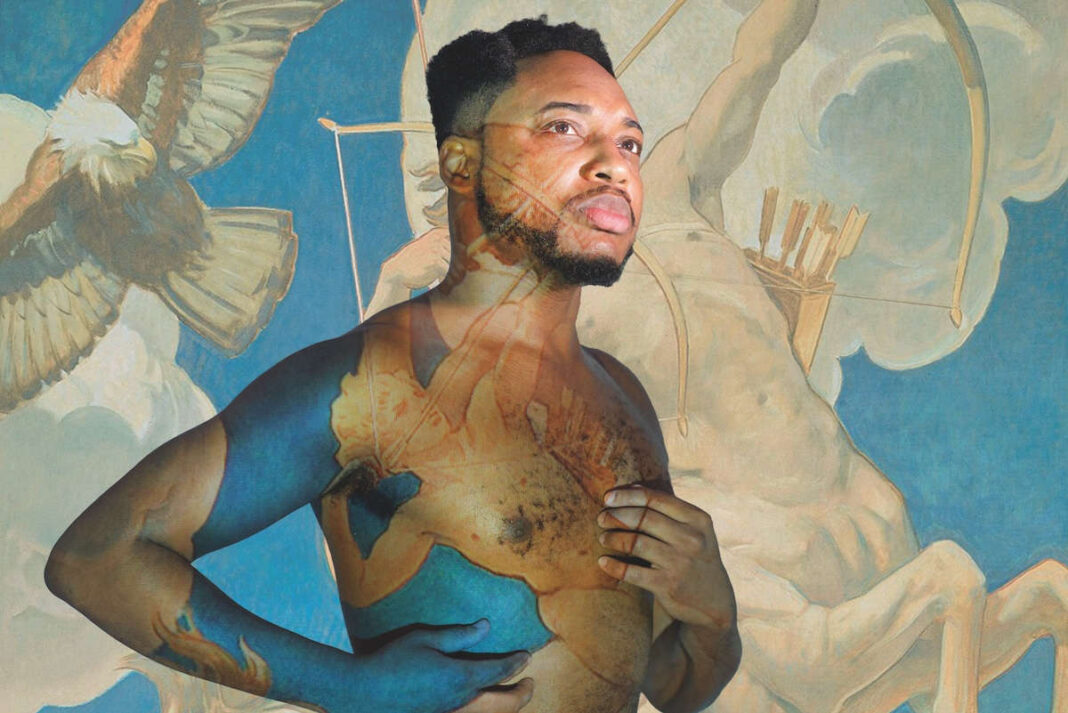
WEO’s third production this year, American Apollo, is based on the story of Thomas Eugene McKeller, a Black hotel worker who became the model and almost undoubtedly the lover, too, of famous painter John Singer Sargent. Sargent drew and painted many images of McKeller, but these were mostly kept secret for years. In the 1920s, McKeller posed for multiple images for murals at Harvard’s Widener Library, including Eros, Atlas and Apollo, but all of the final images are portrayed as white men.
Director Nataki Garrett, making her WEO directorial debut after having directed The Central Park Five at Portland Opera and The Fire Opera at Detroit Opera, met composer Damien Geter while at Portland, she said. Their connection led to her invitation to direct American Apollo. The conductor, Oakland Symphony’s music director Kedrick Armstrong, furthers his connection to WEO.
Garrett found McKeller’s story and its continued relevance intriguing. “You have a love relationship between two men, an interracial one,” she said. Yet while art lovers are very familiar with Singer Sargent’s work, “Who is the figure in the murals?” she asks. “This man existed.”
McKeller’s life and relationship to Singer Sargent have increasingly been examined in the modern art world. In 2020, Boston’s Isabella Stewart Gardner Museum presented “Boston’s Apollo: Thomas McKeller and John Singer Sargent.” Gardener was a prominent patron of the artist, and at least one story of the times tells of McKeller carrying Gardner, who had suffered a series of strokes, up a staircase. Gardner is a character in American Apollo.
During the rehearsal process, Garrett said, she is assisting the performers in creating the world of McKeller and Singer Sargent, “so that they can do the technical work they need to do.” It’s necessary, she explained, for them to form a conduit to the characters’ humanity. And in contrast to opera of past ages, where often singers simply stood on stage and sang, modern performers want to embody their characters, which means staging.
“Younger, more diverse audiences are interested in deeper storytelling,” Garrett said. “There is so much story in the body.”
Asked about the timeliness of American Apollo at this moment in the country’s history, she said, [“It has the potential] to reflect back to us who we really are.”
American Apollo joins WEO’s two other 2026 mainstage offerings, Benjamin Britten’s operatic interpretation of the Henry James classic The Turn of the Screw, followed by Handel’s 1711 comic opera Rinaldo, in a version inspired by comic books.
The final event of the season is an orchestral preview performance of Claude & Marcel, a new opera by composer Alyssa Weinberg and librettist Stephanie Fleischmann. The piece, a WEO commission, comes out of the company’s successful Aperture program. Conceived during the pandemic, when live performance was impossible, Aperture offers a commission to chosen projects for development. Its first premiere of a completed work, Dolores, based on the life of Dolores Huerta, was a huge hit for WEO last season.
The opera now known as Claude & Marcel was the runner-up in the first Aperture competition, which had 80 submissions, said WEO’s general director, Mark Streshinsky. After being chosen as the second commission, it received an award of $60,000 for development.
The libretto follows the true story of two French artists, Claude Cahun—born Lucy Schwob—and Marcel Moore—born Suzanne Malherbe. They met as teenagers, adopted non-gender-conforming names and lives, moved to Paris in the 1920s and became part of the flourishing Surrealist art movement there, which included André Breton and Salvador Dali.
As the Nazis began taking control of the city in the late ’30s, the couple moved to the Isle of Jersey in the English Channel—but the Germans took the island in 1940, inspiring the pair to devise an elaborate psychological warfare scheme, involving slipping anti-Nazi notes, poems and songs into the pockets of German soldiers, as well as into their cigarette packs.
SFMOMA is the performance site, chosen, Streshinsky said, because the museum’s collection includes actual photographs and gelatin silver prints created by Cahun and Moore in the 1920s.
A fully staged production of Claude & Marcel is planned for 2027. As with American Apollo, Streshinsky said, the opera evokes “shared empathy in these times … these are resistance stories.”
West Edge Opera 2026 Festival, Aug. 1-16. ‘The Turn of the Screw,’ Aug. 1, 9, 15; Rinaldo, Aug. 2, 8, 15; ‘American Apollo,’ Aug. 8, 13, 16; ‘Claude & Marcel,’ Aug. 23. Oakland Scottish Rite Center, 1547 Lakeside Dr., Oakland. Single and series tickets available. 510.841.1903. westedgeopera.org