
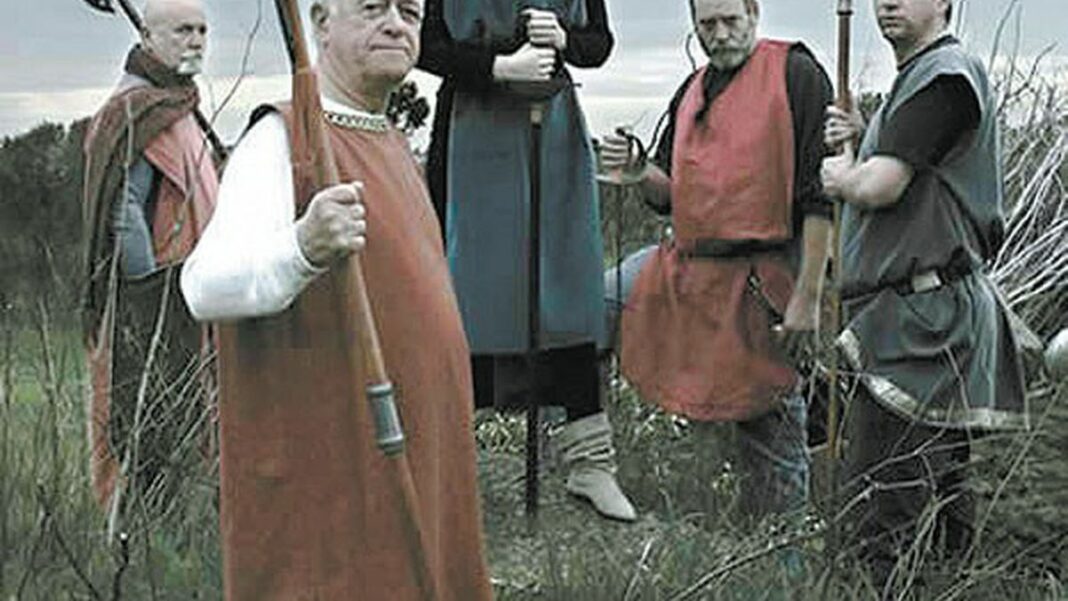
Saint Joan of Arc could be any allegory for any modern politician
you can think of. Like George Bush, she had a penchant for violating
checks and balances (or, in her case, superseding the feudal
aristocracy) mostly because she saw herself as an emissary from God.
Like Barack Obama, she had a “yes-we-can” type of work ethic, and a
will strong enough to overcome numerous detractors. Not surprisingly,
she remains one of the most enigmatic figures in history: a solid
peasant girl who commandeered the French army during the Hundred Years’
War, was burned for heresy in 1431, got absolved (well, sort of) in
1456, and was finally canonized in 1920 — at which point she
reemerged as a pop culture icon.
Three years later, playwright George Bernard Shaw decided to rewrite
her story, arguing that Joan of Arc had been maligned — or, at
the very least, undersold — in the writings of Shakespeare,
Voltaire, Mark Twain, and Anatole France. Shaw’s 1923 play Saint
Joan was an antidote to the traditional Joan of Arc story;
brilliant in many ways, and at the same time very obsessive. Shaw
treated Saint Joan as part drama, part morality tale, part
pedagogical tool. His characters were composites of real historical
figures, and he presented most of them as petty, insecure little men
who couldn’t bear anyone challenging their patriarchal order. The
original Saint Joan clocked in at three-and-a-half hours and
kicked off with a prologue that was nearly as long as the play itself.
On the whole, it was vastly in need of some editing.
Which is where director David Bogdonoff comes in. His new rendition
of Shaw’s Saint Joan — now on stage at Contra Costa Civic
Theatre — is a judiciously expurgated version of the original
1923 play. Bogdonoff apparently took Shaw’s didacticism with a grain of
salt. He tried not to overly romanticize the central character, and
promised in the director’s notes not to assail us with connections to
current news events. Moreover, he tried to make the villains a little
less buffoonish. (Shaw said the play had no villains, but it clearly
did.) Shaw’s play set Joan of Arc against an elite group of sissies and
knuckleheads; Bogdonoff makes them all seem a little more human. Still,
Bogdonoff couldn’t keep his cast members from giving it their own comic
spin.
Saint Joan is really more of an ensemble piece than a
character-driven storyline, but it succeeds on the strength of a couple
great actors. The first is Kate Culbertson, who plays an infectious but
unexpectedly delicate Joan. In the opening scene, she barnstorms into
the Castle of Vaucouleurs and tries to win over Count Robert de
Baudricourt, who will ultimately grant her permission to visit Charles
the Dauphin’s court in Chinon. In the original script, de Baudricourt
was an ineffectual gatekeeper who overcompensated by abusing others.
But in this version, he’s rather under-acted by Joe Fitzgerald, who
seems bemused by the seventeen-year-old country girl who wears men’s
clothing and knows how to fire a canon. In contrast, Culbertson is a
fiery presence, tromping about the stage and giddily rhapsodizing about
the voices in her head (supposedly visitations from saints). As an
activist, she’s dazzling. As a miracle worker, she’s dubious —
until the end of the scene, when de Baudricourt’s steward rushes in to
announce that the formerly infertile royal hens are suddenly laying
dozens of eggs. Yet it isn’t until Scene 2, when Culbertson is paired
with the other best actor in the play, that Saint Joan really
gets interesting.
Scene 2 is our first introduction to Charles the erstwhile Dauphin,
who is later crowned King Charles VII (“the Victorious”) as a result of
Joan’s leadership in the Battle of Patay. Played here by rookie actor
Misha Madison, he is by far the most entertaining part of Saint
Joan. Though the play does not pretend to give a historically
accurate portrait of Charles VII, Madison’s take is hilarious. He’s the
perfect foil for Joan: a bitchy drama queen who rolls his eyes and
looks bored whenever she talks. She offers to give him courage, he
whines. She abets his rise to power, he tells her to speak to the hand
(or the 15th-century equivalent). In the very last scene, when Joan of
Arc is canonized but denied the power to resurrect herself, Charles VII
gives her a big what-ev-er: “Poor old Joan,” he says. “They’ve
all run away from you.”
If every cast member were as entertainingly self-ironic as Madison,
Saint Joan might actually have been a comedic satire of gender
roles and political hypocrisy. But Bogdonoff obviously wanted to
preserve the emotional tenor of the story — if anything, he
downplayed most of Shaw’s humor. In this version, Joan’s fortunes turn
very quickly: She has her first defeat in Scene 5 and loses the
confidence of those around her; by Scene 6 she’s in shackles, tried,
and sentenced to death by a jury of unscrupulous men. The actors play
it straight all the way through a protracted epilogue, which was really
Shaw’s excuse to get on his soapbox and derogate all the men who
exploited Joan of Arc for their own means.