The art critic and philosopher Arthur Danto characterized art made
after Warhol’s subversive Brillo Boxes as a kind of applied
philosophy or epistemology (investigation of knowledge or perception),
but embodied in physical objects rather than verbal architecture.
Contemporary art’s welter of signs and symbols generally confirms this
insight; so perplexing is the onslaught at times that we are reminded
of the lovingly mocking inventory of dramatic styles in Hamlet
— “pastoral-comical, historical-pastoral, tragical-historical,
tragical-comical-historical-pastoral,” etc., but life, admittedly, is
no less hybrid and contradictory than art. The 81 paintings in
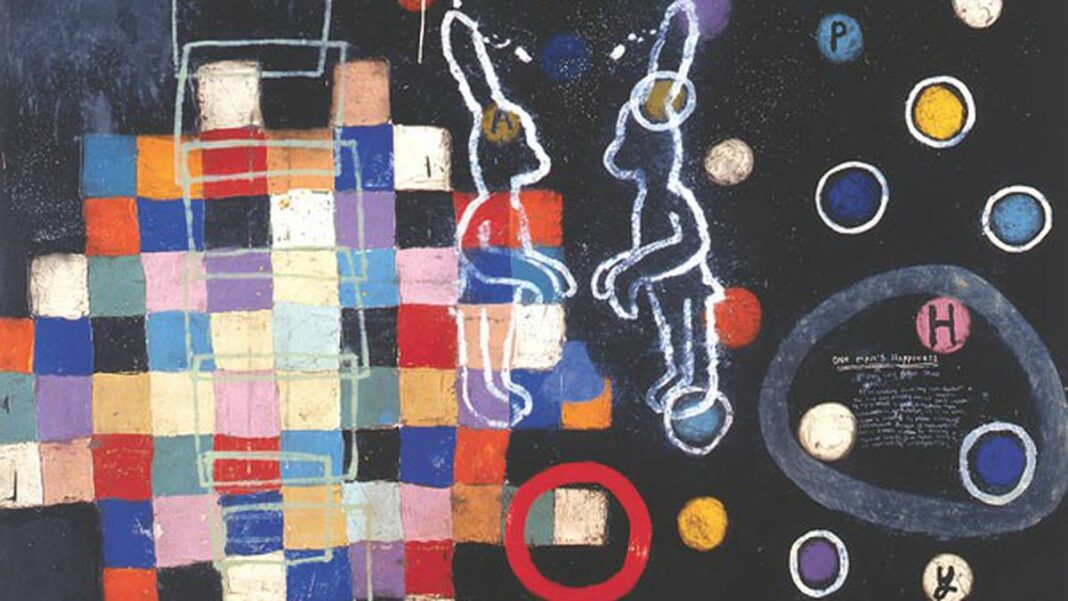
Squeak Carnwath‘s retrospective at the Oakland Museum of
California, Painting Is No Ordinary Object, explore
consciousness, à la Danto, but they’re also traditional handmade
artifacts that capture the mysterious world of objects and words,
sights and sounds, in oil paint. So committed is Carnwath to her medium
that she replicates wallpaper/textile patterns and jotted notes on torn
scraps of paper, elements eminently collage-ready, in Philip Guston’s
“colored mud.”
Paradoxically, the obvious beauty of these richly colored, heavily
worked paintings leads some to underestimate them as mere eye candy,
and to misconstrue Carnwath’s declarations of aesthetic independence.
Fortunately, senior curator Karen Tsujimoto and art critic
John Yau have written illuminating essays for the show’s catalog
that consider this highly eclectic work from the contradictory
viewpoints of its various sources: painting tradition (Rembrandt,
Turner, Pollock, Rothko, New Image, graffiti, folk art); post-painterly
avant-gardism (conceptualist lists and numbers, minimalist grids,
performance art ritual); and Carnwath herself: the child who made
laboriously antiqued treasure maps and hid them for strangers to find;
the young feminist making installation art about Virginia Woolf and the
risks and rewards of creative life; the mature painter preserving in
her painted time capsules both borrowed motifs like religious symbols
and interesting quotations and “the really boring things, the things
that people ignore,” both ordinary objects and the mental chatter of
all higher primate brains; and the veteran teacher commemorating
vanished friends and colleagues — applied philosophy. Carnwath
incorporates a wealth of styles and motifs in her work beneath a
unifying aesthetic: “Painting is a philosophical enterprise, a kind of
alchemy [in which] inert material becomes something else a document of
being a repository of the human spirit.” Her paintings,
stream-of-consciousness thought-plasmas that are both ethereally
optical and physically tangible, celebrate the floating world of
phenomena and its no-less-transitory percipients, and affirm the joys
and consolations of that alternative spiritual practice, the garage
philosophy of art. Through August 23 at the Oakland Museum of
California (1000 Oak St., Oakland). MuseumCa.org or 510-238-2200