
Global superstar and Green Day vocalist Billie Joe Armstrong had
somewhat one-dimensional ideas about musicals before green-lighting
American Idiot, the amped-up rock opera debuting at the Berkeley
Repertory Theatre on Friday, September 4.
“I mean, I’ve taken my kid to see The Lion King before,” says
the mid-thirtysomething, who’s been married fifteen years. “And it’s
like we might as well be going to a Jonas Brothers concert or
something.”

Credits: Doug Hamilton
Credits: Doug Hamilton

Credits: Kevin Berne
Credits: Doug Hamilton

Credits: Doug Hamilton
For a band that’s made its millions on speed, pot, masturbation,
paranoia, teen angst, and suicide, the world of chorus lines and
saccharine, sappy arias just didn’t seem to fit. Thanks to Mamma
Mia, it doesn’t have to.
The rock opera adaptation of Green Day’s multiplatinum 2004 smash
American Idiot is going to challenge the very definitions of
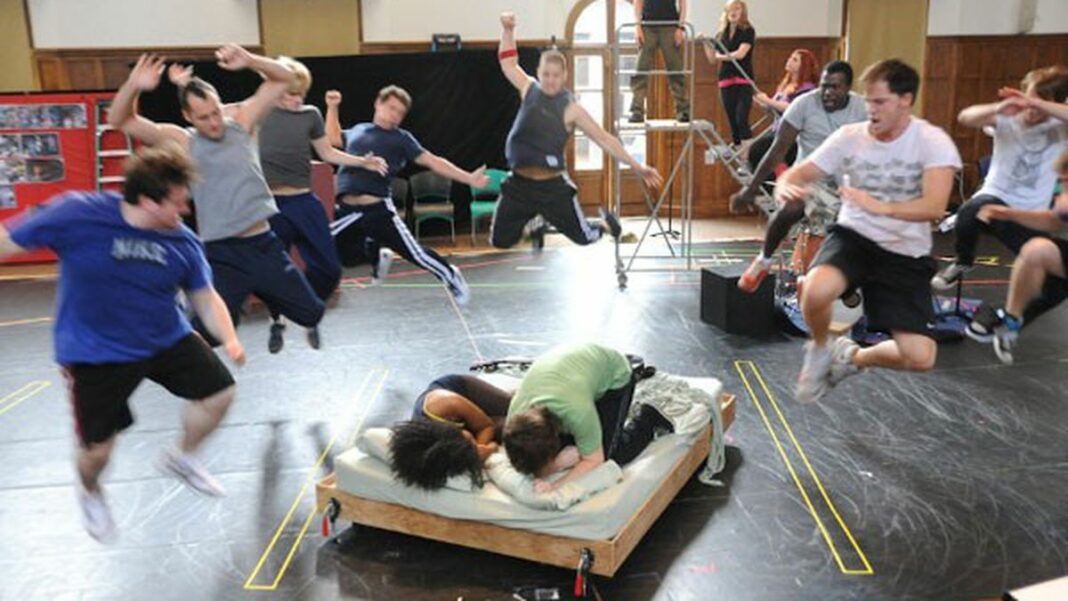
punk, theater, and musical. The 75-plus-minute performance with a cast
of 19 tells a Fight Club-esque story of self-discovery through
death and destruction, yet it uses no words outside of the lyric
content of the album. The hit album is played from beginning to end
live by a band (not Green Day) and intercut with B-sides as well as
three songs from the band’s new album 21st Century Breakdown,
including the hit “21 Guns.”
After eight albums and almost twenty years together as a band
— a near impossible feat these days — Green Day has
undertaken its ballsiest and most experimental project yet. Taken with
the unprecedented press shine now on the forty-year-old Berkeley Rep,
as well as the fact that the project employs dozens of local artists
amid a searing arts recession — and this musical might be the
most boundary-violating, “punk” thing Green Day has ever done.
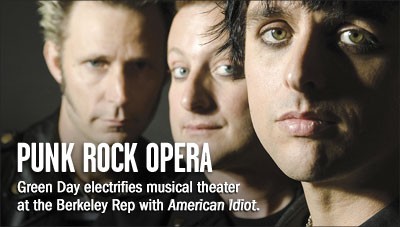
The story of trio Billie Joe Armstrong, bassist Mike Dirnt, and
drummer Tre Cool has ascended to the status of legend. Emerging from
the East Bay’s punk rock scene of the early 1990s, they played fast,
simple, snarling jams cut with melody and a cleverness that helped them
break out from the pop-punk pack at the time. (Blink-182, anybody?)
Kerplunk in 1992 and the single “Welcome to Paradise” softened
up the beachhead for 1994’s major-label debut Dookie on Reprise,
which did fifteen million in global sales. Insomniac in 1995,
Nimrod in 1997, and Warning in 2000 propelled the band
far from the punk rock ghetto and set the stage for 2004’s gargantuan
American Idiot.
“It was something that I’ve always wanted to do, hoping that I had
the guts to be able to do it,” Armstrong said. “You have to take
everything you learned and take a huge risk. You just evolve as a
person and figure out what’s important to you. Being a rock star can be
a really positive thing. It just kind of depends on the way you go
about it.”
Armstrong says Idiot was the band accepting stardom, ditching
the shackles of punk’s rules and risking everything on a decades-old
form, the rock opera. After an aborted attempt to make a more
traditional album called Cigarettes and Valentines, Green Day
channeled The Wall, Tommy, and maybe a little of the
Broadway musical Oliver!
Written and recorded in Oakland and Los Angeles, American
Idiot includes the nine-minute, five-part, punk rock call to arms
“Jesus of Suburbia.” Hooked on soda pop and Ritalin, there’s nothing
wrong with this “Jesus.” This is how I’m supposed to be/in a land of
make believe/they don’t believe in me.
Jesus dallies with the military but ultimately travels from the
suburbs to the city where he meets his doppelgänger, the
self-destructive “St. Jimmy,” whose theme is a classic punk track:
fast, simple, dirty, and short — clocking in at 2:55. Drugs
emerge as an outlet in “Give Me Novacaine” while transcendence comes in
the form of female archetype “Whatsername,” who appears on “She’s a
Rebel” and “Extraordinary Girl.”
“Letterbomb” delivers the anarchic climax to St. Jimmy, then “Wake
Me Up When September Ends” confronts the death of the hero’s father,
offering little solace. The messy, five-part, nine-minute “Homecoming”
loosely sews up the narrative, with “Jesus” finding himself through the
love of Whatsername and by becoming a rock star. It’s ridiculous and
ambitious and filled with more hooks than a fishing boat and it went on
to sell more than fourteen million copies worldwide.
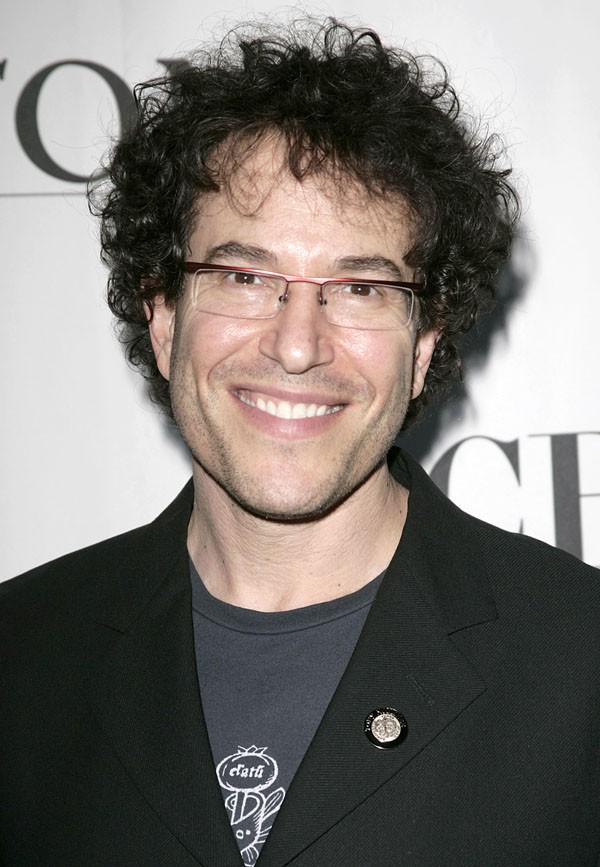
Among the long list of new fanatics was Tony Award-winning musical
director Michael Mayer, who in 2006 was in Los Angles filming
Flicka and blasting Idiot from his car on the freeways of
LA.
“‘Holiday’ was the first single I heard,” Mayer said. “And then,
around the time ‘Boulevard of Broken Dreams’ came out I was, like,
‘Holy fuck. Holy shit. Who are these guys that can write such
beautiful, poetic stuff?’ and I listened to the whole album and I was
really dazzled by it: the political agenda, the urgency of the message,
and the poetry really of both the music and the lyrics. They were
completely bedazzling to me. And I was obsessed with it, so I listened
to it all the time.”
Mayer used Idiot professionally as a sort of language to
describe elements of a new musical he was working on at the time called
Spring Awakening, which went on to win a Tony Award for best
musical in 2007.
“So I started referring to it while we did Spring Awakening,
and it just tickled something in my head. I thought, ‘Jesus, this is
ready to go.’ I could actually imagine other characters. ‘What would it
be like if you took some of these songs and pulled them apart and gave
certain lyrics to other people instead of just this single voice?'”
While rock critics were writing the words “anthemic,” Mayer
physically saw large groups of people singing in his head.
“I started to imagine it in my head while driving the Pacific Coast
Highway. I would think, God, that would be so cool to see a whole
community of people past teenage years. They’re not kids. They’re
adults but their lives haven’t happened yet — the sort of
disenfranchised young adults of America. The suburban wasteland that
makes it almost impossible for anyone to imagine anything else than
what’s right in front of them.
“And I thought, well, being kids and with the drugs and the popping
Ritalin, someone else’s cocaine, all the trappings described so
eloquently in ‘Jesus of Suburbia.’ I know that is reality for a lot of
people. And living in these horrible dark ages of the Bush
administration was as frustrating and despairing as it was — God
— I saw, This stuff is real and people are connecting to it. I
thought, they’re personally giving voice to a whole generation of
Americans who have probably felt completely disenfranchised and
completely apathetic and unable to effect any change.”
Mayer flippantly told Rolling Stone and Variety that
he’d love to do American Idiot for his next project, and then
Mozart called him to put it together. Mozart’s real name is Tom Hulce,
nominated for an Academy Award for playing Mozart in the film
Amadeus. He appeared in the movies Mary Shelley’s
Frankenstein, and Jumper and was nominated for a Tony Award
for his role in the play A Few Good Men.
“He calls me and he goes, ‘I just read your interview in
Variety; are you serious about American Idiot?'” Mayer
recalled. “And I said, ‘Totally.’ And he said, ‘Well, let’s try to make
that happen.’ And I said, ‘Ha ha ha, okay. Knock yourself out,’ because
I thought, ‘There’s no fucking way. Someone’s either doing it already
or they’re not going to be interested.’ Tom can get people on the phone
that a lot of other people can’t because he’s number one a first-class
artist in his own right, and he’s got a long career and fantastic
relationships.”
Hulce and Mayer met with Green Day’s manager and agent, and Mayer
pitched his idea of adding characters and lengthening Idiot.
Armstrong was interested, so the band flew out to New York to watch
Spring Awakening — which uses the alt-rock of Duncan Sheik
to adapt a banned German play from 1891 about puberty, masturbation,
sex, pregnancy, suicide, abortion, and death in a deeply repressive,
religious country where the adults are suspect. Hmmmm.
“It just sounded fitting,” Armstrong said. “I didn’t know who they
were or anything at the time, but when I saw that, I knew they were
brilliant. What they were doing was kind of revolutionary. The audience
was onstage. It was based off a turn-of-the-century play, and yet all
the subject matter is totally current. I see that and the way they
approached it with real feelings and real sort of life — they’re
artists, you know?”
The cast of Spring Awakening and the Green Day trio went out
for drinks at a local theater hangout, and Mayer left with an exclusive
right to develop a reading of the rock opera. In a way, Idiot
was a logical follow-up to Awakening, because issues of God,
country, and identity often follow the formative crises of puberty and
adolescence.
Mayer wrote it in six weeks, calling Armstrong to talk story and
character development. “Jesus of Suburbia” became “Johnny,” alongside
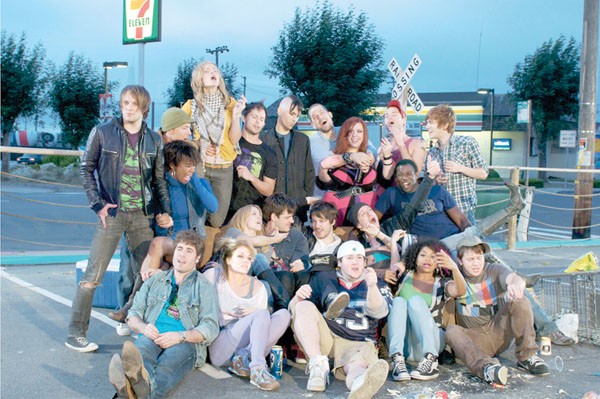
main characters St. Jimmy and Whatsername as well as a bigger cast of
stoners, anarchists, and artists drawn from the East Bay arts scene.
The set drew from the grungy warehouse spaces of Berkeley and costumes
from the late Bush years. Johnny and St. Jimmy emerged as Fight
Club-like splits of the same character.
“St. Jimmy is kind of the Brad Pitt and Jesus of Suburbia; Johnny is
sort of the Ed Norton,” Mayer said. “Is he a real person or are they
parts of the same person? And Billie Joe confirmed that was of great
interest to him.”
The show included no dialogue or normal words. “I thought a lot
about whether Billie Joe and I should craft some dialogue. What became
very clear right away, except for little letters that Johnny writes, I
felt like the songs are so articulate. And when you put them in the
mouths of characters who are living and breathing in front of you
— Will sitting on the couch and lighting up a joint and singing
the first part of ‘Novacaine’ while he’s staring at TV — you
understand what his circumstances are. What more do you need to be
saying? It’s so clear.”
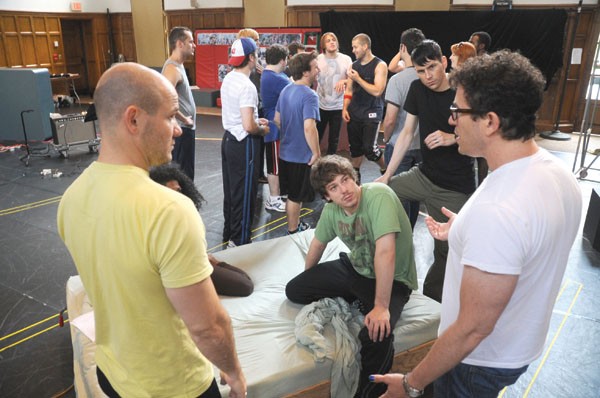
After months of development and the addition of a musical arranger
and choreographer and a cast of twelve that included Mayer’s lead from
Spring Awakening, Armstrong was scheduled to watch a reading. If
he liked it, the whole band would watch one. If not, the project
stopped.
“We sort of bit the bullet, but what happened was the entire band
came and I was just dying,” Mayer said. “We read through the whole
thing, about seventy minutes long nonstop, the kids did a fabulous job.
I could not look over at the band, I was so scared, and at the end of
it they gave the kids a standing ovation. They were wildly enthusiastic
and gave me lots of really great input.”
“It’s amazing,” Armstrong said. “People are going to be blown
away.”
At the same time, Hulce got in touch with his longtime friends at
the Berkeley Repertory Theatre to set up a reputable yet intimate home
for the show in Green Day’s backyard. The Rep’s history of producing
edgy stuff, and its career arc from a little garage playhouse to
regional powerhouse paralleled Green Day’s rise in many ways, said
Susan Medak, the Rep’s managing director. At least twelve years of
edgy, experimental, multimedia material laid the groundwork for Hulce’s
phone call, Medak said. No other theater was in the running to host the
event. “I’ve known Tom for 25 years, back when he was playing a young
Romeo,” Medak said with a laugh.
After a trip to New York to make sure everyone was on the same page,
the Rep slated American Idiot — its first-ever musical
— as the opening show of its annual program. The phone has rung
off the hook ever since, Medak said.
The recession has been murder on the arts, and Rep operations had to
be slashed 18 percent this year, she said. But American Idiot
has become the fastest advance seller in the Rep’s history. Almost
every night is sure to be sold out in the 600-person Roda Theatre
— which offers the modern multimedia accommodations and size for
such a huge endeavor.
“It’s been hysterical,” Medak said. “There are some Green Day fans
who are nervous because they assume, and I think it’s legitimate, that
we’re going to mess with the material, or it’s going to be Green Day
onstage. It’s not going to be the band on stage.”
Of course, with fame has come some attendant headaches, Medak
said.
“We have only fewer than 600 seats in the theater and there are
thousands who want to be here for opening night. We rarely have to deal
with problems with scalpers, and already we’re doing everything we can
to advise ticket buyers not to buy if a deal appears too good to be
true. It probably is.”
If the show does well, it could tour the world. Mayer said he has no
idea if he’s going to be the only one who likes Idiot. On one
hand, the process feels like a smooth alignment of the stars. On the
other hand, he sees where the piece needs work.
“I’m terrified,” he said. “We’re not turning a movie into a musical
where everybody knows the story already and has certain expectations.
This is an original story in a way, and the material we have to tell
the story is these songs and it’s really a wonderful, exciting, and
terrifying challenge.”
Armstrong is more sanguine. “I keep seeing it from a standpoint
where I’ll go a couple of months where you don’t see anything then I’ll
go in and sit in on a workshop. The way that everything’s evolved every
single time has been amazing. The story line keeps getting stronger and
stronger, and the characters keep getting stronger and stronger, and
then the musical arrangement from Tom Kitt is really inspiring.”
Historically, running away from society to join the theater was a
defiant, “punk rock” act, everyone agrees. In a way, Jimmy’s archetypal
journey to artistic self-actualization mirrors not only Green Day’s
journey, but that of many of the artists in the Berkeley Rep show as
well. “Especially the kids that are in the show — people, I
should say,” Armstrong said. “They’re in it, they’re artists, and
they’ve given their whole life over to acting, singing, and dancing in
its truest form. Their lifestyle and livelihood, it’s sort of punk rock
to me.”
Even the waning of the angst-ridden Bush era can’t defuse the energy
of the show. Global problems now stand in for the evil of Dick Cheney,
Armstrong said. “It is hard, because I think back, and it was easier to
point at what the problem was in 2003. But now I think it’s coming from
so many different angles and it’s such a different crisis every
week.”
Mayer also was worried that Idiot could be viewed as
yesterday’s angst. “But surprisingly, no. That was a concern that I had
going into it. You watch one of these clips through and it puts you
right back into it. We’re so far from being out of the woods. It’s
perfectly good timing.”
American Idiot opens Friday. Mayer says bring your ear
plugs.