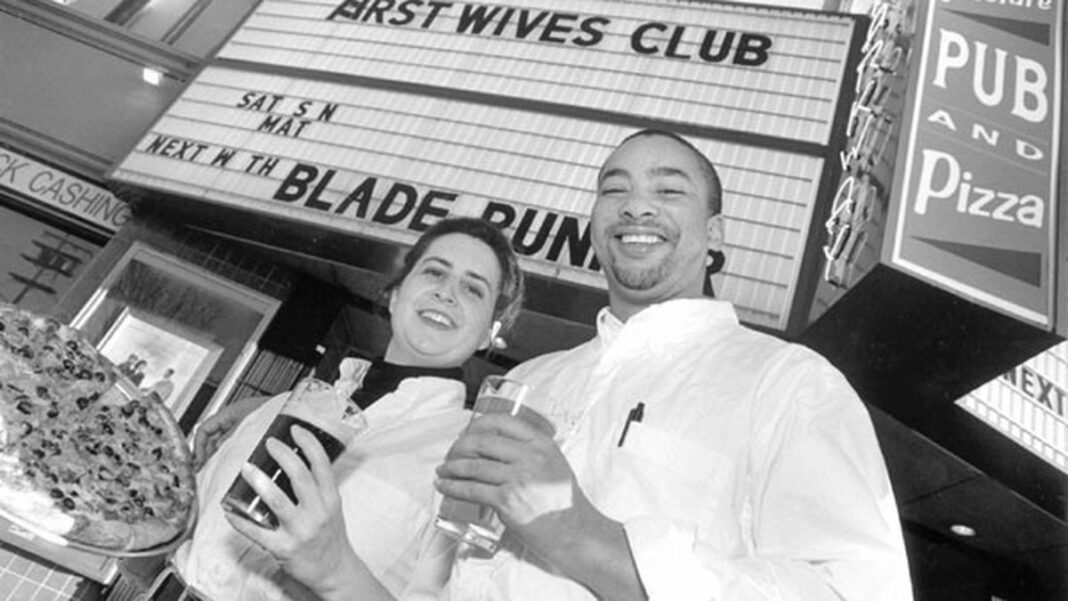
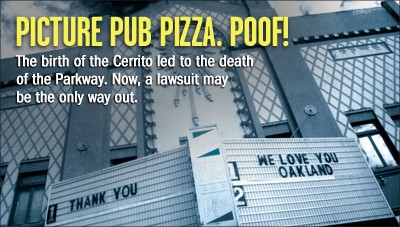
The marquee read “We Love You Oakland.” Tickets were sold out, and a
line of moviegoers wrapped well around the block. It was the Parkway
Theater’s busiest night in recent memory. But the mood was far from
sunny. With only a few days’ notice, the Parkway was closing, marking
the loss of a community institution, the shuttering of a city landmark,
the end of an era. Hundreds had gathered to pay their respects.
The theater at 1834 Park Boulevard fell dark the next evening, but
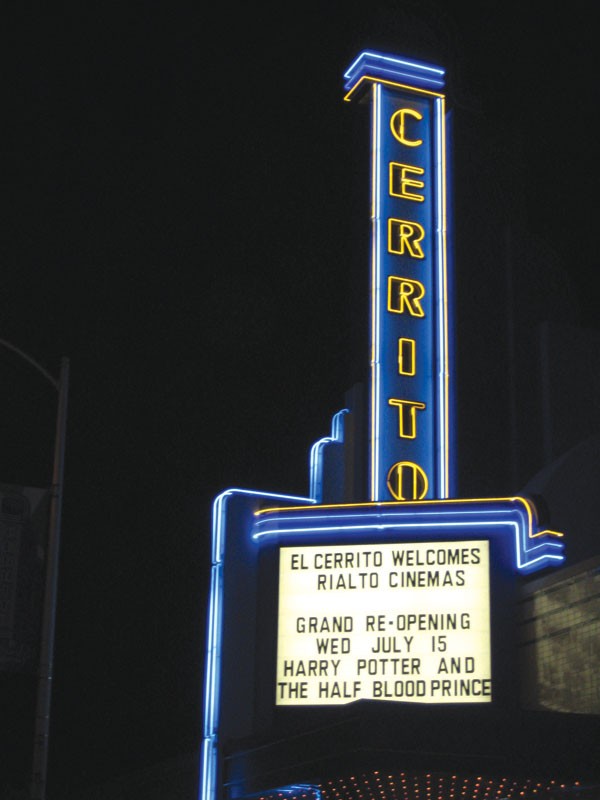
its sister facility in El Cerrito remained aglow in blue neon. It had
opened along a modest stretch of San Pablo Avenue in late 2006 as an
extension of Kyle and Catherine Fischer’s beloved Speakeasy Theaters
brand. The couple had spent the previous five years working closely
with the City of El Cerrito, which invested more than $4 million in
restoring the art deco movie house and returning it to full operation
in the Parkway’s image. With the March 22 closure of the Oakland
theater, attention turned to sparing the Cerrito from the same fate. It
had been doing good business, consistently filling seats and making
money month to month. Yet less than nine weeks later, it, too, shut
down.

Credits: Chris Duffey
Credits: Phyllis Christopher
Credits: Nate Seltenrich
How it all happened soon became the subject of rumor and
speculation. Was Speakeasy Theaters a victim of the recession? Of
Netflix and multiplexes? Of a shoddy business plan? A malevolent
landlord? Why had the Parkway closed so suddenly, and was the Cerrito’s
failure related? Each theory had its backers, but the truth wasn’t so
clear-cut. Behind the scenes, a more insidious game of finger-pointing
was developing. While the Parkway sat empty and the Cerrito
transitioned to its next stage, there emerged two very different
accounts of what went wrong. Thinly veiled accusations of bureaucratic
malfeasance and financial incompetence began to soil the
once-productive relationship between Speakeasy Theaters and the City of
El Cerrito.
While the city quickly turned its theater over to a new operator,
Speakeasy CEO and former attorney Kyle Fischer began contemplating a
multimillion-dollar lawsuit claiming ownership of the building’s
extensive improvements and equipment. The city has dismissed his claims
and threatened a countersuit for millions in unpaid loan funds and
future rent, which it had previously offered to forgive.
As the public eye moves on to the next act at both theaters, one
thing looks certain: The birth of the Cerrito contributed to the death
of the Parkway, and a protracted legal battle may be the only way out.
Its outcome could have immense implications for the future of El
Cerrito’s newly restored theater and the legacy of Kyle and Catherine
Fischer, Oakland homeowners and parents who spent thirteen years
building a beloved East Bay business and a matter of months watching it
crumble.
Kyle and Catherine Fischer first entered the 1920s-era Parkway
Theater in August 1996. It had last shown movies in 1990 and, as a
venue for raves and other parties, become a magnet for crime. It
sported carpeted walls, decrepit plumbing and electrical systems, and a
plywood floor with no seats.
But the then-unmarried business partners — Kyle, a passionate,
emotional, shoot-from-the-hip kind of guy and Catherine a cooler, more
diplomatic operator who fancies herself an eternal optimist — had
big dreams for the space. They planned to turn it into California’s
first speakeasy theater, which would combine second-run films and
adventurous, community-based programming with food and beverage service
for a 21-and-over crowd. In January 1997, the Parkway opened with a
showing of Fargo, which was already out on videotape, and the
Speakeasy mold was cast.
“There’s a group of people in the East Bay who aren’t being
satisfied in the multiplexes,” Kyle Fischer told the Express at
the time. “That’s our crowd.” And he was right. While the Parkway
initially lost money, by the end of its first year it had begun to
materialize as both a community linchpin and a destination for a
certain class of moviegoer from throughout the Bay Area.
If nothing else, it offered patrons a unique night out. Comfy,
stuffed chairs and couches with tables in lieu of typical theater
seating; pitchers of beer and wine; and a kitchen turning out pizzas,
sandwiches, and salads fostered an ambiance that mattered as much as
what was playing onscreen. But the theater’s bargain-price programming
excelled in its own way: In addition to progressive indies, second-run
Hollywood flicks, and old classics, the Parkway added B-movie horror
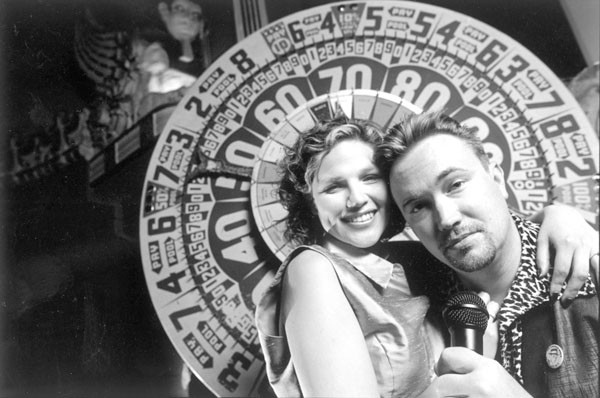
and quirky theme nights through charismatic booker Will “the Thrill”
Viharo, who often appeared onstage with fellow host and future wife
Monica the Tiki Goddess. The Parkway’s weekly Baby Brigade broke the
mold even further by offering daytime shows where crying children
wouldn’t become outcasts. And that was just the beginning.
By early 2001, the Parkway Speakeasy was entrenched — and
profitable. But a fortuitous occasion would forever alter its
trajectory and that of its owners. Ten miles away, in the small suburb
of El Cerrito, a man named Harry Kiefer decided to sell his building.
He’d been using it to store furniture for 35 years, but it was no
ordinary warehouse; it was the shell of an old movie palace, a fact few
people around town seemed to know. It might’ve landed on the chopping
block if not for the efforts of El Cerrito resident and
historic-building buff Dave Weinstein. He alerted city officials to the
building’s hidden history — including the period details still
intact inside — and sparked their interest in restoring the
theater.
Small, independent movie theaters like the one that city
administrators began to envision tend have a domino effect on the
surrounding area. “The theater is a cornerstone of a shopping
district,” said Allen Michaan, owner of Grand Lake Theater operator
Renaissance Rialto. “With it comes increased foot traffic that can
revitalize an entire neighborhood.” This was precisely what the City of
El Cerrito had in mind for the building’s nondescript block. All it
needed was a knowledgeable developer and future operator to guide the
process.
Of the many independent theater operators the city approached in the
ensuing months, its top choice was Speakeasy. Both parties agree to
this day that the city openly sought to emulate the Parkway’s success
in Oakland by applying the same blueprint to El Cerrito. The city first
contacted Speakeasy in April 2001, shortly after it learned about the
theater. The Fischers took a look at the space and thought it could be
a great fit, but told city staff they lacked the funds to get it off
the ground. Undeterred, El Cerrito reached out to the Fischers again a
year later with a better offer: The redevelopment agency would pony up
the cash if Speakeasy would oversee the restoration and later operate
the theater. Still concerned about the financials but reassured by the
city’s support, the Fischers decided to give it a try. If the
public/private partnership worked, they figured, they could continue to
grow their business by bringing the Parkway model to other cities.
After the El Cerrito Redevelopment Agency bought the building for
$500,000 in June 2002 and issued a call for proposals, the Fischers
submitted their vision in writing. They were the only people who did,
and won the contract.
From the start, the deal was tinged with controversy. Some El
Cerrito residents opposed using public money to buy and develop a movie
theater — especially one that would be operated as a
profit-generating enterprise by a private business. The unusual deal
the city struck with Speakeasy Theaters sits at the heart of the
tension between them today: a triple-layer scheme that first loaned
Speakeasy Theaters $2.47 million of redevelopment agency money, then
funneled $2.88 million of agency funds directly through Speakeasy to
outside contractors for additional construction costs, and finally,
once development was complete, entered into a complex lease agreement
whereby Speakeasy owed $10,000 a month in rent that would be credited
toward its 25-year loan.
“It is a complicated transaction,” said attorney Karen Tiedemann,
who represents El Cerrito’s redevelopment agency. “In part it’s
complicated because there was a lot of work that needed to be done on
the building. The agency realized that an operator couldn’t afford to
do all the work.”
While arduous, development of the theater was ultimately a success.
Efforts were made to preserve and restore as many of the original
elements as possible, including murals of dancing maidens and Greek
gods that framed the original screen. An entire second story was built
to house another screen, while two cafes were added downstairs. The
project later received a Design Award for restoration from the
California Preservation Society.
Yet by the time the Cerrito opened in November 2006, the renovation
had taken a heavy toll on Speakeasy Theaters. The thousands of hours
Kyle and Catherine Fischer dedicated to the project meant time away
from the Parkway, which they claim contributed to a decline in profits
and annual growth — from as high as 13 percent before beginning
work on the Cerrito down to 4 percent in 2003. Even more daunting,
after starting the project in the black, the Fischers had accrued
considerable debt. This was partially related to delays of nearly two
years and cost run-ups from $3 million to more than $5 million. They’d
also used their own money to pay for some improvements, such as
$100,000 on the kitchen.
Furthermore, the Fischers say they were locked into a lease that was
too severe. To get the new theater on its feet, they say they asked to
not pay rent until the seventh month of operations, just as they had
years before at the Parkway. But Kyle believes the redevelopment agency
balked because it did not want to appear to the public that it was
subsidizing a private business. Still confident that the city had
Speakeasy’s best interests in mind and would relax the rent requirement
after the first year, the couple signed.
They did not pay rent for the first several months, and only by
infusing the Parkway’s modest profits into the Cerrito were they able
to pay it intermittently throughout the first year. Meanwhile, a
variety of other unforeseen factors undermined the Cerrito’s launch,
such as initially being placed in the same exhibition district as
downtown Berkeley and thus not being allowed to show any of the same
movies at the same time. The beginning of the recession and the ensuing
Writer’s Guild of America strike also hurt, the Fischers said. After
finally catching up on twelve months of rent, they stopped making
payments altogether.
“In the first year of the Cerrito, we told them, ‘This is more rent
than we can handle,'” Kyle Fischer said. “They had known we were in
financial trouble from day one. We were trying to figure out how to
resolve this from pretty much the middle of the first year of
operation.” The city’s response, he claims, was to offer promises of
aid that never arrived.
El Cerrito redevelopment manager Lori Treviño, who served as
a liaison between the Fischers and the city, sees it a bit differently.
She says the Fischers were cavalier about Speakeasy’s financial
position and frequently assured the city that as soon as they got
situated, the theater would recover. She and city manager Scott Hanin
also say that redevelopment agency staff asked the Fischers on multiple
occasions to submit a formal proposal for a potential lease
modification, but never received one. “I don’t think we understood the
full extent of the problem,” Treviño said. “We had no idea what
their debts were like.”
Speakeasy’s financial reports for 2007 — its first full year
of operation in both theaters — suggest the Parkway was making
nearly $12,000 in profits every month. The Cerrito, however, ran an
operating loss of $465,000 for Speakeasy Theaters that year. By
factoring in the increasing debt the Fischers were carrying —
including $340,000 in accounts payable, $42,000 in bank overdraft, and
$5,000 in accrued payroll — the picture grew even grimmer.
In May 2008, Kyle finally sent a letter to Treviño and Hanin
admitting that not only couldn’t Speakeasy pay its rent, but that after
raiding their personal savings accounts, stock holdings, and children’s
college funds to grow the business at the city’s preferred pace —
an accelerated, all-at-once approach that differed from the Parkway’s
more organic development — he and Catherine didn’t have enough
money to pay the $60,000 they still owed to general contractor BBI
Construction. The letter did not explicitly request a restructuring of
the lease, but suggested it would help.
“It is truly difficult for me to write this letter to you,” Kyle
began. “Catherine and I take a great deal of pride in our business and
our ability to run it profitably. … In the ten-plus years that
Speakeasy Theaters has been in operation, we have only experienced one
other time that has been as challenging as the present time. We
survived this difficult period through ingenuity, creativity and gall.”
But now, Kyle continued, he and his wife were backed into a corner and
could no longer rely on their autonomy. “We are open to suggestions,”
his letter concluded. “We are going to keep fighting regardless but we
have run out of our personal resources.”
Both Speakeasy Theaters and El Cerrito were in a tough spot, but
Kyle’s announcement set in motion a concerted effort to make things
better. In her reply, Treviño offered consolation: “Although we
have some limitations, we want to do what we can to support you in
this.” It was music to the Fischers’ ears.
First, the city needed a better picture of Speakeasy’s position. So
the city council ordered a complete financial review. This didn’t begin
in earnest until August and wasn’t complete until the end of September,
leaving a span of four months in which the Cerrito continued to lose
money while nonetheless improving its business. Treviño blamed
the delay on the state of the company’s books. “Their record-keeping
was poor,” she said. “The accountants that we hired had to reconstruct
a lot of it.”
The audit found that operations at the Cerrito had improved so much
that it lost less than $25,000 in the first nine months of 2008. It
would prove profitable by the end of the year, save for the hundreds of
thousands of dollars of startup debt it still carried. The Parkway’s
fortunes, however, had significantly worsened, and it was now losing
money monthly — a fact the Fischers attributed to a declining
economy; deteriorating relationships with film studios due to late
payments; legal struggles and extended lease negotiations with the
theater’s landlord; and, ironically, business lost to the increasingly
popular Cerrito Theater.
The results of the financial review were presented to the city
council in October, and in November the Fischers and city staff sat
down to hammer out a solution. “Everyone felt good about it,” Catherine
said. They simply had to present the proposal to the city council and
serve notice to the public. Catherine expected an amended lease and
additional funds to be approved by February.
But instead of a resolution, the Fischers got a letter from
redevelopment agency chairman Bill Jones requesting more information
— namely, a new business plan modeled with the proposed relief.
The agency appointed a two-person subcommittee to oversee this final
step. “The intention of the Agency Board is to continue the
relationship possibly by revisiting the Cerrito Theater Lease
Agreement,” the letter closed. “We are optimistic that the relationship
will be successful for years to come.”
Another month put further pressure on Speakeasy, and the company was
steadily incurring additional debt by paying its accountant throughout
the negotiations. “At this point I was saying every other day to them
that we’re running out of money from a cash-flow standpoint,” Kyle
said. With little money available to pay movie studios for films,
Speakeasy had begun to enter a death spiral as it continued to await
action by the City of El Cerrito.
Meanwhile, the Parkway’s situation had gone from bad to
irreconcilable. On Friday, March 19, Kyle Fischer released an e-mail
blast announcing the Parkway’s closure that Sunday. It came with no
warning, shocking fans and employees alike. Due to the company’s
suffocating debt and debilitating battle to save the Cerrito, Speakeasy
Theaters had become so cash-poor that it couldn’t pay the Parkway’s new
rent of $10,000, nearly doubled in July 2008 when its lease
expired.
The landlord, who Kyle says was unwilling to negotiate, had issued
an eviction notice. But Kyle misread the date and failed to take
immediate action. “That was definitely my mistake,” he said. A few
weeks later, he reread the eviction notice and realized the deadline
was nearly upon him. “I expected the sheriff to show up the next day
and lock the place down.” So he did what he felt he had to: close the
theater before someone else could.
By then the El Cerrito City Council had decided not to endorse the
modified Cerrito lease and loan terms that city staff and the Fischers
had agreed to back in November, and began working on a draft of its
own. At an April 6 joint meeting of the redevelopment agency and city
council, the council finally presented its offer, a package that
addressed many aspects of Speakeasy’s finances, including rebates for
$120,000 in previous lease payments, an additional $50,000 loan, and a
laddered approach to future rent payments that began with only $2,000
per month in 2010. It was prepared to present its offer the very next
day and sign it into action by May 4, a full year after the process had
begun with Kyle’s letter.
Tragically, just hours before its long-anticipated rescue was slated
to be announced by the city council and posted for public comment, Kyle
suggested to Lori Treviño in an email titled “winding up” that
the theater had run out of money. “I will be sending out a press
release in the next week or so indicting that Speakeasy Theaters will
be leaving the Cerrito Theater,” he wrote. “We have held out as long as
we could.”
The Fischers were quickly apprised of the council’s decision and
timetable. They responded that nevertheless, they’d be able to last
another few weeks at the most, perhaps just a few days at the least,
after which point the business would no longer be able to secure films,
food, and other necessities. Kyle had decided to offer advance warning
of that impending deadline in order to correct his mishandling of the
Parkway’s closure.
However, the premature announcement backfired — at a special
April 8 meeting, the redevelopment agency voted not to offer assistance
to a company teetering so near to the edge and evidently intending to
close. So it withdrew the loan and lease modifications proposed by the
city council just two days prior and opted to begin the process of
transitioning to a new operator. According to council documentation,
Treviño conveyed to Catherine Fischer via a phone conversation
the following afternoon that “the Board had decided not to continue
with Speakeasy.” Yet evidently unaware of the ramifications of the
city’s about-face, the Fischers persevered six more weeks by
withholding California sales tax in a last-ditch effort to keep the
theater open. Nearly three weeks after the date at which the city’s aid
would’ve kicked in, Speakeasy was finally forced to withdraw from the
Cerrito.
Fault for the Cerrito’s failure, and likewise that of the Parkway,
does not rest squarely on either party. Speakeasy Theaters may have
made poor management decisions and kept inadequate financial records,
but city officials coaxed the operator into the relationship and were
decidedly unhurried in offering a bailout. The Fischers feel they were
led on and left out to dry, while the city claims the couple was
uncooperative and disorganized throughout the entire process. Whatever
the reason, the same agency that took a year to deliver aid to its
struggling partner was able to turn the Cerrito Theater over to an
entirely new operator in less than two months.
At midnight on July 15, the Cerrito Theater presented a sold-out
screening of Harry Potter and the Half-Blood Prince to celebrate
its reopening under independent operator Rialto Cinemas, which also
runs the Elmwood in Berkeley and the Lakeside in Santa Rosa. But the
ghost of Speakeasy Theaters still hung in the building. After all, the
theater had been designed in its image, and little had changed since it
left. Convening in the lobby shortly after the curtain rose to a round
of audience applause, Rialto employees seemed elated to have completed
the mad dash toward reopening the theater. They looked forward to
serving the people of El Cerrito as a family-friendly, all-ages
venue.
Kyle and Catherine Fischer, for their part, are far from ready to
move on. They still owe $650,000 to contractors, $250,000 to
themselves, and more than $4 million to the City of El Cerrito. It’s
debt they plan to erase through litigation. Although they’ve never
officially listed the theater as a company asset, they now argue that
its millions of dollars of improvements belong to Speakeasy Theaters.
The reasons are threefold, the Fischers say: They held the contracts
for all work, they purchased the equipment through monetary gifts and
an unsecured loan, and they represented to contractors and the public
that it belonged to them. The Fischers also claim they are owed for
serving as consultants over thousands of hours of theater development.
“We’re gonna sue them for a lot of stuff if this goes to court,” Kyle
said. Over the last few weeks he has repeatedly threatened the city
with a lawsuit, and as of last week began interviewing attorneys to
represent Speakeasy’s case.
The city, however, believes the Fischers’ claim to the theater and
its equipment has no merit, largely based on a one-paragraph clause in
the lease titled “Surrender.” It states that anything left in the
building after thirty days beyond termination of the lease becomes
property of the city. The city, which still holds the deed to the
building itself, also argues that because it initially paid for
everything, whether through a loan or direct payments, it assumes
ownership of all improvements.
El Cerrito’s threatened counterclaim for unpaid loan and lease
monies is disputed as well. While the Fischers signed both documents at
the time, a letter drafted by their friend and practicing attorney
Brian Toppila late last month argued that both the loan and the lease
cannot be valid at the same time, and therefore Speakeasy Theaters
cannot be liable for both debts. “It is all very confusing and hands
are not clean,” Toppila wrote.
The disagreement marks a bitter end to a remarkable project. The
Fischers, who invested thirteen years of their lives in Speakeasy
Theaters, have lost their livelihood in more ways than one. “When we
think about this in real terms, we weep,” Kyle said. “This hurts beyond
hurt. The Parkway was our child. I can’t tell you how much joy we got
out of the Parkway.” Without a doubt, so did its many followers. One of
the theater’s greatest coups, Kyle recalls, was being named the “Most
Appealing Spot” in Bay Area nightlife by Zagat Surveys in 2002 and
2003.
“I regret ever having gone into the City of El Cerrito,” he added.
“We were having a great time at the Parkway. I wish I had never heard
of the City of El Cerrito.” Nevertheless, the theater will long stand
as a symbol of what the Fischers’ effort, expertise, and unique
partnership produced. It has already become a rallying point for El
Cerrito residents — a burgeoning community center, a source of
civic pride, and an anchor for a growing commercial district that
includes a cafe and record shop, a yoga studio, an art studio, and
more. The proud “Cerrito” sign out front serves as a standing greeting
to travelers along San Pablo Avenue.
“If it wasn’t for the Fischers, I don’t believe the theater would
exist today,” said Dave Weinstein, who, after notifying city officials
to the theater’s presence, became chairman of non-profit citizen
advocacy group Friends of the Cerrito Theater. “They deserve a
tremendous amount of credit.”
Gary Meyer, founder of Landmark Theatres and current operator of the
Balboa Theatre in San Francisco, agrees. “The City of El Cerrito,
Friends of the Cerrito, and Speakeasy Theaters were visionaries,” he
said. “It is a beautiful theater. It’s a real asset for the East
Bay.”
The Parkway’s façade, meanwhile, has grown considerably less
inviting. An accordion-like steel gate extends across the theater’s
front door. A series of ground-floor windows have been boarded up with
what appears to be drywall. Numerous upper-floor windows contain signs
reading, “Office for Lease.” A single movie poster remains: Benjamin
Button, out Christmas Day 2008. Yet all is not lost. The two large
“PARKWAY” signs atop the building still radiate neon green light. They
offer promise that the theater, currently the subject of ongoing
negotiations for a new operator, will follow the Cerrito’s lead and
rise from the direst of circumstances to shine again.