To learn to ride a unicycle without falling, get two friends to
stand on either side of you, and wrap your arms around their shoulders.
Sit up straight, look forward, and rest all your weight on the seat.
Pedal a half-turn and stop, then a full turn, and then two turns. Once
you feel you are in control, switch to holding onto your friends’
wrists, then one friend’s wrist, and then a wall. Finally, and God
willing, you’re ready for the open road — or perhaps the
basketball court.
Learning to unicycle is 90 percent perspiration, 8 percent body
control, and 2 percent brain, says John “the Uni-Cyclone” Foss, who
helped pioneer the sport of mountain unicycling, or MUni, in the early
1980s. “It’s a fun sport that teaches you you can do the impossible,”
he said. “People who like to do hard stuff are very interested in
unicycling.” Among the myriad challenges available to contemporary
unicyclists — hockey, track and field, artistic freestyle, road
racing, mountain unicycling, and “street” style included — the
strangest must be unicycle basketball. The sport is an unexpected,
unnatural collision of concepts that can be difficult to visualize
without actually witnessing it, but it works. It can be as beautiful as
a choreographed ballet one moment and as frenzied as a youth soccer
game the next, but it’s always interesting.

Credits: Chris Duffey

Credits: Chris Duffey
Credits: Chris Duffey
Credits: Chris Duffey
Credits: Chris Duffey
Credits: Chris Duffey

Credits: Chris Duffey

Credits: Chris Duffey

Credits: Chris Duffey
Credits: Chris Duffey
Unicycle basketball has been contested on an international scale
since at least the late 1960s and its origins extend decades further.
Today it’s a slowly but steadily growing sport that figures as a
central event at Unicon, the biennial unicycle world championships and
convention.
At this December’s Unicon XV in Wellington, New Zealand, one of the
favorites — or at least a promising dark horse — will
arrive from our own backyard. The Berkeley Revolution, a relatively
nascent team with almost no experience against other formal squads (the
closest one is in Phoenix), has nonetheless maintained a steady
practice schedule since 2003. It now places itself among the top active
teams in the world.
“If you play every week, you’re gonna get good,” agreed Foss, who is
familiar with the Berkeley team but has no affiliation with it. The
Revolution’s weekly practices at Strawberry Creek Park bear this out.
But how good are they? And can they give the Puerto Ricans, unicycle
basketball titans who have won twelve of the last fourteen world
championships, a run for their money?
The Berkeley team’s roots lie, of all places, in the colder climes
of Michigan. Marcus Hertlein was living in Ann Arbor in the mid 1990s
when, encouraged by friends from a juggling club, he began to dabble in
unicycling. He could ride only five or six feet without falling when
Sem Abrahams, whose Semcycle brand is today a leading name in unicycle
performance and sales, convinced him to try unicycle basketball.
Hertlein found that playing basketball on his unicycle led to
drastic improvements in his riding, as the mind tends to focus on the
game while pedaling becomes passive and second-nature. “It was
incredibly fun,” said Hertlein. “Every time I went, I improved
incredibly, much more than I had previously.” He was hooked.
About four years later, a job at the Lawrence Berkeley Lab brought
Hertlein to the East Bay. It didn’t take long for him to seek out
like-minded folks, and he found them at the Berkeley Juggling Club.
There he met Tom Holub, who picked up unicycling in 2000 for practical
reasons — he worked at UC Berkeley and needed a way to get around
campus. Walking was too slow, bikes too complicated, and scooters good
only for downhill. It was three months before he could realistically
use a uni and a year before he deemed himself proficient. By then he,
too, was hooked.
Holub, a lifetime basketball fan, took quickly to Hertlein’s idea of
starting up a unicycle basketball squad in Berkeley. But few others
shared his enthusiasm, and the pair had a hard time finding more than
one or two other riders to show up for Tuesday night practices. “In the
early days it was pretty informal and very small,” said Holub. “There
were times were I said, ‘Oh, this just isn’t worth it.'” But two years
later, in 2003, the sport began to gain momentum in Berkeley. Soon
Hertlein, Holub, and a growing number of unicyclists were playing
regular three-on-three and four-on-four games.
Over time, the players’ skill levels improved immensely. Yet
continuity was hard to come by. They didn’t consider themselves a team
so much as an assemblage of unicyclists who practiced when they could.
Attendance varied sharply as players graduated from Cal or left the
area for other reasons and newcomers drifted in and out. Finally, in
2007, the team concept coalesced when a few regular players began to
plan a date with Unicon XV two and a half years down the line. Today,
with the New Zealand championships right around the corner, the team’s
foresight appears to have paid off. “In terms of the individual skills
that we have,” Holub said, “I don’t think that there’s a team out there
outside of the Puerto Ricans who can top us.”
Fog is rolling in thick over Strawberry Creek Park in West Berkeley.
Darkness is falling, and the gathering bay breeze shows no signs of
backing down. The park is empty save for a few stray dog walkers
— and, at the south end, a sweaty band of six men and one woman
playing full-court unicycle basketball on an outdoor court under timed
lights. The sight is nothing if not surreal.
But the more you watch, the more it comes into focus. These guys can
play. Jim Sowers, the oldest person on the court at 47, parks his
unicycle at the top of the key and, before his defender can adjust,
deftly sinks a three-pointer. Five minutes later he does it again. He’s
also a highly physical player under the hoop, and has made it his
mission to acclimate his teammates to the aggressive play of the Puerto
Ricans. They’ve been known to grab opponents’ jerseys or attempt to
knock them from their cycles — which refs tend to let slide
— and Sowers worries this will throw the Revolution off its
game.
A lifelong fan of the sport who grew up “in a basketball town in a
basketball state,” Sowers has become the team’s unofficial coach and
helped to teach plays, drills, and fundamentals to his teammates. Along
with Adam Politzer and captain Lance Thornton, Sowers led the charge to
derive a bona fide team of five to seven from the pool of fifteen to
twenty players who attend the weekly practice sessions. Together, the
three of them came up with the Revolution’s team name, concept, and
logo.
Thornton, the perfect captain, plays a John Stockton-like role on
the court. He distributes the ball evenly and unselfishly from outside
the key, attracts defenders then dishes to open teammates, and drives
to the hoop for easy layups when a lane opens. He got his first
unicycle as a gift from his parents at age eighteen. At the time he
lived in rural Mississippi, hardly a haven for quirky behavior, and
didn’t start riding in earnest until he moved to Berkeley in 2000 and
hooked up with the juggling club.
Politzer is more of a Horace Grant, a utility man with a quiet
temperament. He’s versatile, well-rounded, reliable — the sort of
guy you want on your team. He’s not afraid of contact, and his
unicycling skills allow him to reverse under the basket for a better
angle on a rebound, drop to the baseline and back-door a defender for a
shot at the hoop, and apply enough defensive pressure to force a
turnover. He picked up unicycling and unicycle basketball at the same
time two and a half years ago and quickly became a core member of the
Berkeley team.
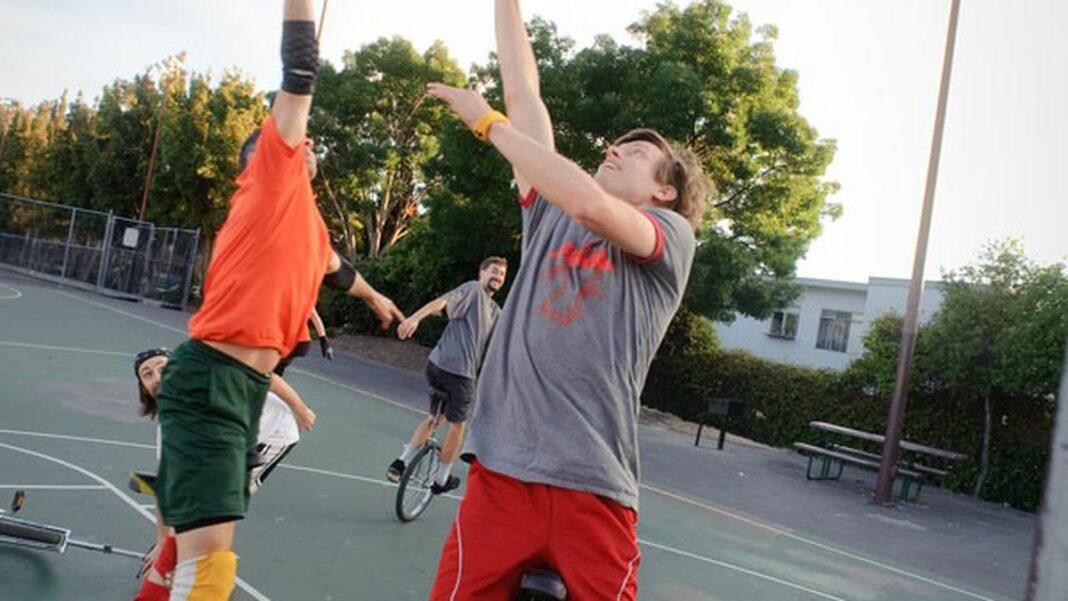
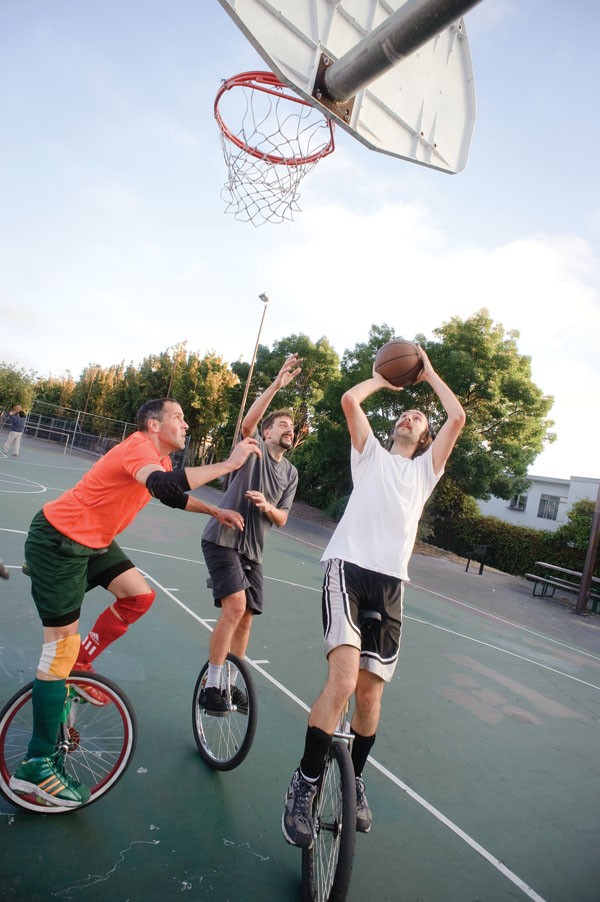
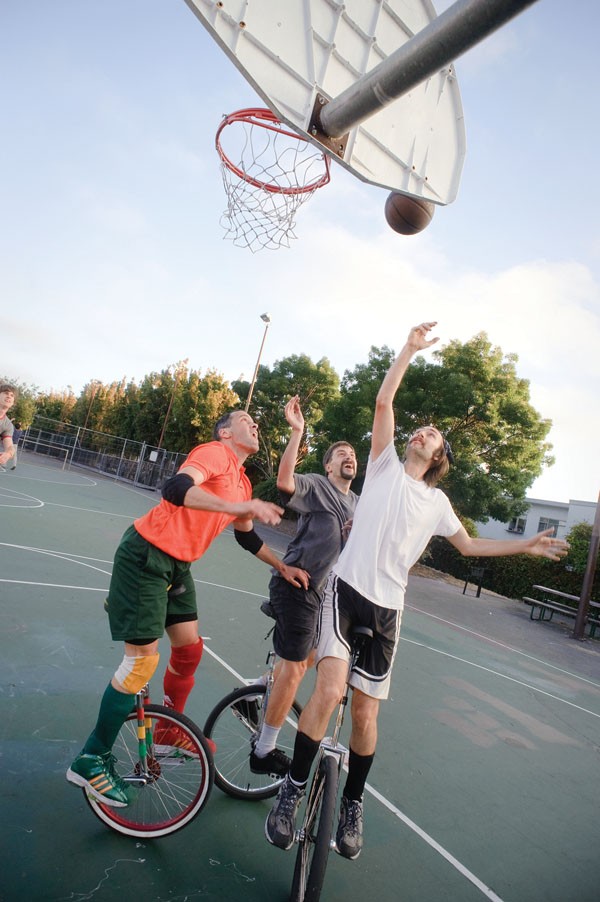
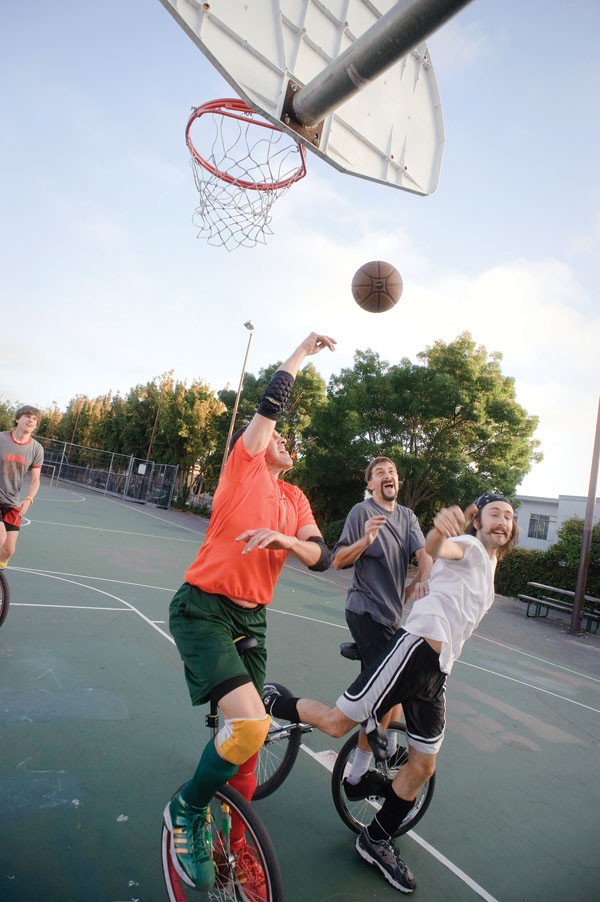
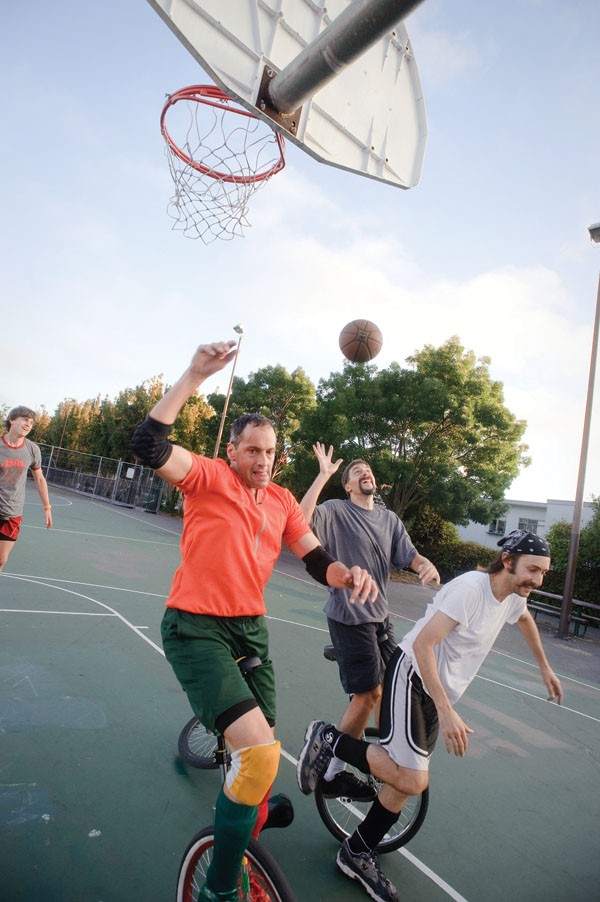
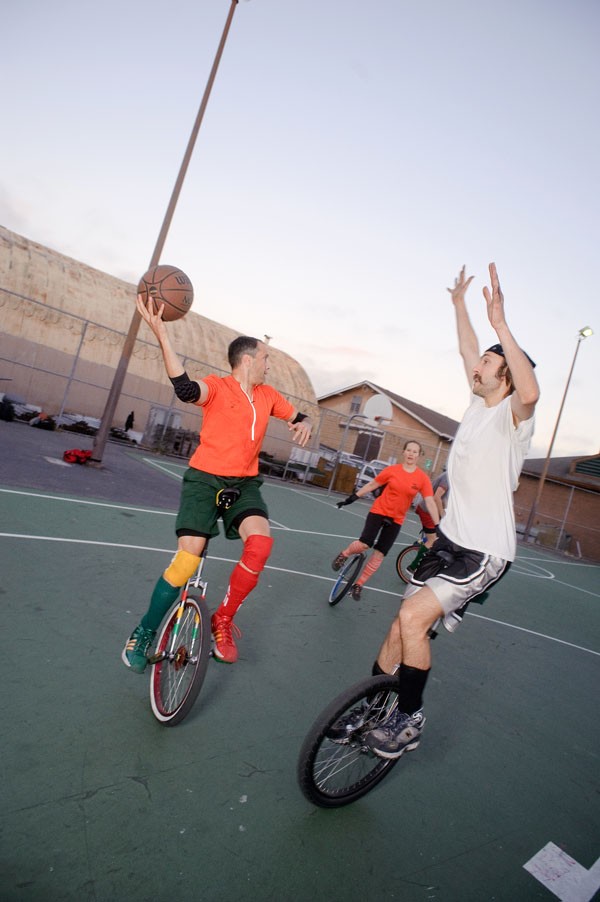
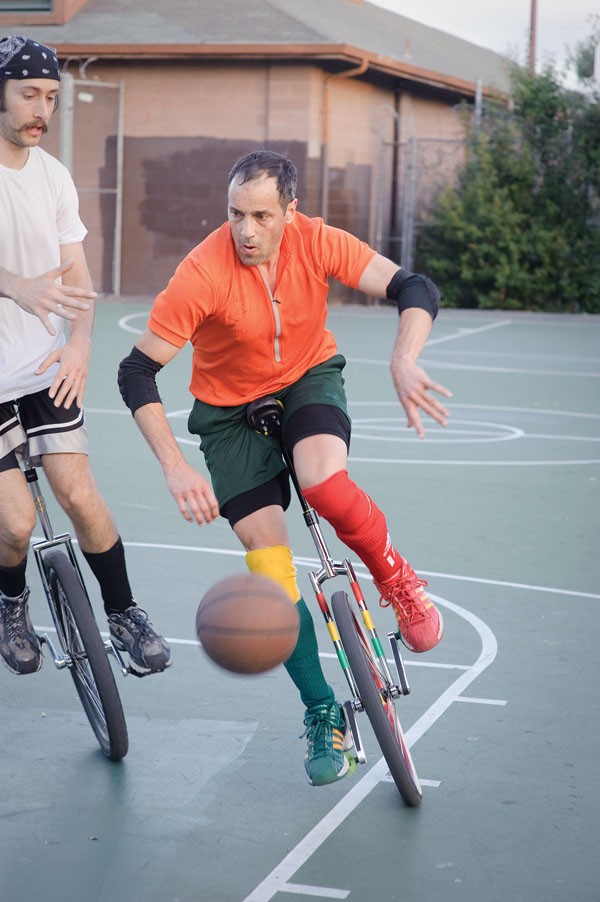
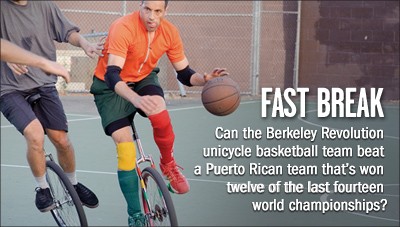
The scrimmages, typically played by ones to seven or eleven, look
and feel much like a traditional basketball game — except that
movements are accompanied by whirring wheels and pedals. There are
in-bounds plays, quick passes, weaves, picks, screens, give-and-go’s,
drives, high-speed fast breaks, zone and man-on-man defense, steals,
blocks. Players must call their own fouls. The Berkeley team’s shooting
percentage from the field is impressive — sometimes as high as 50
percent — mainly because their shot selection is smart.
A well-executed play can be a gorgeous thing to witness. Consider
the one that ended one of tonight’s games: Rolling across the top of
the key, Sowers made a quick pass inside to Thornton, who accelerated
past his defender, drove to the hoop, and kissed the ball off the glass
and through the net. Moments like these make unicycle basketball a more
fluid, visually pleasing game than its traditional counterpart.
Even on this dark, cool weekday night in mid-August, a few
spectators have stumbled across the game and stayed to gawk, as they
often do. “We thought we were going for a walk, but we’ve been standing
here ten minutes, watching,” said Evan Pyke of Santa Clara. He and two
friends found themselves transfixed twenty feet from the court.
“We are amazed and dumbfounded,” said Bronwen Stanford of Berkeley,
wide-eyed. “It’s very impressive. … I was kinda confused that they’d
be doing these two things at once.” After a bit more thought, she
added, “Wow. I’d like to do that.” Practices are open to the public and
unicyclists of all stripes, but any novice player who witnesses a
couple minutes of the Revolution’s current scrimmages is likely to be
scared from trying. This will change, the team promises, once the
championships are over.
Even to the casual observer, play is physically demanding,
punctuated by a constant stream of oofs, aahhs, and
ughs. Sometimes it’s carnage under the hoop, with arms flailing,
knees spinning, unicycles clattering and clanging against one another
and crashing to the court like metal dominoes. Players who fall off
their uni must scurry out of the way as quickly as possible, because if
the ball touches them while they’re down it’s a turnover.
Injuries are frequent, from the garden-variety bashing of shins
against pedals and the bumps and bruises of multiplayer collisions to
less-forgiving incidents like riding into a pole or falling wrong.
There are turned ankles, tweaked wrists, banged elbows and knees.
Politzer sustained the worst injury by breaking his wrist after a fall
two years ago; he was off the court for three months. The uniform of
shorts, T-shirts, and tennis shoes is augmented as each player sees fit
with shin guards, knee pads, elbow pads, and even the odd helmet.
Two and a half hours of this is more than just sport. It’s a serious
workout that requires considerable stamina and strength. Regular riders
may see a transformation in their legs and core; in Sowers’ case, he
says, his entire body. Even when they’re tired, they keep playing. And
after that, when 10 p.m. has rolled around and they’re exhausted and
dripping with sweat, it is tradition for anyone on the team who is
available to convene for snacks and refreshment at nearby Lanesplitter
Pub. It seems that no amount of pizza or beer can put a dent in the
conditioning unicycle basketball affords.
Among the many questions often asked of unicycle basketball players
— How long has this existed? Does it hurt when you fall? Are you
in the circus? — perhaps the most common is also the most
pragmatic: What are the rules? The answer may come as a surprise, if
only for its simplicity. Unicycle basketball follows standard Olympic
basketball guidelines, with a few minor tweaks.
The modifications fill only half a page in the International
Unicycling Federation official rulebook: 1) A player off his or her
unicycle is considered off-side; 2) the player in-bounding the ball may
have only one foot on the ground; 3) a player who receives the ball
while progressing can make three idles (an idle is one half-turn
forward and one half-turn backward to maintain balance) before
dribbling or throwing; 4) contacting the ball with the unicycle is a
nonfoul violation; and 5) the standard three-second rule is adjusted to
four seconds.
These are the rules that will steer the play of the 25 or so teams
expected to compete in Unicon XV’s round-robin knockout-style
tournament. Puerto Rico (which is sponsored by Walgreen’s this year),
Switzerland (the only other team to win at Unicon since 1994), Germany,
and Berkeley will likely field the top teams, but the football axiom of
“any given Sunday” applies to unicycle basketball, too.
At this summer’s national championships in Minnesota, captain
Thornton had a chance to scout some of the Revolution’s competition.
Twenty-two teams from cities across the United States competed,
including ten that formed on the spot. Of those 22, about fifteen had a
low skill level. Puerto Rico didn’t field its A-team, but it did send
two second-rate teams and two highly skilled players, one of whom could
leap off his pedals for a slam dunk. Thornton, the only player from
Berkeley to attend, landed on a team from Rochester, New York, that
lost 42-10 to the tougher Puerto Rico squad in the semifinals. An
experienced team from Minnesota — likely Berkeley’s only
continental competition — ended up taking first place.
Unicon XV, the first unicycle world championships to be held in the
Southern Hemisphere, will feature more than twenty events. These fall
into the broader categories of track and field (the most popular),
mountain unicycling, road racing, freestyle, hockey, and basketball. In
addition to the competition, the eleven-day gathering straddling New
Year’s Day also features workshops, casual rides, and social
activities. Ken Looi, chairman of the convention’s organizing
committee, expects about 700 competitors in all. “It’s an amateur
sport, so apart from shiny medals and bragging rights, there is no
monetary gain from any of this,” he wrote in an e-mail. “People compete
because they are passionate about unicycling.”
Eight members of the Berkeley squad, plus a 17-year-old MUni
champion from Los Gatos who recently committed to practicing with the
Revolution, plan on attending Unicon. A couple key players will be
missing, and by the time the tournament rolls around the team will
likely still be entirely untested. Refined basketball skills are the
remaining weak link, and over the next three months the team plans on
squeezing twice as much practice time into every week and devoting more
time to plays and drills. Toward that end, the team is also hoping to
find a volunteer coach, possibly from a local high school or community
college, who could guide their progress from the sidelines.
It all adds up to a challenge, complicated by the fact that the trip
won’t be cheap. Airfare to New Zealand typically runs about $1,600;
multiply by nine and you get nearly $15,000 for the team. Add the $600
they’ll need for uniforms and it’s easy to see why the Revolution is in
the market for a sponsorship or two of its own. Still, there’s no
reason not to go for it. As Sowers constantly reminds his teammates,
“This is our only chance to be world champions.”