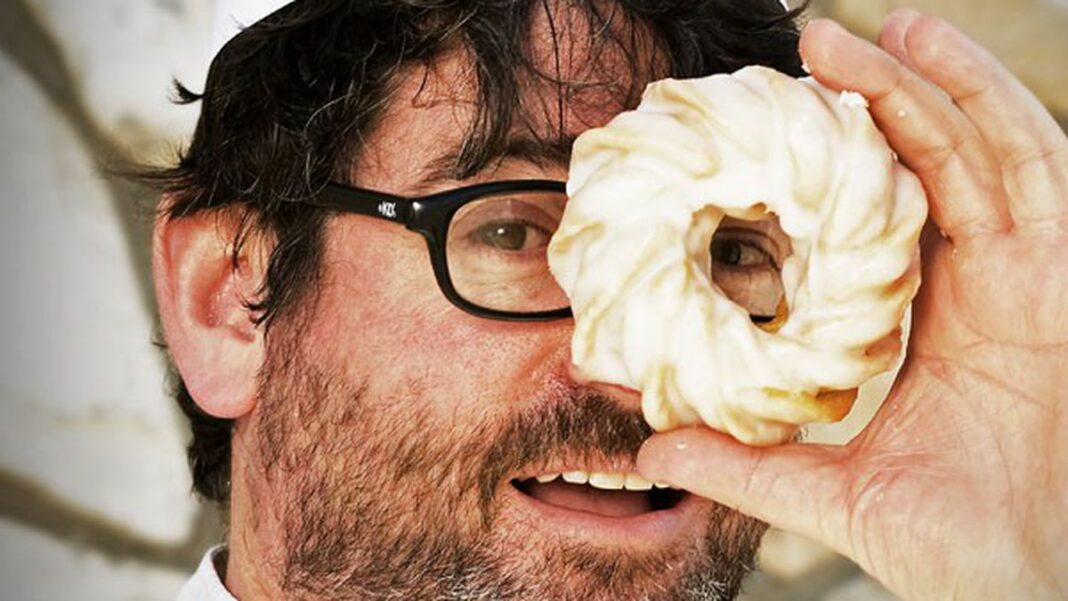
In a small kitchen in West Oakland, a batch of freshly glazed
doughnuts cools on a baking rack. The rows of ring-shaped pastries
glisten under coats of chocolate, cinnamon, and blueberry. It’s a
tantalizing scene for any junk food lover, but there’s something
missing from these doughnuts — and it’s not just their centers.
The cake-style doughnuts made by Pepple’s Donuts lack some of the
quintessential ingredients of the traditional fried dessert. They’re
largely organic and totally vegan, meaning they’re made without butter,
egg, milk, or lard. While the term “vegan” may conjure images of a
sparse diet of nuts and berries, Pepple’s doughnuts are part of a
growing number of non-dairy options that dispel that minimalist
image.
Credits: Sonya Revell

Credits: Sonya Revell

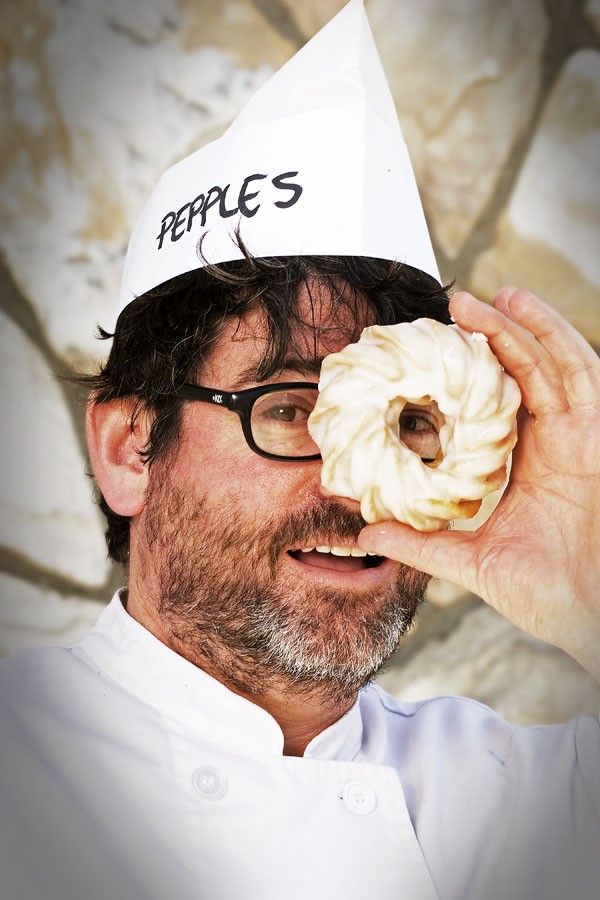
“Vegans want junk food, but so much junk food isn’t vegan —
and the stuff that is, is just — junk,” said owner Josh Levine.
“I wouldn’t even say that my doughnuts are junk food, because there’s
nothing junky inside them.”
Pepple’s is a small but sizeable operation: The deliver about 500
doughnuts a day to coffee shops, restaurants, and grocery stores
throughout the East Bay and San Francisco. They cost more than
conventional coffee shop doughnuts — ranging from $1.75 to more
than $2 each — but then, these aren’t your conventional
doughnuts.
Levine’s vegan concoctions are in fact healthier than the treats
found in many bakeries and stores, which are riddled with preservatives
and high fructose corn syrup. He uses organic ingredients when he can
— including fresh fruit from local grocers like Monterey Market
and Berkeley Bowl — and estimates that the finished product is
about 90 percent organic. Additionally, the doughnuts are sweetened
with evaporated cane juice, which his girlfriend, pastry chef Rebecca
Stevens, says gives people less of a sugar spike than cane sugar. While
they make the usual flavors, like chocolate and maple glazed, they also
make unusual flavors like lemon poppy seed, coconut, blueberry, and
even one with cookie crumbles.
Still, the pastries are comprised of pretty much what one would
expect from a dough mixture destined for the fryer. The flour is
unbleached, the salt is kosher, and the oil is organic — and it’s
all held together by soy lecithin, a binding alternative to eggs.
If there’s any question about the healthiness of these ingredients,
the answer might be found in the sizzling sound of frying oil. “They’re
vegan, yes,” said one of the company’s two bakers — aptly named
George Baker — but he has no illusions. “It’s still fried dough.
I mean, how good can that be for you?”
Pepple’s fries their doughnuts in palm oil, an animal- and
cholesterol-free alternative to the pork-rendered lard once prevalent
in doughnuts. You might be more hard-pressed to find a lard-laden
doughnut today, as many bakeries (including chains like Krispy Kreme
and Dunkin’ Donuts) now use vegetable oils in their fryers. But even
the healthier alternatives may contain the trans fats that result from
hydrogenation, and which have been linked by the FDA to increased risks
of high cholesterol and coronary heart disease.
Levine doesn’t deny that his doughnuts, despite being vegan, are
still high in fat and sugar: “If it’s junk food, it’s the fanciest junk
food you can get,” he said. And there’s no rule that a vegan pastry
should be healthier than any animal-filled dessert.
That’s just fine with Mike Thorn, an Oakland resident and
nineteen-year vegan, who eats a Pepple’s doughnut with his coffee every
Sunday from Rockridge’s Cole Coffee. He went vegetarian at fifteen for
animal rights and environmental reasons and cut out dairy shortly
after.
Any health benefits of veganism — like a lower overall intake
of saturated fats and cholesterol — were largely incidental to
Thorn’s dietary decision. While he does eat a lot of vegetables, he
still craves junk food. And after going nearly two decades without a
doughnut, Thorn said he has no qualms about indulging in the fried food
when he has the option.
“It’s a damn doughnut,” he said. “Deep-fry that shit and cover it in
sugar. It’s not supposed to be good for you — it’s supposed to
taste good.”
Thorn isn’t the only vegan whose animal-free diet choice hinges on
more than his health. Dustin Hall, drummer for the now-defunct Bay Area
band Gather (a politically charged straightedge hardcore band with all
vegan members), said his choice to go vegan stemmed from a staunch
opposition to animal abuse.
Hall said the absence of cholesterol and animal fats in vegan junk
foods give them an instant advantage over their dairy-filled brethren,
but that’s where it ends. “The biggest killer in all junk food
is sugar,” he said. “Vegan snacks tend to have just as much sugar,
which is why it’s still appropriately considered junk food.”
To be sure, a vegan diet does not guarantee an exclusively healthy
or balanced diet. Many vegans still salivate over the foods that are
but a memory on the tip of their taste buds.
“We all grew up on the typical, horrible American diet,” Hall said.
“So, now that we’re vegan, we’re still not opposed to the flavor
of a hot dog — or pizza, or ice cream, or candy bars. We’re
opposed to the ingredients, not the flavor.”
Taking advantage of this demand, some local restaurants are
incorporating vegan options — and in some cases becoming strictly
vegan. Pizza Plaza in Oakland started off as a typical meat-and-cheese
operation, until, in 2006, Hall’s vegan friend Aaron Zellhoefer asked
the owner if he would make his pizza without cheese. He did.
Zellhoefer and the shop’s owner, Armin Ahmed, who was a vegetarian
at the time, started an in-depth discussion about veganism. “I didn’t
realize it in the beginning,” Ahmed said, “but I found out there are a
huge number of vegans in the East Bay.”
A week or so after his fateful visit, Zellhoefer returned with a few
blocks of Follow Your Heart “cheese” — a tofu-based cheese
alternative. Ahmed tried it out on a pie — and it melted —
along with his original menu plan. Soon after, he added a couple vegan
items to his menu, and then a few more, until he phased out the meat
altogether.
“I slowly stopped offering meat pizzas when I realized that I could
make enough to support myself making just vegan and vegetarian pizzas,”
Ahmed said. Thus, a new restaurant was born. Zellhoefer, Hall, and a
troop of their vegan friends (including Hall’s band mates) began
frequenting the spot, which had suddenly become a cheese-less
haven.
“I felt real support from them,” Ahmed said. “Dustin’s band carried
a message about veganism. I felt like I was making something that they,
and all supporters of veganism, could relate to.” As a nod to his
friends, Ahmed offers a “Gather Band Deal” — two pizzas with
three toppings each and vegan cheese sticks. The shop also has a
magazine rack filled with pamphlets on veganism.
Pizza Plaza may be the only East Bay pizzeria that’s exclusively
vegan, but Lanesplitter, the popular pizza place and pub with spots in
Albany, Berkeley and North Oakland, makes its own cheese substitute,
dubbed “Notta Ricotta,” out of soy-based ingredients. Fellini, an
Italian restaurant in Berkeley, also offers a soy-based cheese along
with tofu and other vegan “meat” toppings.
Some people criticize diets based largely on imitation foods. Dr.
John McDougall, a nutritionist and vociferous proponent of the virtues
of low-fat vegetarian or vegan diets, published a newsletter, called
“The Fat Vegan,” in which he decries the practice of substituting dairy
and meat products, item for item, with processed vegan versions.
“People who have declared themselves ‘vegan,’ have said ‘no’ to
eating all animal-derived foods,” he wrote. “At extraordinary personal
costs, many of these guardians labor tirelessly to protect the welfare
of all animals. Fat vegans, however, have failed one important animal:
themselves.”
McDougall added, “Instead of animal fats and proteins, fuel becomes
vegetable oils and isolated soy proteins. Calorie for calorie, in terms
of nutrition, the fake food is no better, and in some ways worse, than
the real thing.”
The isolated soy protein that McDougall frowns on is commonly used
in imitation meats, including the “pepperoni” at Pizza Plaza, to add
protein. According to the Soyfoods Association of North America, the
isolate, which is derived from de-fatted soybeans, is high in amino
acids, low in fat, and free of cholesterol, which qualifies it as an
acceptable replacement for meat protein under the FDA’s standards.
Other imitation meats, like the Tofurkey sausages used by Pizza
Plaza, contain tofu as a protein source. Actually, one serving of
Tofurkey’s “Sweet Italian Sausage” has 29 grams of protein, or four
grams more than is needed in a day.
For vegans who’ve eliminated many of the foods that were once
staples or indulgences, the forbidden foods can become very alluring.
Mel Chang, who blogs about her adventures with cooking and eating vegan
food (veglicious.blogspot.com),
acknowledged the fixation that some vegans develop over foods they no
longer eat. “I think it’s easy for vegans to become obsessed with
finding replacements for junk food because our whole society is
obsessed with junk food,” she said. “When you’re suddenly not able to
go down to the corner market and buy a hyper-processed, beef fat-filled
snack cake, it becomes a welcomed challenge to recreate those foods
that are comforting to us.”
The Emeryville chocolate maker Coracao Confections is another
company that strives to meet that challenge. Coracao’s organic
chocolates are not just vegan candy, but vegan candy that’s also free
of refined sugars, hydrogenated oils, wheat, gluten, and even the soy
that is prevalent in so many dairy-free snacks. Oh, and they’re raw
— so absolutely no stoves are harmed in the process.
The chocolatiers behind Coracao Confections, Daniel Korson and
Matthew Rogers, met while working as pastry chefs at raw foods
restaurant Cafe Gratitude, where they also ran the chocolate
department. The restaurant’s nut-based, naturally sweetened raw
desserts helped inspire Coracao Confections’ similar approach to
sweets.
Korson said he and his business partner were both big junk food
eaters when they were younger, but both cut out the foods to focus on
healthier eating. “But on some level I think we both missed them,”
Korson said, “Compare that to some crunchy, raw, vegan date ball with
flax seeds and somehow it just doesn’t have that same deep level of
satisfaction or fun.”
The result of the chefs’ shared junk food deprivation: A collection
of chocolates made with what they call “superfoods,” such as
“antioxidant-rich” goji berries and acai. Another ingredient is raw
cacao, which, according to Korson, is one of the most antioxidant-rich
foods ever tested. The beans contain nutrients like magnesium, which
contributes to bone and immune support. Zinc, iron, and chromium also
crowd inside the uncooked beans.
Because the chocolates are uncooked, Korson says the vitamins
present in their ingredients stay intact. Compared with the nullifying
effect of the fryer, nothing in raw foods is broken down. “Think about
it in terms of an apple,” Korson said. “An apple is a very healthy
food. What happens if you roast that apple? All that vibrancy, flavor,
and raw nutrition in its pure state has been lost.”
The sizable list of nutrients in Coracao Chocolates reads more like
the label on a vitamin bottle than a candy bar wrapper. Until doctors
start prescribing the chocolates as medicine, though, they still
qualify on some level as sweets. After all, they are sweetened —
albeit with agave nectar and coconut sugar, which are comparatively
lower on the glycemic index than sweeteners like corn syrup and refined
sugar.
And Coracao chocolates still contain calories, but while
conventional chocolates get their fat from dairy ingredients like
butter and cream, a variety of nuts constitute part of Coracao’s fat
source. It’s clear by names like “almond coconut dream,” “brazil nut
maca-malt cup,” and “macadamia coconut dream” that the candies are
particularly nutty.
Nuts are an important source of unsaturated fat and protein for
vegans. According to the North American Vegetarian Society,
nutrient-rich calories in nuts can also effectively satiate someone’s
appetite, so smaller amounts of food (like a piece of chocolate) are
more likely to satisfy someone’s sweet tooth.
Yet eating too much of anything, even an antioxidant vegan
superfood, isn’t healthy. Even the most unsaturated, uncooked,
all-natural foods contain fats and calories that shouldn’t be
over-consumed. Though Korson hails the healthiness of his chocolates
— they’re actually about one-fourth of his diet, though he
wouldn’t recommend that much chocolate to everybody — Korson
says, “Just like everything else, it should be eaten in moderation. If
you’re thirsty, water will save your life — but you can also
drown in it if you’re not careful.”