Environmentalists are not only worried about the plan by state
officials to renew aerial pesticide spraying for the light brown apple
moth. They’re also concerned about some of the state’s other
extermination proposals, including a plan to enter people’s backyards
to attach pesticide-laced “twist ties” to their trees and shrubs. And
perhaps the most troubling proposal by state agricultural authorities
is their plan to spray hundreds of thousands of utility poles and trees
with an insecticide that is fatal to cats and honeybees and harmful to
young children.
Other startling eradication plans by the California Department of
Food and Agriculture, which is determined to exterminate the light
brown apple moth despite convincing evidence that it may be only a
minor pest, include breeding and irradiating hundreds of millions,
possibly billions, of moths. State officials plan to release the
sexually sterile insects throughout Northern and Central California in
the hopes that they will disrupt the breeding cycles of fertile moths.
“The goal is to produce a minimum of 20 million sterile male moths per
day,” states the department’s draft environmental impact report on the
planned eradication efforts. The report goes on to say that state
officials plan to release an astonishing “500,000 moths per acre” in
some areas.

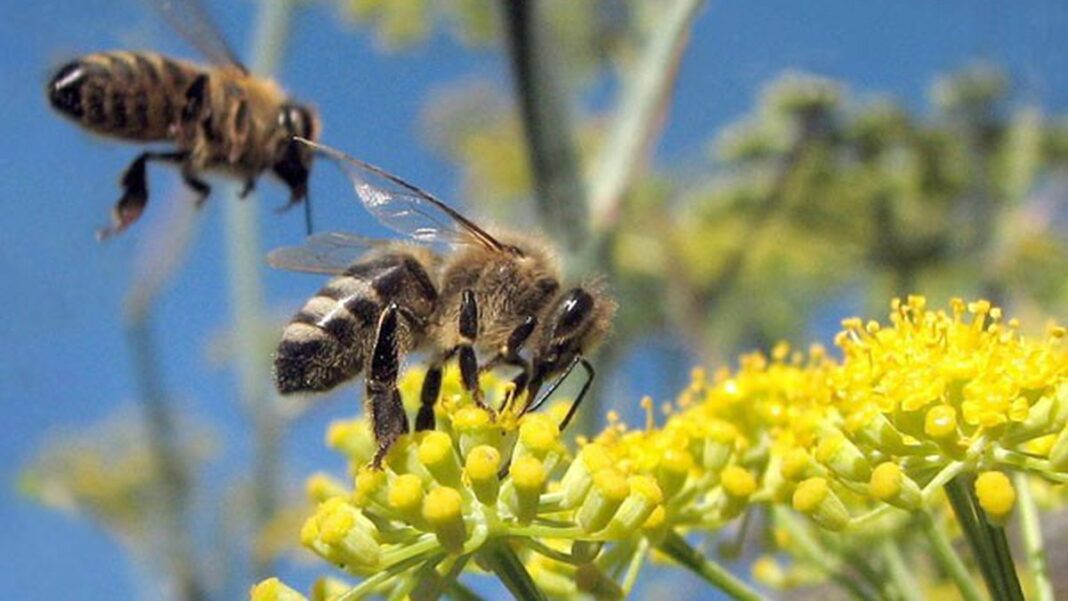
The state plans to use an insecticide that is fatal to honeybees. Credits: wolfpix/Flickr (CC) 
Permethrin also is toxic to cats. Credits: rainy city/Flickr (CC)

State officials, working at the behest of the US Department of
Agriculture, hope to begin implementing the eradication proposals in
the next several months as part of the government’s $100 million
campaign against the moth. Last week, the public comment period ended
on the state’s draft EIR, and officials plan to finalize the
environmental report soon. The USDA also recently received the blessing
of a panel from the National Academy of Sciences, which said the
federal agency was within its legal rights to declare the light brown
apple moth a major pest. That panel, however, also strongly criticized
the scientific reasoning behind the agency’s decision (see “Shoddy
Science,” 9/16/09).
Not only are environmentalists troubled by the state and federal
extermination plans, but some leading experts in the field say the
proposals are a colossal waste of time and money, and pose unnecessary
risks. Derrell Chambers, a former longtime USDA scientist and expert on
insect management, told Eco Watch that the eradication plans simply
won’t work. “The bottom line is it’s just not possible,” he said of the
effort to exterminate the light brown apple moth in California.
Kensington resident Chambers worked for the USDA for 37 years. He
was director of the agency’s Agricultural Research Service Center in
Gainesville, Florida, which specializes in studying insects. His
expertise was the use of pheromones to disrupt insect mating and
reproduction. The USDA plans to use pheromones as one of its primary
weapons against the light brown apple moth, particularly with aerial
spraying and the twist ties. Consequently, Chambers’ strong criticisms
of the eradication proposals represent a stinging blow to the agency
because of the respect he garnered in the field and his longtime,
high-ranking position in the USDA.
Chambers says the primary problem with trying to eradicate the light
brown apple moth is that it lives in “microhabitats.” That is, the moth
doesn’t fly very far and tends to stay in a defined, forested area with
dense brush. It’s also tough to target with pesticides because each
moth rolls itself in a leaf during its larval stage. “There’s always
going to be refuges where a significant number of moths are going to be
unaffected,” Chambers said. As a result, those surviving moths will
ultimately lead a resurgence, thereby requiring continued pesticide use
in an endless cycle of “eradication.”
The retired entomologist also was critical of the mass-sterilization
plan. In order to render moths completely infertile, they have to be
zapped with high doses of radiation, he explained. But all that
radiation will severely weaken the moths, and thus limit their ability
to fly around, find mates, and reproduce. “They’re already a
weak-flying insect,” he said, referring to the inability of healthy
light brown apple moths to fly more than a few hundred yards. “I just
don’t get it. It can’t work.”
And other experts have noted that irradiation itself is typically
not 100 percent successful. So if the state plans to produce 100
million light brown apple moths a week, some small percentage of them
will remain fertile. For instance, if the radiation treatment fails on
just one-tenth of 1 percent of the insects, then the state could
produce and release up to 100,000 fertile moths every five days without
realizing it. “That’s more moths than the moths they’ve found total so
far,” noted Roy Upton, a Santa Cruz-based activist who has closely
followed the moth controversy. Chambers recently endorsed an exhaustive
scientific literature review that Upton conducted in an effort to
convince the USDA to downgrade the light brown apple moth to minor pest
status, which would prohibit mass eradication efforts (see
“Whitewashing the Moth?” 9/9/09).
But as misguided as the massive moth-radiation program seems to be,
opponents say the widespread spraying of a poison that is fatal to cats
and honeybees and dangerous to children is over the top. State
officials plan to squirt a sticky combination of pheromones and
permethrin, an insecticide, on up to 1,200 utility poles and trees per
square mile in areas where they find light brown apple moths.
Agricultural officials maintain that blanketing urban and suburban
neighborhoods throughout the Bay Area, including the East Bay, with
gooey “dollops” will be safe because they will be applied at least
eight feet off the ground, and so will be above the “breathing zone” of
the average person.
However, Upton and other opponents point out that some cats and
children like to climb trees, and so could easily come in contact with
permethrin — as could honeybees. The Environmental Protection
Agency classifies the chemical as a “potential human carcinogen,” and
children exposed to it have developed respiratory and immune-system
problems. For cats, studies have shown that permethrin nearly always
causes severe toxic effects that read like some sort of horror-film
script. They include excitability, twitching, tremors, convulsions,
vomiting, diarrhea, muscular weakness, respiratory distress,
hyper-salivation, and death. In other words, cats that get the poison
on their fur or paws and then frantically lick it off, could not only
end up dying, but dying horrible deaths.
While the twist ties will be laced with pheromones and not
permethrin, the idea of having state officials entering tens of
thousands of backyards to hang twist ties on trees and shrubs like
Christmas ornaments is not likely to be very popular. The plan is to
hang up to 250 of them per acre in a five-mile radius around a moth
infestation. So far, the moth has been found in large concentrations in
San Francisco and Santa Cruz counties, and smaller concentrations in at
least sixteen other counties, including Alameda and Contra Costa. So
what happens if homeowners refuse to allow state workers on their
property to put up a bunch of toxic twist ties? State officials have
yet to say. “There hasn’t been nearly enough disclosure to the public,”
said Erin Tobin, a staff attorney at Earthjustice, an Oakland-based
environmental group that strongly opposes the state’s plans.
Earthjustice also is concerned about the new pesticide that the
state plans to use for aerial spraying. Agricultural officials stopped
using the pesticide Checkmate after hundreds of Santa Cruz County
residents reported getting sick after the first round of spraying
nearly two years ago. The state’s draft environmental impact report
describes the new pheromone-based pesticide, Hercon BioFlake, as
consisting of small square plastic flakes that contain moth pheromone.
But Earthjustice points out the environmental impact report contains no
analysis of the potential risks posed to children or animals if they
ingest the flakes. “We’re concerned that what children do is when they
find things on the ground, they stick those things in their mouths,”
Tobin said.
Mike Jarvis, a spokesman for the state agricultural department, said
his agency is reviewing the concerns raised by opponents and is
“working to find the most safe and efficient program.” But in the draft
environmental report, the agency downplays the risks posed by the
flakes, maintaining that they will be sprayed only over “forests and
chaparral” and agricultural areas. But state officials have yet to
disclose exactly where those places will be and how close they will be
to more populated areas where children are present. Tobin pointed out,
for example, that the state’s description of where it plans to spray
the flakes could include the East Bay hills.