
Sixteenth century diplomat Niccolò Machiavelli was a
consummate striver with a wobbly moral compass. His most famous
accomplishment — a political treatise called The Prince
— was oft-dubbed “a handbook for tyrants.” He curried favor with
diplomats by preying on their basic instincts; hence the phrase
“Machiavellian mentality.” He was evil, but he apparently didn’t have
an evil countenance, as playwright Gary Graves notes in his new Central
Works play, Machiavelli’s The Prince. The play imagines a
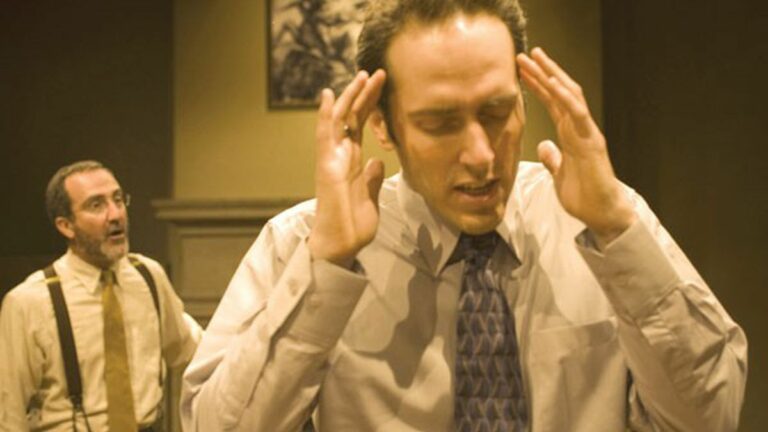
meeting between Machiavelli (a clean, bespectacled, weasel-like Richard
Frederick) and his former student Lorenzo de Medici II (Michael
Navarra), during which Machiavelli gives the young nobleman a copy of
his treatise, handwritten in a black Mead notebook. Graves took pains
to contemporize his source material and make it resonate with modern
audiences: Both Machiavelli and Prince Lorenzo wear business suits, and
use modern language to discuss ancient political conflicts in Florence
— it’s easy to imagine them transplanted to the Oval Office. What
results is a captivating drama about power and its effect on
character.
Power, to Machiavelli, always amounted to a cost-benefit analysis.
The goal is to expand and consolidate one’s empire, which occasionally
requires a prince to kill defectors, raise taxes, or retract promises.
Such cruelty and perfidy did not easily appeal to Lorenzo, who liked to
think of himself as morally upright. (“My word is my bond,” as he says
in the play). Navarra plays the character as a wide-eyed young
commander-in-chief who’s riddled with anxieties. He’s in a bit of a
pickle: His uncle abdicated the throne and moved to a monastery in St.
Michael; meanwhile, Florence suffers from a broken water system and a
huge budgetary crisis. Lorenzo has vague ideas about transforming the
place into a metropolis, but he lacks a concrete plan. He harbors bad
memories of the Siege of Mondolfo, during which Lorenzo razed an entire
village and looked away as his soldiers butchered the men and raped the
women. He says he wants to redeem himself, beat off enemies, and
sustain a large principality without resorting to absolute despotism.
According to Machiavelli, that’s not possible.
The interweaving of history and fiction is largely what makes this
Prince interesting. At the time that Machiavelli wrote his
original treatise, two families — the Roveres and the Medicis
— were contending for much of central Italy. The Medicis were in
the ascendency; the Rovere family was on the outs, but trying to get
back in. Thus, Lorenzo II (a Medici, grandson of Lorenzo the
Magnificent) spends much of the play fretting about how he’s going to
stave off Francesco de la Rovere, a prominent rival who is trying to
overtake Tuscany with an army of mercenaries. Enter Machiavelli, a
long-time diplomat who had served the Florentine government during an
anti-Medici period (he was accused of conspiring to remove Lorenzo’s
father, and tortured). By time he meets up with Lorenzo II (to whom
most published versions of The Prince are dedicated), he had
spent several years exiled on the outskirts of Florence. Machiavelli’s
attempts to endear himself to the young prince are glaringly
self-interested, since he’s obviously looking for a job in the new
court. (This probably wasn’t far from the truth either, although the
book was published five years after Machiavelli’s death).
Machiavelli pretty much hews to the contents of his book, even to
the point of lionizing his former superior Cesare Borgia, who was known
for carnage. He tries to suck up to Lorenzo be teaching him how to be a
good tyrant: Avoid mercenaries, instill fear in all subjects, keep your
word only when it suits you; extend the olive branch to Francesco and
then murder him. Richard Frederick is saddled with making the character
Machiavelli utterly calculating and self-interested, but also somewhat
of an underdog. For the most part he looks more diminutive than Lorenzo
(partly because Frederick is smaller than Navarra, and wears geeky
glasses), so Frederick has to reveal his inner-evil in small gestures
— like furtively taking a glass of water while Lorenzo’s back is
turned, even though he’s offered one at the beginning of the play.
Yet, Lorenzo isn’t the great peace-maker he purports to be, either.
He’s much closer to the crafty, miserly, controlling, but thoroughly
effective prince that Machiavelli envisions. It’s not hard for Navarra
to reveal that part of his character, since he manages to look like a
bad guy. (Blame it on the smirking half-smile plastered on his long
narrow face — it doesn’t exactly bespeak goodwill). The set
design reflects his moral quandary. Atop the fireplace hangs a Ruben’s
study of Leonardo da Vinci’s painting The Battle of Anghiari,
which shows a violent clash of soldiers on horseback, trying to slice
each other’s heads off. Opposite the painting is an illuminated cross,
made from light projected on a dark wall. All the action of the play
occurs between these two poles. At particularly dramatic moments, the
characters gaze searchingly at the cross, then at the notebook, then at
each other. By then end, it’s clear that Lorenzo has shifted over to
Machiavelli’s side.