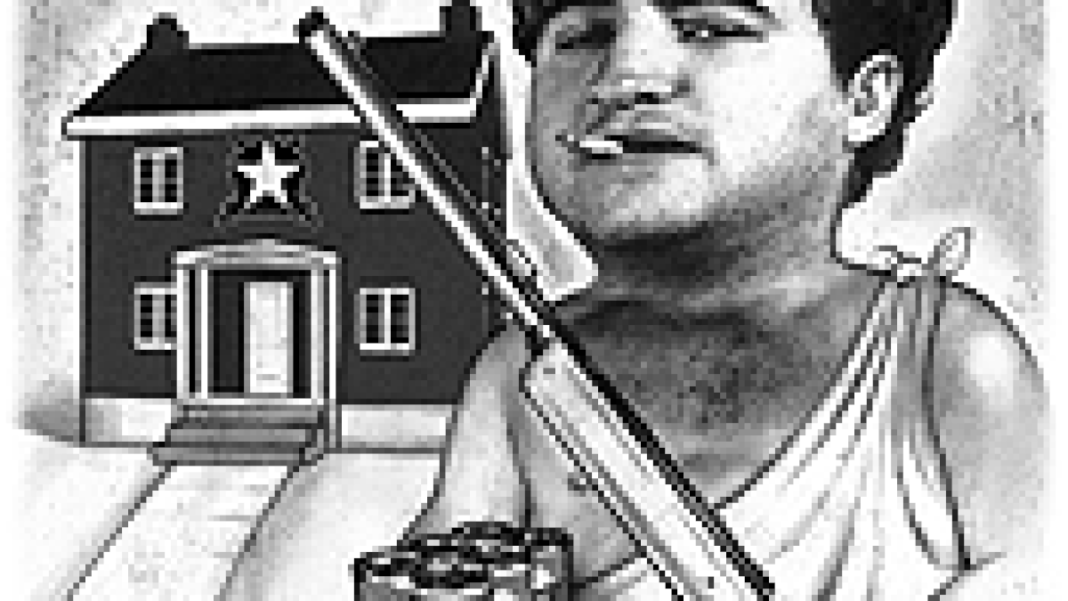
You can still find at least one eternal truth when you go to college: Frat boys love pisswater brew. A gaudy Coors sign hangs in the bedroom above the entrance to Pi Kappa Phi, the UC Berkeley fraternity whose charter was recently suspended after three members were fingered in a hazing stunt involving a young man in his underwear, a BB gun, and a big, danky spliff. Which brings us to our second eternal truth: That is so gay.
You can always learn a little something about a school’s zeitgeist by the kind of trouble its students get into. Fifteen years ago, a cocktail of drugs and radical-left politics doomed Barrington Hall, the great Breughel painting of Berkeley campus counterculture. Today, two very different student living experiments face extinction for their sins. The cooperative Le Chateau, which took over Barrington’s anarchist mantle and served as a base of operations for student activism in the 1990s, will be scrubbed clean this summer, its residents evicted to make way for quiet graduate students.
The Pi Kappa Phi fraternity faces a similar fate for an entirely different species of rowdiness. On April 8, up to fifteen members allegedly grabbed one of their pledges, dragged him into the house, and interrogated him about where his fellow pledges might be. When he didn’t give them a satisfactory answer, three members allegedly stripped him down to his boxers, tried to force him to drink alcohol, blew dope smoke in his face, and shot him thirty times with a BB gun. A Kaiser Permanente nurse called the cops while treating the pledge, and the three alleged shooters have been expelled from the frat. University officials have placed the fraternity on suspension, and the Pi Kapps’ parent organization has suspended the charter of its Cal chapter pending an investigation, which could lead to the house closing altogether.
But unlike the residents of Chateau, the Pi Kapps aren’t going without a fight; in fact, they were plenty aggro when I showed up last week. Many Berkeley fraternity houses are blessed to have been built in an era when attention to detail mattered, but the Pi Kapp compound is a sad, fading, cream-colored box, enlivened more by the abandoned couch and rusting barbecue grill out front than the crumbling Greek letters on the facade. No one answered the door, but one student leaving the building assured me they were just a little shy: “The whole house is in there, man. They’re not gonna talk.”
This didn’t sound like the Pi Kapps Southside knows so well. One of its members, Sam Endicott, serves as president of the campus Intrafraternity Council, the official face of Greek life. Another, Sam Kim, is the council’s vice president for risk management, responsible for drafting “incident reports for Greek Code of Conduct violations.” But the most extroverted Pi Kapp is undoubtedly Adam Guthrie, who in 2003 pulled a double shift while a Daily Californian columnist, covering both the coozehound and the boozehound beat.
“It was another ordinary evening of partying in the life of Adam Guthrie,” one piece began. “Hollered at a few of my boys, got some females together, and rolled out to a party.” When a woman with whom he had recently slept gave him the cold shoulder, he tried to guess why “through the Albertson’s-brand-vodka-induced state of confusion,” until he finally realized she was sitting next to the boyfriend she had cuckolded. “The description given of him when she and I first met gave his identity away,” Guthrie wrote. “I believe her exact words were, ‘I’m annoyed with him because instead of spending time with me, he works out three hours a day to overcompensate for having a small … you know what.'” Eventually, Guthrie found peace of mind in the theory that he was just along for the ride when she decided to stray. “If they’re going to cheat on their boyfriend with some stud,” he concluded, “that stud might as well be you.”
Now that the scandal has broken, the Pi Kapps have hunkered down. Endicott refused to answer any questions about the house, and chapter president Alejandro Ortiz did not respond to an e-mail seeking comment. Guthrie refused to go into detail about the house or his writing, ending his e-mail correspondence with “Take your nonsensical reporting elsewhere — and do not contact me again.” And the rest of the chapter refused to open the door. When I looked in the kitchen window, which is set back a few feet from the sidewalk, a young man opened a side door and demanded to know what I wanted. I asked to speak to the residents and gave him my card after a short exchange, but he told me to get lost. “Don’t bother the guys in the house,” he said. “It’s private property, and you’re on it. Now get off it.”
Immediately after this encounter, two people called this paper’s office claiming I had barged into their house and refused to leave, and threatening to call the police. One woman, who called herself Amber, said I looked like a rapist, and she was hiding in a room dressed only in her “bra and panties.” Again with the underwear. What is it with these people?
Fortunately, Pi Kapp’s neighbors were only too willing to dish. The adjacent Alpha Delta Phi is known as the “literary fraternity,” because its founder, Samuel Eells, designed it as a literature appreciation society, and because once a year its members get really shitfaced and act out a Shakespeare play. Alpha Delts Nick Gonsalez and Shay Anti sat down before the house’s big-screen TV and discussed their experiences living next to the Pi Kapps. “I don’t really want to talk shit about another house,” Anti said, “but I’m not sorry to see them go.”
Everyone gets drunk and noisy on occasion, but according to Anti and Gonsalez, the Pi Kapps take it to another level, throwing toilets and junk into the Alpha Delts’ pool, banging on their door after midnight and calling them out, or sneaking into other frats and trashing the rooms of random people. At least three times this semester, they said, someone has vandalized or stolen their cars after Pi Kapp parties, and fistfights between Pi Kapps and other fraternities are common. Last September, after a hurricane postponed Cal’s game with Southern Mississippi, members of the football squad got into a monster brawl with the Pi Kapps at the tail end of a party; Anti claims he raced back and forth, trying to make sure no one damaged the Alpha Delts’ cars.
So far, this is still just kid stuff. But Anti makes another, more serious claim. Before joining the Alpha Delts, he rushed the Pi Kapp house, where he learned that his brothers would kick the shit out of him as a final test. “I was informed that at some point, members would beat on pledges and jump them in,” he says. “I’ve seen it, in their backyard.”
The Alpha Delts have a clear view of Pi Kapp’s barbecue deck from their house. It was here, Anti says, that he watched four or five Pi Kapps jump a pledge last semester, beating on him while he covered up and fell to the ground. “They were up on the deck, just whaling on a kid one day,” Anti says. “Their house is known as a fighting house.”
According to Mark Timmes, the chief executive officer of the Pi Kapps’ national organization, jumping in pledges is a much more serious offense. “If that took place, that type of conduct is more than inappropriate,” he says. “It’s unacceptable.” Still, the Pi Kapps have a fair chance of riding this out in the end. Endicott and Kim are still in senior positions in the Intrafraternity Council, where they exercise considerable influence over their peers. Hang tough, fellas, and you just might live to drink another day.
The same can’t be said about the last of the Diggers over at Le Chateau. Two weeks ago, the University Students Cooperative Association, the parent organization that owns the co-ops around campus, voted to shut down Chateau and spend the summer renovating it to attract graduate students. Chateau’s neighbors had filed a nuisance suit against the co-op, and the judge in the case recently awarded them $63,500 in damages stemming from noisy parties and other collateral effects of moving next door to student housing. But what truly doomed Chateau was much simpler: Its own residents just gave up. Of the 75 residents, only fifteen planned to return next semester, and a deflated air of ennui pervades the complex, whose tenants feel worn down by the lawsuit, parliamentary wrangling with the board of directors, and the constant need to justify their culture.
“The general mood is, let’s just move on,” says house manager Anna Karysheva as she sat on the porch of Chateau’s main house. “Enough is enough.” A mild breeze pushed old coffee cups past soiled couch cushions under the porch swing, and all was still in the living room just inside. A local transient walked up the steps and asked if he could have a two-by-four leaning against the wall. “Sure, go ahead,” she replied.
For the last fifteen years, Chateau has served as the repository for the dwindling tribe of freaks and radical leftists who still wander campus. Lothlorien, the vegetarian co-op nestled among the fraternities above Piedmont Avenue, also boasts an activist culture, but Chateau’s proximity to People’s Park and Telegraph Avenue gave it the sketchy edge every metropolitan college town needs to stay sharp. People painted graffiti on the walls, cooked Food Not Bombs fare in the kitchen, and planned demos in the living room, aided in part by a boarding system whereby anarchist punks who graduated long ago still lingered in the scene. But the neighbors’ suit and a spate of bad press began to erode the students’ taste for the crunchy life, and the house killed the boarding program and chased the nonstudent gutter punks out. Food Not Bombs activists couldn’t cook meals there anymore, although a compromise motion allowed them to wash their dishes.
According to Karysheva, all the reforms in the world didn’t seem to satisfy the neighbors, and it seemed just a matter of time before the end. The meeting two weeks ago lasted past midnight, but by the seventh hour, their fate was sealed. When Barrington was closed in 1990, its residents — myself included — fought the eviction in court and squatted the house; hundreds of supporters battled the Berkeley cops in an all-night riot, and the USCA hired off-duty police officers to patrol the building. But that was another era, when the radical left was still ascendant and the Cold War was just beginning to wind down. Today, the boys of Pi Kappa Phi have more fire in their bellies, and Chateau’s last generation is walking away with a sigh. “Everybody’s relieved that it’s finally over,” Karysheva said. “At least we know.”