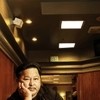
When James Bond enters the Oaks Card Club in Emeryville, he scans the pit’s packed poker tables and his face lights up. His thin black mustache curls upward above a foxlike grin. His jet-black hair is perfectly combed to a fluff on top and slicked back on the sides. His gold chains dangle down to his midsection atop his silky clothes.
The three rings on his left hand glisten as he walks. Starting from the pinky and moving toward the middle finger, an amethyst, diamond, and synthetic ruby all compete for attention with his silver-faced watch.

The Oaks Club fixture poses with his “castle.” Credits: Anthony Pidgeon Bond uses his prodigious chip stacks to intimidate: “If they want to take this away from me, I say go for it. But it’ll take an Act of Congress.” Credits: Anthony Pidgeon
Bond hooks his designer sunglasses to the lapel of his shirt and calls out to the woman at the coat check. “How you doing today, honey?”
“Doing just fine, Mr. Bond,” she says. “Just fine.”
“Oh, good,” he replies.
Then Bond calls out to a dealer: “Louie! Where’s the ladies tonight?”
“My house, Mr. Bond!”
“Well, save one for me.”
Louie laughs and moves on. Bond then passes a female dealer on her break and reaches out for her hand. “Hell-lo, beautiful,” he says.
“Hello, Mr. Bond,” she says.
Bond is still barely inside the card club. He nods to a floor manager at a podium, who writes his name onto a list of new players waiting for an open seat. Unlike most customers, Bond does not formally check in at the Oaks. When a manager sees the card room’s well-known customer with the spy’s name, he knows it usually means Texas Hold ‘Em.
“I also put you down for stud,” the manager says. “Just in case.”
“Nah,” Bond replies. “Not tonight. Hold ‘Em is good.” He takes a spot along a wooden railing that overlooks the poker table he’ll most likely be seated at in thirty minutes. He’s been coming to the Oaks for four years and knows his opponents well. There’s Mike, an obsessive bluffer whom Bond loves to play against; Mike never has much of a hand. There’s Joe, an old-timer wearing a Boston Red Sox cap who has been frequenting the Oaks for fifty years. There’s Ty, one of Bond’s main nemeses, a “rock” who plays so tightly that he rarely bets; but when he does, he usually has “the nuts” — the best hand on the table.
“I don’t like the way he plays,” Bond says, peering over the railing. “Me, I like to rumble. I like to get everyone raising, having fun, throwing chips in the pot — in other words, gambling. … I’m not saying he’s not a good player; he is. I’m just saying I like to have a good time, have some fun in there, mix it up.”
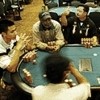
Inside the Oaks, James Bond is an absolute celebrity, and not just for his flamboyant style and friendly treatment of the staff. Players at the card club choose what kind of stakes they’ll play for. The highest rollers hit the $30-$60 table, where $30 is the minimum bet and $60 is the maximum. Of course, Hold ‘Em has several rounds of betting — and sometimes raising and reraising — so the pots on that table can equal a mortgage payment in an instant. Most players, consequently, prefer the pace of a $6-$12 game, or even the $3-$6 table.
And then, there’s the $1-$2 table, the lowest-stakes game in the house. At this table, the skill of play does not match the kind you’ll find worshipped on ESPN. Players are usually too new to make wise choices, or too old (and thus budget-conscious) to make bold ones. The wagers are so measly it’s often difficult to raise anyone out of his or her hand. In fact, so many players ride their hands all the way to the finish line that the game is nicknamed “No Fold ‘Em Hold ‘Em.”
Bond, for all his big-time aura, prefers “the drunks and the rookies” of the $1-$2 table. He is more than happy to liberate them from their chips. To further mess with the psyche of his opponents, Bond likes to buy in for as much as $500 at a time. At fifty cents a chip, Bond stacks his money in chest-high columns, constructing a red and yellow fortress atop the green felt in front of him. At a table where men in dirty jeans sometimes approach with nothing more than a crumpled $10 bill and a prayer, Bond’s fortress is designed to invite envy.
“It’s my style of play,” he said as he leaned on the railing and prepared to buy in. “I know some guys don’t like it. One guy was teasing me the other night, saying, ‘Why you buy all those chips for this table, why you buy all those chips?’ I say, ‘It’s not your game, man, this is my game, this is how I play. So don’t worry about it.'”
Bond smiled again. “It’s to intimidate them, to show them I’ve got the power. If they want to take this away from me, I say go for it. But it’ll take an Act of Congress.”
It might take an act of God to take the poker chips away from all Bond’s fellow bettors. As the country goes bonkers for Texas Hold ‘Em — 1.8 million players are wagering $200 million online every day, according to PokerPulse.com — real card clubs are filling up with eager newcomers. Oaks owner John Tibbetts credits the four-year-old poker boom for a “significant rise” in his business. And as these new players ease themselves into the game, many turn naturally to the low-stakes tables.
“A $1-$2 is a comfortable transition from your home to the card room,” Tibbetts says. “If you’re not really sure where you fit in, or you’re intimidated by the level of play at the other tables, you can sit in on a one-two until you’re ready to graduate to the next level.”
Tibbetts’ club is the only one in the Bay Area, possibly the only one in the state, that offers a $1-$2 table. The economic returns make no sense to many club owners. The house rake on each pot is only two bucks. A $3-$6 game, by comparison, pulls three bucks out of every hand, and there’s no shortage of customers.
But in the strange-but-true calculus of gambling, the $1-$2 table also makes no sense for players, according to Lee Jones, author of Winning Low Limit Hold ‘Em. In fact, Jones was astonished to learn that such tables still existed. He notes that the house rake on a $1-$2 table is disproportionately large compared to what’s being bet; even the best players struggle to break even over the course of an hour. According to poker gurus, a good player hopes to win two to three pots in an hour. But over time, as the smart player folds the majority of his hands waiting for a strong one — the boring part they don’t show you on those televised poker tournaments — the pot he finally wins is minuscule compared to what he’s already bet.
“If you could see the house dealer reaching into the pot and grabbing chips out every time,” Jones says, “you’d realize everyone’s stacks are dwindling, and it’s just a matter of time before they’re all down to the felt.”
If two players on the $1-$2 table went back and forth betting the same amounts while a dealer took $2 out of every pot, the house would have all the chips after a few hours. Jones says the only way to win at this low-stakes game is to get hot and then get out.
But gamblers don’t get out. The $1-$2 table attracts the least-skilled players, who make the most erratic bets. Therefore, the ups and downs of the typical player are enormous compared to the consistent but grinding work of the pros. “They’ll win and get caught in ‘jackpot mode,'” Jones says of the typical low-stakes player. “They’ll loosen up and get stuck chasing a big pot the next hand, over and over. Luckily, since one-two games usually have four players going down to the river, the pots are flush with chips, and you can pull in monster pots. But you’ll also have nights when you win nothing.”
On one recent Friday night, James Bond sat down with only a $100 buy-in. It was small potatoes for him, but still $80 ahead of his average competitor. The lack of clay in front of Bond was noticeable even to the staff.
“Where’s your castle tonight, Mr. Bond?” a young female dealer asked.
“I’m gonna build it,” he replied in a flirty voice.
“I’m gonna help you,” she said.
Bond whistled toward the ceiling, delighted by her response. He enjoys himself most when the dealers tease him back.
“That’s very kind of you,” he said. “Now deal me a jackpot!”
The jackpot, as many Oaks players know, is the “Bad Beat Jackpot.” A so-called “bad beat” is when a player turns over a great hand — say, three aces over two jacks — only to get beat by a stronger hand — say, four kings. The bad beat is so heartbreaking to the gambler that the Oaks offers a jackpot payout to a player who loses in remarkable fashion. The losing player (or winning, depending on how you look at it) can win half of $15,000, with the rest divided among the other players at the table. The giveaway is a great incentive for players to park themselves at a table, lest they miss out.
Although he has never won a jackpot in four years of playing, Bond often tells dealers, “Deal me the jackpot.” He’s been at table where someone else won, he says, but has never caught the winning hand himself.
Still, on this evening, Bond seemed to be off to a promising start. He was playing Hold ‘Em, a seven-card game in which players are first dealt two down cards apiece. His were two eights, a mid-level pair that might get folded at the World Series of Poker, but never at this table.
Bond peeled two fifty-cent chips from his pile and matched the bet. “Donations, donations,” he teased his fellow players. “Who would like to make a donation to my little fund?”
The other players sighed at Bond’s comments and called him. All nine players stayed in the game, and the dealer pushed the chips to his left side.
The remaining cards in Texas Hold ‘Em are dealt face up and shared in common by every player at the table. The third, fourth, and fifth cards — known collectively as “the flop” — are turned over simultaneously, and players bet based on what kind of hand they’ve just made. The three cards revealed by the dealer included another eight, which gave Bond three of a kind — a strong hand at any table. Four of his opponents folded, and the rest matched the dollar bet.
The sixth card arrived without fanfare.
From Bond’s position, it was possible he had the best hand going into the seventh and final card, or “river,” as it is called. As the betting increased, he stayed in, and the river revealed a nine. Bond felt relieved: None of his competitors could possibly have a flush, and there was only a tiny chance of anyone having a straight. He could beat two pairs, which players on this table routinely fall in love with, despite their relative weakness.
Another round of betting ensued, pushing the pot somewhere near thirteen dollars, and the players showed their cards. Bond showed his eights, and most of the other players slid their cards face down, disgusted.
However, a player at the other end of the table saw Bond’s cards and grinned. He turned over two nines. He’d caught the third nine on the river, a lucky break.
Bond shrugged it off. “What can you do, man?”
But a player in a Nike sweat jacket and tattered sweatpants looked at the winning player as he pulled his chips in. “You stayed in all the way with a pair of nines? Damn, man, we gotta call this game the River if you’re gonna do that.”
Bond took his next two cards. He was dealt a four and three in different suits, and matched the $1 bet in front of him. It was a terrible hand to stay in on, but the small risk made it playable.
“I smell something here,” he said to the other players. “Somethin’s a-cookin’.”
Bond learned to play cards with his family growing up in Guam. As a teenager in 1969, he served in Vietnam, where he showed a knack for pulling off dead-of-night recon missions. His sergeant, he says, couldn’t pronounce his real last name, Tyquiengco (ty-quain-co), and gave him the James Bond moniker, which stuck. At the card room, Bond sometimes wears a gold dog tag with his military portrait around his neck.
“The next James Bond should be played by an Asian man,” he joked one day, “so the world can see all of our moves.”
After the war, Bond married and raised two kids in Vallejo. But in 1985 he got divorced, and his new single life left him looking for entertainment, which he found with cards. “I got into it when I separated,” he said one day in the Oaks cafeteria during a break. “I had nothing to do. I got into bowling, too. … I’d get bored at home and I wanted to go out and just hang out with friends.”
Big card games in Reno and Las Vegas, he soon learned, often led to big losses. The rush of winning was incalculable, but the losses added up. After he retired, he still enjoyed poker, but he preferred the low-stakes games, which allowed him to spend more time at the table. He’d made some money on real estate in Guam and recently sold a house in Walnut Creek, he said. Five years ago, he recalls walking into a Bay Area card room and seeing a guy with huge stacks of chips at a low-stakes table.
“I thought to myself, ‘He won all those,'” Bond recalled. “When I played him, I realized, you cannot raise a man with sixteen thousand chips in front of him.”
He took his new strategy to the Oaks, and at first was greeted with a cool reception. “When I first saw him and all those chips, I thought ‘It’s all a bunch of bullshit,'” recalls Joe, the Boston Red Sox fan, who declined to provide his last name. “Who needs all those chips on this table? And he’s talking all of his bullshit with the dealers and players.” Joe waved his hand dismissively. “But after playing with him for a while, he’s alright. He’s a tough player.”
The best poker players know the math of the game. They know the odds of making that straight or flush, and bet accordingly. Better players even factor in the relative attractiveness of the pot they’re competing for, which helps them determine whether placing another bet makes economic sense. And the truly excellent players know the math game and the psychological one: the reading of their opponents’ that might give them an extra edge.
Bond, however, eschews all the formulas and strategies that have flooded the market in recent years. His poker experience, he says, is accrued from the years he has spent on the tables, which are plentiful. Bond can play at the Oaks for twelve hours at a time on the weekends, and he recently went thirty hours straight.
“I was seeing double by the end of it,” he said. “I saw six cards on the flop and couldn’t tell if they were hearts or diamonds.”
For Bond, his initial strategy is to feel the cards dealt to him. “It’s all in the deal,” he says. “Some dealers give you the good ones. Others, they’re a jinx. I get a sour feeling in my gut, knowing my card isn’t coming. But it depends on the dealer, too. Some dealers jinx you.”
Bond pays attention to the sequencing of the cards as well as watching his opponents’ reactions. Saucer eyes from across a table mean big cards. “When it’s high cards, all high cards are coming out,” he says. “When it’s low, there will be no pictures coming out. … You have to keep track on the game. You have to be focused at all times. You cannot be distracted by anything. You cannot be tired, you cannot be drunk.”
Bond bets according to his reading of the game. If it’s likely someone has him beat, he’ll bow out. But if he raises he likes to warn his opponent, “Don’t raise me back. If you do … beat me.” Whether due to such boasting or because of the size of the castle in front of him, few people raise James Bond.
This style of playing by gut instincts leads to the roller-coaster ride Bond knows well. The more chips he has, the more likely he is to play marginal hands off the bat. Sometimes, it pays off. “When I get lucky, I get aggressive,” he said, “and when I get aggressive I get lucky.”
The only thing that knocks Bond off his game is what he calls “the distractions.” For instance, one recent afternoon he was having trouble enjoying himself when he saw other players in the room who owed him money. He said he purposely refrained from making a large chip purchase since he was waiting to get repaid, and didn’t want his debtors to think he’d forgotten. By his count, about ten people owed him a total of $3,000. If they saw all his chips, they might think it was okay to skip payment.
“I’m too generous,” he said outside during a cigarette break. “I try to help these people out, and this is what I get? They try and avoid me.”
Bond said he’d looked across the table at a guy who owed him $100. The guy raised him. “I said, ‘You raising me with my own money,'” he said in disgust. “He said, ‘Yeah, James Bond. What are you going to do?’ After that, I couldn’t play. I was too distracted.”
Bond is known for his generosity around the Oaks, and even though he may flaunt his chips, he also is known for lending to players down on their luck. While mooching from an opponent would get laughed at on the high-end tables, Bond feels a sincere connection to his fellow players at the $1-$2 table.
A player nicknamed Pokeymón has known Bond for years and their friendship extends beyond the card room. Pokeymón, who refers to himself as an artist and comedian, recently made Bond a silk-screened T-shirt showing Bond’s deep-lava-red Chrysler Sedan. In place of the front license plate, the artist inserted a 007 logo, and added Bond’s military portrait along with a photograph of one of his grandchildren to the shirt.
“He’s one of the sweetest guys in here,” Pokeymón said as he watched Bond play one afternoon. “He’s got the biggest heart, always playing with people and looking up. One thing about James Bond: Doesn’t matter if he wins or loses. He’s the same good guy, every day.”
But on that particular day, the cards were coming up foul, Bond recalled — too many jinxy dealers on the floor. He lit a second cigarette and said if he counted it all up, he probably lost $60,000 this year alone.
“I’m bored, man,” he said, as he looked at the bright intersection of San Pablo and 40th and took a drag of his smoke. “I come here for entertainment. This is how I enjoy myself. I’m just trying to keep out of trouble, so I come here for entertainment.
“No matter how good you are,” he went on, “good players lose. It’s not their night, they don’t get the cards, they get a bad dealer. It’s all about being lucky, picking the right seat, having the right attitude. It’s luck.”
Bond reflected more on his bad run of luck. “I know it’s not a good thing to gamble — because gamblers lose a lot of money,” he said. “And I lost a lot of money because of my gambling in time — and I’ve won quite a bit, but you lose more than what you win. Because the only time you win in gambling is if you win the lottery and you’re ahead by millions. Every gambler experiences a big loss.”
The following Friday, just after 10 p.m., Bond had been in the card club for six hours, and he was winning big. The dealer fanned the cards and Bond was dealt an ace and a four. After a round of betting, the flop arrived, revealing an ace of spades, four of clubs, five of hearts.
“Oh, brudder,” Bond muttered, as if he were intimidated by the ace. Five players stayed in and Bond called the bet. When another bettor raised, he simply matched the bet. No use in going over the top.
On the turn, a ten of diamonds showed up.
Bond shook his head. “That’s the wrong pair.”
Another round of betting circled and five players all stayed in, including Bond, who still had two pair, but not necessarily the strongest hand on the board.
On the river, another ten arrived, putting Bond’s aces-high two pair at risk. A single ten held by any of his five opponents made three of a kind.
Bond stayed in the final round of betting, despite the risk. The odds favored a triplet with this many people still in the hand. Bond read the faces of his opponents and got the feeling, he later said. The feeling that told him: I’ve got the best hand, no matter what.
No one raised, which suggested, perhaps, that no one had the third ten.
The players turned over their cards.
“Oh, man,” Bond said, looking around the table for the offending card. “No one has a ten, huh?” he said, sounding almost embarrassed. “Jeez, I’m a lucky guy right now.”
The good hands kept coming. Bond won the next pot with a flush of diamonds. He got so excited, he threw his cards on the table face up, unaware an elderly man at the other end of the table was still deciding whether to stay in.
The dealer and a few players quickly alerted Bond, who scraped his winning cards back toward his chips. Regardless, the old man failed to see Bond’s ace high, and called the bet.
The dealer pushed the chips toward Bond again.
The next hand, Bond nailed an opponent on the river, this time catching the lucky break. “Oh, this game is too much,” he said as he stacked his new chips.
Then the winning got out of control. Bond won five pots in a row on a table where he was beating an average of five players each time they turned over their cards. It was an outrageous swing for any player on any table.
The railbirds behind Bond began to buzz. “Mr. Bond,” one said, “you do no wrong tonight.”
“I’m hot, man,” he said to the supporters who’d gathered behind him. “I’m gettin’ the cards.”
Bond lifted his next cards off the table and in front of his chest to let the railbirds see what he held. He folded the crap hand.
“Maybe I should break,” he said. “It’s cooling off.” He was up to $200, then after a few more wins up to $280. He lost two big hands in a row, and decided to take a smoke break.
Nearing 11 p.m., the castle was stacked high, and yet Bond looked almost bored with it. His poker etiquette wouldn’t allow him the pleasure of gloating. He took a walk outside with his smoke and said he was ready to call it quits for the night. He’d play for another hour or two, but he was getting tired.
Shortly after Bond returned to the table, Joe, his buddy in the Red Sox cap, was up fifteen dollars. Joe had been there for hours also, but he was content with his winnings for the night.
“Where you going, buddy?” Bond asked.
“I’m going home,” Joe said, and cracked a polite smile. “Some people don’t live here.”
Bond looked around the table, not willing to take the comment personally. “You don’t want to hang out with the boys,” he teased. “It’s Friday night, man.”
“And tomorrow is Saturday,” Joe said. He took his chips and headed to the cashier’s window.
The floor manager called out another name, and a new player took Joe’s seat. He was one of the younger guys, a new player in a baseball cap and sunglasses. He bought in for a modest $40 and blew into his hands.
Mr. Bond welcomed him to the table. The kid took a glance at Bond’s small castle of chips while the dealer passed out another round of cards.
“Okay, fellas,” Bond said to the table. “I win the jackpot now. I can feel it.”