

Now half a century old, Alvin Ailey‘s tour de force dance
piece, Revelations, still has strong political resonance
and still elicits a rapturous audience response every time it’s
performed. One can only imagine how dazzling the piece must have been
when it premiered in 1960, at the height of the civil rights movement.
In its original form Revelations was an ambitious and sprawling
work. It clocked in at more than an hour, and attempted to document
several centuries of history from slave plantations to sharecropping.
At that time it had no real antecedents in the dance world. In 1962
Ailey whittled it down to three sections, forming a seamless allegory
about faith and the African-American church lineage. That year it
toured the US and quickly became the best known modern dance piece in
the world.
Since then, Ailey’s tale of spiritual deliverance remains largely
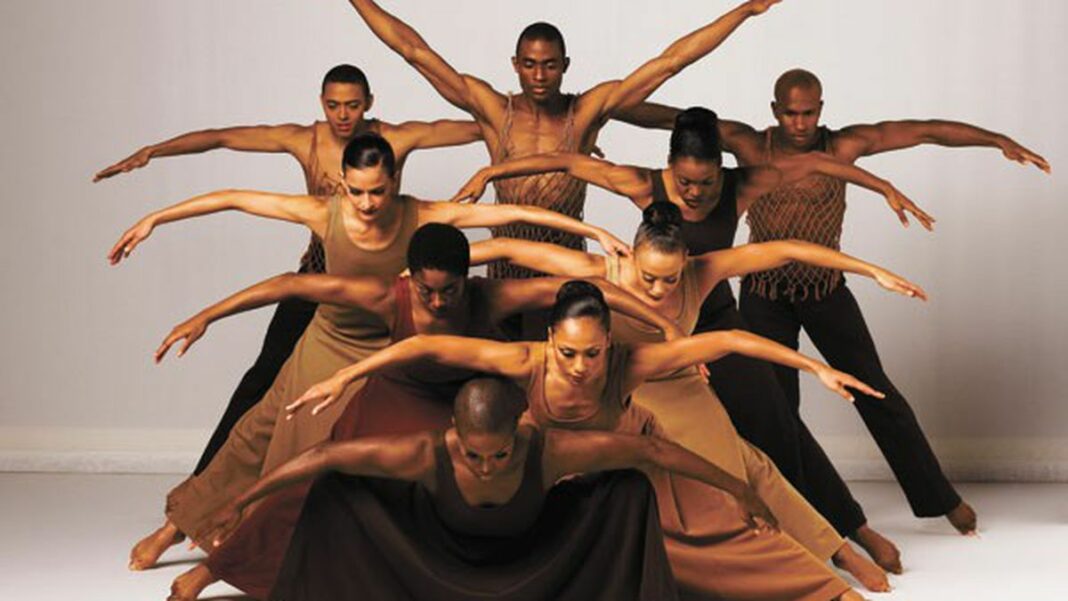
unadulterated. The first part, “Pilgrim of Sorrow,” is about slavery
and suffering, as conveyed through a spiritual sung in the background,
“I’ve Been Buked.” A heavy brown color palette and dense choreography
— the dancers move through a world that seems to be compressing
— underscore the emotional subtext of the piece. It’s about
anguish, but it’s also about a willingness to survive, and the two
sections that follow — a baptism and Southern church revival
— turn past pain into grit, endurance, and soulfulness.
Revelations mixes religious traditions with modern idioms in a
way that’s unique to the black church, and offers coded political
messages for those willing to look for them. Ailey, in fact, envisioned
“the audacity of hope” long before President Obama found words for it:
Revelations begins dusky brown, but ends in searing bright
yellow.
Next week the Ailey dancers will perform Revelations (or
parts of Revelations) no less than seven times during the
group’s annual run at UC Berkeley’s Zellerbach Hall, which also
will feature excerpts from Blues Suite — Ailey’s 1958
genuflection to the juke joints of his Texan home town — the
Charlie Parker tribute “For Bird — With Love,” and several other
flagship works from the choreographer’s oeuvre. This year’s tour also
includes two premieres that will showcase the dance troupe’s stylistic
range. The first is Go in Grace, Hope Boykin’s homespun
narrative about a working-class family, featuring music by the
all-woman a capella sextet Sweet Honey in the Rock. The second,
Festa Barocca, is a large-scale baroque piece conceived by
Italian choreographer Mauro Bigonzetti, with music by Handel and Bach.
Designed as a rather grandiose fiftieth anniversary commemoration,
Festa premieres the last three nights of Alvin Ailey’s six-day
run, on a program that culminates with Revelations. It should be
an interesting juxtaposition. March 3 through 8. $36-$62. CalPerfs.berkeley.edu