
Why did the administrator, the IT specialist, and the stay-at-home
dad spend nearly sixty hours over four weeks writing and recording an
album they never intended to sell? Because they could. And because
someone dared them to. No pot of gold waited at the end of the album;
no prize money, no label or sponsorship deal — just a vague
guarantee that they’d be glad they did it. So it came to be that three
men from Oakland and Fremont resolved to turn over their weekends and
weekday evenings throughout the month of February to the painstaking
yet ultimately satisfying task of producing a complete pop album.
For four years now, the RPM (Record Production Month) Challenge has
implored regular folks, dreamers, and working musicians alike to
produce the best album they can in 28 days, for no real reason other
than why not? It started in Portsmouth, New Hampshire, in 2006.
Taking inspiration from National Novel Writing Month — a
like-minded, Oakland-based endeavor in which participants must write a
50,000-word novel during them month of November — and encouraged
by the rapidly increasing ease of digital home-recording, staff members
at Portsmouth’s weekly newspaper The Wire decided to organize a
local album-making month.

Credits: Nate Seltenrich
It was a huge success, says Karen Marzloff, cofounder and managing
editor of the six-year-old paper. Local musicians submitted 165 albums
that met the RPM Challenge’s parameters, which are the same today: ten
songs or 35 minutes of original music, postmarked by March 1. Word
spread and interest grew, and by 2008, a paper in St. John’s,
Newfoundland, Canada decided to host its own challenge, drawing around
thirty participants. For 2009, RPM organizers actively recruited other
regional hubs and landed cohorts in Athens, Georgia; Philadelphia,
Pennsylvania; Jackson, Mississippi; Austin, Texas; and the East Bay,
where the Express rallied 88 bands and artists to take part.
That’s in addition to hundreds of independent musicians around the
world, in countries like Portugal, Italy, Japan, Sweden, Finland, and
Scotland, who interact with fellow RPM Challenge participants
online.
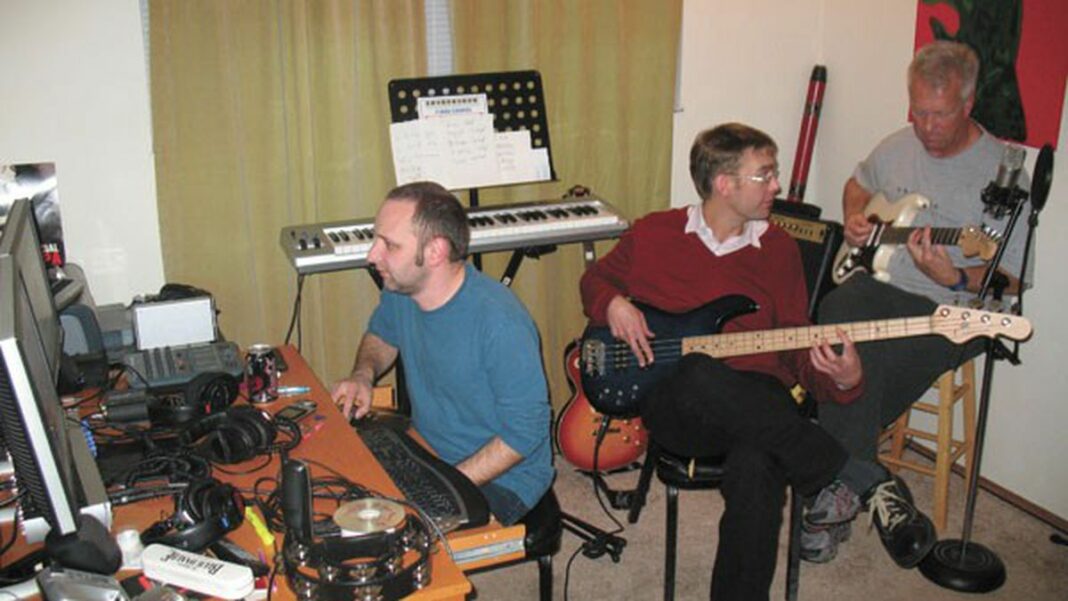
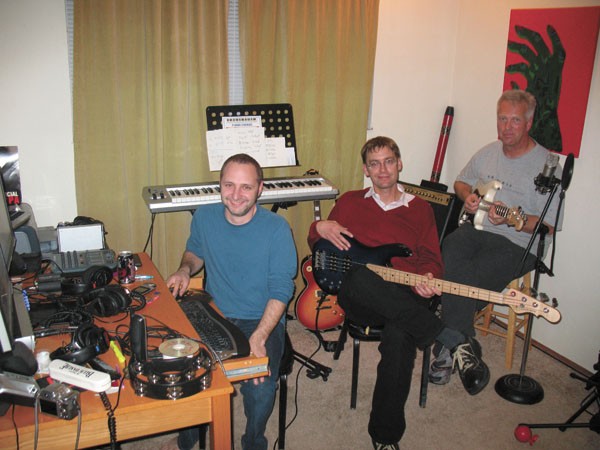
Hence, Dog Without Warning is connected to an international
community of music-makers, despite being holed up in a small,
white-walled bedroom in a modest suburban ranch home in Fremont. This
is where Kevin Costa (administrator, 37), Dustin Miller (IT specialist,
34), and Tom Fields (stay-at-home dad, 54), amateur musicians who’ve
played together for years, while away the hours crafting their first
album as a trio. The recent defection of their drummer, which otherwise
might have led to the dissolution of the band, conveniently aligned
with the RPM Challenge and inspired them to explore new directions for
their broadly versed pop-rock sound.
“Are we keeping the piano?” Costa asks on one mid-February Tuesday
evening, referring to a song they’re hashing out.
“Yeah,” Miller replies incredulously. “What, you don’t like the
piano?” He’s manning the computer and can copy, paste, cut, and
otherwise tweak previously programmed and recorded audio tracks with
the click of a mouse.
“No, I like it,” Costa says, and so it stays. Thus the hours tick by
on this eighth or ninth meeting of Dog Without Warning for the 2009 RPM
Challenge.
Oakland resident Martin Gales spent most of the month with an album
of his own front and center in his mind. He teamed up with fellow
part-time musician Deedra Wong, after they were introduced by a mutual
friend specifically for the Challenge, under the name Deed Martin
Project. The two didn’t get started until February 9, when they met for
the first time and mapped out the album. Gales’ goal was to try to find
what he calls his “signature sound.” After weeks of trading parts back
and forth via e-mail and one additional meeting at the end of the month
to record, what he arrived at was something more tenuous. “We didn’t
really have an identity,” he said. “We didn’t have time to think about
Who are we? What are we? We just had to do it.” The result
nicely hybridizes Gales’ dark, hard-hitting electronic production with
Wong’s slick trip-hop vocals. Gales says they plan to work more
together in the future.
But not everyone who attempted the RPM Challenge greeted the end of
February in quite the same fashion. According to Marzloff, out of 2,300
individuals and groups who signed up to participate this year, 827
turned in completed albums: a 36-percent completion rate, up slightly
from last year and continuing a gradual up-tick as repeat participants
learn from previous mistakes. In its debut, the Bay Area community
matched this year’s average almost precisely, with 32 albums from 88
sign-ups.
Adam Chew of Berkeley was one of the majority who didn’t complete an
album. Age 39 and a musician since 14, Chew has ample experience
playing live. He’s performed solo and with various outfits at venues
including San Francisco’s Hotel Utah, Berkeley’s Starry Plough, and
Oakland’s Epic Arts. Recorded music has always been secondary to his
work, something he hoped to help remedy through the RPM Challenge. At
first he was successful, writing and recording five songs in his home
studio by the month’s midway point. But then, as an experiment, he
decided to give up smoking. Everything changed. “I ended up just really
hitting a creative wall and not being able to get past it,” said Chew.
“That internal critic got louder as I went back instead of looking
forward.” He tried to write more songs but couldn’t, and he eventually
gave up.
Creative and technical difficulties are deadly within a four-week
window, but simple logistics, often taken for granted, can be just as
crucial. “I saw it as an opportunity to step out of my comfort zone,”
said Oakland’s Vera Robinson, registered as Iowa Jai for the Challenge.
An aspiring rapper since childhood, she’d never had much of a chance to
record or any reason to compose full songs. Motivated by RPM, Robinson
got her cousin to make some beats and completed lyrics for all ten
tracks. But she never did nail down the studio time, leaving her with
nothing to show for her work during the month. “I was really excited
about it,” she said contritely.
The 2009 RPM Challenge officially wraps up on Saturday, when
listening parties to showcase participants’ work are scheduled in each
of the regional hub cities. One song from each album, typically of the
submitter’s own choosing, will be played for an audience of fellow RPM
participants and members of the general public. It’s often the first
opportunity for musical laypeople, receptionists and bartenders and
doctors and teachers who might otherwise never have made an album, to
have their work broadcast in a public setting. “At the risk of sounding
hokey,” said Marzloff, “it can be an incredibly magical night.” In
other words, ample justification for all that hard work.