On January 7, the streets of Oakland erupted into an orgy of
property damage when a protest honoring murdered Hayward resident Oscar
Grant turned violent. Helicopters buzzed over the downtown skyline, and
you could feel tension in the air. Eyewitness accounts tell of
protesters breaking store windows, setting cars on fire, and throwing
bottles from rooftops. Videos show angry mobs trying to tip over police
cars as officers in riot gear hung from the sides of an armored truck.
By the time the rioting was quelled, more than one hundred people had
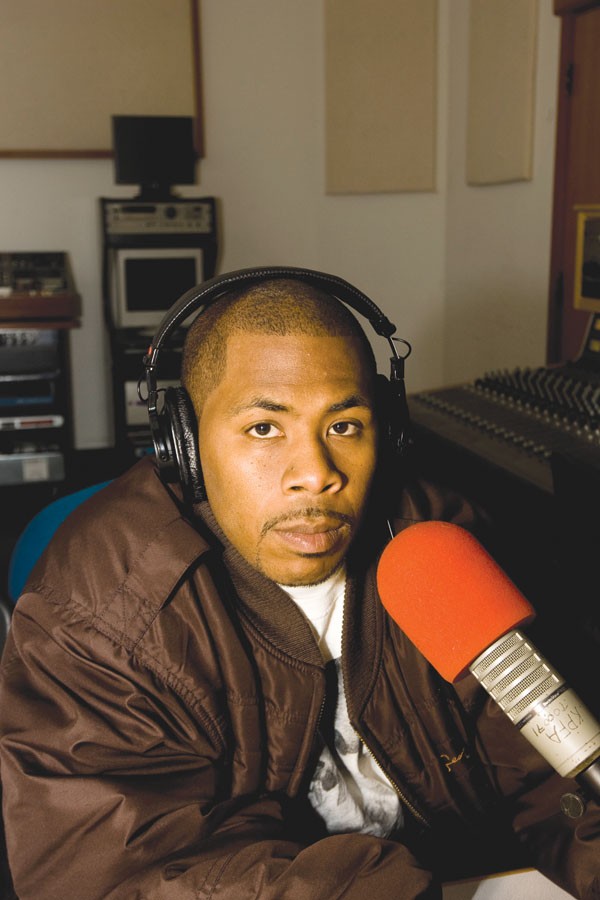
been arrested. Journalist JR Valrey was among them.
One week before, in the early hours of New Year’s Day, Grant had
been shot in the back by BART cop Johannes Mehserle at the Fruitvale
BART station. Cell-phone footage of the shooting was soon all over the
Internet, and the protest was organized to demand justice for the slain
22-year-old and his family. Valrey attended not so much as an observer
but as a participant.
Credits: Ali Thanawalla
Credits: Ali Thanawalla

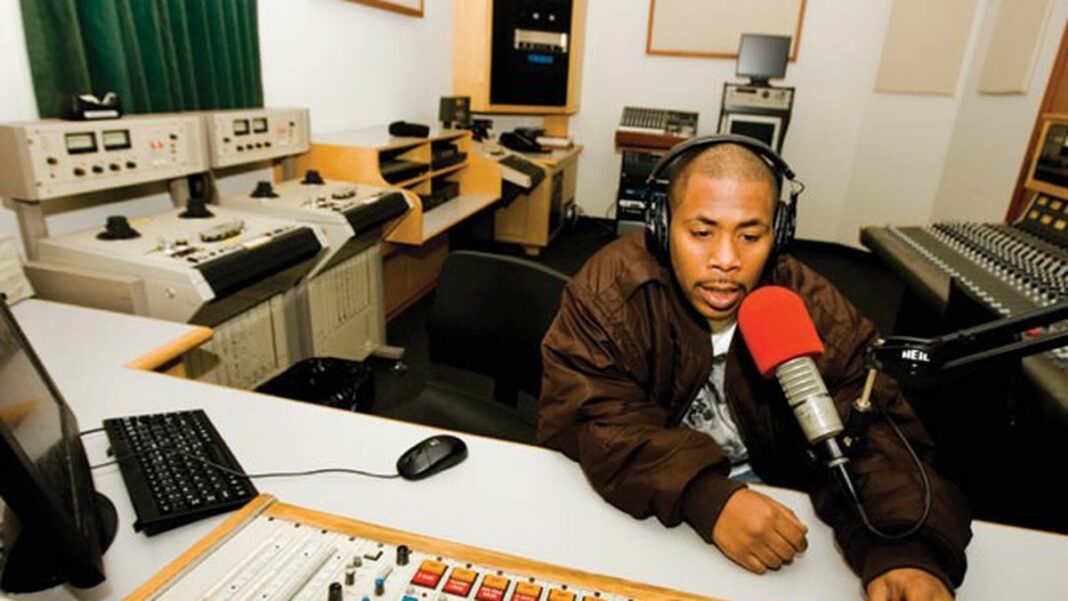
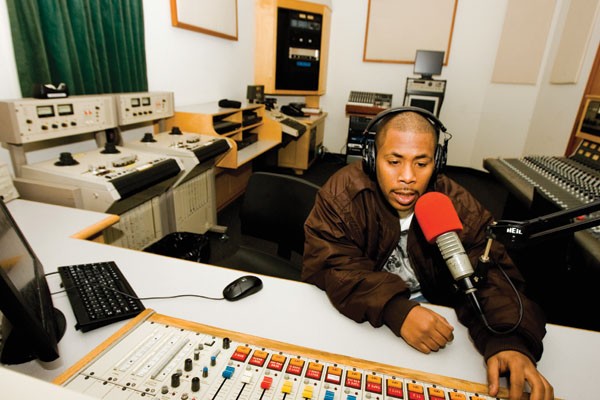
Valrey is what you might call an advocacy journalist. With his KPFA
radio segement The Block Report, his job as associate editor for
San Francisco Bay View newspaper, and his position as the
so-called “Minister of Information” for the Prisoners of Conscience
Committee (POCC), he has become known for covering police shootings.
When he reached the protest, he did something no mainstream journalist
would do: He took the mike and spoke to the crowd, demanding justice
not just for Grant, but also for other victims of police violence.
“Why didn’t people come out when Bay Area police officers murdered
unarmed Terrence Mearis, unarmed Casper Bajo, unarmed Anita Gaye,
unarmed Gary King, unarmed Gus Rugley, unarmed Cammerin Boyd, unarmed
Idriss Stelley, or when the police terrorized fifteen-year-old unarmed
Laronte Studesville, unarmed Randy Murphy, or unarmed Nadra Foster?”
Valrey asked the crowd. “Is it because these cases were not caught on
camera?”
By sunset the protest was dying down, and Valrey says he left to
meet some friends. But about one hour later, he says he got a call that
there was rioting downtown. When he returned, he saw dozens of police
in a huge circle on 14th Street and Broadway, occupying the
intersection in front of City Hall. According to his Bay View
article “Oakland rebellion: Eyewitness report by POCC Minister of
Information JR,” protesters shouted slogans at the police as angry
bands of people smashed car windshields and storefronts with
skateboards, their feet, and other objects. Valrey said he began taking
photographs.
Mayor Ron Dellums soon made an appearance, walking through the angry
crowd, as Valrey put it, “like black Jesus.” The mayor made his way
across Broadway to the Civic Center area and then delivered a short
speech in which he called for civility to prevail. Valrey says Dellums
was swiftly booed off stage and retreated back to the safety of City
Hall. The rioting soon resumed. Windows were smashed, cars and trash
cans were set ablaze, and protesters taunted officers or lay down in
front of police lines with their faces down and their hands behind
their backs, mimicking the posture of Oscar Grant when he was shot.
According to Valrey’s article, the police began breaking into groups of
six or seven and rushing rioters, tackling and arresting anyone in the
vicinity.
Valrey says two officers chased and tackled him while he was taking
photographs by the Federal Building. He spent the night in Santa Rita
Jail and was charged with felony arson, which carries a possible
sentence of three years in a state penitentiary. In all, 160 people
were arrested on the night of January 7, mostly on misdemeanor charges.
All but ten subsequently had the charges against them dropped. Just
four people, including Valrey, are still facing felony charges.
Oakland police would not release information describing the events
the leading up to his arrest. Valrey also declined to go into greater
detail, claiming that he doesn’t want to compromise his defense. But he
insists that he is innocent. “I have no history of arson, when I was
arrested there was no lighter, no matches, not even paper to light
anything.”
Valrey claims his arrest was payback for his years of covering
police brutality. “I was covering it as a journalist,” he said. “But
one thing that’s different about me from the rest of the rebels is that
the Oakland police know me. … I’m not a stranger to the power
structure of Oakland, so I believe like many others that I was targeted
politically. … We were basically set up on trumped-up charges.”
His lawyer, Marlon Monroe, says the case against Valrey is weak and
will fail: “There’s no physical evidence that they can pin on JR,
despite the fact that there were several officers who witnessed the
arrest, as well as news cameras.”
In the meantime, the arrest has given Valrey plenty of fodder for
The Block Report and the Bay View. In the weeks since the
riots, he has written eyewitness accounts, interviewed people present
at the rioting, and run radio shows interviewing family members of
Oscar Grant. He hasn’t hesitated to use the KPFA airwaves and pages of
the Bay View to call for community support in fighting his
felony charges.
But Valrey hasn’t just covered the riots and their aftermath. He has
participated in “town bizness meetings” focused on what Valrey calls
“police terrorism.” He has helped organize POCC political actions,
including a boycott of BART on what would have been Grant’s 23rd
birthday. And he has defended the Oakland riots as a necessary means of
getting the city’s attention.
Valrey has become the mouthpiece of an anti-police movement that has
grown since Grant’s shooting. He even defends the actions of cop killer
Lovelle Mixon as a “heroic day of resistance against the police.” As
unpopular as these sentiments make him in many quarters, he has become
a beacon for the anger that smoulders among some members of Oakland’s
black community.
Perhaps emblematically, his voice can be heard at the end of a new
song, “Fuck the Police, We Ain’t Listening,” by Oakland rapper Beeda
Weeda. The song begins with sound bites from news reports about the
rioting, and then the chorus kicks in, Fuck the police, we ain’t
listening, Beeda sings. Wanna push us? Wanna push us?
Motherfucker, keep pushing. Burn this bitch to the ground and leave the
whole city cooking. At the song’s end, Valrey delivers a brief
spiel before the fade-out:
This is POCC minister of information JR at BlockReportRadio.com. We changing
what they call rioting into what we call rebelling. We wasn’t just
tearing shit up, we were rebelling against injustices. … We don’t
need just one cop arrested, we need a whole new motherfucking
system.
Clearly, JR Valrey is not your typical police reporter.
Valrey is no stranger to controversy. The thirty-year-old has been
voicing his often-confrontational opinions on The Block Report
for five years now. The show began as a segment called “From the Belly
of the Beast” on KPFA’s Hard Knock Radio. It eventually moved to
Flashpoints, a daily political news show hosted by Dennis
Bernstein. Flashpoints airs The Block Report
sporadically, typically once or twice a week. It also airs locally on
KPOO, as well as on stations in Atlanta; Los Angeles; New York;
Washington, DC; and elsewhere.
Valrey says he uses his journalism to “bring it to the powers that
be.” He ridicules so-called “kiss-ass journalists” who warn him that he
is cutting his own throat by being so up-front about his
allegiances.
“I get criticism all the time because the positions I take are not
the popular ones that someone who wants a career in corporate
journalism would take,” Valrey said. “I get more praise for what I do
though. Way more praise.”
Some of Valrey’s positions include justifying the vandalism of the
“Oakland rebellions,” speaking in defense of Your Black Muslim Bakery,
and glorifying the actions of Lovelle Mixon, who murdered four Oakland
police officers on March 21 before being gunned down himself in a
shoot-out.
“To me, a great journalist is not somebody who has everyone agreeing
with them, it’s somebody who strikes a chord,” he said. “Whether you
like what I write or you hate what I write, I don’t want you to feel
indifferent about what I write.”
Although his journalism didn’t begin as overtly political, Oakland’s
history of black self-empowerment has been a clear influence on
Valrey’s politics and approach to journalism. “I was influenced
politically by my grandmother, who talked a lot about the Black
Panthers,” he recalled. “A lot of the ideas of the Black Panthers, like
communalism, and collectiveness, we practiced as a family in general.
At the same time I was reading stuff like Huey Newton and Malcolm
X.”
His career in journalism began after he attended a summer journalism
program at San Francisco State as an eleventh grader. While attending
St. Joseph’s Catholic School in Alameda, he wrote an article about the
racism that he said he and other nonwhite students faced within the
Catholic school system. The article was published in the San
Francisco Examiner on the same day that O.J. Simpson was found not
guilty, and consequently received a lot of attention. When a teacher
mentioned in the article threatened to sue, several local journalists
came to Valrey’s defense.
“They came to my defense and I really saw the power of journalism in
my own life,” Valrey recalled. When the teacher in question learned he
had the support of the Examiner‘s lawyers, Valrey says she had a
“religious transformation” and decided not to sue. “When I had seen the
power of journalism, I saw that I could use it in the interests of not
just myself but to get justice for my community.”
Since 2002, Valrey has been on the staff of the San Francisco Bay
View, where he covers issues of concern to the black community. For
the past two years, he has been the paper’s associate editor. Managing
Editor Willie Ratcliff stands behind Valrey and his work, which covers
international issues like the war in the Congo and political turmoil in
Haiti, as well as local issues such as prison activism and police
harassment.
Ratcliff said the paper receives a lot of praise for Valrey’s work,
which he has helped to direct. “I’ve tried to teach him not to use
things just to provoke people and make them mad,” Ratcliff said
plaintively. “When you use language like ‘pig,’ you’re just gonna get
people mad. But he’s learning.”
Valrey says both his writing and his radio show are vehicles for his
work with the Prisoners of Conscience Committee, a self-proclaimed
revolutionary organization founded by Fred Hampton Jr., the son of the
assassinated Black Panther of the same name. The committee was
conceived of during the 1990s, while Hampton Jr. spent nine years in
jail for aggravated arson. The charge was related to the firebombing of
a Korean grocery during the 1992 rioting following the acquittal of
officers responsible for beating Rodney King.
The POCC describes itself as “an organization that consists of
African Revolutionary Freedom Fighters whose agenda is to liberate the
minds and hearts of African and colonized people.” The committee refers
to prisons as concentration camps, gentrification as “land grabbing,”
police enforcement as “police terrorism,” and drugs and alcohol as
“chemical and biological warfare.”
It was that last viewpoint that led Valrey to take one of his more
infamously controversial positions as a journalist — defending
the vandalism of two Oakland liquor stores.
In November 2005, about a dozen black men dressed in sharp suits and
bow ties were caught on camera trashing a local liquor store. One of
the men was identified from surveillance camera footage as then
twenty-year-old Yusuf Bey IV. Bey was the leader of Your Black Muslim
Bakery, an Oakland business once known for encouraging black
self-empowerment, but steadily gaining a reputation for violence and
intimidation. The footage, which showed the men breaking bottles and
smashing windows with golf clubs, was run on television news
tirelessly. The story was front-page news across the Bay Area. But only
one journalist was able to interview Bey. That was JR Valrey.
Yusuf Bey IV was the son of bakery founder Yusuf Bey, whose
organization and followers have been implicated in a number of crimes
dating as far back as 1968. In 2002, the elder Bey was charged with 27
counts of felony sex crimes, charges he never had to face in court
because he succumbed to cancer prior to his pending trial. After his
death, two successors were killed under mysterious circumstances before
the younger Bey took the reins in 2005.
At the time of the vandalism, Valrey had known members of the
extended Bey family for years. But, according to Valrey, it was the
liquor store case that began his reporter/source relationship with
Yusuf Bey IV.
Valrey got his interviews by treating Bey like a civic leader with a
respectable platform and not like someone apparently caught on
videotape ransacking two businesses. While other media outlets were
asking how bakery leaders could have become so violent, Valrey avoided
the question completely, and instead let Bey discuss the issue of
liquor stores in poor black neighborhoods.
“The anti-liquor-store movement in Oakland is part of the new
black-power era that is emerging in Oakland,” Valrey said at the outset
of the interview. “A few months ago, some brothers ran up in two liquor
stores in North Oakland and threw all of the liquor that was being sold
on the ground. That one action kicked off a movement that has Muslims
from every faith involved.”
Valrey: “What is the objective of the movement to get liquor stores
out of the black community?”
Bey: “We had liquor stores in our community for a long period of
time, and we know what goes on around these liquor stores. And one
thing about it is, it’s not just liquor stores. They sell crack around
these liquor stores, they’re able to buy crack and drugs from these
liquor stores, and things like this are not supposed to be done by
so-called Muslims. If you say you’re a Muslim, you should have the
action of a Muslim.”
Most conventional journalists would have regarded Valrey’s two
softball interviews as a shameful case of pandering to an apparent
criminal. But Valrey not only defends his right to interview Bey, but
stands by his interview subject. He suggests that Bey is the victim of
a racist media conspiracy.
“I did this interview with Yusuf Bey IV because I think that it is
important for the black community to hear his voice through the barrage
of malicious articles that the mainstream media has been putting out
about him and his codefendants,” Valrey wrote in the introduction to a
Bay View transcription of his KPFA interview. “I’m not a judge
or a jury but, as a journalist, I’m definitely not going to let the
racist media bury someone that I have access to, without allowing him
to say what he has to say. The mainstream media is not used to our
community saying that we are going to make our minds up on what we
believe independent of their white power media infrastructures.”
In a recent interview with the East Bay Express,
Valrey went further still. He appeared to endorse the very acts of
vandalism that Bey and the other bakery members were suspected of
committing.
“I thought that Yusuf Bey and the Black Muslim Bakery took a stand
that local politicians haven’t taken in decades, that being that the
black community is drowning in liquor stores,” Valrey said. “In a lot
of places we don’t have supermarkets but we have liquor stores on every
corner, and it’s an issue that has been talked about for decades and
nobody dealt with it. They’ve never said anything to me as if they done
it or didn’t do it, but whoever did it, I support the fact that they
did what local politicians couldn’t do and they brought the issue front
and center. To this day, nothing has been done to limit the amount of
liquor stores in the black community, which we basically equate in the
black community to biological warfare. If they were involved
with that, I applaud.”
And Valrey’s relationship with Bey would eventually extend beyond
his tacit support for acts of vandalism. It would eventually result in
Valrey being implicated along with Bey in one of Oakland’s
highest-profile murder cases.
The crime that forever changed the public’s perception of the bakery
was the August 2, 2007, murder of Oakland Post editor Chauncey
Bailey. Bailey was gunned down in front of witnesses who saw a black
man shoot him with a shotgun before escaping in a white van. Since
Bailey had been working on a story about the bakery, that institution
was immediately suspected. Because of an unrelated investigation, the
bakery’s compound was soon raided, and several members were taken into
custody, including Bey and employee Devaughndre Broussard. The latter
confessed to Bailey’s murder but later recanted, saying Bey had ordered
him to confess. News coverage of the crime eventually called attention
to a suspicious connection between the suspected mastermind and JR
Valrey.
An October 25, 2008, story by the Chauncey Bailey Project — a
team of reporters and news outlets created to investigate Bailey’s
murder — accused Oakland Police Detective Derwin Longmire of
ignoring crucial evidence connecting Bey to the crime. Cell phone
records and surveillance information available to Longmire evidently
placed Bey outside Bailey’s home just hours before his murder. During
the fourteen minutes that Bey sat parked outside of Bailey’s house in
the early hours of August 2, he made a number of phone calls, mostly to
bakery member Antoine Mackey. But the records show he also made calls
to Valrey.
“During the fourteen minutes he was outside Bailey’s apartment early
Aug. 2, Bey IV received two calls from a person who had known Bailey
for more than a decade,” the article states, “JR Valrey, a blogger and
activist then reporting for the San Francisco Bay View
newspaper, where Bailey sometimes contributed news items. Valrey is
also affiliated with New America Media, a sponsor of the Chauncey
Bailey Project.
“The records show that Bey IV called Valrey twice on Aug. 1, and
that Valrey called Bey IV twice while Bey IV was parked outside
Bailey’s apartment on Aug. 2. The two calls totaled 2 minutes and 18
seconds. Six minutes after leaving Bailey’s apartment, Bey IV called
Valrey at 12:43 a.m. That call lasted nearly three minutes, the records
show.
“Valrey refused to discuss the calls with the Bailey Project.
‘(It’s) none of your business,’ he said, and refused to answer other
questions. ‘I don’t have nothing to say to you, man,’ he said. ‘You all
are the anti-bakery project.'”
The article stated that police never interviewed Valrey regarding
these conversations. But Valrey did subsequently address the
accusations in the San Francisco Bay View.
“Last Sunday,” he wrote, “the Oakland Tribune released an
article from the Chauncey Bailey Project called ‘Evidence Ignored,’
which passed off misleading information as facts and omitted relevant
information in apparent attempts at character assassination.” Valrey
proceeded to accuse the stories of containing errors and outright lies,
“which have made many people outside of the self-congratulating walls
of the journalism industry question its credibility, professionalism
and sincerity.” Valrey said he refused to answer the reporters’
questions because he didn’t believe they were working in his best
interests, nor in those of the black community or Chauncey Bailey.
“Ever since its inception, it was never about honoring and
continuing the work of the late journalist Chauncey Wendell Bailey Jr.
and answering questions regarding his death, as it claims on its web
site,” Valrey wrote in a Bay View article. “The Project and the
Oakland police seem to have more of a lynch mob mentality in their
investigation. They seem to be trying to ensure that their reporting
will result in some young black male or a group of them paying for the
murder of Chauncey, even if they are innocent.”
So what were the phone calls about? Valrey told the
Express that he was calling Bey IV to talk about the case of one
Laronte Studdesville, whom he described as a victim of police
brutality. A meeting with Studdesville’s father had been scheduled for
the following day, and Valrey was inviting Bey to attend.
Valrey’s editor, Mary Ratcliff, confirms that assertion. “What JR
does is very much in the tradition of the Panthers,” Ratcliff said. “He
looks to the street — or gangs, as the police would call it
— and sees that these guys are doing political organizing and
they don’t even know it. Maybe their intentions aren’t always that
great, but many of these gangs legitimately started out to protect
their neighborhoods and their communities. If we could just politicize
them, imagine what we could do. That’s what JR’s always tried to do,
but that doesn’t make him a gangster. I know that he had been trying to
recruit Yusuf for months, telling him that there are better ways of
doing things, and that’s what those calls were about.”
But if this was a business call, then why did it come so late at
night?
“I don’t remember it being around midnight,” Valrey said. “It may
have been around 10. We don’t have a bedtime, neither me nor Yusuf Bey,
as far as I know. To speak for myself, I don’t have a bedtime, so we
don’t just stick to white business time, 9 to 5. I just don’t make
calls in those times and I don’t think that calling someone at 12:00
implicates me in anything.
“I think that I effectively poked a lot of holes in where they were
basically trying to implicate me in a murder that I’m not involved in,
in any way,” Valrey said. “But it also shows the weakness in their
journalism, shows the laziness in their journalism. I did a very
shallow investigation and poked holes all throughout what they were
saying in the article I was in.”
Valrey says he believes that Bey had nothing to do with Bailey’s
killing. “They’re treating them as criminals and they’re trying to be
the judge and the jury.”
The murder of Chauncey Bailey appears to most observers to have been
based upon the notion that imminent reporting from Bailey would
threaten the interests of the bakery. But Bailey was hardly a probing
investigative reporter; in fact, he was widely criticized in journalism
circles for how cozy he often was with his subjects. Valrey advances an
equally improbable notion: that it was Bailey’s ongoing efforts to
expose Oakland police corruption that led to his death.
“At the time of his murder, Chauncey Bailey and Yusuf Bey were both
in my phone,” Valrey said, adding that he and Bailey had a good
relationship. “I also know that Chauncey Bailey was working on a story
dealing directly with the police.”
Valrey maintains that the Chauncey Bailey Project hasn’t done enough
to pursue leads that Bailey was looking into police corruption at the
time of his death, and has suggested not only that Bailey’s murder was
a police cover-up for which Bey was a scapegoat, but also that the
Chauncey Bailey Project is in fact a front for the police.
Bob Butler, a reporter with the Chauncey Bailey Project and
president of the Bay Area Black Journalists Association, denies
Valrey’s suggestion that the project is in cahoots with the police. He
said the project has found no evidence implicating the Oakland police
in the murder. “The last story Chauncey wrote was about the bakery. He
may have been looking into possible police corruption, but we have seen
no evidence to verify that claim,” Butler said. “I’d be very
interested to see evidence that the police were responsible for
Chauncey Bailey’s murder.” Butler points out that the Chauncey
Bailey Project published evidence last June showing that Bey admitted
that he kept the shotgun used to kill Bailey in his closet after the
murder. That information can be found at ChaunceyBaileyProject.org.
But this is not evidence enough for Valrey. “I think that the
Chauncey Bailey Project really speaks to the disconnect between the
journalist world and the real world,” he said. “You have the bigwigs in
mainstream journalism coming together and of course they’re going to
pat themselves on the back for doing a good job. But the question still
remains: They did all this, and they wrote all this about Yusuf Bey,
but he’s not even charged yet, so really the question comes, how
effective are you? Because you guys work hand-in-hand with the police,
obviously. I’m not going to talk to the police, whether it’s through
the Chauncey Bailey Project or whether it’s through a uniformed
officer. If I have anything to say, I’ll say it in the San Francisco
Bay View or on Block Report Radio.”
KPFA has a long tradition of giving a voice to viewpoints otherwise
ignored in the mainstream media. Like Valrey, many of the station’s
contributors have an agenda. Although some staffers dutifully adhere to
the same journalistic standards embraced by mainstream journalists,
others have less interest in reporting the news than in giving voice to
the perceived underdog. Many of these advocacy journalists are, like
Valrey, unpaid volunteer producers.
Unpaid staffers make up a political block of significance at KPFA
and have the support of some paid staffers, including Dennis Bernstein,
who has taken Valrey under his wing by giving him airtime on
Flashpoints. As a member of its volunteer staff association,
Valrey has been critical of KPFA management for some time.
Last year, station manager Lemlem Rijio curbed the influence of the
often-unruly unpaid staffers. Rijio changed the rules to reduce the
voting power of unpaid staffers, who for years enjoyed the same voting
rights as paid staff members when it came to selecting board
representation. Since around that time, Valrey has zeroed in on Rijio
and other station managers.
Last August, while interviewing filmmaker Iana Jones about her
documentary on black radio, Valrey used the topic as a platform to
criticize Rijio. “Even today,” he said, in an implied reference to
KPFA, “there are black puppets put there to keep the status quo in
place.” He also said that the repression of black viewpoints at KPFA is
being enforced “by black face, from the top.” And Valrey made a point
of noting with apparent disapproval — as he has done numerous
times in his Bay View articles — that Rijio is from
Ethiopia.
The interview was one of many times that Valrey has called for a
black public affairs show on KPFA. “That has been one of my major
campaigns,” he said. “There’s black music shows on the radio, but
there’s really no regular black public affairs show. KPFA has these
types of programs for Asians, for Latinos, but not for black people. I
would like to see The Block Report as a weekly or daily, or even
a biweekly program,” he said. “This really came to a head when the
Nadra Foster thing happened.”
Just three days after Valrey’s interview with Jones, the
long-running conflict between some of KPFA’s volunteers and management
once again came to a head when volunteer staffer Nadra Foster was
arrested and removed from the station’s studios by Berkeley police.
Foster had reportedly been banned from KPFA for making long-distance
calls on KPFA phone lines. However, she continued to work in the
station’s studios, coming in about three times a week. She claimed that
she didn’t think the ban was official, as she had never received
anything in writing. When a staff member confronted her for using one
of the studios, a manager called police to remove her. Foster, who had
a prior criminal record, resisted her arrest, allegedly biting one of
the officers during the melee. After more officers were called, Foster
was forced to the ground, put in restraints, and hauled off to
jail.
The Foster incident prompted Valrey to call for Rijio’s resignation.
However, a supporter of Rijio, who asked to remain nameless, said she
was dealing with a family emergency at the time of the incident and
played no role in calling the police.
More recently, Valrey again called for Rijio’s resignation after
several paid and unpaid staff members were reprimanded for supporting
him on air after his arrest. Those reprimanded include paid staffer
Noelle Hanrahan of Prison Radio, and volunteer Nina Serrano of
La Raza Chronicles, who both read the following announcement:
“We believe JR to be innocent of setting fires and causing physical
damages, as he was professionally occupied covering this important
story. … People are showing their support by coming to his hearing
Monday, February 23, at 9 a.m. at 661 Washington Street in
Oakland.”
Hanrahan defends her actions. “Management doesn’t understand the
tradition of Pacifica and why it’s so important that we support and
defend it,” she said. “The guy is out there, and when you’re out there
as a journalist you get blowback, and you have to be supported. If the
DA comes down on him, that probably means he’s doing his job.” Speaking
of Valrey’s call for Rijio’s resignation, she said, “I want things to
change at KPFA, and I support JR’s right to say what he said. JR is a
serious journalist doing important work. In my opinion we need ten
JRs.”
On the day after her announcement, Hanrahan said, she was given a
formal notice of misconduct and asked to take a leave of absence. The
notice, obtained by the Express, claimed violation of station
policy in three regards: making a “direct call to action” over the air,
broadcasting information without authorization from management, and
neglecting to indicate that the information was “not the opinion or
position of KPFA.” Serrano said she was not given a written reprimand
but warned verbally about her transgression. KPFA staffers were also
given a memo reiterating these three rules and noting that their
violation would lead to disciplinary action, Hanrahan said.
Valrey responded with an article in the Bay View. “KPFA was
the first listener-sponsored station in the country when it went into
business in 1949 and was seen as a beacon of audio resistance in
Northern California. Sixty years later, East African-born General
Manager Lemlem Rijio has had broadcasters reprimanded because of their
support for me and the Oakland 100. All of this is some bullshit,
considering that KPFA is constantly begging for money. Isn’t that a
‘call to action’ or ‘advocating action on the air’? … We are urging
everyone to call KPFA and tell them that you will not give them another
cent until the General Manager Lemlem Rijio is fired or steps down. We
need a constant inundation of calls to kick off this part of the
campaign.”
On March 21, three Oakland police sergeants were shot and killed by
parolee Lovelle Mixon. Another officer was severely injured and died
the following day. Mixon, who had a warrant for his arrest for parole
violation, had been pulled over on MacArthur Boulevard in what was
described as a routine stop. After shooting Sergeants John Hege and
Mark Dunakin, Mixon apparently walked over to the officers and shot
them both again, execution-style. He then fled the scene and hid out in
a nearby apartment building. Police raided the building after receiving
a tip as to his whereabouts. From inside a closet, Mixon shot and
killed S.W.A.T team members Ervin Romans and Daniel Sakai with an AK-47
assault rifle. He was then killed by another officer.
While most of Oakland reeled in shock over one of the deadliest
attacks on law enforcement in California history, JR Valrey wrote an
article for the Bay View that essentially justified Mixon’s
actions.
The article, headlined “Police 2, Oakland residents 4,” described
Mixon as “a suicide sniper who used a gun instead of a bomb to take out
enemies of the community.” It described the tragedy as one that “some
in the black community see as a day of heroic resistance against the
police.” The article went on to suggest that street memorials for the
fallen officers were police-created, and that reports of citizens
attending them were media propaganda. “The reality is, when you go to
the scene, which I did a number of times, you see very few residents of
the area — especially young black males — with any sympathy
for the officers.”
Valrey referred to the incident as a “revolutionary suicide,” and
wrapped up his piece with a provocative question-cum-threat: “How does
it feel when the rabbit has the gun? Welcome to East Oakland.”
You can always find another side of the story at BlockReportRadio.com.