Anyone familiar with the plays of Martin McDonagh should brace
himself for grisly spectacles and gallows humor whenever a new one
comes to town. McDonagh is, after all, most famous for The
Pillowman, an astonishing work about a man who became a successful
fiction writer by listening to the sounds of his brother being tortured
every night. The Pillowman jarred audiences when it came to
Berkeley Rep two years ago under the shrewd direction of Les Waters,
who revisited McDonagh’s oeuvre with this year’s equally gruesome
production of The Lieutenant of Inishmore. From the opening,
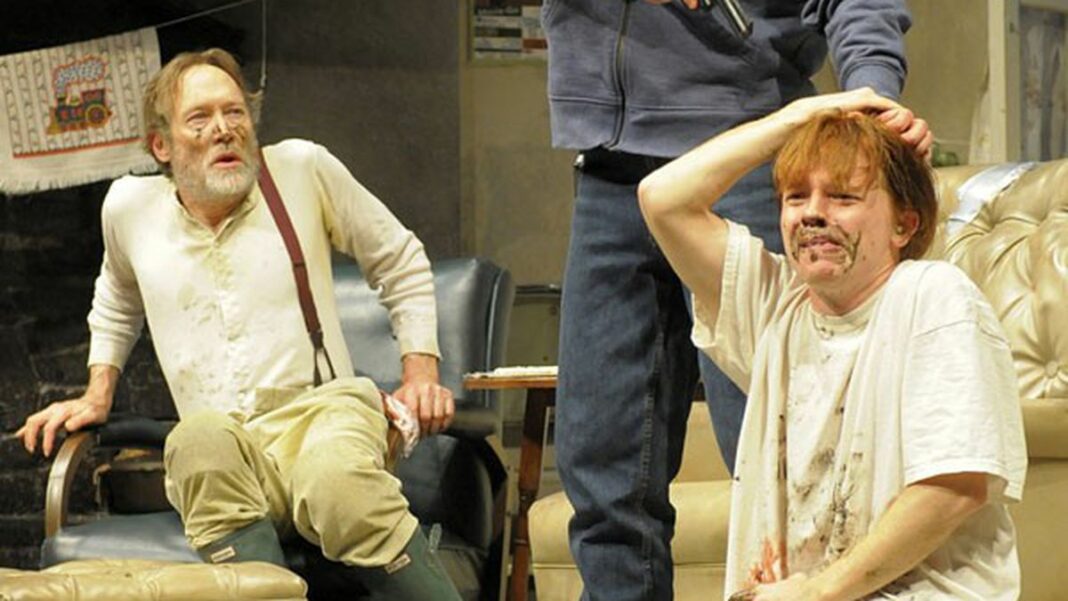
when the grizzled Irishman Donny (James Carpenter) lifts a dead cat
from his coffee table — allowing its head to dangle precariously
from its neck — you can tell where the play is going.
At first it appears that the cat was killed in a bicycle
hit-and-run, and the culprit is Donny’s slacker-neighbor Davey (the
hilarious Adam Farabee). The true story is, of course, much more
complicated: the cat (a big, black, scruffy guerilla of felines named
Wee Thomas) actually belongs to Davey’s terrorist son Padriac (Blake
Ellis), a lieutenant in an IRA splinter group called the Irish National
Liberation Army (INLA). And it was assassinated by Padriac’s erstwhile
comrades as a ploy to get Padriac to rush home so they could kill him,
too. The story takes an entire play to unravel, which is part of the
beauty of McDonagh’s writing: He has a wonderful way of withholding
details and allowing his plays to get ever-more labyrinthine, saving
the “aha” moment for the very end. Nonetheless, McDonagh establishes
his characters and his political subtext right away.
The Lieutenant of Inishmore is really about the IRA and its
various splinter groups, all of which evidently saw violence as
something enabling and liberating — even though it rarely gets
them anywhere. In some respects, the play is very specifically Irish.
The socialist INLA was, in fact, a paramilitary faction launched in
1974 by defectors from the original IRA. Intended as a Marxist
separatist group, it targeted both the British and its parent
organization, the IRA, whose members were also attacking the British.
Only a person well-versed in Ireland’s tangled political history would
understand the point of forming a rogue group to undermine a large
liberation army, when both the rogue group and the large army appear to
be fighting a common enemy. But therein lies McDonagh’s humor. It turns
out he didn’t have to go to absurd lengths to poke fun at the INLA’s
utterly ineffectual approach. The outlandishness was already there for
him; All McDonagh had to do was throw a dead cat into the mix.
Given its subject matter, one would expect a surfeit of blood and
guts in The Lieutenant of Inishmore, and the play does not
disappoint. The (obviously fake) dead cat in scene 1 is just a preview
of coming attractions: In the course of two hours, we are treated to
torn fingernails, shooting massacres, eyes getting poked out, corpses
getting ripped from limb from limb, and roughly thirty gallons of fake
blood splashed across the stage. (The program notes say twelve —
but that seems conservative.) And, yes, this is a comedy. McDonagh’s
humor operates on many levels. There’s a slapstick element to most of
the character pairings: Davey and Donny, whose fear of Padriac leads
them to paint an orange cat with shoe polish and pretend it’s Wee
Thomas (which only gets everyone in deeper trouble); Padriac and the
drug pusher James, who come to a weird reconciliation when Padriac,
midway through torturing James, finds out that Wee Thomas is “poorly”;
Padriac and Davey’s tomboy sister Mairead (a surly but guileful Molly
Camp), whose sexual chemistry seems natural because they are both
sadistic, gun-wielding, political extremists with a soft spot for cats.
Even if you don’t understand the Irish references or find the actors’
accents unintelligible, there’s enough physical comedy to keep the play
moving forward.
Yet, McDonagh’s humor also operates on a more sophisticated level.
The weird alliances and disloyalties between his characters mirror the
ones in Ireland’s various political blocs. Neither Mairead nor Padriac
would hesitate to gun down a family member who stood in the way of
their political ambitions, just as the members of INLA are quick to
fight other Irish republican factions over an ideological splitting of
hairs. In fact, the tit-for-tat between members of McDonagh’s
fictionalized INLA has real historical grounding. “I’d’ve never joined
the INLA in the first place if I’d known the battering of cats was to
be on the agenda,” said Padriac’s would-be killer Joey (Michael Barett
Austin). “The INLA has gone down in my estimation today.”
Of course, the play’s big joke is Wee Thomas, the apparent Helen of
Troy in this production. When the real cat (yes, a real cat) crawls
through a back window, unscathed, you’ll hear a collective “awwwwww” in
the audience — followed by a shudder. We’ve just watched McDonagh
whack about two-thirds of his cast. Could he possibly add a furry
animal to the carnage? No one would put it past him.