
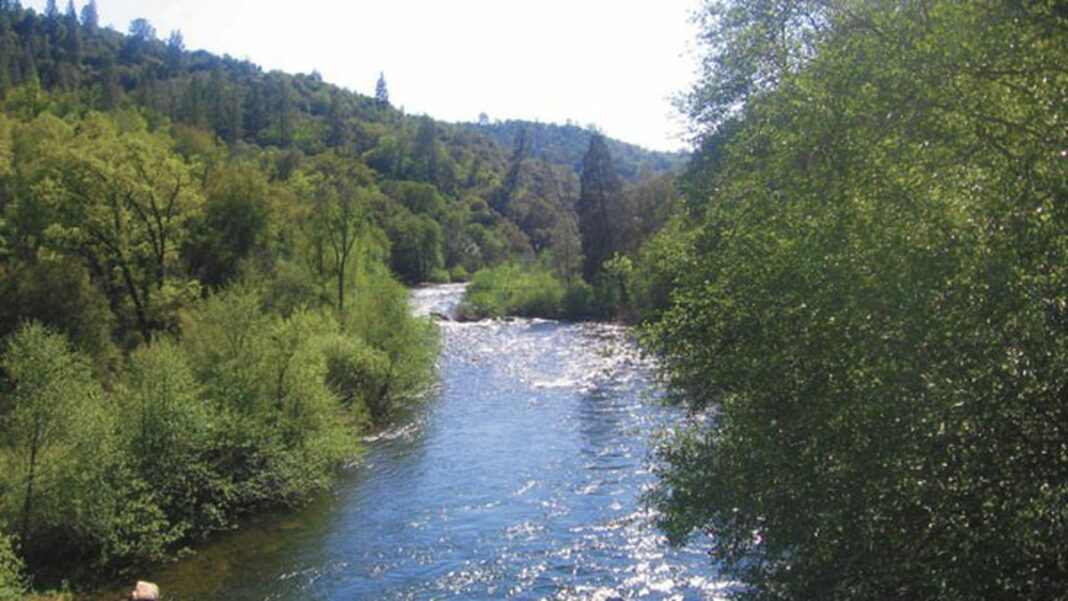
The East Bay Municipal Utility District’s plan to build a new dam
and destroy a scenic stretch of the Mokelumne River has received
widespread condemnation from environmental groups and near universal
opposition from residents and public agencies in the Sierra Foothills.
And it appears that all the sharp criticism may be having an effect.
The water agency has put off its expected approval of the dam proposal
until October and has scheduled a workshop for next month to consider
possible alternatives.
Doug Linney, president of the East Bay Utility District board of
directors, said last week that the board has scheduled the workshop for
August 11, and that possible alternatives to the new dam include
partnering with Contra Costa Water District in its plan to expand Los
Vaqueros Reservoir in eastern Contra Costa County. As Eco Watch has
previously reported, the Contra Costa district’s proposal to enlarge
Los Vaqueros is less damaging to the environment and has generated
little controversy (see “EBMUD Has Yet Another Option Besides a New
Mokelumne Dam,” 6/3/09).
The East Bay MUD board also may discuss a plan to penalize water
guzzlers and thereby lessen demand. The Sierra Club and other
environmental groups have argued that the agency would not need to
build a new dam if it forced its biggest water users to consume less
water by levying steep fines (see “Sierra Water Grab,” 4/29/09). Other
water agencies throughout the arid West that have adopted such pricing
plans have been able to lower water use significantly. In fact, East
Bay MUD itself implemented such a plan during the drought in the early
1990s and it cut water use substantially, but the agency abandoned the
program after enduring fierce criticism from heavy water users in
Contra Costa County.
The East Bay MUD board had been expected to approve preliminary
plans for the dam proposal at the August 11 meeting as part of an
environmental impact report on the agency’s water needs over the next
thirty years. The new 400-foot dam would be built near the existing
Pardee Dam near the Gold Rush town of Jackson and would nearly double
the size of the Pardee Reservoir. The enlarged reservoir would submerge
a five-mile stretch of the Mokelumne and ruin a section of the river
that is popular for fishing, hiking, and kayaking. Not surprisingly,
the dam proposal generated huge numbers of comments on the EIR. “I
think it’s fair to say that we got more of a response on the EIR than
we expected,” said Linney, explaining why the board decided to hold the
workshop and consider alternatives rather than forge ahead with the EIR
as is.
The board’s change of plans also coincided with a decision by Sierra
Club California to endorse a national Wild and Scenic designation for
the Mokelumne. Such a designation, which requires approval by Congress,
would prohibit East Bay MUD from building the dam. Both the US Forest
Service and the US Bureau of Land Management have said that the
Mokelumne is eligible for the designation. Sierra Club California
represents the Sierra Club’s thirteen chapters in the state. The Sierra
Club Bay Chapter had already endorsed the Wild and Scenic designation,
as has Friends of the River.
East Bay MUD’s decision to conduct the August workshop also has
renewed hope among Sierra Foothills residents that the board will
ultimately choose not to build the dam. So far, nearly every public
agency in the region has come out against the proposal. “I’m optimistic
that they will listen to the consensus of our community and understand
the depth of the opposition,” said Katherine Evatt of the Foothill
Conservancy, a nonprofit dedicated to protecting the Mokelumne.
Still, despite the change of plans, it’s not clear which way the
seven-member East Bay MUD board is currently leaning. The only board
member to publicly oppose the dam so far is Andy Katz, who represents
Albany, Berkeley, El Cerrito, Emeryville, Kensington, and a portion of
North Oakland. Dam opponents also hope that Linney, who represents
Alameda and San Lorenzo, along with parts of Oakland and San Leandro,
will ultimately side with them because of his pro-environment
background. But other board members, including John Coleman, who
represents Alamo, Blackhawk, Danville, Diablo, and Lafayette, plus
portions of Pleasant Hill, San Ramon, and Walnut Creek, have pushed
hard for the dam proposal during the past few months. Currently, the
board is scheduled to vote on the final EIR, including the dam
proposal, on October 13. However, that date could be pushed back
further if the board instructs staff at the August workshop to conduct
thorough studies of alternatives to the dam.