
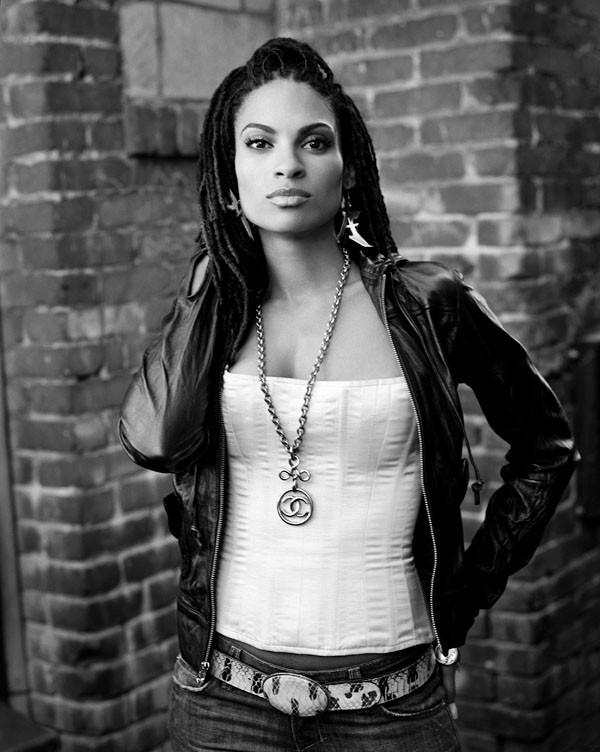
Seven years ago, Goapele Mohlabane would flit in and out of hip-hop
shows like a Queen Cleopatra. She was beautiful in a striking and
unconventional way: long and narrow, with wiry braids and pristine
facial symmetry. She also stood right on the cusp of fame, having sold
several thousand units of her debut album, Closer, and become an
It girl in local periodicals. Goapele had even broken the glass ceiling
at 106 KMEL, appearing on the Chuy Gomez morning show and garnering
frequent radio play at a time when Bay Area artists were all but
shunned by the popular hip-hop station. Still a couple of years away
from inking a deal with Sony, the young singer had an extremely
well-put-together cottage industry backing her up.
Goapele’s success owes partly to her mysterious, Delphic persona and
partly to an unusual vocal style that blends African influences with
American R&B. But much of it can be credited to a homegrown
business model that benefitted her more than her major-label deal with
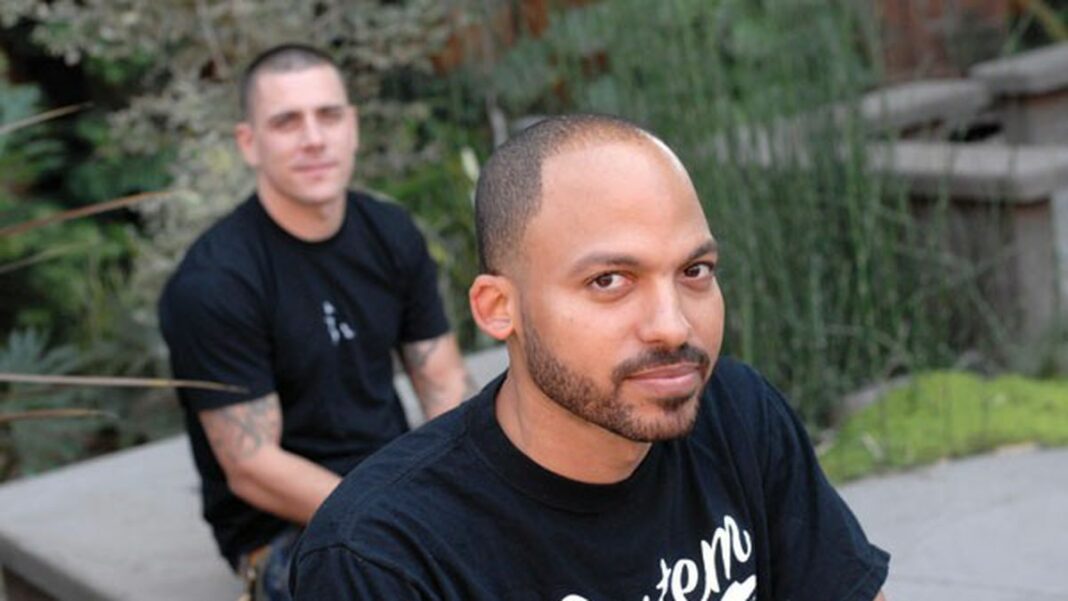
Sony, which ended in 2006. Goapele’s three-person family label,
Skyblaze Recordings, has remained thoroughly intact and is poised to
release the singer’s third album in October. They now manage a swank
recording studio in West Oakland. Goapele’s brother, Namane Mohlabane,
is partnering with San Francisco club owner Michael O’Connor to open a
new live music venue on San Pablo Avenue, in the building that once
housed Sweet Jimmie’s. At a time of mass bloodletting in the record
industry, Skyblaze seems inured to the effects of a bad economy and the
move to digital. Goapele Inc. always finds ways to work within, but
also get around the system.

Credits: Stephen Loewinsohn
Credits: Craig Merrill

Credits: Stephen Loewinsohn

Granted, the singer didn’t always have a pool of money and resources
to shore up her career. She came from a family of modest means. Born in
Oakland to a Jewish mother and South African father, she spent her
childhood moving throughout Oakland and Berkeley. Her mother co-owned a
boutique and cultural center on 40th and Telegraph called the Urban
Village, which, Goapele says, was where she became “a passionate
shopper.” Her older brother Namane was a DJ associated with the popular
crew Local 1200. As teens, they did community activism with the youth
group EYES (Empowered Youth Educating Society), which led social
justice workshops in local high schools. Goapele honed her chops
singing in Oakland Youth Chorus and making cameos at Local 1200 shows,
where she would croon over other people’s instrumentals. She sang her
first local hit, “Childhood Drama,” over the Super Cat song “Dolly My
Baby” (a dancehall track based on a Headhunters sample). Even at that
time she had a sound unlike most other vocalists, influenced both by
classic soul and by the Miriam Makeba records that she listened to as a
kid.
A few interesting twists of fortune led to Goapele’s rise. She spent
two years at the Berklee College of Music, where she sang in a James
Brown ensemble that also featured keyboardist Jeff Bhasker, who would
later become one of her producers. (He’s the current music director for
Kanye West and shaped many of the songs on West’s last album, 808s
and Heartbreak). When Goapele returned home in 2000, she’d already
completed much of the work for Closer. Over the next couple
years she would create a well-oiled marketing machine with the help of
Namane and Local 1200 graphic designer Theo Rodrigues. They teamed up
to put out Closer in 2001, made their own posters and organized
street teams to promote Goapele’s shows. At that point Namane became
Goapele’s official manager. He worked for City Councilwoman Nancy Nadel
by day and spent his nights DJing and advancing his sister’s career.
That year Lee Hildebrand wrote the first profile of Goapele in the
East Bay Express, after he heard the album was moving units at
Amoeba.
Two things distinguished Closer from other local albums and
caused it to generate an instant cult of fandom. One was its musical
sophistication. The title track — made by keyboardist Michael
Aaberg and DJ Amp Live — combines modal chord progression with
simple drum kicks. The strangeness and edginess of the chords make a
neat counterpoint to Goapele’s fragile vocals. The antiwar track “Red,
White, & Blues” includes a protracted, Hendrix-style guitar solo by
Errol Cooney, blurred out by drum patterns meant to sound like choppers
flying overhead. Her ballad “Romantic” with organ trio Soulive, harks
back to an older, more low-down style of funk music; Soulive guitarist
Eric Krasno uses a talk box to modulate the chords. All told, it was
accessible as a pop album, but the songwriting was more studied and
considered than what you’d hear on the radio at that time (or today,
for that matter). The music hit pretty hard.
The other thing that Closer had going for it was extremely
careful marketing, which would become a major hallmark of the singer’s
career. Once Team Goapele had sold about a thousand records, they began
what Namane describes as “probably the most patient radio campaign in
the history of radio campaigns.” DJs were already starting to play
“Childhood Drama” in clubs. (It ended up getting released as the B-side
single, with “Closer” as the A-side.) Goapele had been featured in all
the local periodicals and on indie radio stations like KPFA and KPOO.
She performed around town just often enough to remain a hit (if you
headline the neighborhood clubs more than a few times a year you’re
condemned to be a “local artist,” her brother explained) and had
concise, well-put-together shows that never dragged on. Through his DJ
career Namane had kept in touch with all the main on-air personalities
at KMEL — Chuy Gomez, Big Von, Mind Motion, Rick Lee — and
he began courting them as Goapele’s career picked up momentum. “I was
in conversations with all of them. I didn’t really understand the
politics of radio,” Namane recalled. “A lot of these people were aware
of what we were doing, so when it did come to them having a mixers’
meeting and the song was presented, the DJs were familiar.” Within a
few months, “Closer” was getting played on KMEL about three times a
week.
“It was so hot already; I think her song went to number one within
the first month we started playing it,” said KMEL morning show DJ Chuy
Gomez. “We were already playing it at Mingles and at Geoffrey’s. You
would already hear it in people’s cars.”
By early 2002 Goapele’s sales tally increased to three thousand, and
an additional thousand CDs were pressed up. The team decided to form
its own label, Skyblaze Recordings. That fall they got a distribution
deal with Hiero Imperium, which itself was distributed through Red
Urban Records, a subsidiary of Sony. (Goapele had already collaborated
with the label’s founders, Hieroglyphics, on their 1998 album 3rd
Eye Vision.) To mark the new phase in Goapele’s career, Skyblaze
released a second iteration of Closer called Even Closer,
with a couple of changes in the track list. At that point, fortunes
began to turn in radioland as well. Billboard senior editor Gail
Mitchell came to the Bay Area to write a story on the urban music
scene. At that time most local artists were disgruntled with what they
perceived as a lack of support from KMEL, which mostly played East
Coast and Southern artists while ignoring its home turf. The conflict
became a prominent theme in her article, which went to press just one
month after Jeff Chang’s similarly damaging polemic, “Urban Radio
Rage,” published in the January 22 issue of the San Francisco Bay
Guardian. KMEL was already starting to feel the heat. When Mitchell
questioned Jazzy Jim Archer, the assistant program director at that
time, his offhand, defensive response was an accidental boon for
Goapele’s career. “Local artists have to compete with everyone else and
need to understand that that’s the playing field,” said Archer to
Mitchell. “Among those who understand and work at taking it to the next
level is Goapele, whose music we play.”
“The moment that that quote was printed, they were probably playing
Goapele three times a week,” said Namane. “It was part of the playlist,
it wasn’t part of the agenda.” Within two weeks, Goapele was bumped up
to seven, then fourteen spins a week. Archer called Namane to say that
“Closer” was getting a lot of positive listener feedback. Within three
months, “Closer” went #1 at KMEL. Then it went #1 at local R&B
station KBLX. Then it went #1 at two stations in Los Angeles, and one
station in Baton Rouge.
By the time Skyblaze signed to Sony in January 2004 for a
three-album deal (starting with the February rerelease of Even
Closer), the crew had sold roughly 70,000 units on its own.
(Closer has now sold about 200,000 copies internationally.) “We
were doing enough business that it wasn’t like we were desperate to
sign with a major,” Namane recalled. “It just felt like, ‘We’ve gone #1
here, here, and here,’ If the Bay Area is the #5 market in the country,
we extrapolate those numbers out. When I was in the meetings with the
managers, this is the math that I’m explaining to them: ‘Look, this
model worked here. And it didn’t just work here, we replicated it in
LA. And we’ve done it in Baton Rouge, and we’re starting to do it in
Washington, DC. So it’s not just a local phenomenon.” The Goapele
marketing template had a grassroots logic to it: Start with local PR
and a street team, do local shows, then go to radio. Goapele and Namane
had derived that methodology from their work as community organizers,
and from promoting DJ-dance parties for Local 1200. They were
go-it-alone entrepreneurs who could command a room full of label
executives, and do business on their own terms.
Meanwhile, Goapele had cultivated an image that appealed to a broad
listener base. Unlike most contemporary soul singers, she was cautious
and demure — a sheltered Rapunzel who sang about romance in a
very ambiguous way. “Romantic” is the raciest song on her first album,
and even that one has a rather conservative vision of relationships
(Buy me flowers I’ve never seen/Wake me up from my dreams/To bring
me french toast and tea). The title track “Closer” sounds like a
put-on when you realize it’s actually about getting “closer to my
dreams.” Her persona remained fairly consistent in Change It
All, the sophomore album that she released on Sony in December
2005. It was more musically adventurous, with a peppy, girl-group-ish
song called “Love Me Right,” a rock ballad called “Dark Side of the
Moon” that spawned from a one-off session with producer Linda Perry,
and a breakup duet with rapper Clyde Carson. Through it all, Goapele
remained coy. Her fantasies about love had kind of a retro cast and
rarely went into specifics beyond the type of breakfast she wanted in
bed. She’s canny around the media and reluctant to talk about family or
relationships. “As a writer, sometimes I can be self-conscious about
what I’m saying and what I’m sharing,” she admitted in a recent
interview. Such coyness may have lightened her appeal in the short run,
but it’s probably contributed to her longevity. The rest of the R&B
world teemed with prepackaged Lolitas and Queen Bees, but Goapele
seemed to occupy a class of her own.
Her image was of a piece with Skyblaze’s whole way of doing
business. Even working under the auspices of Sony, it still behaved
like an indie label. Within a few months of the deal, Namane realized
that Sony wasn’t going to ramp up the marketing effort for Even
Closer. “There was a radio promotions guy who was supposed to be
working the record, and it just kinda didn’t happen,” he said. “The
record never grew beyond the markets we had gotten. That guy ended up
getting fired, and a new person came on, but by then we just said,
‘Okay, whatever, let’s just start working on a new album.'” In early
2005 “Closer” went #1 in Detroit, but Sony had already given up.
Skyblaze had shifted all its efforts towards Change it All,
which dropped that December. Namane, Goapele, and Theo took their
earnings and built a studio in Emeryville, and would later move to
their current digs in West Oakland.
Skyblaze’s contract with Sony allowed Sony to share revenue on the
distribution of Even Closer, although Skyblaze still owned the
masters. It also permitted Sony to bankroll and oversee up to three
additional albums. In mid-2006 the option to renew came up, and
Skyblaze sent its parent label a letter giving it sixty days to decide
whether to make another record. Sony dragged its heels, probably
because label chair Donnie Ienner had just resigned, and everyone under
him had cold feet, Namane surmised. At that time the only artists Sony
was promoting were guaranteed top sellers who had platinum records
already — e.g., Beyoncé, John Legend, and Amerie. “Most
artists, if they’ve only been signed to a major — if they had a
demo, and some A&R signs them — then the label is all they
have,” Namane explained. Labels are very good at convincing you that
‘We are what makes you famous.’ So most artists would never take that
option and say ‘Hey, it’s time for you to pay up.’ They’re not famous
enough and powerful enough to do that.” But Goapele already had a whole
infrastructure behind her, plus a recording studio and a coterie of
producers — many of who had started at Skyblaze. She was on track
to sell 100,000 copies of Change It All and make a third
album.
“Our perspective was not that we were getting dropped,” said Namane.
“We were forcing the issue. We wanted all of the rights back.”
Thus, Sony terminated their contract in 2006, and Goapele took a
brief hiatus to have a baby. Skyblaze moved to its current studio the
Zoo, a new-music incubator funded by retired Google software engineer
Dave Watson. The Zoo is an ideal place for Goapele to indulge her
plodding and meticulous album-making process. (She’s the kind of
musician who revises a song up to five times before it’s finished.) All
the rooms have couches. There’s a place to shower and a small gym with
rubber workout balls. Goapele spent much of the last year recording her
new album here while Namane set his sights on a new business venture
— the Brick & Mortar Music Hall, which he and Michael
O’Connor will open at the end of this month. They’ve divided the space
into several storefronts: Three retail spaces in the front lead into
the two-tiered music venue, which abuts a large Caribbean Creole
restaurant. The retail portion will include a men’s clothing store
operated by O’Connor (he also owns the Mission District shop Density,
which specializes in urban couture), and a fashion boutique called
Indigo that O’Connor will co-own with Goapele. (She says her role will
mainly be “conceptual.”
Goapele’s new album, which she, Namane, and Theo have financed from
their personal coffers, has several things going for it. The first is
that Goapele has finally done away with the prudishness that
characterized Even Closer and Change It All. “It is a
little more aggressive,” Goapele said of the new album. “I feel like
I’m at a different place lyrically and in my life. I’m more a grown
woman.” Her new single, “Milk and Honey,” sounds a lot closer to
contemporary hip-hop than any of her previous material. With a jagged,
metallic beat supplied by local producer Bedrock (who did a lot of work
on Change It All), it’s trendier than any of her previous
material. Goapele’s voice wobbles in and out of a thick fuzz of guitar
and keyboards. She modulates it with Autotune software. The lyrics,
while still vague, are a lot more suggestive than before (Just lay
back, relax, let me blow your mind). “Something about being a mom
— it just kind of opened me up more,” said Goapele.
Although Goapele is still choosing a song list for the new album
(yet to be named), it appears that “Milk and Honey” is no aberration.
Sitting at one of the Skyblaze computers on a recent Tuesday, Bedrock
plays another new track that mixes reverb-heavy Rhodes with a grinding
kick and snare — the main signifier of hip-hop. Goapele also
recorded a track with Blue Note keyboardist Robert Glasper and drummer
Chris Daddy Dave when they came to Oakland Yoshi’s a few months ago.
Rhythmically, it’s trickier than most of what you’ll hear in hip-hop.
“I’ll call it 4/4 with a subdivision of 7 for the first bar,” said
Aaberg, listening to the instrumental version in his own East Oakland
studio.
Meanwhile, “Closer” continues to evolve on its own. A lot of rappers
have repurposed it on their mix tapes: In the past couple years,
Goapele has found rap versions by Clyde Carson, Special Ed, and the new
Cash Money rapper, Drake. “It kind of surprises me every time, but it
hits a little harder than sometimes it’s assumed to,” said Goapele, who
now receives “Closer” remixes via Twitter. She’s currently talking to
Maxwell and Anthony Hamilton about the possibility of collaborating on
future records. Her forthcoming album includes a track by Kanye West.
She keeps in touch with Prince.
Reemerging as a starlet is hard to do, especially when you have a
child to raise, and no mother-ship label to pay for your next album. No
matter how much Goapele reinvents herself, it will be tough to
replicate the success of “Closer.” Some folks would argue that she’s
hampered her chance at stardom by staying in the Bay Area, which isn’t
as well resourced as New York, Los Angeles, or Atlanta. Yet what might
be a ball-and-chain for some is security and a sense of rootedness for
Goapele. She’s sticking with the family operation that initially
propelled her career and gave it momentum when Sony jumped ship.
Her brother-manager Namane remains cautiously optimistic: “I would
say this is what many artists refer to as ‘being dropped’ — but
most artists don’t have the means to create, distribute, and market
their own product,” he said. “Just to give you some context: Five
months later, Goapele was in a conversation with Prince about that
situation. He was like, ‘So you’re free now, right?’ He doesn’t work
with people who he doesn’t consider free.”