
With a title like Fat Pig, you might expect a play about
women’s bodies and body anxiety — or, perhaps, societal anxiety
over women’s bodies. All of which form the blueprint for Neil LaBute’s
new drama, the second in a trilogy about gender, relationships, and the
beauty myth. Yet Fat Pig (through December 6 at the Aurora
Theatre) offers a surprising twist on the theme. It starts out
predictably: Boy meets girl in pizza parlor. Girl wolfs down three
pieces pizza, one salad, one spring water, one order of garlic bread,
and one ice cream. Boy looks askance (“Pre-tty big.”). Girl
offers boy her second ice cream. Girl impresses boy with
self-deprecating fat jokes and knowledge of obscure Alistair MacLean
war movies. They exchange numbers. Then it veers in a different
direction. Several scenes pass before you realize this is not about
women at all. Rather, it’s a play about men, men’s insecurities, and
men’s relationships with other men.
Whether of not LaBute knew that is open for debate. His play sets
you up with two principal characters whose romance produces the central
drama of Fat Pig, but not the central conflict. The Aurora
production — directed by Barbara Damashek — casts Liliane
Klein as the eponymous fat girl Helen, a perky, smart, attractive,
heavyset librarian who eats for every reason other than physical
hunger. Like the fabled Helen of Troy, she seduces a man and creates a
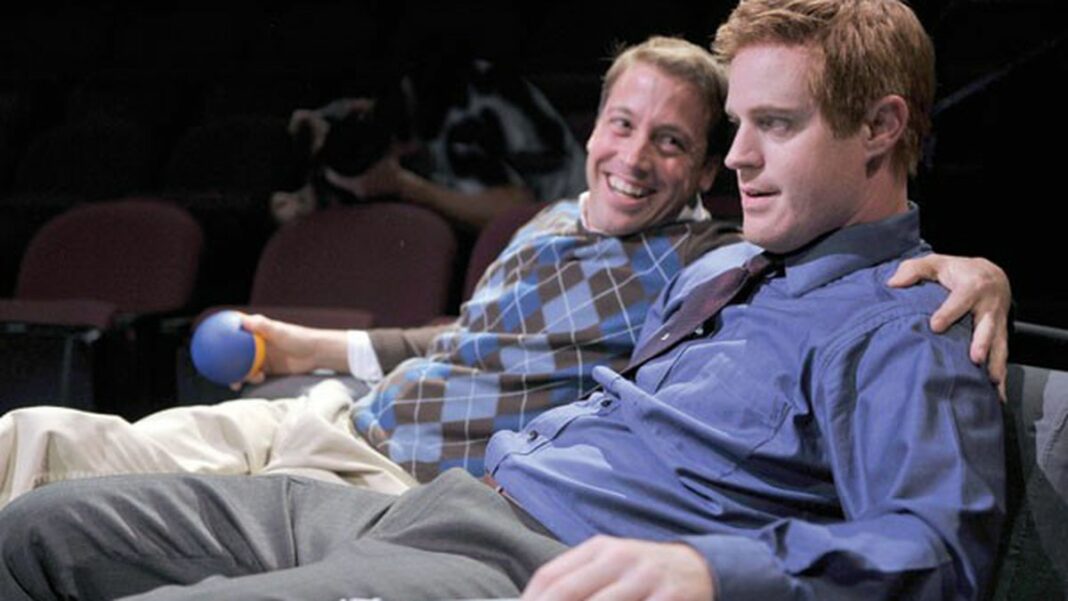
war. The man in question is Tom (Jud Williford), an upstanding
office-worker type whose own self-doubt comes to bear in the first
scene, when he hesitates before accepting Helen’s ice cream.
(Apparently, he seldom eats dessert without checking the nutrition
label.) Tom is the type of guy who generally hews to societal
expectations and peer pressure. He plays basketball at the Y on Friday
nights; volleys insults with Carter, the office gadfly (Peter Ruocco);
and tries to hide his romance from the watchful eyes of co-workers.
Williford dons a sandy-haired wig for the part, which makes him
resemble Richie Cunningham from Happy Days — a consummate
conformist.
Ostensibly, Fat Pig tells the story of a closet relationship.
Tom courts Helen in secret, sneaking her into movies after they’ve
started, not picking her up from work, and refusing to introduce her to
his friends. Long after their romance should have progressed, the two
still speak awkwardly to each other, skirting around the issue of
Helen’s weight and describing their feelings in euphemisms. It’s the
kind of dynamic you might expect from an interracial couple, or a
romance across social classes, or any other pairing that goes against
the grain. In this case, it’s difficult to trust Tom when he professes
any kind of affection for Helen because you never see the evidence.
Their love scenes always occur in isolation; the bed they share is a
polar ice cap (Tom compares it to a lone raft in a great empty sea). It
isn’t until the penultimate scene that we get a glint of real
chemistry, when Tom lies down on the couch clutching Helen’s
photograph.
But this isn’t a play about Helen, or even Tom and Helen. It’s about
Tom and Carter. Played with terrific subtlety by Ruocco, Carter is a
cipher — the guy who witnesses and comments on the action. Like
the fashion rags arrayed on their office coffee table, or the magazine
pinups on Helen’s bedroom wall, Carter is supposed to represent
societal views about beauty and the female body. He’s the Iago in this
story, jealously stalking Helen and Tom while they dine in a local
seafood restaurant, then stealing Helen’s picture and spreading it
around the office. Along with Tom’s ex-office-fling Jeannie (Alexandra
Creighton), Carter provides a constant stream of fat-phobic comments to
sabotage Tom and Helen’s relationship. He’s also an ambiguous moral
compass. At one point, he tries to rationalize his fear of fat people
with a story of childhood drama — that of a 350-pound mother who
drove his father away. Carter chides his friend for dating a fat girl,
but also characterizes Tom as a guy trying to do good in a world that
won’t allow it. Toward the end of the play Carter shifts from the
frenemy role to become a kind of odd spiritual guide. In a moment of
candor, he looks hard at Tom and says, “I know you’ll do the right
thing.” On the surface, that sounds like a cliché. In this
context, though, it’s quite cryptic.
Carter is actually the strongest character in this play and the one
who will steer Tom and Helen’s relationship to its conclusion. Small
clues in Mikiko Uesugi’s set design, such as a floor painted to
resemble a basketball court, show that this play is more a window into
the private lives of men than the private lives of fat chicks. The
actresses are strong, even if their characters seem one-dimensional.
But it’s the two guys, mean-spirited and frustrating as they are, who
make all the decisions and propel the action forward. If there’s any
lesson to be gleaned here, it’s that Tom couldn’t do the right thing if
he tried — too many forces are conspiring against him. So who’s
the real pig, anyway?