Five hundred pieces. A tableful of passionate puzzlers. And a race against the clock.
The fun, cooperative, yet competitive hobby of jigsaw puzzling is flourishing in the East Bay, courtesy of Assemble Puzzlery. A little more than a year ago, Erica Elms and Jen Thompson, who live three blocks from each other in Richmond and became friends through their kids, took a break at the Factory Bar.
“We commiserated over how political everything had become and our corporate jobs,” Elms said in a phone interview. They both had fond memories of sitting around a table with others, doing puzzles and connecting with fellow players. So, Elms said, “It was time.” Assemble Puzzlery was in the works.
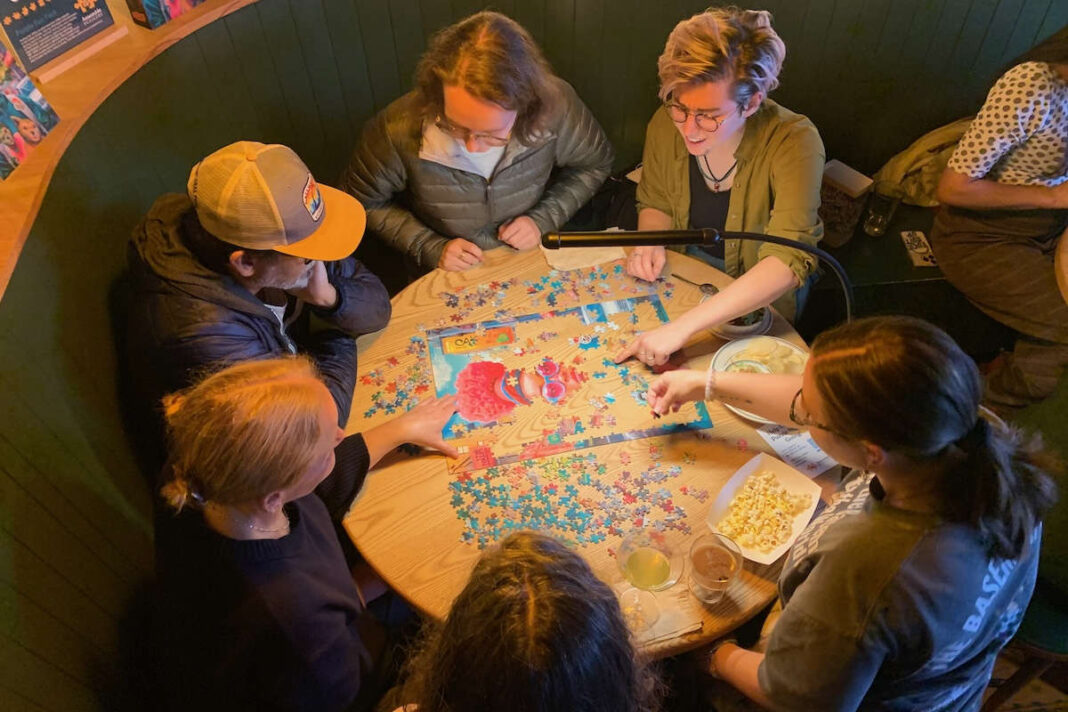
The partners quickly discovered plenty of East Bay venues—breweries, restaurants and cafes—that welcomed the infusion of groups “who want to get away from screens,” Elms said, and who also ate and drank at events, and drew in people. They evolved their format, which includes “speed puzzling,” in which teams or pairs race against each other to complete the same puzzle, usually 500 pieces for teams and 300 pieces for pairs, in a set time. The partners help connect people to form a team, if needed. Speed puzzling involves a fee, which is paid by each group before the competition starts.
The teams/pairs pick a team name and select a table, at which the puzzle is concealed. “We go over the rules, blow a train whistle and start the timer,” Elms said. She and Thompson monitor the tables, so team times are recorded accurately.
Assemble Puzzlery events also offer free options, such as casual puzzling and “puzzle chess,” in which two players take turns assembling the puzzle, and puzzle swaps, where participants bring in and take home older puzzles.
The website also explains “Puzzical Chairs,” a game created for people “who want to meet new people but hate awkward small talk.” Participants are handed a schedule card and a random puzzle piece, which doubles as a raffle ticket. Each person is randomly assigned a table with three other players and a 500-piece puzzle. Every 30 minutes, everyone rotates to a new table. After two hours, the “after party” lets people mingle, enjoy a drink and maybe reunite to finish a puzzle. This activity requires advance registration.
In order to create a welcoming and functional puzzling space, the partners have invested in special lighting, puzzle boards and puzzle mats, Elms said. As much as possible, puzzles are sourced locally, from companies such as Oakland Puzzle Company and Unified Pieces. Elms said, “We’re committed to supporting small puzzle companies,” which gives the artists creating the puzzles a percentage of sales.
Working on puzzles together in this collective way is a good example of “parallel play,” Elms noted. For adults, this means a connective, quiet way to be together without a constant demand for high-volume conversation or direct engagement. Research shows that it also reduces stress and anxiety.
“Data shows that people enter in a meditative state while puzzling,” Elms said. “You get a little dopamine hit when you place a puzzle piece.”
Studies have also shown multiple brain benefits, Including:
- Improvement in short-term memory, as a player recalls shapes and colors, strengthening brain cell connections.
- Enhanced spatial reasoning, as the player mentally rotates pieces.
- Increased cognitive reserve.
- Sharpened problem-solving skills, as the player formulates strategies, sorts pieces, and uses trial-and-error testing.
Then there are the social benefits. Assemble Puzzlery events have already fostered a number of friendships, Elms said. She estimated that in the first year, they have hosted approximately 30 events. “We see people exchanging phone numbers. And we are getting to know them, too,” she said.
As an activity, puzzling draws in a wide range of ages. “Some people bring their kids,” Elms said, “and we get seniors as well.”
The partners, always on the look-out for more venues and spaces to partner with, also seek to build relationships with businesses that might want to hold puzzling nights as part of their team-building efforts.
Asked for a favorite story from one of the events, Elms recalled, “One evening at Gilman’s [Gilman Brewing Co. in Berkeley], a group of tech bros came in for a beer, and ended up grabbing a puzzle.” After working on and completing it, one of them said to her, “This was amazing. We just had the best conversation we’ve ever had.”
The next Puzzle Night is from 6-9pm on Aug. 19, at Gilman Brewing Co., 912 Gilman St., Berkeley. For more information and to register, visit assemblepuzzlery.com.