Along the street-like canals of the ancient Aztec city Tenochtitlan—modern day Mexico City—vendors routinely sold various meats, stews and even chili sauces that Spanish ethnographer Franciscan Friar Bernardino de Sahagún described as “hot, very hot, very, very hot.” Street vending worked its way into colonial Mexico, later evolving into a robust part of the country’s formal and informal economy.
The tradition remains alive and well in Oakland’s Fruitvale District, where Mexican and Latine immigrants have shaped their own culture and inspired that of the whole country.
Fruitvale’s vending ecosystem, and the people who ran it, were a driving factor in Oakland becoming the first city in the U.S. to implement an ordinance legalizing the mobile food industry in 2001.
International Boulevard is far from an ancient waterway, but the principle is the same: every block is a stone’s throw away from vendors selling hot chili sauces and the meat to put them on. Much like the competing sounds of bachata and banda, taco trucks are emblematic of Fruitvale, serving as tiny cultural hubs whose simmering vats of frying oil and glaring rejection of atomized introversion make the district what it is.
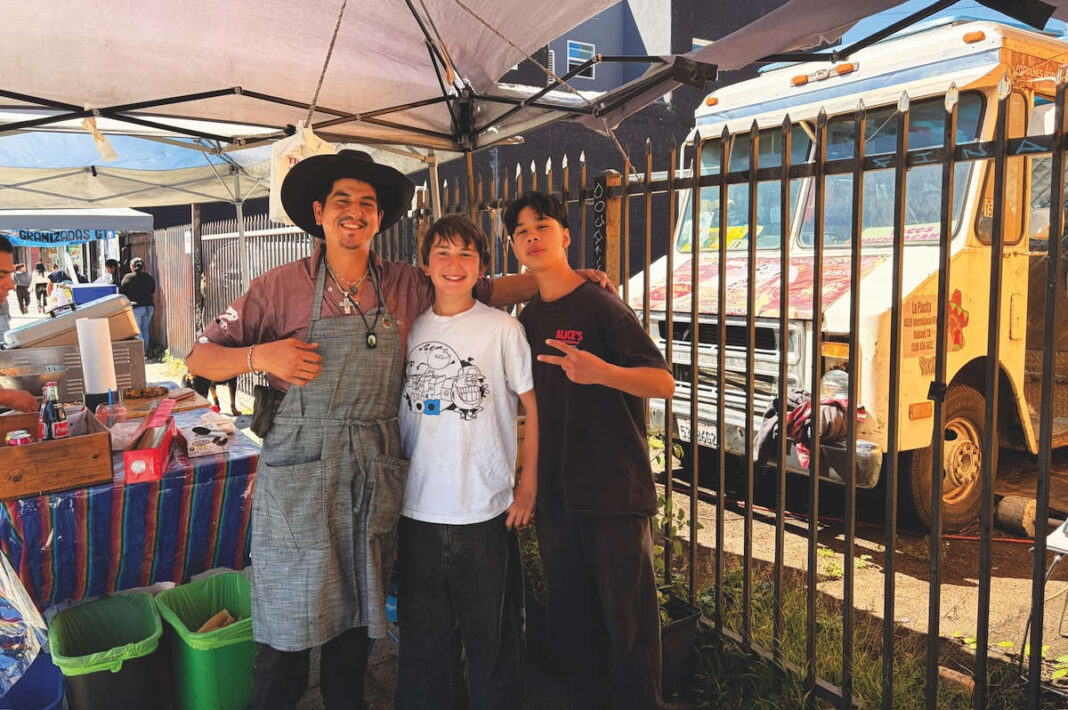
On 35th and International, Enrique Soriano wears a black cowboy hat and greets nearly every person who comes to his set-up in front of a small truck labeled “Estilo Michoacan” with some variation of “Oye, primo” or “Hey, cousin.”
His family started the business across the street in 1998. Soriano then went to culinary school, eventually finding employment in fine dining kitchens—an experience which left him disheartened.
“I was making really good food and the people we were serving, you know, didn’t seem very appreciative of it, and the people who really deserved it didn’t have access to it,” he said of his reason for returning to International Boulevard to build the family business back up.
He uses the skills he learned from his time classically training in a myriad of international cuisines to supplement knowledge gained from making carnitas, from live pig to plate, in Michoacan every summer as a kid. Soriano wants to combat the idea that Mexican food is just quick and cheap by keeping the quality of everything high, from ingredients to final product, while maintaining prices accessible so that he can continue to fulfill the goal of feeding his community.
“Sorry I couldn’t work today; I was at the waterpark,” yells a kid from a scooter. Soriano tells him not to worry, to enjoy his summer.
Isaac Settoes, 12, says he has been interning at Estilo Michoacan and later came with his friend Michael Gomez, 13, to see if he could join in. Interning at the food truck involves hovering around Soriano, getting fed and asking how he makes the thick slabs of chicharon taste so good, to which Soriano replies with an in-depth explanation of the frying process.
“This guy is one of the nicest people you’ll meet,” Gomez says.
“Hands down, best tacos on the block,” says Settoes.
A sense of allegiance to one’s preferred food truck is a common theme along the boulevard.
“This one is good,” says Lila Stevens as she waits for her order in front of Tacos Guadalajara on 44th. “That’s why we come to this one; not all of them are good.”
She stands in a purple dress, with Geraldine Ashley at her side in a sparky red pantsuit. They come here after Sunday service and are clearly not the only ones to do so, as Ashley affectionately greets multiple people who pull up to the small seating area in front of the truck wearing similarly formal attire.
Ashley grabs her order and slots it in the same arm she holds her Bible, the holy scripture comfortably sitting in front of a brown paper bag with a can of coke peeking out of it.
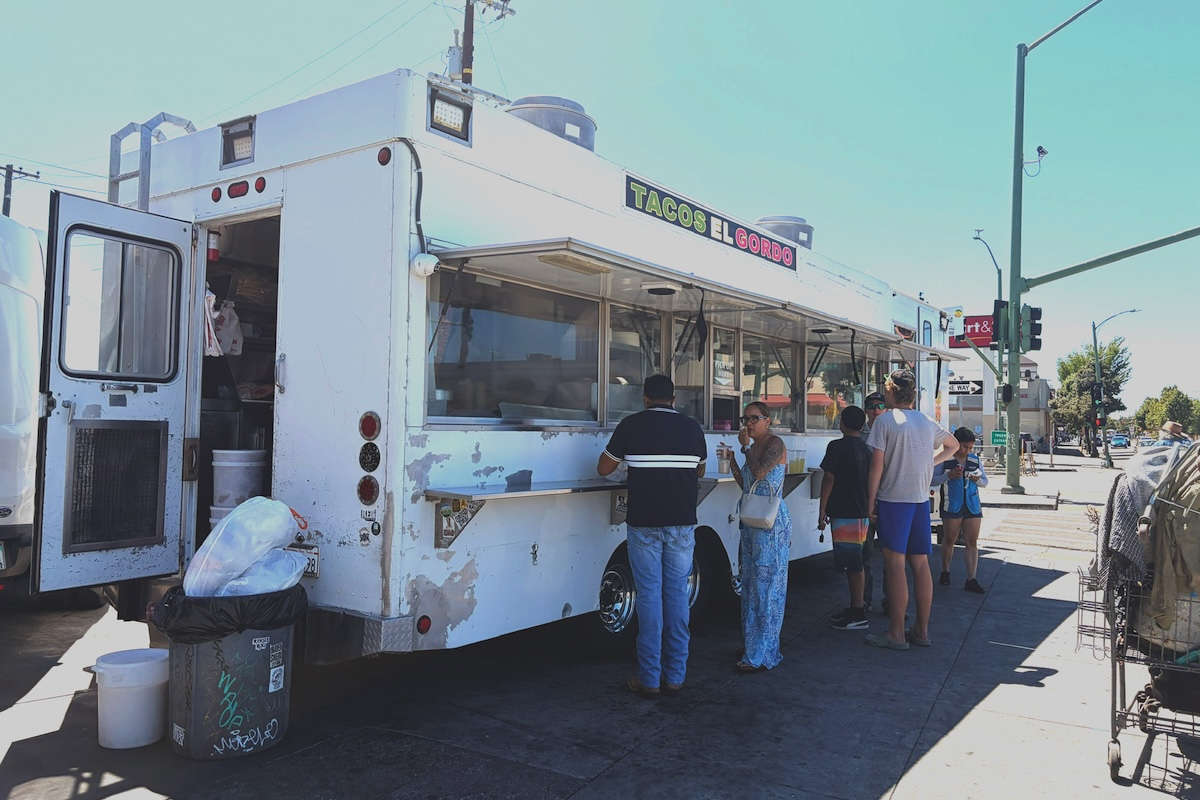
Alex Alcala and Silvia Villalvazo are loyal to Tacos El Gordo, an unassuming white truck with nothing adorning it but the words “Tacos El Gordo,” written in the same colors as the Mexican flag at its center.
Alcala met the owner, Carlos Montero, upon arriving from Jalisco 27 years ago. At that time, Montero vended with nothing but a cooler and a bicycle in front of the Smart and Final adjacent to where his taco truck now stands.
Montero says that when he first started, everyone—including law enforcement and the public health department—was after him. Then in 2001, following the landmark ordinance, Montero began running the business officially, continuing to build bonds with his customers. Those bonds have lasted until this day.
“Even their kids come now,” he says in Spanish.
Alcala and Villalvazo have visited his restaurant in Hayward and every location in San Leandro, and stop by whenever they pass by the original truck in Fruitvale.
“It represents us all as Mexicans, so seeing how it’s grown is admirable,” Villalvazo says. “Eating one of these tacos, you remember your ranch back home.”