Obscured by digital innovations, it’s easy to overlook the mighty pulley. Evidence of its use can be found as far back as Ancient Egypt’s Twelfth Dynasty; later, pulleys were employed in essential mechanisms during the Renaissance.
The pulley’s central actions and supreme value rely on the use of a wheel with grooves in its circumference through which cables, belts or ropes exert tremendous power. Capable of moving or lifting large loads industrially, everyday life is equally pulley-reliant—think elevators, window blinds, garage doors and more.
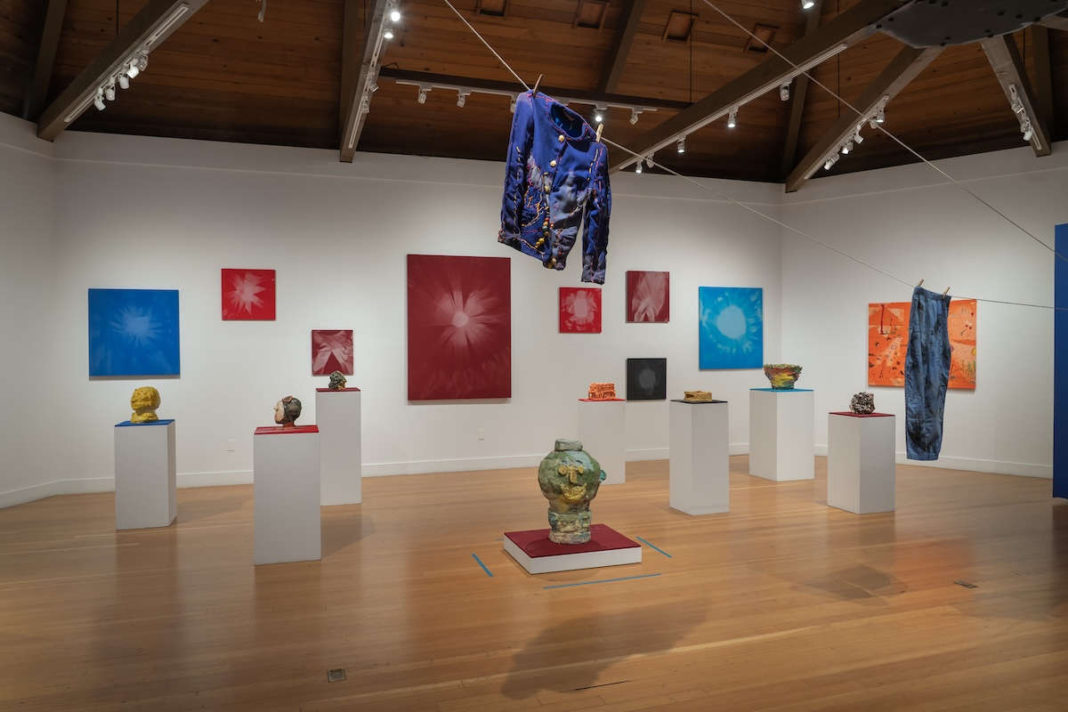
Leave it to artists to find new purpose in the humble pulley, as evidenced in an exhibit on display through Nov. 16 at Berkeley Art Center. Artists from NIAD Art Center teamed up with Oakland-based curator/multidisciplinary artist Christopher Robin Duncan over a two-year process that resulted in the show’s 27 artworks. Each fabric canvas, wearable fabric and ceramic sculpture created shared a three-to-six month outdoor exposure.
Marvelously, the simple pulley from which the exhibition draws its title was used to lift the artworks to the rooftop. Metaphorically, the mechanism served like a beacon of light, underscoring the exhibit’s “elevate all” intentions.
Founded in Richmond, NIAD Art Center is a studio and exhibition space in which adults with intellectual and developmental disabilities create the featured art. More than 80 participants are now prominent artists represented by national and international galleries. Works by NIAD artists can be found in the permanent collections of The Museum of Modern Art New York, SFMOMA, RISD Museum, MAD Musée in Belgium, the Oakland Museum of California and more.
Duncan first encountered NIAD artists while participating in a group exhibit at Marin MOCA. All of the artists’ work involved textiles or sewing. Duncan, some of whose work consists of painted and/or photographic images cast on fabric and exposed to long-term sunlight, was intrigued. “It was powerful and profound,” he said. “My work paired with what felt like their pure, open expression. I was so moved. That was the spark.”
Rooftops—large, flat open spaces—are essential to Duncan’s practice. Driving to NIAD one day, he noticed the building’s roof. The idea that germinated led to PULLEY.
Art-making is often a solo endeavor, but Ducan found that working with the NIAD artists transformed his thought patterns. “During the workshops, every role I had ever formed for myself was altered or broken,” he said. “Their way of interacting with materials had no rules, no parameters. I was clutching my pearls and thinking things like, ‘You’re going to paint on that already?’ I found myself surrendering, stepping out of the way.”
The most significant element beyond discovering NIAD artists’ approach was conveying the artwork to the roof. “We prepped everything and when the full moon came, it was time to get the fabric on the roof. I had thought I’d just carry it up, because I’m able-bodied,” Duncan said.
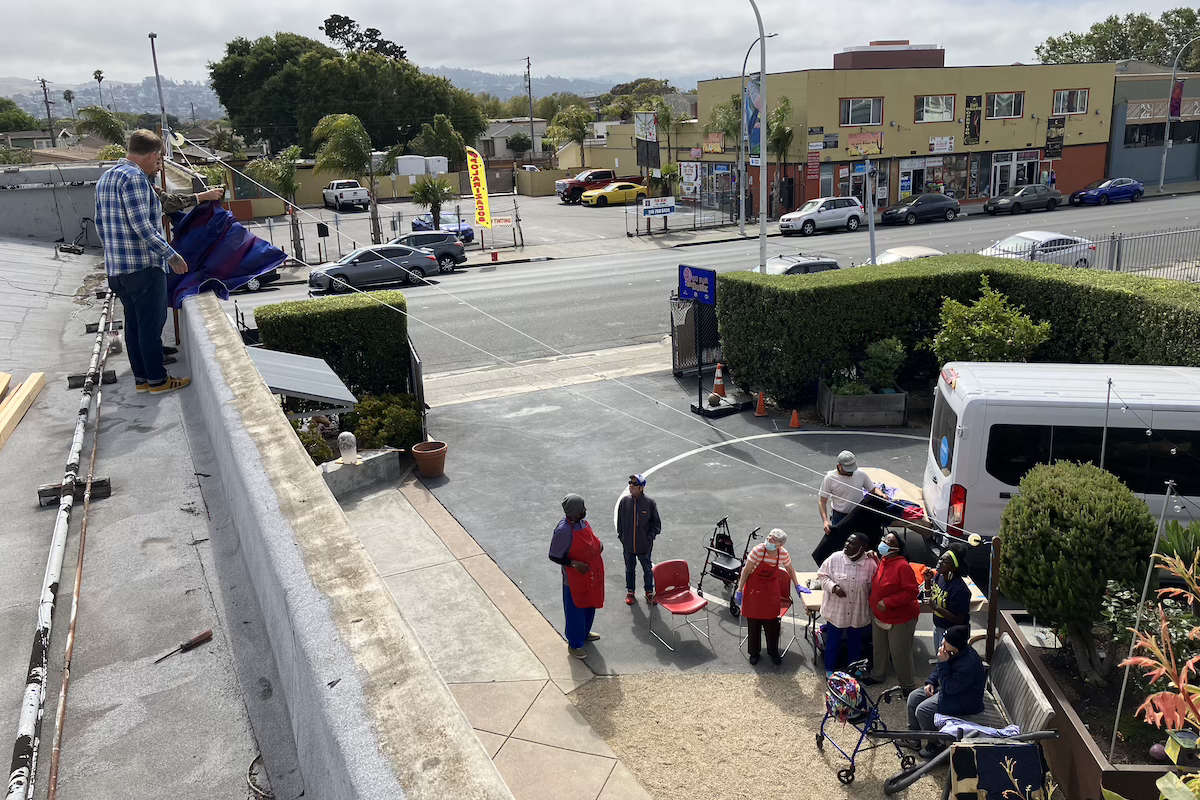
“An interesting moment came when the head facilitator said, ‘Let’s find a way so everyone can be involved’ and came up with the pulley system,” Duncan continued. “It was ridiculous, wonderful and fun, with everyone putting their work on the pulley, running it up, having time pass and then harvesting it.”
Invigorated by the interactions, Duncan said, “You go somewhere and think you’ll be an educator. Then you walk into a space and realize you are the student. I definitely benefited from the NIAD artists, and I’m just grateful to have paid attention.”
Having paid attention to time and its effects since childhood—watching family members age, the choreography of light and shadow outdoors—Duncan knows the arc’s value. Slowing down in defiance of the speed of contemporary life allows transformation that breeds revelation, growth and understanding.
“Looking back and letting things marinate has caused me to move forward with more integrity,” he said.
The exhibition is accompanied by a catalogue published by LAND AND SEA with essays by the publisher’s co-founders, Duncan and Elena Gross—writer, curator and director of exhibitions and public programs at the GLBT Historical Society in San Francisco. After the closing event, the publication will be available for purchase and found on the NIAD website.