Ancestral connections and the generational futures of Black communities have for centuries been stolen, redlined, colonized and rendered insecure. Oakland Museum of California’s (OMCA) latest exhibition, “Black Spaces: Reclaim & Remain,” focuses primarily on art and architecture, while seamlessly integrating essential archival objects that illuminate the past, present and future worlds of Black Americans in West Oakland.
“Black Spaces” was developed with local artists and in collaboration with East Bay residents affected by displacement. Like lightning bolts, items from OMCA’s permanent collection and three newly commissioned installations reveal the history of Russell City—now the City of Hayward—and other locations where systemic, racist oppression disrupted, displaced and supported practices that continue to threaten Black communities.
The people forced to sacrifice homes, the family legacies perilously positioned and dreams for future generations’ land ownership are animated through individual stories told by the installations of artist Adrian Burrell, architect June Grant—with blink!LAB architecture—and the Archive of Urban Futures and Moms 4 Housing. Pursuing intersecting themes of home, memory, civic activism and creativity, the art on walls and in display cases, films and videos rings loud and clear with the rhythms of Black communities. Scenes of revolution, resilience and joy are told across all genres.
In the Bay Area, the long history of displacement finds vivid portrayal in art that centers on homes, domestic spaces, urban streets, and cultural and communal institutions. Text panels, interactive maps, puzzles, photographs and videos describe and illustrate destructive policies, such as what occurred in Russell City in 1964. The town that thrived post-World War II but by the late 1950s had only 1,400 residents, most of them Black, was declared “blighted” after Alameda County refused to provide sanitation and fire services. Annexed by Hayward, residents were evicted under eminent domain; the land used for an industrial redevelopment project. Belatedly issuing a formal apology in 2021, Hayward launched the Russell City Restorative Justice project in 2022.
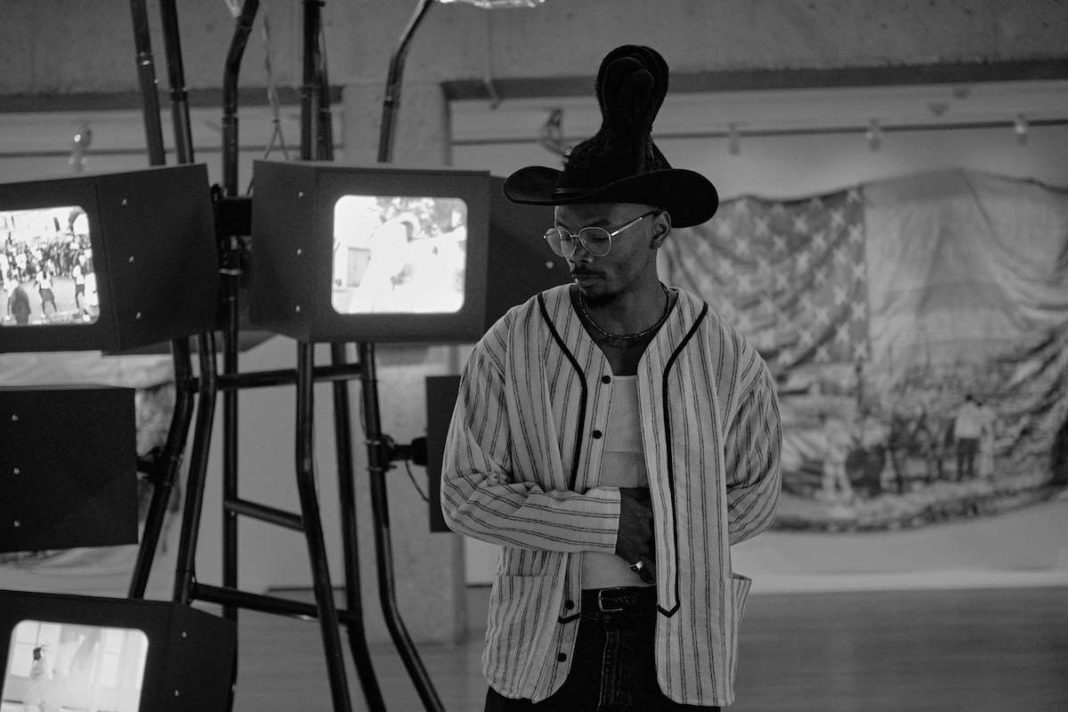
Third-generation Oakland artist Burrell in an interview lays the foundation for his multimedia installation that includes assemblage, works on paper, archival documents, videos, sound and text. Tracing the journey that took him from Oakland to Louisiana and eventually, Senegal and Nigeria, Burrell investigated ruptures due to empirical colonization that caused catastrophic schisms in his family line and are mirrored in world history and the contemporary lives of African Americans.
Back in the states, he visited Louisiana sugar cane fields and the graveyard of a church his family rebuilt in 1864 after it was burned in an act of mass violence against the Black community. Reading gravestone names he had seen on family census records and marriage licenses, he placed his hands in the soil. The tactile moisture called up his grandmother’s voice, causing him to think about the unbreakable rhythms of Black lives.
“Imperialism, colonization and slavery didn’t break them,” Burrell says. “Stories of how they burned the houses in Russell City after residents were forced to leave made me think about the playbook of deep hate that not only envisions harm to the current community but [harm that] is felt across generations.”
Burrell recognizes contemporary echoes of Russell City’s “soundtrack” in Tulsa, Black Wall Street, Rosewood, Oakland, and other events and spaces. Consistently conveyed in dramatic pieces sculpted by intense light, shadow and saturated color, a still from his Electric Slide film shows Burrell dancing with his mother and sister in a grassy, flower-sprinkled backyard. The concept of teaching a spirit born into a family and arriving from heaven having forgotten its ancestral history, is central.
“Teaching becomes the responsibility of the people on the ground,” Burrell says. “The installation meditates on body knowledge, the relationship between heaven and earth—and rehearsals. The Haitian Revolution was a rehearsal of liberation. It showed us what was possible so future generations can add to it. In the quotidian, that becomes a block party, someone getting the food or cleaning up, organizing resistance, making art, rehearsing and exercising the language of care.”
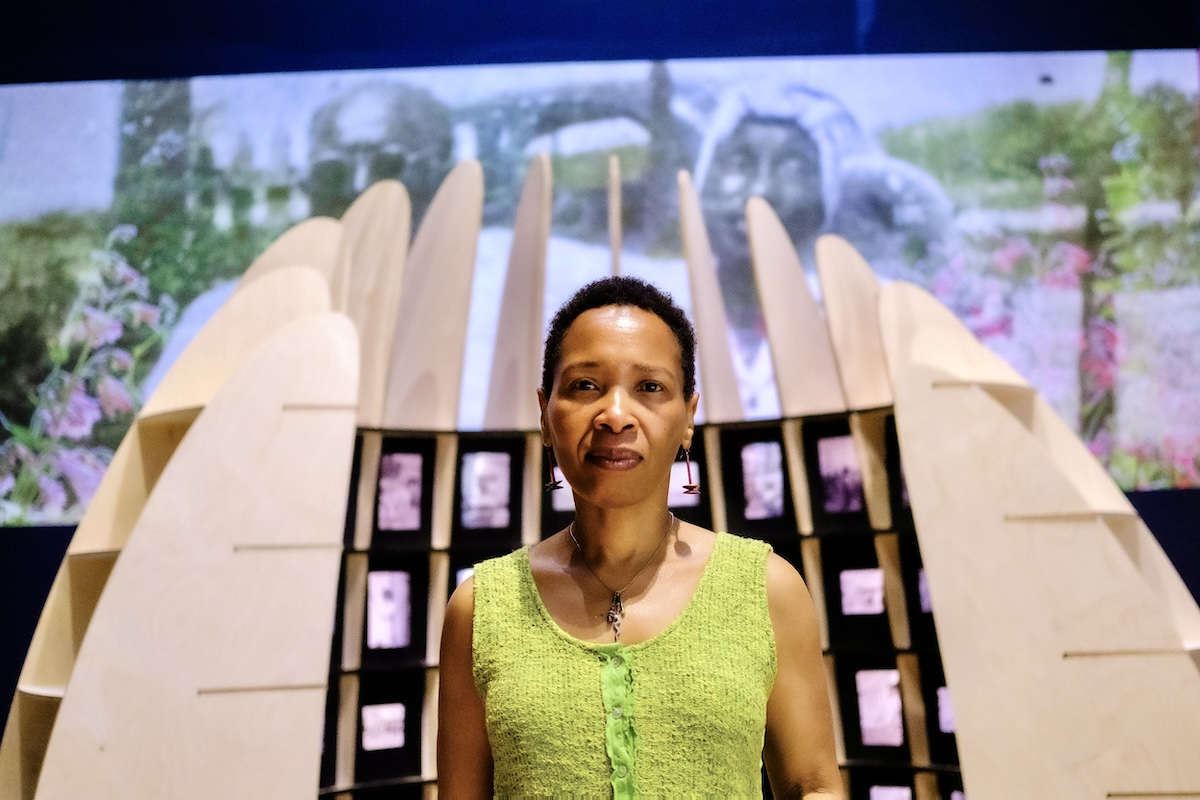
Grant, in a separate interview, speaks of time and place as continuums. “How do we use the timeline to project into the future?” she asks. “I’m interested in people being unshackled from the weight of the current moment to dream of the future.”
By interacting with open-ended models and activities, people find things to retain and the changes they might choose for the children of today and tomorrow. Grant says racist wheels that continually spin throughout history demand she look for pins to push into—and stop—the cycle.
“Urban renewal, the BART train, highways, the post office in West Oakland: All brought in eminent domain,” she says. “And here we are today, with even the post office a point of contention and in jeopardy … what’s our plan?”
Grant recognizes home ownership and the ability to deed it to the next generation as a critical thread in America. “When controlling that is constantly under threat, it becomes a psychological issue,” she says. “What is home when it is always under threat? The population has to always be in defense mode. They can never dream of what is possible.”
Family homes sold because of the impossibilities of refinancing dismantled Black cultural networks, family histories and people’s sense of legacy and security in Oakland and other cities.
“Through eminent domain [and other practices], communities became fractured, tenuous,” Grant says. A wood-and-foam core model in the exhibit The New Johnson Family Home and Accessory Dwelling Unit, and an inserted family photo, broaden the representation of a family unit. Complete households might hold multiples—young families, in-laws, members struggling and others. The piece symbolizes and reflects today’s real-life family situations.
Another display offers not an architectural blueprint or an urban street map, but rather hand-sized buildings that can be freely moved on a tabletop.
“I’m trying to [inspire] a deep dialogue about the interiority of our spaces. The models are open and abstract because I’m not trying to provide finite solutions. I’m saying, ‘What if? What if we add ADUs, [shared] workspaces?’ We then start talking; we become a community,” she adds.
Burrell and Grant, their eyes open to the plunder of Black spaces and cognizant of the dangers of negative framing, find themselves pushing forward with hope found through engagement. Black futures are not permanently stolen; they are for current and next generations to preserve, restore, build and dream into the future.
‘Black Spaces’ runs through March 1, 2026, at Oakland Museum of California.