Known for its emphasis on short films shown over a long weekend, the Albany FilmFest is changing tack this year. The theme of the 15th annual festival is “Courage, Hope, Resistance.” Five documentaries all made by East Bay filmmakers will show, one each month, at Rialto Cinemas in El Cerrito starting on June 19 through Oct. 16. Each film in its own way contends with crumbling American institutions. Ones that we collectively, and naively, believed were strong enough to withstand the predations of a despot and his vampiric minions.
Denise Zmekhol’s Skin of Glass (June 19) starts as a filmed memoir. Zmekhol recalls her childhood in Brazil with a voiceover and an array of childhood photographs. Then she methodically brings her father, Roger, into the story. In the 1960s he was a celebrated architect in São Paulo who designed a skyscraper that’s known as the Pele de Vidro or Skin of Glass.
The archived images of Zmekhol’s sleek building show the promise of mid-20th century Brazilian architecture. One of her father’s original drawings is a rendering of a rounded office staircase. The startling bannisters suggest organic vines or branches that would ephemerally circle the ascending human form. With a thriving architectural movement in place, São Paulo was poised to become a model city of the future—until a military dictatorship took over the country.
In one of many unforeseen outcomes, the regime bankrupted the tenants. All of that city’s promise ended in ruins. The filmmaker’s contemporary shots of Pele de Vidro pan across broken or boarded-up exterior windows. And, like many of the adjacent buildings, it’s now inhabited by “hundreds of homeless families.” The divide between the haves and the have-nots is now a chasm there. The dictatorship ended 40 years ago, but Brazil has yet to recover from it.
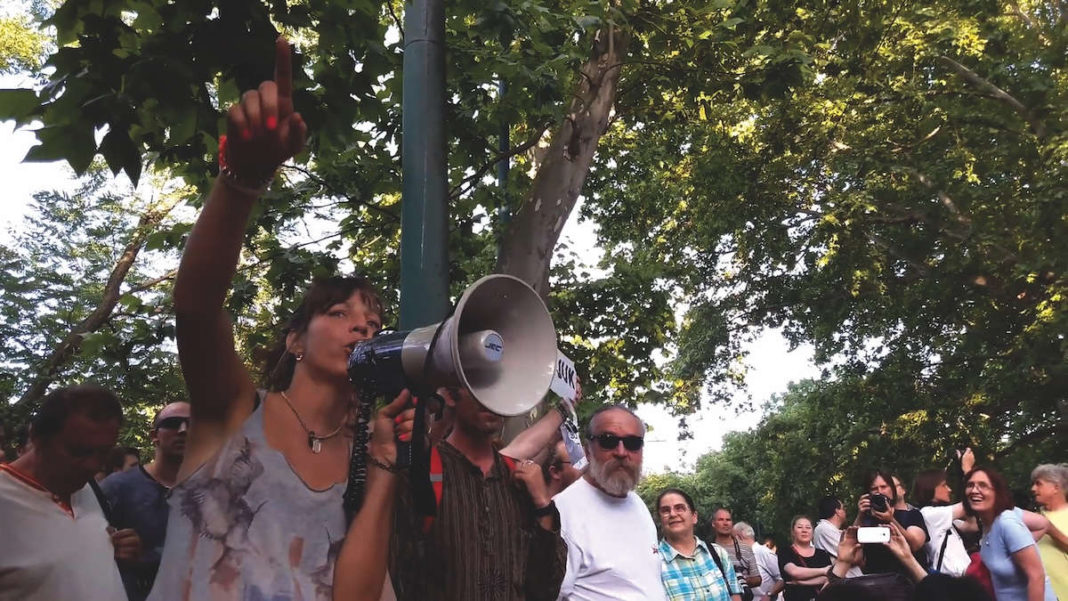
There are, of course, obvious parallels to the current state of housing in America and elsewhere. Skin of Glass, like the other films curated for the festival, are actively alerting us to the danger signs of an encroaching nationwide system failure. Democracy Noir (July 17) also tells a before-and-after story. Connie Field’s film is set in Hungary. It charts the rise of Hungary’s conservative prime minister, Viktor Orbán, through the eyes of several disillusioned citizens.
Despite a decade under Orbán’s leadership, the faces of a journalist and a politician from an opposing party still register shock and disbelief at the speed with which he shifted Hungary’s culture and politics to the right. Field also features a mother and daughter, living under the same roof, who are ideologically opposed to one another. While her mother praises Orbán for the changes he’s implemented, the daughter silently blinks her incredulity into the eye of the camera. The scene illustrates the political and philosophical divide within a single family while also indicating two distinctly different interpretations of reality.
Rick Goldsmith’s Stripped for Parts: American Journalism on the Brink (Oct. 16) is a scrappy tale that recounts the dismantling of local newsrooms across the country by—wait for it—awful billionaires. They adopt the tactic of vultures, diving down on failing news organizations, buying them out, firing the staff and somehow making a profit off of the carcasses. The pace and look of the documentary isn’t as lyrical as Skin of Glass, but it’s as distressing to watch as any segment of 60 Minutes.
The more hopeful films in the festival posit models for activism. The 9 Lives of Barbara Dane (Aug. 14), by Maureen Gosling and Jed Riffe, is a biopic about the late singer, songwriter and activist. Black-and-white clips from the 1950s and ’60s capture Dane’s powerful voice booming out jazz songs. Dane moved away from jazz and into folk music, writing and playing songs that didn’t have the same staying power that Joan Baez’s, Woody Guthrie’s and Bob Dylan’s did. But Jane Fonda, Baez herself and Bonnie Raitt all testify to Dane’s talent and to her lasting commitment to a variety of social causes.
Rialto Cinemas Cerrito, 10070 San Pablo Ave., El Cerrito. albanyfilmfest.org