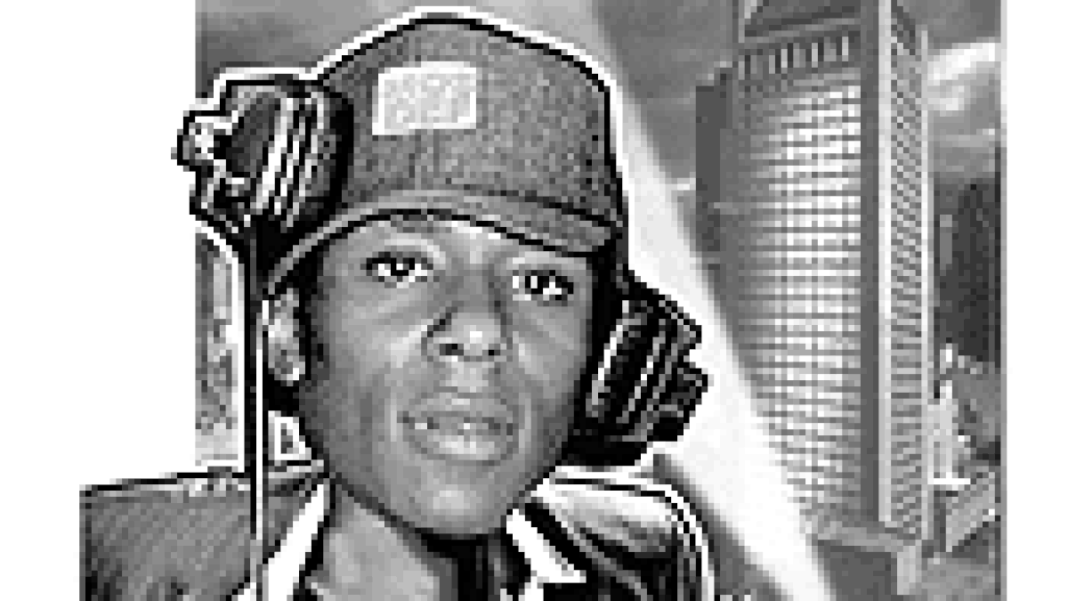
“I think that Islam itself is the unofficial religion of hip-hop,” proclaims Adisa Banjoko, the San Jose-based writer, publicist, radio show host of One Mic on KNEW-AM, and student of Gracie-style Brazilian jujitsu. “So much hip-hop has come to be that has referenced Islam, that many of the people themselves don’t even recognize it. Like, why is it that Biggie Smalls was going on about From Mecca to Medina? He’s not talking about Saudi Arabia.”
Banjoko, aka “The Bishop of Hip-Hop,” has been one of the truest voices of West Coast rap journalism for more than a decade now: His byline has appeared everywhere from XXL to Yoga Journal. In fact, it’s tempting to call him the prototype rap intellectual. He is equally at home in a coat and tie, or a beanie, puff jacket, work boots, and Tupac T-shirt. Furthermore, he is equally willing to debate the merits of Chuck D vs. Ice Cube, George Jackson vs. George Jefferson, or Sonny Chiba vs. Chow Yun-Fat.
Banjoko was born Jason Parker in San Francisco some 35 years ago. He changed his name in 1988 when he adopted the Muslim faith, after being inspired by Public Enemy’s classic “Bring the Noise,” which sampled Malcolm X’s now-famous “Too black, too strong” quote. Before settling in San Jose, he lived in San Bruno and Oakland; super-OG Bay Area hip-hop fans might even remember his stint as an MC in the Afrocentric group Freedom T.R.O.O.P. 187.
Rather than simply plugging Banjoko’s new book, Lyrical Swords — a collection of essays on hip-hop culture and its connections to Eastern philosophy, spirituality, and religion — I thought I’d employ him as a guest commentator on Islamic hip-hop. We absorbed ten cuts (both new and old) from Islamic-identified rappers, and afterwards talked hella shit … oops, I mean, engaged in an analytical discourse about various issues and tangents relating to Islam and rap.
Azeem, “Platinum Trendz”
Show Business (2004)
AB: I can tell this is from the Westside. Who is this? Aaah, he’s so raw. … I think that’s the sad part of a lot of hip-hop is it’s just a list of brand names. It’s just a checklist of what you have. One of the things about Islam is God definitely wants you to live well. You don’t have to live all outside your means, and mortgage the house for some gold teeth or whatever, but if you can afford the cool ride? Buy it. As long as you’re not buying it just to drive by the people who are on the bus.
C2tE: Around my way, I see Geo Metros with spinners on them.
AB: At that point, you just gotta shake the head.
Ali Shaheed Muhammed, “Industry/Life”
Shaheedullah and Stereotypes (2004)
AB: That was tight. I like that whole album, by the way. Again, just the cat’s name, it’s one of those things that makes Islam the unofficial religion of hip-hop.
C2tE: Ali Shaheed Muhammed, he’s up there with Farrakhan and Malcolm X, he’s like the Muslim that people know.
AB: Yeah, that’s true. Even if you don’t know anything about Islam, you know his name.
Mos Def, “Ghetto Rock”
The New Danger (2004)
AB: Well, Mos is one of the best lyricists in hip-hop, possibly ever. It’s been a long time since an MC made me feel that way. The stuff he says goes past a lot of people, but a lot of people it still hits. He’s very beautifully Islamic on wax, meaning that a lot of it is not very overt, like this one right here, with The star and the crescent. I was told, and I don’t know if it’s absolutely correct, that man has no real light, he just reflects, and any good that shines from him shines as a reflection of God.
C2tE: I thought it was interesting that Mos used a rock beat. That’s definitely not your typical run-of-the-mill hip-hop song.
AB: At the same time, even though the beat is real bare-bones, he kept it ghetto with that. I don’t know what it is about guitars and black people. Especially young cats. Like, our parents listened to the guitar all day. But this generation is not really checking for the guitar. Still, cats in the hood aren’t necessarily gonna turn it, even though they hear the guitar. They might be like, “Hmm. But the beat’s knockin.”
Brother Ali, “Star Quality”
Shadows on the Sun (2003)
AB: Know what I thought when I was listening to this? In this first verse, he mentions something about the Koran, and I realized at that point that that’s one of the things that has happened in hip-hop. You hear terms like the Koran being used, and you don’t know what it is. But later on in life, you hear the same phrase and you’re like, “Oh, the Koran, that’s what Brother Ali was talking about.” You come to Islam less afraid than most people in America, who have no frame of reference for it.
C2tE: He talked about the Koran in the first verse, and then in the next verse, he’s talking about, If I would have known it was Ladies Night, I would have put baby wipes on my balls.
AB: (Laughing) I know! That was too much information for me!
Paris, “Evil”
Sonic Jihad (2003)
AB: I think Sonic Jihad was one of the rawest hip-hop albums ever. When Public Enemy and KRS were doing their thing, like “Black Steel in the Hour of Chaos,” that wasn’t real. But Paris made his album not long after 9/11. Everything he did, with the cover, with the plane going toward the White House, every track he did, not only going against the Bush administration but Fox and the media in general, and all the different things that the American policy has done to the rest of the world. The greatest jihad is to speak the truth to power.
Poor Righteous Teachers, “Can I Start This”
Holy Intellect (1990)
AB: This particular song is one of my favorite rap tracks ever, of all time, in the history of hip-hop. One of my great memories of this song, there used to be a [KPIX TV] show named People Are Talking, and Paris was gonna be on the show and we were gonna be in the audience. On the way to the show, me and my man Brett played “Can I Start This,” like, one hundred times in a row. In my opinion, Wise Intelligent is one of the most underrated and underappreciated MCs. The album that best reflects that to me is New World Order. I think that album was a hip-hop classic.
Akbar, “Battle Cry”
No More Prisons 2 (2003)
AB: Islam has definitely given African Americans a positive frame of reference for themselves in America. That’s something you have to go search pretty hard to find. When you research the cartography, the shipbuilding, the architecture, it gives a good frame of reference. That’s the thing that is really kinda scary about hip-hop, is not just a Muslim MC, but any MC, can take you back to the beginning of time and bring you all the way back to 2005. From an amoeba to right now.
C2tE: What’s really interesting, as we listen to all these Islamic MCs, is there’s not too much ignorance being sprouted. They’re really lacking in the ignorance quotient.
AB: This goes back to when we were talking about PRT: Part of the proof of being a Muslim is not being stupid. So that always pushed forth in their rhymes. “Not only am I going to outdo you lyrically, but I’m also gonna show you I’m smarter than you in my rhymes. And I’m more intelligent by virtue of Islam.” And the other thing is most of these cats don’t know much about religion in general, until they start digging into hip-hop and hip-hop gets them digging into other books. It’s one of the rare places where African-American men can show off their intelligence and not be called white for it, know what I mean?
Frontline, “Time 4 Bizness”
Who R U (2004)
AB: Hot. One of the things I love about hip-hop is it’s extra-mannish, it makes you want to step up after you hear it.
C2tE: They produced this track, and I think it makes a difference when the beat and the rhymes go together. They’re talking about providing leadership. It’s right on the edge of being gangsta.
AB: It’s right there, but they never go over! They never cross the line, you know. Like when he said that line about his family. [Touch my family and I’ll have to kill ya. ] I got two kids and a wife, I can feel that, you know what I’m saying? I think most Muslims really don’t want violence, but once that line has been transgressed, the light clicks on. It is an incredibly hard thing to stop.
Tyson, “Cali Story”
Ghetto Messiah (2004)
AB: I was lucky enough to be able to see Tyson perform for the first time about three months ago. That particular song is incredibly touching to anyone that knows anything about living in California. It’s hot. I believe that should have probably been the first song on the album.
C2tE: He buried it way down, on like track 12.
AB: It’s such a gem. I think that Tyson definitely has a lot of other jams on this album that are tight, but it’s worth it just for this song. He gets the real level of despair on the streets of California. Not on the Hollywood side and “Who Angelina Jolie’s trying to date” or whatever. In between those things is lots of pain. Lots of suffering, lots of poverty, lots of dope. Hip-hop is the only art form out there reminding people of that.
The Last Poets, “Black Is”
This Is Madness (1970)
AB: I used to live in East Oakland on Seminary, and I would listen to nothing but the Jazz Messengers and the Last Poets. Black is not beautiful anymore. It doesn’t matter if white people or any other people think it is. Black people stopped knowing that they’re beautiful. In this world of “Go get your nose broken and have it carved out like this” and different eyes every day of the week, they make it so much easier to run away from who you are and cover up everything that is in you. Or try to remind you that it’s worthless. “What you really are is worthless; what you want is this nose job, this skin lightener, these contacts, and the blonde hair.”
C2tE: That’s kinda what Azeem was talking about. That’s definitely a cipher, from Azeem to the Last Poets; it’s like the entire range of hip-hop history.
AB: Yeah.
So, after hearing ten tracks — a complete cipher, according to Islamic mathematics — it was time to say “peace.” And after examining the evidence (i.e. the minaret-like stack of CDs by Islam-identified MCs, including a bunch we didn’t get to, such as Q-Tip, Brand Nubian, Wu-Tang, and Rakim), it seems that Banjoko is right: Islam has always been a spiritual and intellectual influence on hip-hop, and most likely always will be. Like PRT might say, word is life.