
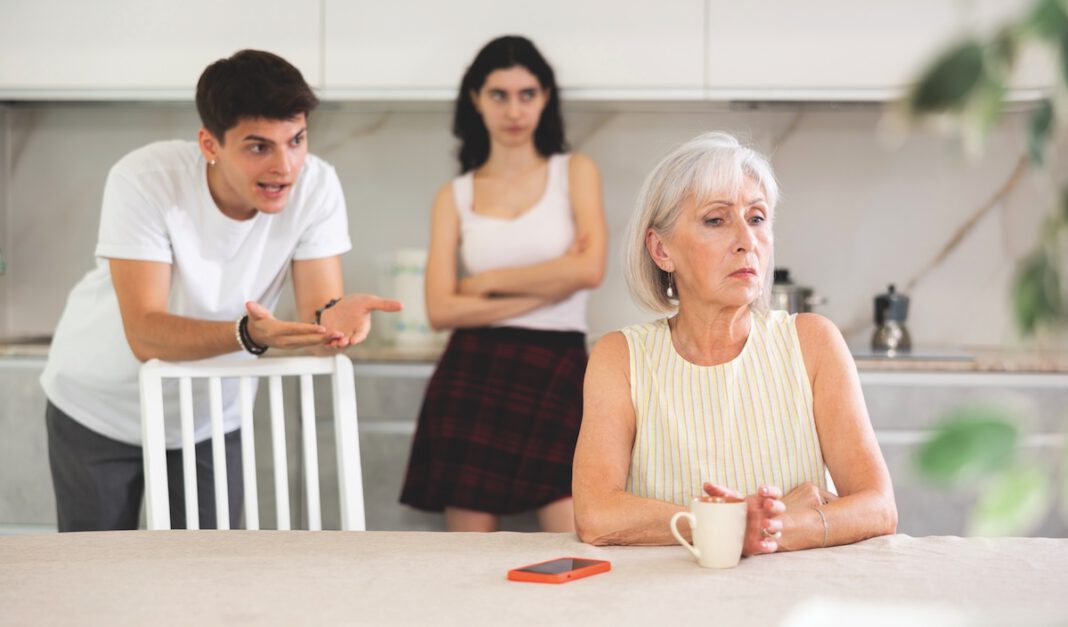
In the past year, a rising number of Gen Z adults decided to go “no contact” with their families. Their decisions were due to their mental health, favoritism and control, abusive and harsh parenting, differences in values and differences in expectation.
Usually not just one event, but multiple events, lead individuals to cut off their families.
Aliya Dunbar, from Richmond, has been estranged from her family for five years. She and her oldest sister remember times when their father was there—such as when the two were dropped off at a gas station for their father to pick them up at—and also when he was not, such as school graduations.
“He would help me with my homework and stuff when I was younger. This was when I was in elementary school,” Dunbar said. “But then there would be times where he’s like, ‘OK, I’m gonna see you.’ But then he would never come. I remember my eighth grade graduation, and this also happened with my 12th grade graduation. He came, and he didn’t stay the entire time. It’s like, ‘OK, well, you’re there, but you’re not there.’”
Bartender Joseph Gomez, from Mountain View, cut off his family due to issues that began his last year in high school and continued into his early 20s. Gomez grew up in a strict household where mental illness was not talked about and where communication issues lingered with his father, who passed away last year from a heart attack.
“We lived under the same roof and stuff, but we weren’t speaking at all,” Gomez said. “So if I had to talk to him about something I would have to tell my mother to tell him, and she would tell me his response. My mother was kind of the ‘go-between guy.’”
Younger generations are most likely to set boundaries to protect their wellbeing. Unfortunately, going “no contact” is the preferred solution, rather than trying to resolve family issues.
The topic has begun to spark debate online, whether it’s the fault of the parent or the child. Videos on TikTok and YouTube address the matter, with the hashtag #ToxicFamily so far reaching 1.9 billion views on TikTok.
According to a survey by Talker Research, 60% of Gen Z and 50% of millennials have cut off a family member. In addition, 36% of Gen Z adults felt like they were being disrespected, resulting in a family member being cut off; and 30% said that either the person was being too negative and/or they felt the relationship had a negative effect on their mental health.
Another sign that a family is falling apart is phone numbers being either muted or blocked, with 36% of Americans blocking a friend or family member on social media and 30% removing a loved one from a group chat.
Gen Z respondents said that rather than communicating to address issues, they feel ready to distance themselves from a loved one. One issue is that family members don’t have the language for family estrangement, which can also lead to judgment from other family members.
As a defense mechanism, family members who have been cut off sometimes say, “You’re ungrateful,” “You never appreciated anything,” “You’re spoiled” and “[You’re] holding a grudge.”
Dr. Joshua Coleman, a leading Bay Area psychologist from Orinda, was featured on an Oprah Winfrey podcast about Gen Z going “no contact” with family. He also wrote two books on family estrangement: Rules of Estrangement and When Parents Hurt.
In a phone interview, he said the issue is an indicator of how poorly Gen Z is doing since it has the highest rates of anxiety, depression, suicidal ideation and actual suicide, compared to previous generations.
“They’re being told that the reason for their mental illness has to do with dysfunctional parenting, dysfunctional families—and I think it’s a misdirection,” Coleman said. “A lot of Gen Z are spending more time online than other generations, and getting their information online. So I think that’s a big part of it.”
The saying, “Blood is thicker than water,” signifies that familiar bonds are stronger and more loyal than friendships or other relationships. But that perspective is changing as more adults find healthier relationships outside their families, where their friends sometimes treat them better than their kin.
“I think the era of ‘blood is thicker than water’ is no longer true here,” Coleman said. “Most people are nicer to their friends than they are to their family. Their expectations may be different than they are from their family. There’s not the same kind of history of conflict that we have with our family.”
However Aliya Dunbar, of Richmond, says that the saying can go both ways, as she has family members she trusts but also has family members she would rather go “no contact” with.
“My eldest sister and I were very close and I would do anything for her; she would do anything for me,” Dunbar said. “But also I’ve had family members—my mom, my dad, my aunt, my grandma—who’ve been distant and verbally abusive, and let those things go on. So I’d rather let the water seep through.”
Another issue concerns whether Gen Z has appropriate conflict-resolution skills. This generation may be good with setting clear boundaries, systemic focus and compromising.
But what Gen Z individuals struggle with is sensitivity to feedback, resorting to avoidance and ghosting, and short-term resolutions rather than actually resolving conflicts.
According to another survey—this one by ZeroBounce—millennials prefer to handle conflicts via email, texts and other messaging apps to avoid face-to-face confrontations. They also need context for decisions made without explanation. About 53% of millennials feel underequipped with leadership skills because they lack conflict-management training.
In families with more than one child, they have assigned one child the role of the scapegoat, while assigning the other child the role of the parentified child. That dynamic can be viewed as toxic.
Lia Huynh, a marriage and family therapist from Milpitas, said the scapegoat child is the child who always gets in trouble and is blamed for the family problems, while the parentified child is the one who gets straight A’s and looks out for the family.
“The scapegoat child might say, ‘Nobody protected me’ or ‘Everyone was against me. No one understood me,’” Huynh said. “But the parentified child would say, ‘I gave up so much for the family’ or ‘I worked so hard to hold everyone together.’”
In certain cultures, like Asian communities, family is taught to be the most important thing. Huynh believes this is due to the emphasis on family and communal culture.
“You have your family unit and you do everything to preserve that family unit,” Huynh said. “When you make decisions, you make it not for yourself, but for your family. There’s a lot more sacrifice for each other. People are more willing to sacrifice. There’s a lot of expectation for everyone to sacrifice.”
But in Western countries, many people move out when they are 18 years old, either to go to college or to live on their own as adults. About 27% of adults are now completely estranged from their families.
“Carl Pillemer at Cornell said 27% of people over 18 are estranged from a family member,” Coleman said. “Another study said that 26% of fathers are estranged from a child. So different studies show different statistics, but the figures are high and they’re worrisome.”
Approximately 22% to 30% of Gen Z adults identify as LGBTQ+. With families that are unwilling to accept them when they open up about their sexuality, these Gen Zers sometimes cut off their families because they feel compelled to remove themselves from environments they deem homophobic and/or transphobic.
“It’s understandable that they’d want to limit, if not end, contact with that person,” Coleman said, “because that person’s not showing them respect about some fundamental aspect of their identity.”
Then there’s the situation when parents do not accept their adult children’s future spouses due to their own high expectations.
“If it’s just like a preference thing, like, ‘Oh, they don’t have the right schooling; they might not have the right pedigree; they’re not the right ethnicity,’ you can talk to them about your fears,” Huynh said. “But at the end of the day you don’t want to create an estrangement between you and your kid, because they need you.”
Psychologists and critics warn that the “epidemic of estrangement” can lead to social isolation, prolonged grief and the avoidance of healthy conflict-resolution skills.
But cutting off one’s family can result in a sense of relief, including a secure sense of self, stress relief and liberation. In addition, it can open up mental and emotional space for an individual to decide what “family” actually means to them.