
More than 65% of the members of the Black Panther Party were women. Women of all ages, many of them young—teenagers, even. They taught at community schools, registering voters, handing out free food and running free medical clinics.
They were the rank-and-file, said Fredrika Newton, Huey P. Newton’s widow, and president and co-founder of the Dr. Huey P. Newton Foundation. In those days, she said, so was she. And their contributions, the heart of the Black Panther Party’s (BPP) message, faded in the media’s obsession with black leather jackets and rifles.
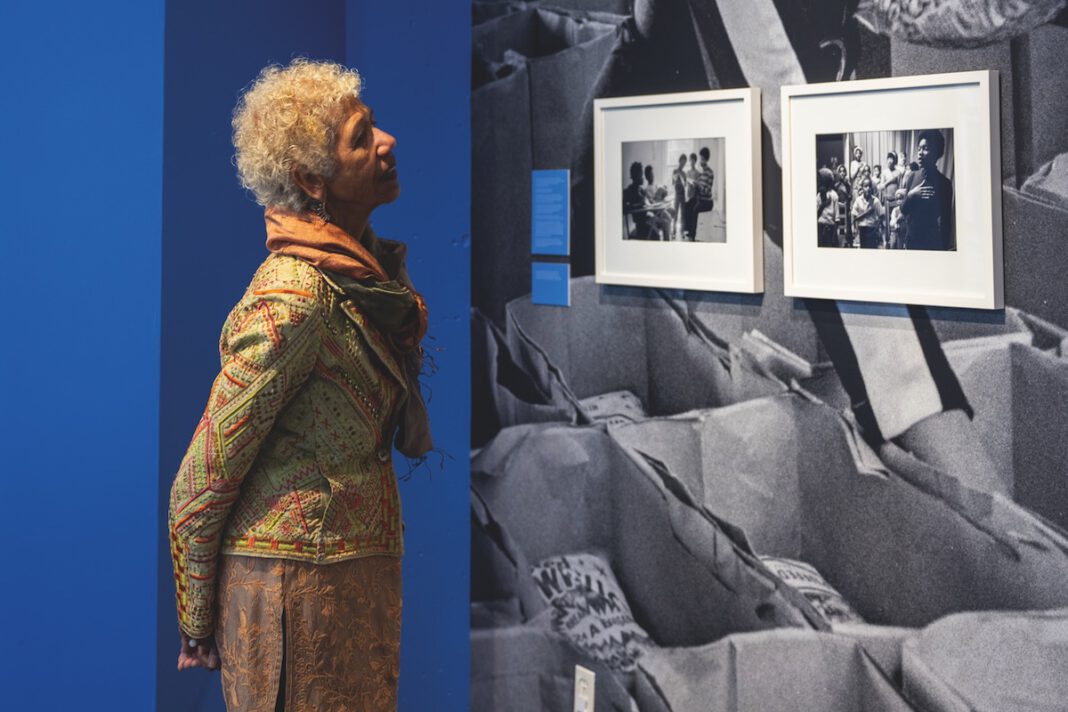
But with the 2022 publication of Comrade Sisters: Women of the Black Panther Party by Ericka Huggins, with photos by Stephen Shames, these women, their stories and their faces began to be truly acknowledged again. The book inspired museums to create exhibitions featuring the images and the stories. Now through January 2027, Oakland’s Black Panther Party Museum, which is administered by the foundation, features the “Comrade Sisters” exhibition. The exhibit showcases the photos Shames took beginning in 1963, while a 20-year-old student at Cal, and extending through 1973.
The exhibition also includes four iPads, providing the chance to listen to 10 of the 50 stories in the book as read by a poet, and a television display playing videos of archival footage and more recent videos of BPP members telling their stories.
Newton noted that this exhibition fits with her 30-year mission to preserve the history of the BPP. Proud of the photos and stories, she salutes the women “who were up at 5am to feed kids, the ones the community came face-to-face with. They were the oil that kept the party going.”
These women included Brenda Bay, known for her leadership of the party’s Intercommunal Youth Institute, which operated in the Fruitvale area and provided the day school program for BPP families.
“Women tend to minimize their contributions,” Newton said. In addition, she said, there has been direct omission and erasure of their contributions by media that preferred to focus on the men of the BPP. And, the efforts of the federal government, in particular the FBI under J. Edgar Hoover, determined to eradicate the BPP.
“That’s why these exhibitions can have even more impact now,” she said.
Xavier Buck, Ph.D, the founding director of the Black Panther Party Museum, co-curated the Oakland exhibition with Moeni Loku Rudd. “When the book came out [in 2022], we were in the beginning stages of opening the museum,” Buck said. But staff were in communication with Ericka Huggins and her partner, Lisbet Tellefsen, he said, along with other former BPP women members who remained in the East Bay. This helped expedite bringing the exhibition from the Museum of Social Justice in downtown Los Angeles to Oakland.
“Not all the photos from the book are in the exhibition,” Buck said. But it includes photos such as one of a young Angela Davis, who contributed the forward to Comrade Sisters; the famous picture of Ericka Huggins laughing; and multiple images of female BPP members engaged with children, distributing food and providing free medical care.
Buck compared the times we live in now to the 1960s and ’70s, when multiple movements, including the BPP, pushed back on injustices and ingrained racism. Since the June 13 opening, he said, visitors have traveled from across the country to see the exhibition.
Asked about his own favorite photo, he cited one of a young Assata Shakur. Shakur, Tupac Shakur’s godmother, joined the BPP as a young woman in Oakland, working to coordinate protests and community education programs. After moving to Harlem, she led the BPP’s local chapter. Eventually, it is believed, she became unhappy with the male-dominated BPP structure and left the party. But she remained an activist for racial justice.
During the opening, Newton said, a workman hired to install cameras couldn’t finish the job because the gallery was too packed. The exhibition, she said, reminds people that these women’s legacy is “a legacy of love.”
Museum of Social Justice materials said this: “Throughout the US, Comrade Sisters were mothers, sisters, aunties, cooks, housecleaners, churchgoers, high school and university students, teachers, artists, factory and retail workers, poets, dancers, writers, and musicians. Primarily between the ages of 14 and 21, they decided to transform the conditions for those facing injustice. What motivated them? Love.”
Newton said, “They saw something in their community that touched their hearts. Everyday people can make a change. You can make a change on any level if you follow your passions and follow your heart.”
‘Comrade Sisters: Women of the Black Panther Party,’ Black Panther Party Museum, 1427 Broadway, Oakland. Wed-Sat, 10am to 3pm through January 2027. Free. blackpantherpartymuseum.org